The application gives the latest real-time hourly measurements for pollutants measured at all the Government of Nova Scotia’s ambient air quality monitoring stations in the Province. Pollutants measured at the monitoring stations can include:
- ground-level ozone (O3)
- fine particulate matter (PM2.5)
- carbon monoxide (CO)
- sulphur dioxide (SO2)
- total reduced sulphur (TRS)
- nitrogen oxides (NOx), nitric oxide (NO) and nitrogen dioxide (NO2)
Real-time air pollutant measurements can be viewed under the “Current Measurements” tab, while historical air quality data can be graphed and downloaded under the “Data Search” tab. The most recent measurements have not yet been validated by quality assurance personnel, and therefore the Data Validation Table should be reviewed to determine validation status for each station and pollutant. Validated data sets are also available through the National Air Pollution Surveillance (NAPS) Network and through Nova Scotia's Open Data Portal. All data are reported in Atlantic Standard Time (AST).
Wind direction and wind speed are measured at all stations, except for Kentville. To date, wind direction and wind speed data are not validated and should be used with discretion.
Ambient air monitoring stations measure the quality of outdoor air and air pollution emissions from many sources, such as industrial facilities (electrical power plants, pulp and paper mills), vehicles, natural sources (such as forest fires and trees), and emissions generated in Nova Scotia, neighboring provinces and states, and globally.
This information is compared against Maximum Permissible Ground Level Concentrations in the Nova Scotia Air Quality Regulations, and the Canadian Ambient Air Quality Standards (CAAQS) which replaced the Canada-wide Standards for Particulate and Ozone in 2015.
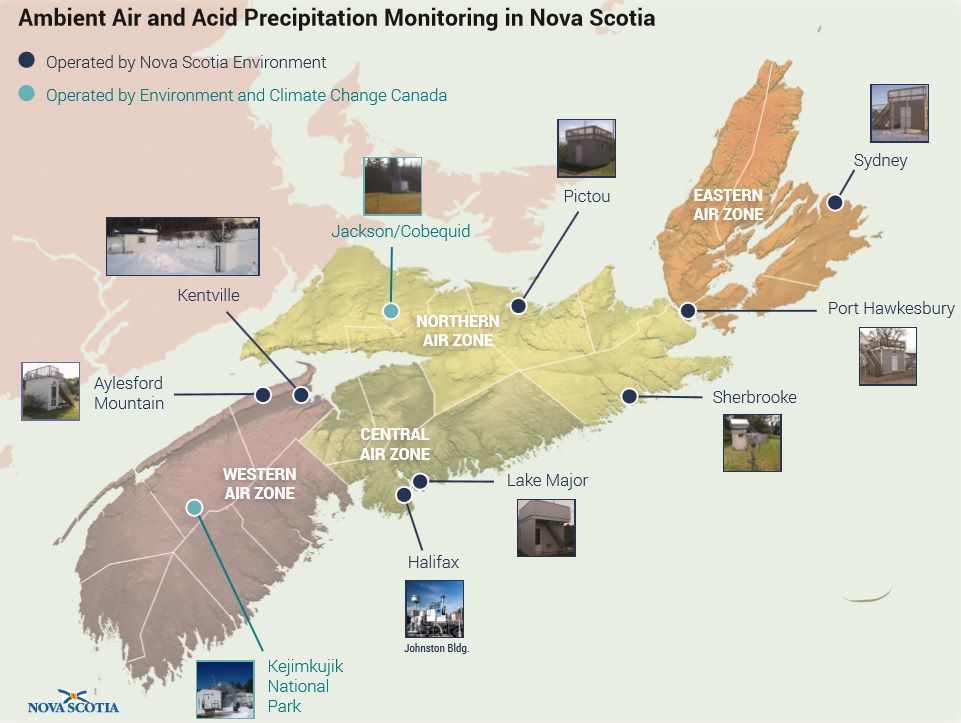
Provincial ambient air quality monitoring stations are located in these communities:
- Aylesford Mountain
- Kentville
- Halifax
- Lake Major
- Pictou
- Port Hawkesbury
- Sydney
Air Quality Health Index (AQHI)
The latest measurements of PM2.5, O3, and NO2 are used to report the Air Quality Health Index (AQHI) which is available on Environment Canada's Air Quality Health Index website. Environment Canada updates the current AQHI each hour and provides forecasted maximum values twice daily. The AQHI is a public information tool available to assist individuals in making short-term decisions about adjusting their activities to limit exposure to air pollution. The AQHI is based on raw data which has not been validated, so it is not used to determine trends or for other detailed analysis of ambient air quality.
Data on Volatile Organic Compounds
Volatile organic compounds (VOC) are sampled in Halifax. VOC data are available from the National Air Pollution Surveillance (NAPS) Network. This includes historical data for the former Granton site.
Acid Precipitation
Acid precipitation samples are collected in Sherbrooke and Jackson. Acid precipitation data are available from the National Atmospheric Chemistry Database (NAtChem).
Contact
Nova Scotia Environment and Climate Change
Air Quality Unit, Sustainability and Applied Science Division
Tel: 902-424-3600
Email: air@novascotia.ca