The Economics and Statistics Division maintains archives of previous publications for accountability purposes, but makes no updates to keep these documents current with the latest data revisions from Statistics Canada. As a result, information in older documents may not be accurate. Please exercise caution when referring to older documents. For the latest information and historical data, please contact the individual listed to the right.
<--- Return to Archive
For additional information relating to this article, please contact:
May 05, 2025NATIONAL GRADUATES SURVEY, 2023 (CLASS OF 2020) The National Graduates Survey reports on labour market outcomes of postsecondary graduates. Responses were collected information from persons who graduated from public postsecondary educational institutions in Canada in 2015 and 2020. The National Graduates Survey is conducted three years after graduation. Responses are grouped either by province in which studies were completed or province of residence when the survey was collected. Results exclude those who have subsequently carried on with further studies as well as those who had incomplete responses.
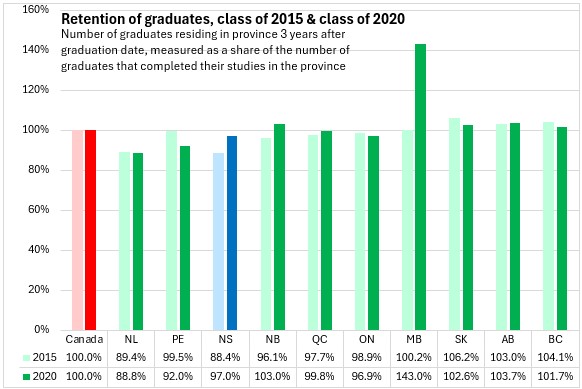
Retention of graduates of the class of 2020 (province of residence in 2023)
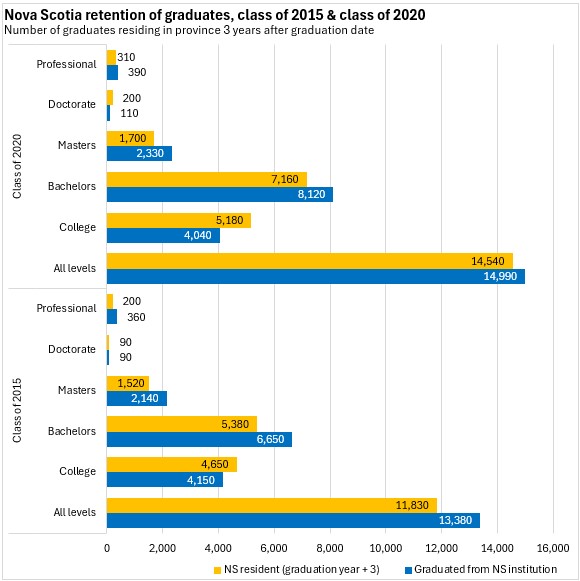
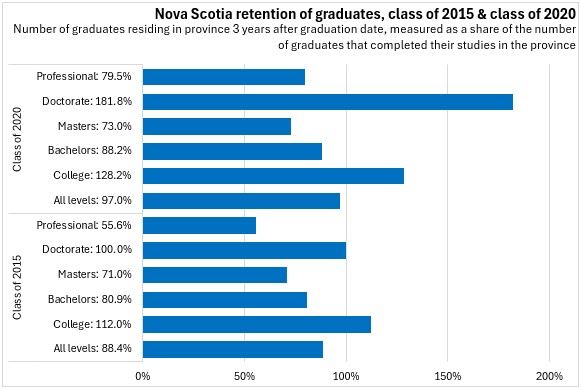
In 2020, there were 14,990 graduates from Nova Scotia post secondary institutions. By 2023, there were 14,540 post-secondary graduates of the class of 2020 that were resident in Nova Scotia. The number of class of 2020 graduates residing in Nova Scotia in 2023 amounted to 97.0% of the comparable graduating class of 2020 from Nova Scotia institutions. Nova Scotia's retention of graduates was stronger than the 88.4% reported for the class of 2015 (as of 2018).
Across Canada, there was a marked improvement in the retention of graduates in Manitoba. Retention declined in British Columbia, Saskatchewan, Ontario, Prince Edward Island and Newfoundland and Labrador.
As of 2023, there were substantially more college and doctoral graduates from the class of 2020 residing in Nova Scotia than actually graduated from Nova Scotia institutions in 2020 (though the number of doctoral graduates was very small to begin with).
Median earnings (class of 2020, by province of residence in 2023)
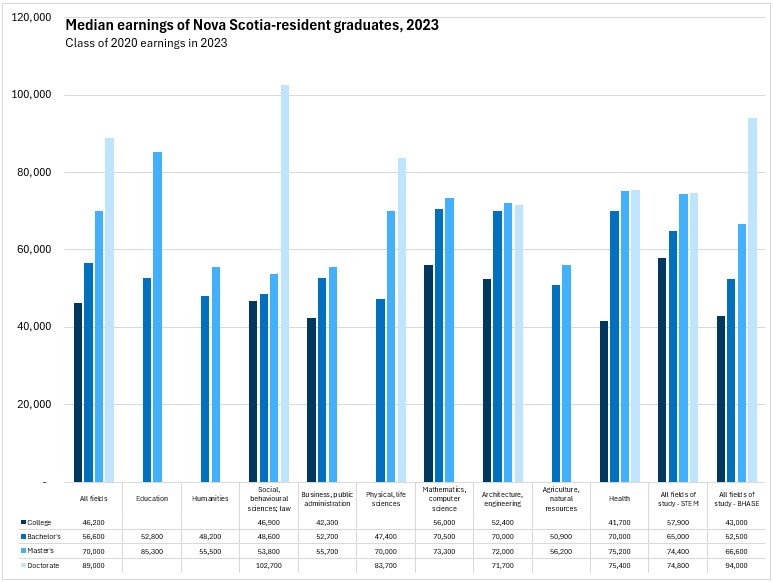
The median employment earnings of class of 2020 graduates that resided in Nova Scotia in 2023 was $55,000. Median earnings (among all levels of education) were highest for those that studied education and math/computer science. Median earnings were lowest for graduates of visual/performing arts/communications technologies as well as personal/protective/transportation services programs.
At most levels of education, median earnings were higher for graduates of STEM programs (science, technology, engineering, mathematics and computer sciences) than for graduates of BHASE programs (business, humanities, health, arts, social science, education, as well as legal studies, trades, services, natural resources and conservation). The exception was at the doctoral level, where median earnings of BHASE graduates were higher than those of STEM graduates. Graduates of professional programs are not reported separately in this analysis.
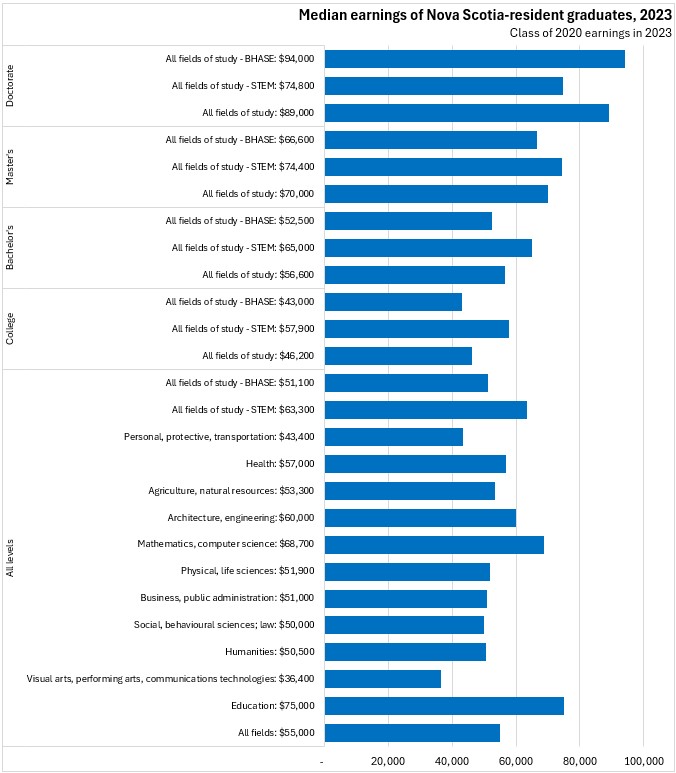
Across all disciplines, levels of education influence median earnings. College graduates reported the lowest median earnings while doctoral graduates reported the highest median earnings. Bachelor's graduates earned more than college graduates, but less than those with Master's degrees. For most areas of study, there were positive returns (higher median earnings) as a result of pursuing Bachelor's, Master's or Doctoral studies. There were notably larger returns to advanced studies in education, social sciences/behavioural sciences/law (doctoral level in particular) and physical/life sciences. Graduates of professional programs are not reported in this analysis.
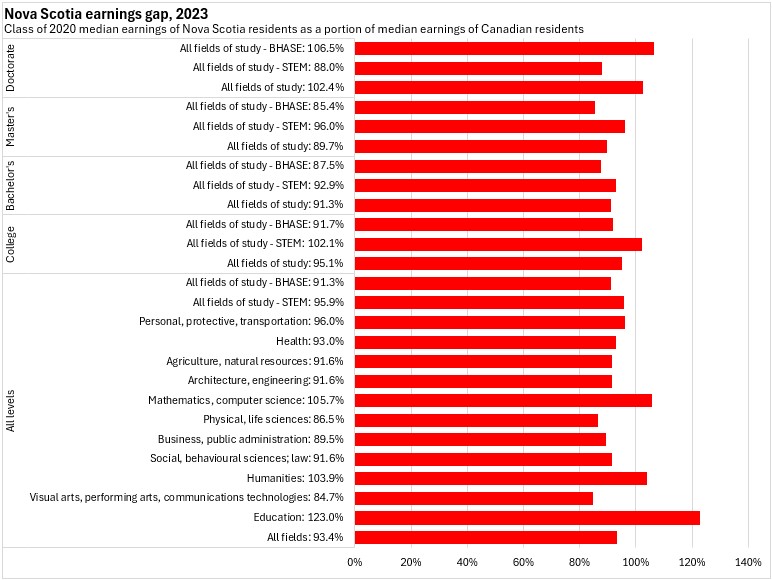
Median earnings for Nova Scotia resident graduates of the class of 2020 were 93.4% of the national median earnings of class of 2020 graduates. For most areas and levels of study, Nova Scotia median earnings were less than their national counterparts. However, median earnings were higher for Nova Scotia-resident graduates in education, humanities, math/computer science as well as college graduates in STEM fields and doctoral graduates in BHASE fields. Graduates of professional programs are not reported separately in this analysis.
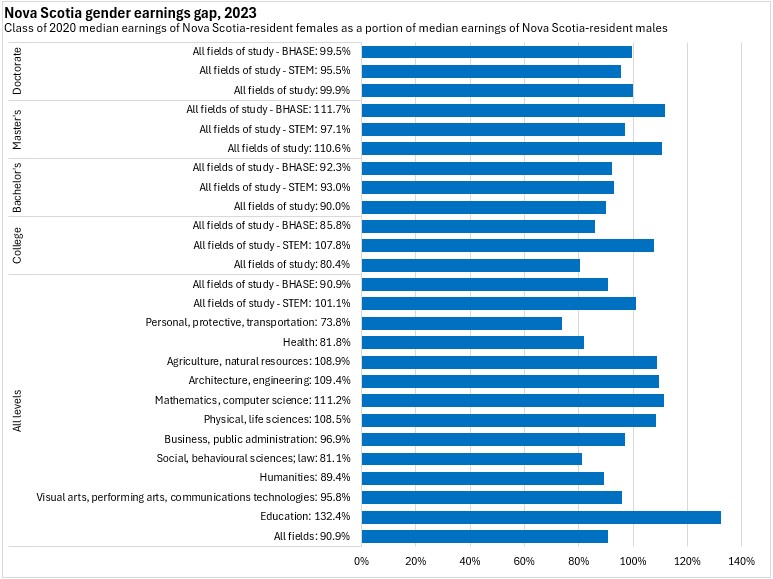
Earnings differences between males and females are a long-standing phenomenon in Canadian labour markets. In 2023, Nova Scotia-resident female graduates of the class of 2020 had median earnings that were 90.9% of their male counterparts. Female median earnings were notably higher than male earnings in education, STEM fields at the college level and BHASE fields at the Master's level. Female doctoral graduates had about the same median earnings and male doctoral graduates. Graduates of professional programs are not reported separately in this analysis.
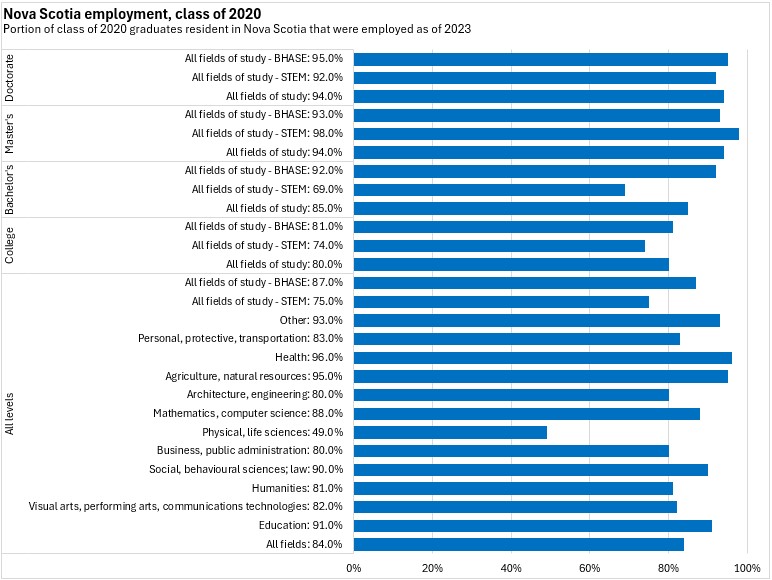
Among class of 2020 graduates residing in Nova Scotia in 2023 (who didn't carry on to further studies), 84.0% reported being in employment. There were notably higher employment levels for Master's and Doctoral-level graduates as well as for those in health, agriculture/natural resources and education. Employment was notably lower among graduates of physical/life sciences programs. Graduates of professional programs are not reported separately in this analysis.
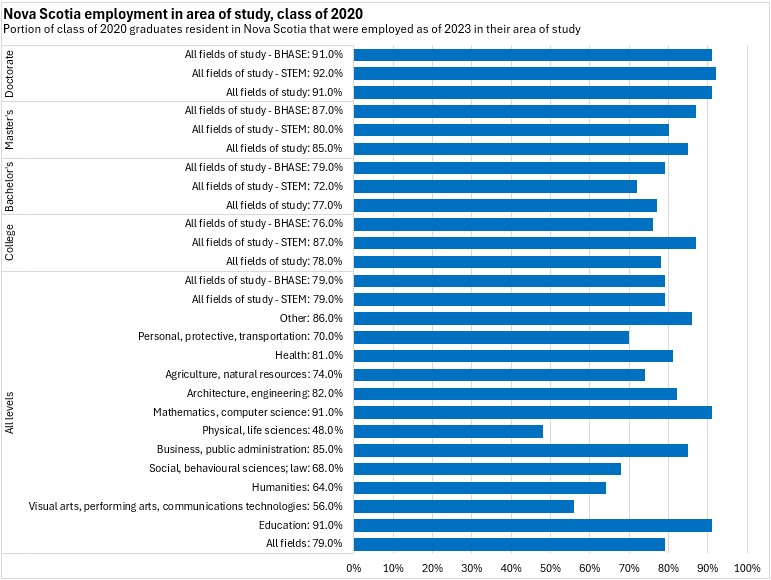
In Nova Scotia, 79.0% of resident class of 2020 graduates reported working in an area that was related to their studies. This was notably higher for doctoral level graduates as well as for those who studied math/computer science and education. Those who studied physical/life sciences, visual arts/performing arts/communications technologies, humanities and social/behavioural sciences/law were less likely to report working in an area related to their program of studies. Graduates of professional programs are not reported separately in this analysis.
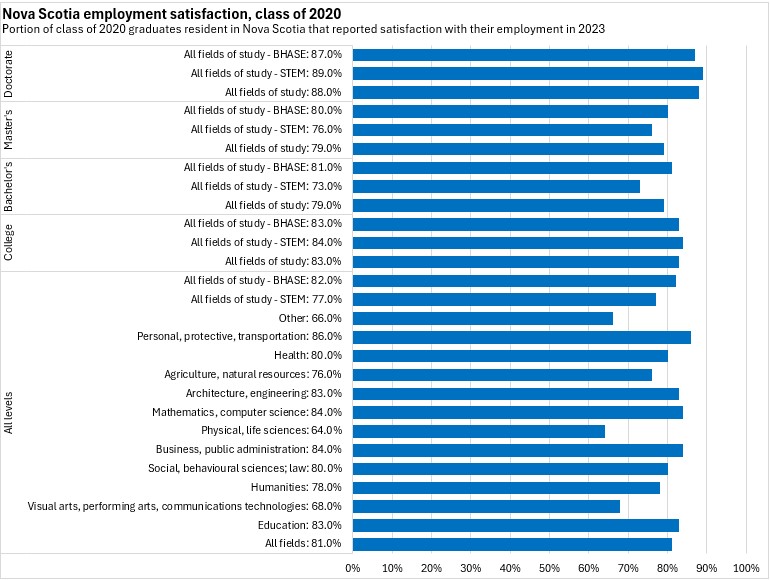
Among class of 2020 graduates working and residing in Nova Scotia in 2023, 81.0% reported being satisfied or very satisfied with their jobs. Job satisfaction was highest among doctoral and college graduates as well as among graduates of personal/protective/transportation services, math/computer science, architecture/engineering, business/public administration and education programs.
Source: Statistics Canada. Table 37-10-0252-01 Labour market outcomes three years after postsecondary education, by province of residence; Table 37-10-0254-01 Portrait of postsecondary graduates, by province of residence; Table 37-10-0253-01 Portrait of postsecondary graduates, by province of study
<--- Return to Archive


