The Economics and Statistics Division maintains archives of previous publications for accountability purposes, but makes no updates to keep these documents current with the latest data revisions from Statistics Canada. As a result, information in older documents may not be accurate. Please exercise caution when referring to older documents. For the latest information and historical data, please contact the individual listed to the right.
<--- Return to Archive
For additional information relating to this article, please contact:
May 14, 2025LABOUR MARKET CHARACTERISTICS OF PERSONS WITH AND WITHOUT DISABILITIES, 2024 Statistics Canada's Labour Force Survey collects information on labour market indicators for persons with and without disabilities.
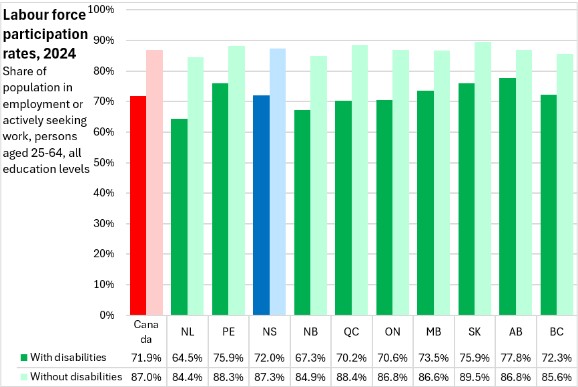
In 2024, 72.0% of Nova Scotians with disabilities (aged 25-64) participated in the labour force. This was slightly above the national average, but considerably lower than the participation rate of Nova Scotians without disabilities (87.3%). Across Canada, labour force participation of persons with disabilities was highest in Alberta and lowest in Newfoundland and Labrador.
All provinces reported substantially lower participation rates for persons with disabilities. The largest gap was in Newfoundland and Labrador while the smallest gap was in Alberta.
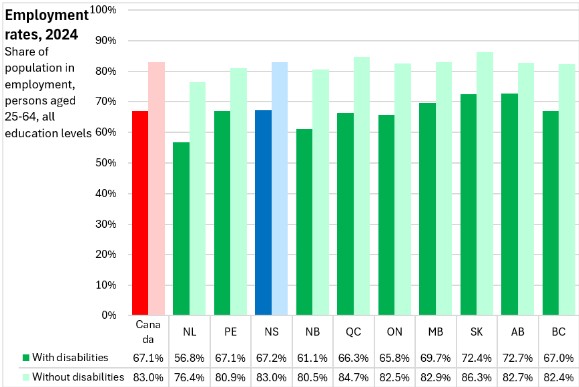
The employment rate for persons with disabilities (aged 25-64) in Nova Scotia was 67.2% in 2024 - about the same as the national average (67.1%), but 15.8 percentage points lower than the employment rate for Nova Scotians without disabilities (83.0%). Across Canada, the employment rate for persons with disabilities was highest in Alberta and Saskatchewan; the lowest employment rate for persons with disabilities was in Newfoundland and Labrador (which is consistent with a lower participation rate for persons with disabilities).
In every province, employment rates for persons without disabilities was higher than for persons with disabilities. The largest gap was in Newfoundland and Labrador while the smallest gap was in Alberta.
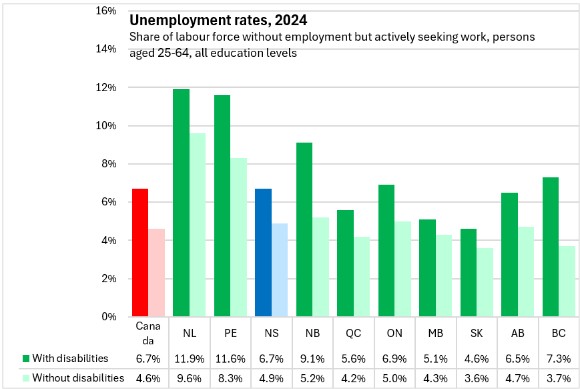
Unemployment rates for persons with disabilities were higher than for persons without disabilities in every province. In Nova Scotia, the 2024 unemployment rate for persons with disabilities was 6.7% - the same as the national unemployment rate for persons with disabilities. The lowest unemployment rate for persons with disabilities was reported in Saskatchewan (which also had the lowest unemployment rate for persons without disabilities). The highest unemployment rate for persons with disabilities was reported in Newfoundland and Labrador (where the unemployment rate for persons without disabilities was also highest among provinces).
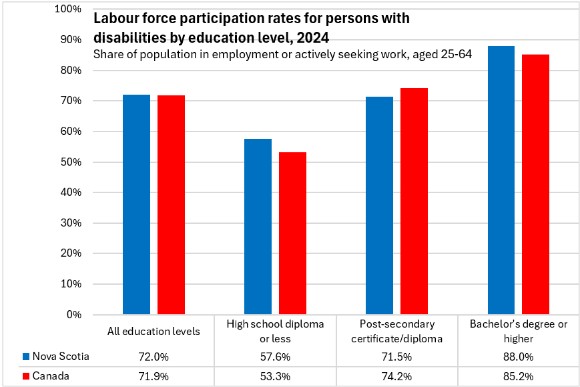
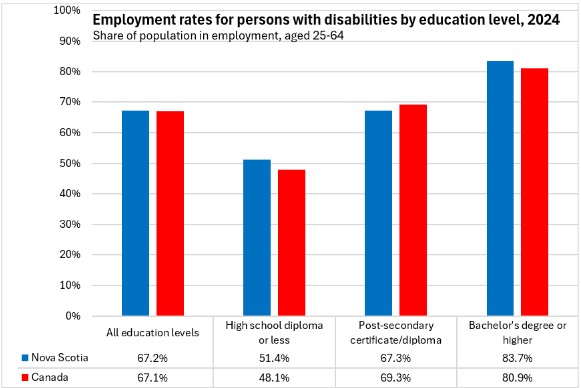
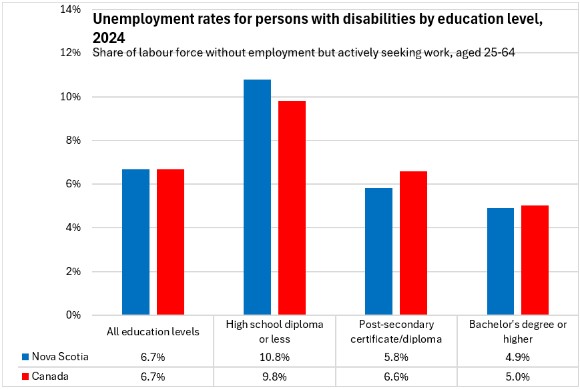
Persons with disabilities that have higher education levels report greater labour force participation rates, higher employment rates and lower unemployment rates.
Nova Scotia's participation rate for persons with disabilities was higher than comparable national averages for those with high school and lower education levels as well as for those with a bachelor's degree or higher education. The participation rate for Nova Scotians with disabilities who had a post-secondary certificate or diploma was below the comparable national average.
As with participation rates, Nova Scotians with disabilities that had university degrees as well as those with high school or lower levels of education exceeded comparable national averages. The employment rate for Nova Scotians with disabilities that had a post-secondary certificate of diploma reported lower employment rates than the comparable national average for persons with disabilities.
Nova Scotia's unemployment rates for persons with disabilities that had a high school or lower level of education were higher than for Canadians with disabilities that had similar education levels. Nova Scotians with disabilities that had post-secondary certificates/diplomas as well as those with university degrees reported lower unemployment rates than Canadians with disabilities that had similar levels of education.
Source: Statistics Canada. Table 14-10-0477-01 Labour market indicators for persons with and without disabilities, annual
<--- Return to Archive


