The Economics and Statistics Division maintains archives of previous publications for accountability purposes, but makes no updates to keep these documents current with the latest data revisions from Statistics Canada. As a result, information in older documents may not be accurate. Please exercise caution when referring to older documents. For the latest information and historical data, please contact the individual listed to the right.
<--- Return to Archive
For additional information relating to this article, please contact:
May 20, 2025LABOUR PRODUCTIVITY AND HOURS WORKED, 2024 [PRELIMINARY] Statistics Canada has released preliminary labour productivity accounts for 2024.
The data are consistent with provincial and territorial real GDP by industry data for 2024 as well as the Survey of Employment, Payroll and Hours and the Labour Force Survey. Data reported below focus on business sector industries and do not include either government or non-profit institutions. For example, education refers only to private educational institutions and not government-funded schools.
Large employment losses in high contact service industries in 2020 distorted hours worked and productivity results for all provinces. Loss of employment hours in labour-intensive and lower productivity industries increased business sector average productivity by 6.9% in 2020. Subsequent employment recovery in these labour intensive industries lowered business sector labour productivity.
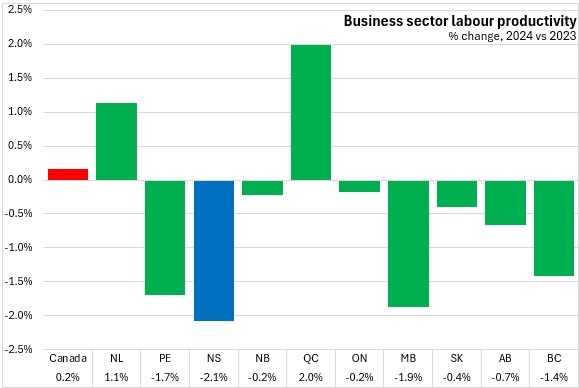
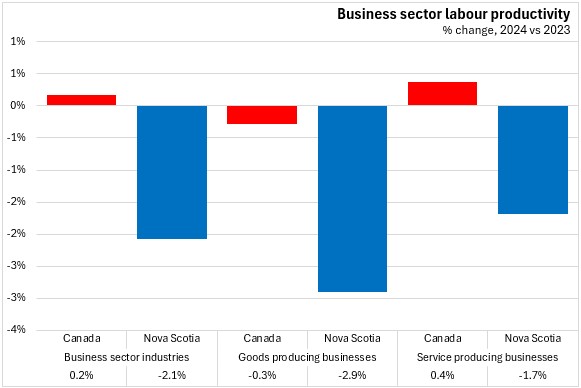
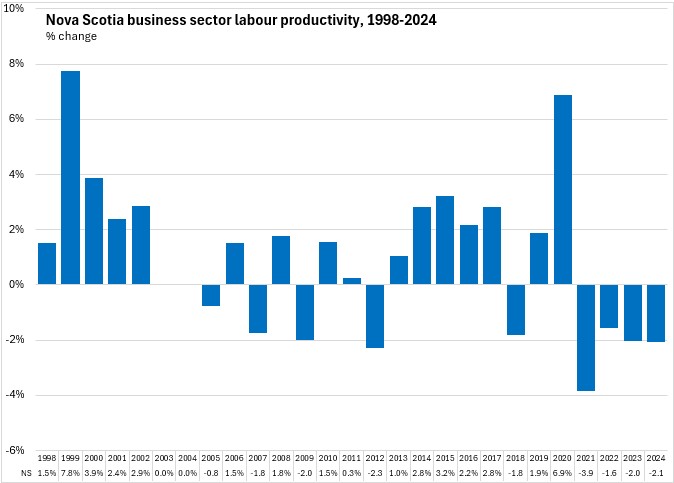
Nova Scotia's business sector labour productivity fell by 2.1% in 2024 - the steepest drop among provinces. Nationally, business sector labour productivity was edged up 0.2% dsespite declines in every province except Newfoundland and Labrador and Québec.
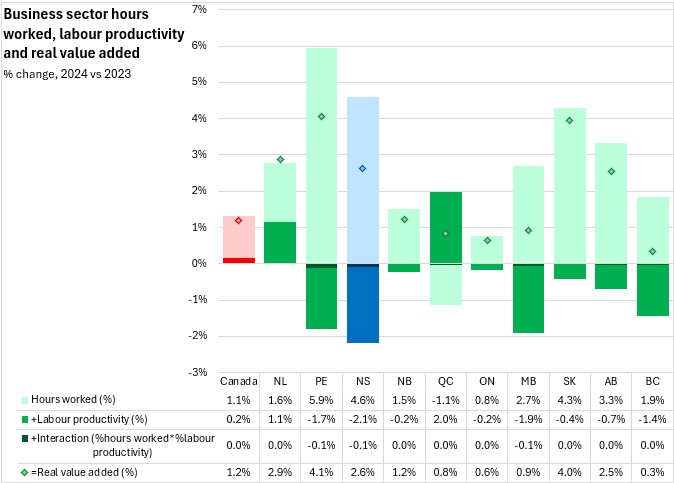
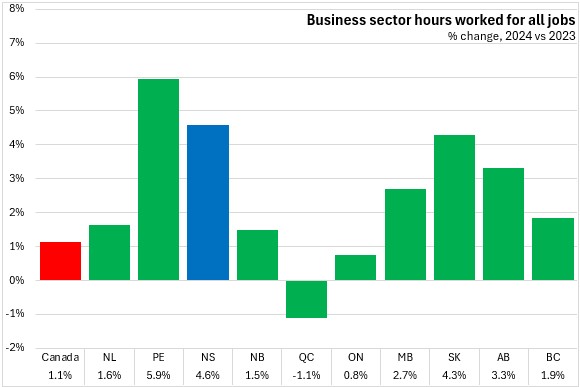
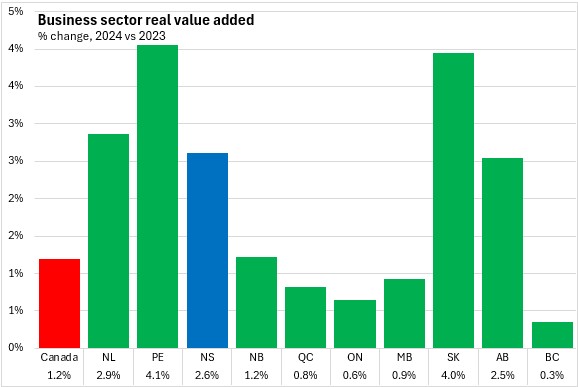
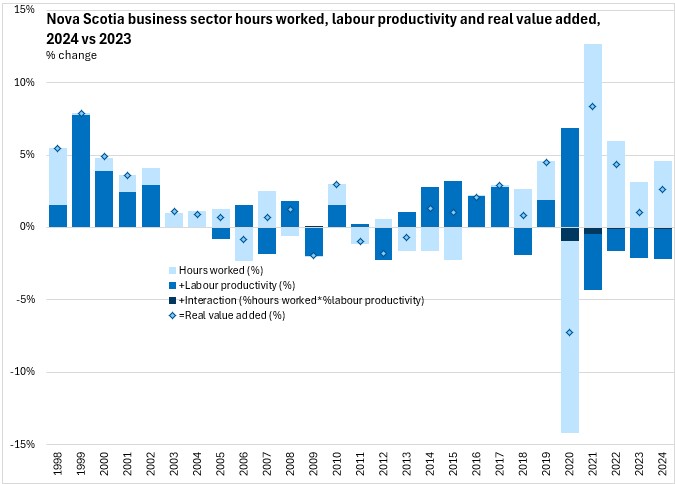
Hours worked in Nova Scotia's business sector increased by 4.6% while real value added grew at a slower pace at 2.6%.
All provinces except Québec reported gains in business sector hours worked from 2023 to 2024. Québec's fall in hours worked was offset by the fastest rise in labour productivity among provinces. In Newfoundland and Labrador, rising productivity compounded the rise in work hours, boosting business sector real value added. For all other provinces, growth in hours worked outpaced the rise in business sector real value added.
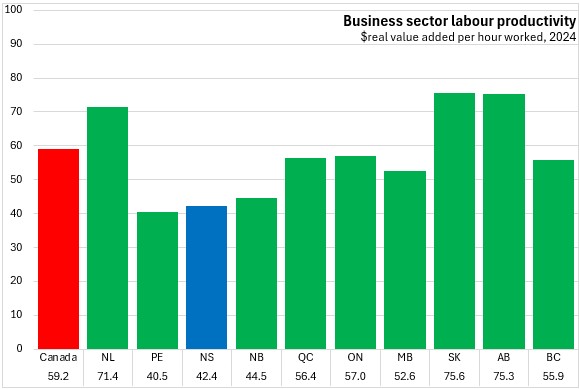
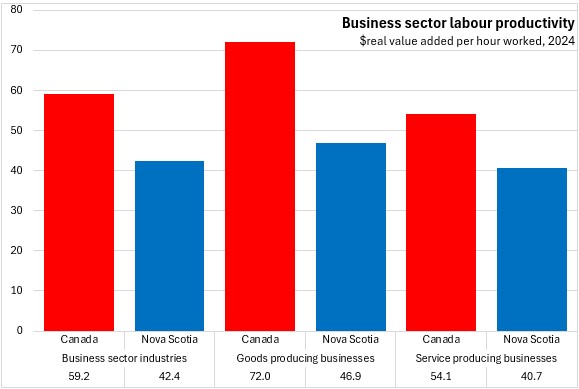
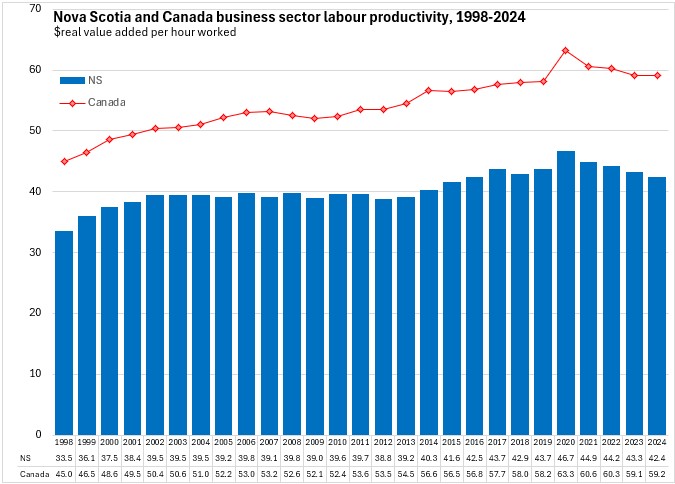
Labour productivity represents the amount of real value added generated per hour worked. Nova Scotia's business sector labour productivity was $42.4 in real value added per hour worked in 2024 - the second lowest among provinces (ahead of Prince Edward Island).
National business sector labour productivity was $59.2 in real value added per hour worked. Labour productivity is considerably higher in resource-producing provinces (Newfoundland and Labrador, Saskatchewan, Alberta) as resource industries generate large amounts of real value added with comparatively few hours worked. Labour productivity was lower in all three Maritime provinces.
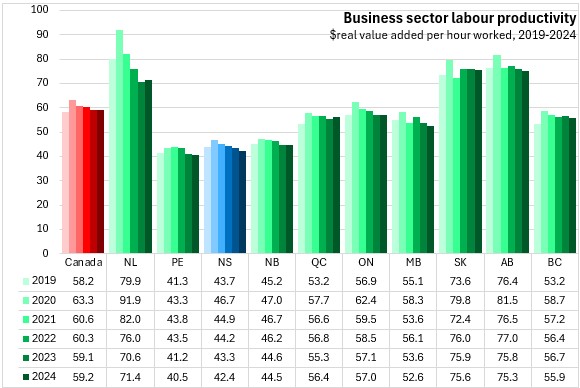
After rising in 2020, Nova Scotia's business sector labour productivity has declined in each of the last 4 years. Ontario and New Brunswick have also reported labour productivity declines in each of the last 4 years.
Business sector hours worked increased 4.6% in Nova Scotia in 2024 - the second fastest growth rate after Prince Edward Island. All provinces except Québec reported higher hours worked.
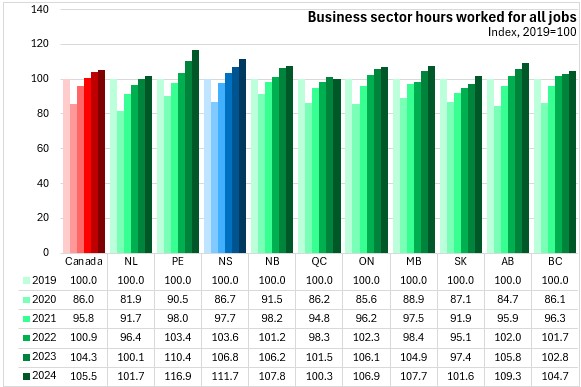
Compared with 2019, Nova Scotia's busines sector hours worked have grown faster than the national average. Only Prince Edward Island reported a stronger increase in business sector hours worked over this period. Québec, Saskatchewan and Newfoundland and Labrador reported the least growth in hours worked over this period.
Nova Scotia's business sector real value added increased by 2.6% from 2023 to 2024 - outpacing the national growth rate of 1.2%. Prince Edward Island and Saskatchewan had the largest growth in business sector real value added while British Columbia reported the least growth.
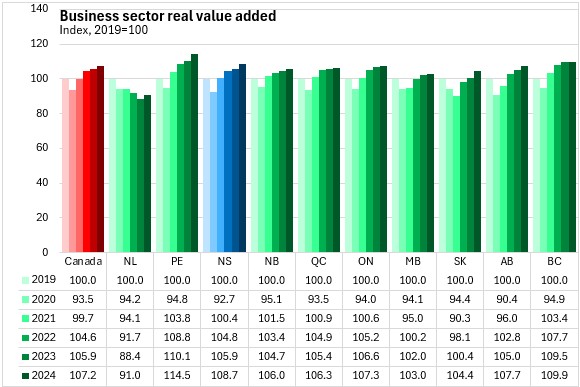
Compared with pre-pandemic levels from 2019, Nova Scotia's business sector real value added was 8.7% higher in 2024. Nationally, business sector real value added was 7.2% higher in 2024 than in 2019 with gains in all provinces except Newfoundland and Labrador. Real value added for Prince Edward Island has grown the most compared to 2019.
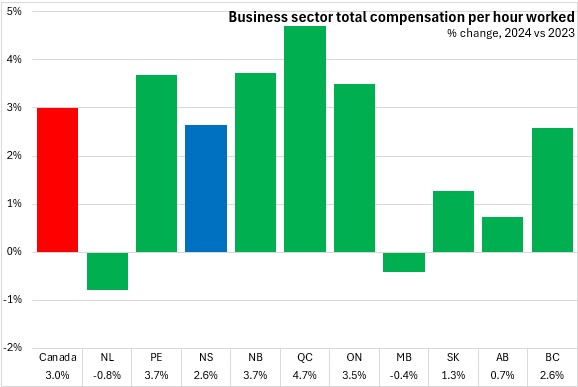
Business sector employee compensation per hour worked increased by 2.6% in Nova Scotia in 2024, which was slower than the national pace of 3.0%. All provinces except Newfoundland and Labrador and Manitoba reported rising business sector employee compensation per hour worked with Québec reporting the fastest growth.
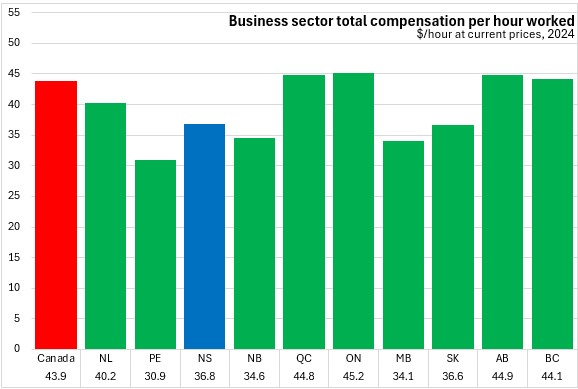
Nova Scotia's total employee compensation in the business sector was $36.82/hour worked in 2024. This was 84.0% of the national average ($43.85/hour). Employee compensation per hour worked was highest in Ontario (closely followed by Alberta, Québec and British Columbia) and lowest in Prince Edward Island.
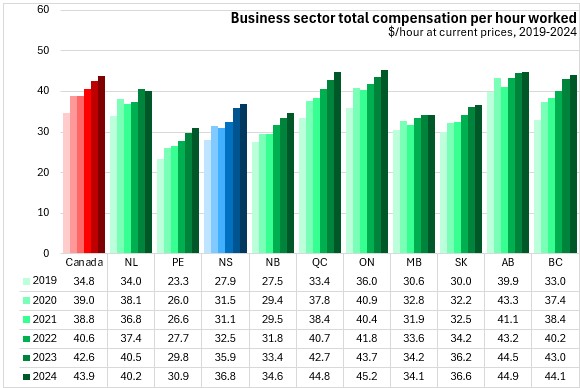
Nova Scotia's total compensation per hour worked increased by 31.9% from 2019 to 2024. Nationally, employee compensation per hour worked increased by 26.1% with gains in all provinces. Québec and British Columbia reported the fastest gains in employee compensation per hour worked over this period while Manitoba and Alberta reported the slowest growth.
Unit labour costs represent the amount of labour compensation required to generate $1 in business sector real value added. Unit labour costs rise when employee compensation per hour rises. Unit labour costs fall when labour productivity improves.
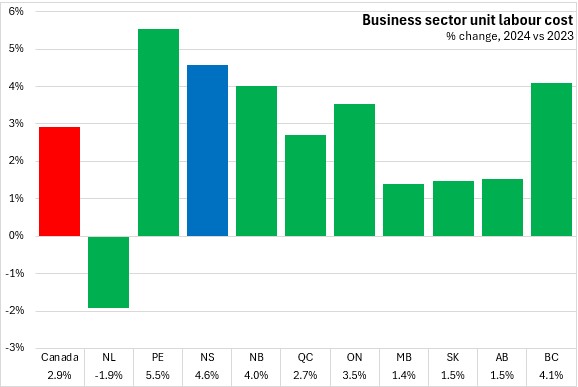
In 2024, Nova Scotia's business sector unit labour costs increased by 4.6% - the second fastest rise in unit labour costs among provinces (after Prince Edward Island) and above the national pace of 2.9%. Unit labour costs were up in all provinces except Newfoundland and Labrador.
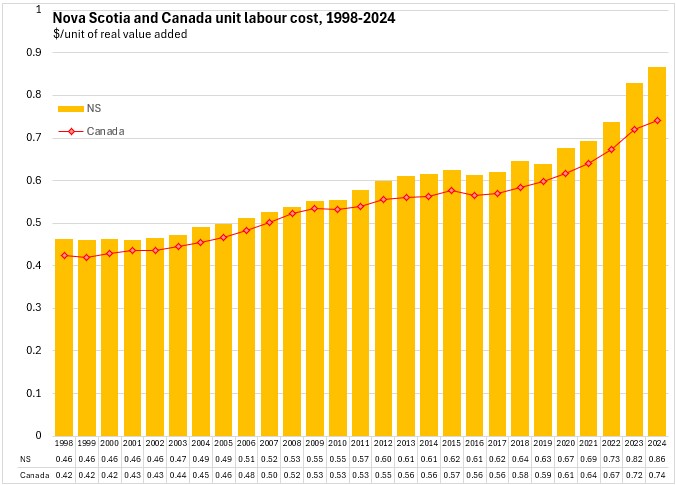
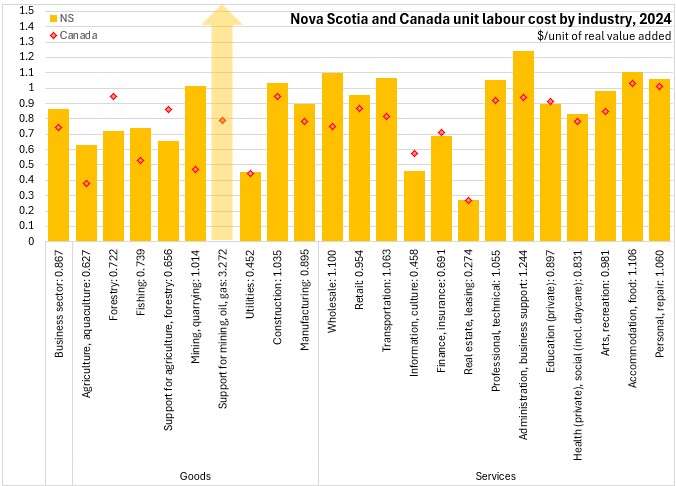
Nova Scotia's unit labour costs were $0.867 per $1 of real value added in 2024. This was the highest among provinces. Saskatchewan had the lowest unit labour costs.
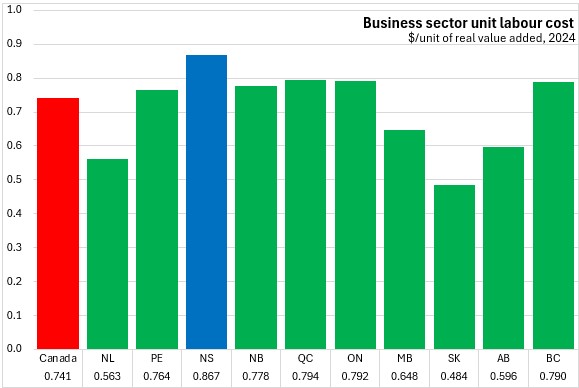
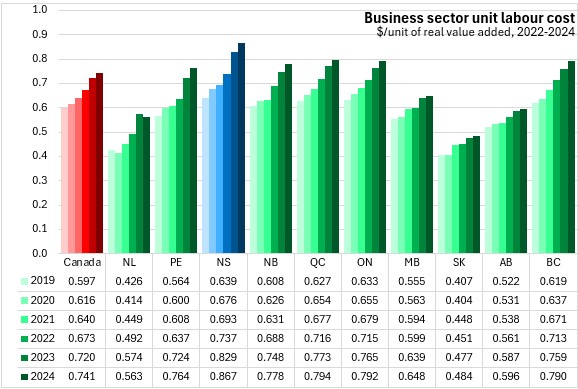
Nova Scotia's unit labour costs rose in each year from 2019 to 2024, rising by 35.7% over 2019 levels in 2024, outpacing all other province (Prince Edward Island's growth in unit labour costs was almost as fast). National unit labour costs were up by 24.1%. Alberta reported the slowest increases in unit labour costs over this period.
Nova Scotia's business sector labour productivity declined in 2024 for both service industries (-1.7%) and goods industries (-2.9%). Nova Scotia's decline in productivity was notably sharper than the national pace for goods while national services industries reported productivity gains.
Nova Scotia's labour productivity was 71.6% of the national average. Nova Scotia's productivity gap reflects both lower goods industry productivity (65.1% of the national average) and services industry productivity (75.2% of the national average). This reflects different industrial composition between Nova Scotia and Canada. For example, Canada's relatively high goods industry productivity is elevated by resource extraction industries that are much more prevalent in some other provinces.
Prior to the pandemic, Nova Scotia's labour productivity had been a consistent driver of growth in real value added. After the pandemic anomalies of 2020, Nova Scotia's productivity has been declining in each year and has fallen just below pre-pandemic levels. Nova Scotia's decline in productivity from 2020-2024 has been steeper than the national productivity decline over this period.
Nova Scotia has not had 4 years of consecutive productivity declines through the entire data series (starting in 1997).
Following the severe distortions in 2020, Nova Scotia's labour hours worked have grown rapidly - reflecting both post-pandemic hiring as well as rapid population and labour force growth. Despite declining productivity, Nova Scotia's business sector value added has risen in each year since 2020.
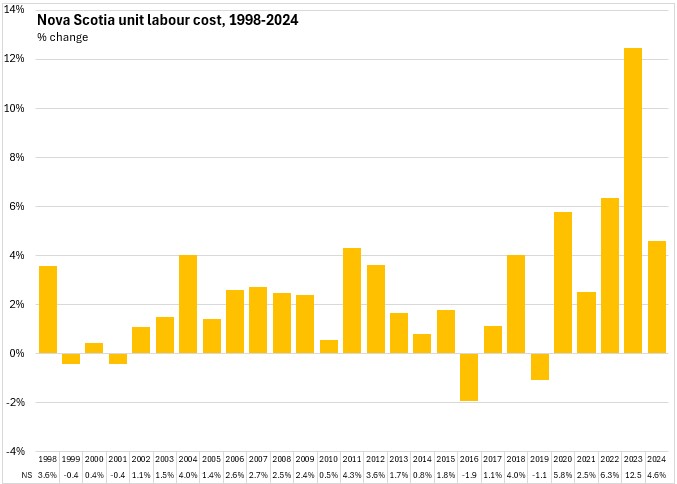
Nova Scotia's unit labour cost growth has been particularly acute in the last two years, advancing well ahead of the national average. Nova Scotia's unit labour costs were 17.4% higher than the national average in 2024.
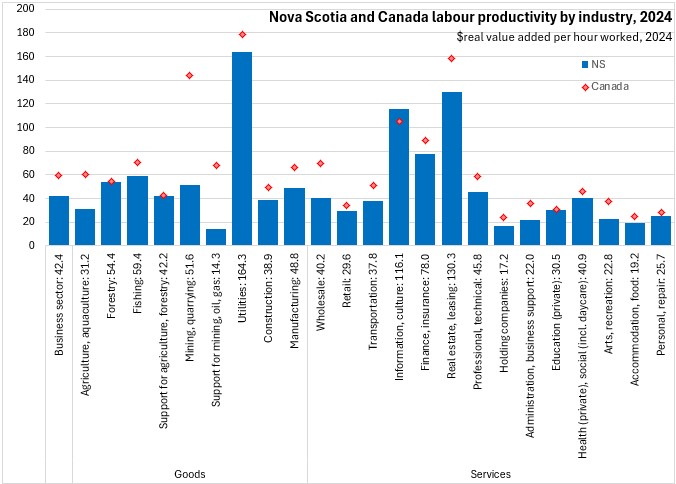
Nova Scotia's labour productivity in 2024 was highest in utilities, real estate/leasing, information/culture and finance/insurance. Nova Scotia's labour productivity was notably lower than Canadian industry averages for most sectors (exceptions: forestry/support for forestry, information/culture and private educational services).
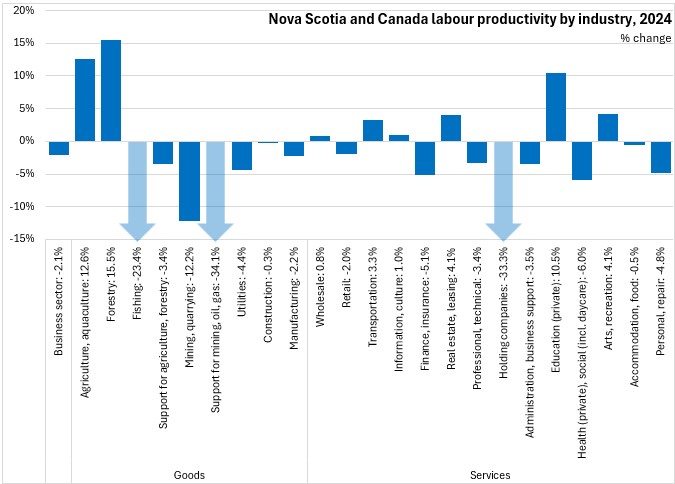
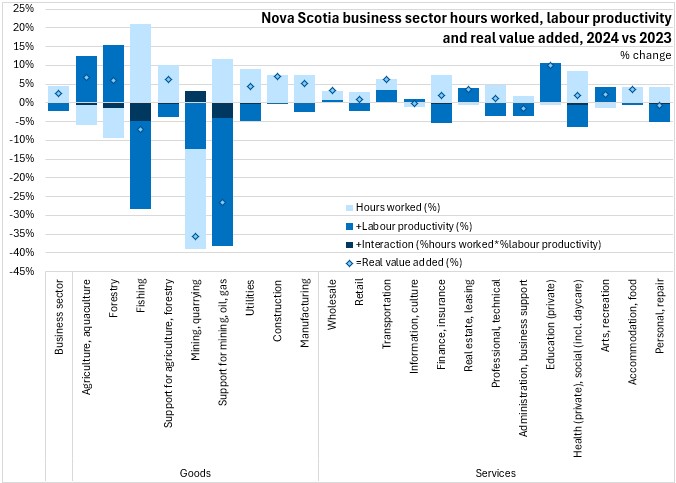
Nova Scotia's labour productivity declined most for fishing and support for mining/oil/gas as well as in mining/quarrying. Productivity was also down in the relatively small holding company industry. Fishing and support for mining/oil/gas both reported substantial gains in hours worked despite declining real value added. In mining/quarrying, hours worked and real value added were both down.
The fastest gains in productivity were in agriculture/aquaculture and forestry where falling hours worked did not prevent rising real value added.
Nova Scotia's higher unit labour cost is observed across many industries. The highest unit labour costs were in support for mining/oil/gas (a relatively small industry) as well as administrative/business support (which includes call centres). The lowest unit labour costs were in real estate/leasing, information/culture and utilities.
Nova Scotia's unit labour costs were generally above their Canadian industry averages, with the exceptions of forestry, support activities for forestry, utilities, information/culture, finance/insurance, real estate/leasing and private educational services.
In the last year, unit labour costs grew fastest for fishing, support for mining/oil/gas, mining/quarrying, finance/insurance and personal/repair services. Unit labour costs were down only for agriculture/aquaculture and forestry.
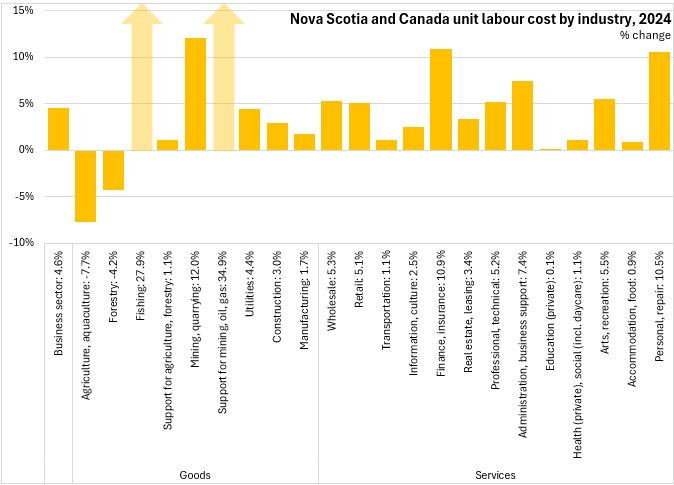
Source: Statistics Canada. Table 36-10-0480-01 Labour productivity and related measures by business sector industry and by non-commercial activity consistent with the industry accounts
<--- Return to Archive


