The Economics and Statistics Division maintains archives of previous publications for accountability purposes, but makes no updates to keep these documents current with the latest data revisions from Statistics Canada. As a result, information in older documents may not be accurate. Please exercise caution when referring to older documents. For the latest information and historical data, please contact the individual listed to the right.
<--- Return to Archive
For additional information relating to this article, please contact:
May 30, 2025CANADIAN ECONOMIC ACCOUNTS Q1 2025 
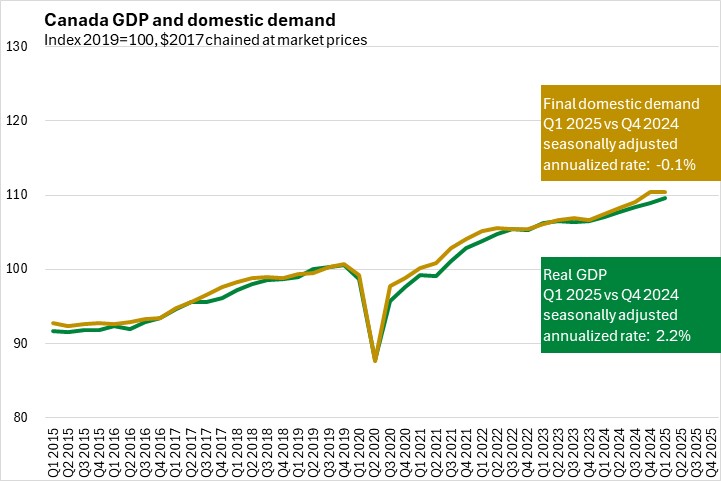
Canada’s Real Gross Domestic Product (GDP) grew at a seasonally adjusted annualized rate of 2.2% (all figures seasonally adjusted at annual rates) in the first quarter of 2025, following a 2.1% gain in Q4 2024.
Growth was primarily driven by rising exports, as well as increasing final consumption of households, non-residential investments, and investment in inventories. There were offsetting declines in government consumption and investment, as well as residential investment, and rising imports which are subrtracted from GDP.
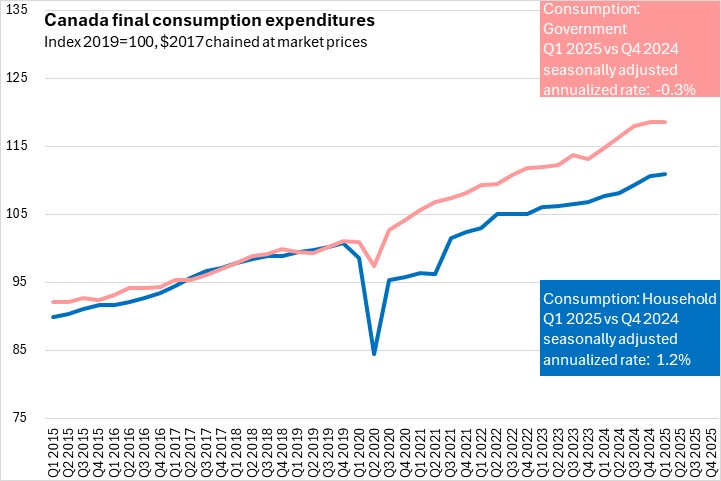
Household consumption growth increased at a seasonally adjusted annualized rate of 1.2% in Q1. The increase was led by higher spending on rental fees and financial services. Government consumption expenditures decreased by 0.3%.
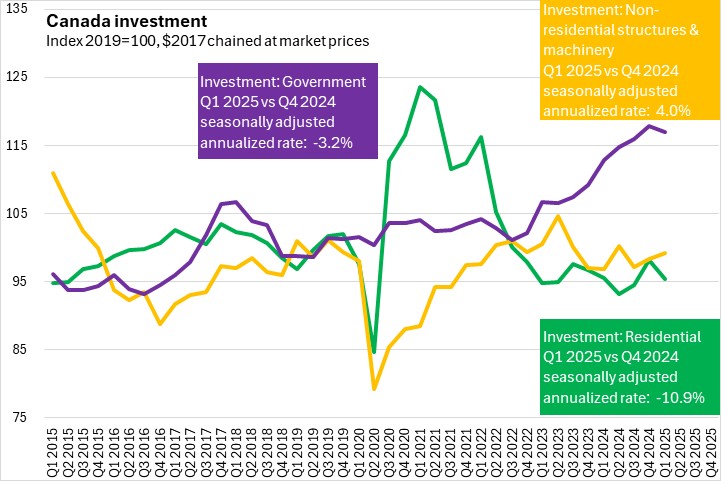
Residential investment fell by 10.9% in Q1 2025, driven by an 18.6% decline in ownership transfer costs (representative of resale market activity).
Non-residential investment rose by 4.0% in Q1 on higher investment in machinery and equipment, while government investment was down 3.2% in Q1 2025.
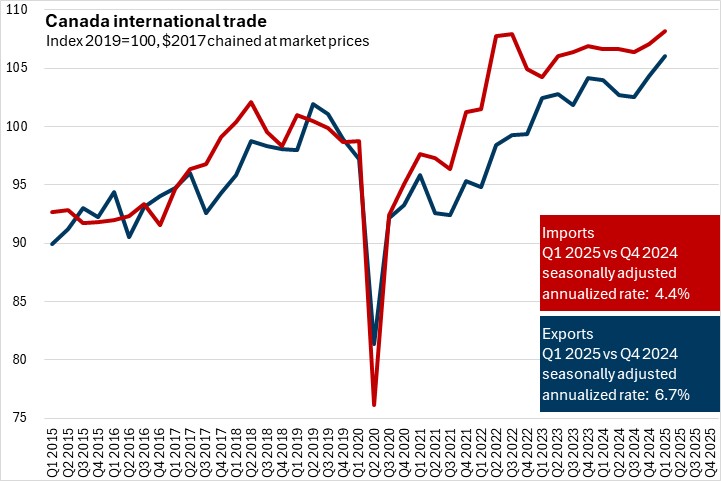
Exports continued to grow in Q1 with a 6.7% increase. Export growth was strongest in passenger vehicles and industrial machinery, equipment and parts, while energy exports declined. Imports rose by 4.4%, and was similarly driven by imports of industrial machinery, equipment and parts, and passenger vehicles.
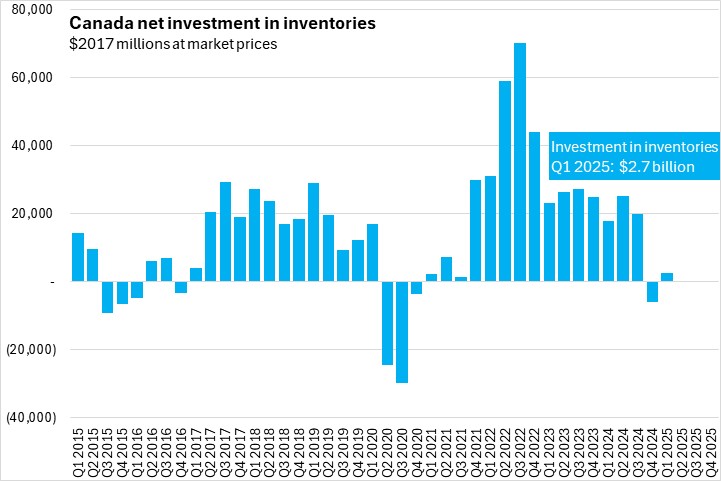
Investment in inventories was $2.7 billion in Q1 2025, rebounding from a decline in Q4 2024.
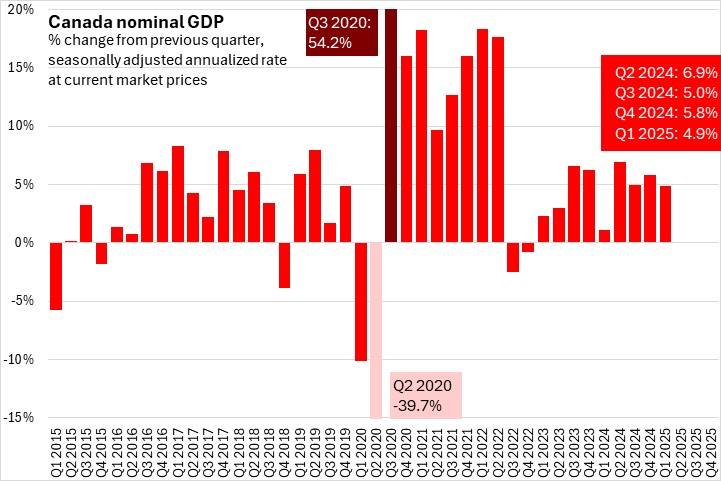
Nominal GDP increased at a seasonally adjusted annualized rate of 4.9% in Q1 2025, slowing from the 5.8% pace set in Q4 2024.
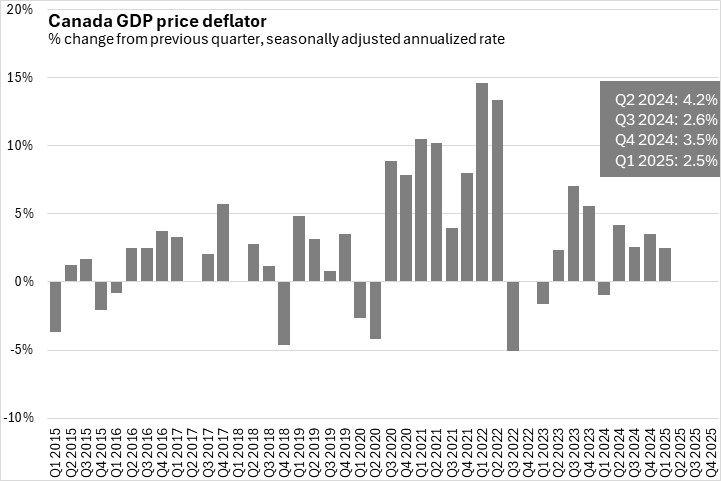
The overall GDP deflator (reflects overall price of domestically produced goods and services) increased by 2.5% on annualized basis.
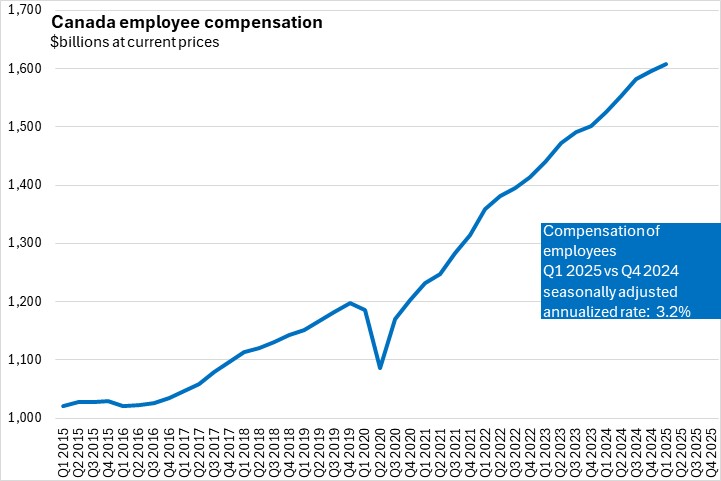
Employee compensation (measured in current prices, not real volumes) was up by a seasonally adjusted annualized rate of 3.2% in Q1. Growth was led by higher wages in health care and social services, as well as construction. Wage growth was stronger in the western provinces of Saskatchewan, Alberta and British Columbia.
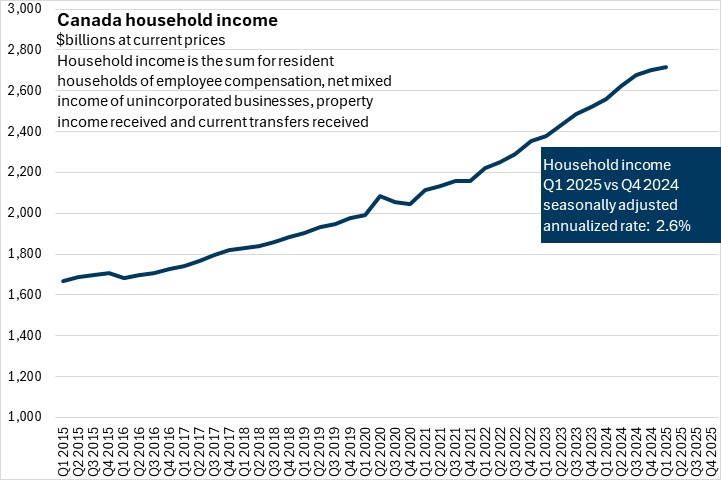
Including mixed income from unincorporated businesses, property income (such as interest and dividends from financial assets), current transfers (such as CPP and EI) with employee compensation, Canada's overall household income grew at a seasonally adjusted annualized rate of 2.6% in Q1 2025. Household investment earnings fell in Q1.
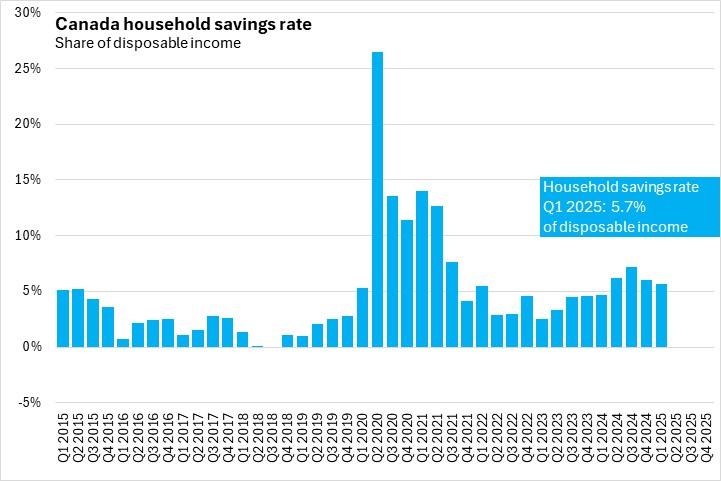
The household savings rate fell to 5.7% of disposable income in Q1 as disposable income growth fell short of the increases in consumption.
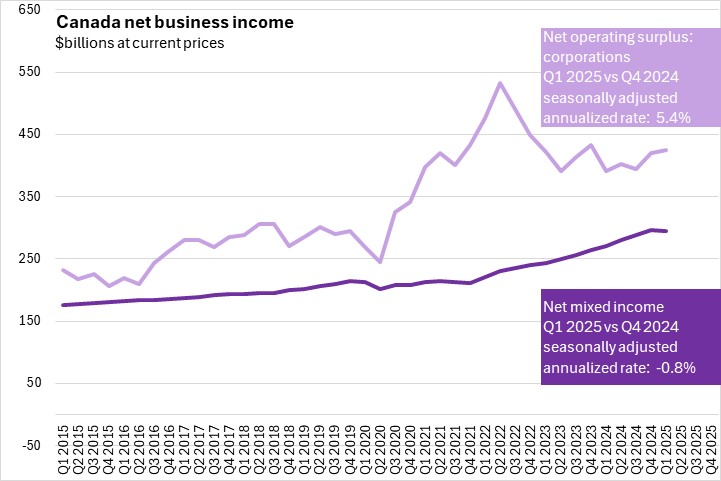
Net operating surplus for corporations rose at a 5.4% seasonally adjusted annualized growth rate, with strength in oil/gas extraction and manufacturing, as well as motor vehicle manufacturing. Net mixed income of unincorporated businesses was down 0.8% in Q1.
Source: Statistics Canada. Table 36-10-0103-01 Gross domestic product, income-based, quarterly (x 1,000,000), Table 36-10-0104-01 Gross domestic product, expenditure-based, Canada, quarterly (x 1,000,000), Table 36-10-0112-01 Current and capital accounts - Households, Canada, quarterly; Table 36-10-0130-01 Gross domestic product price indexes, annual (2017=100); Table 36-10-0699-01 Gross domestic product, expenditure-based, Canada, annual (x 1,000,000)
<--- Return to Archive


