The Economics and Statistics Division maintains archives of previous publications for accountability purposes, but makes no updates to keep these documents current with the latest data revisions from Statistics Canada. As a result, information in older documents may not be accurate. Please exercise caution when referring to older documents. For the latest information and historical data, please contact the individual listed to the right.
<--- Return to Archive
For additional information relating to this article, please contact:
May 30, 2025NON-RESIDENTIAL FIXED CAPITAL INVESTMENT, Q1 2025 Non-residential fixed capital investment consists of expenditures made by business, governments and non-profit institutions serving households that add to the capital stock for production of goods and services in an economy. Investment that are included are buildings, engineering construction (i.e. bridge, mine structure), machinery and equipment, and intellectual property products (i.e. software, mineral exploration) but it doesn’t include non-reproducible assets (lands, mineral deposits, natural resources) or housing investment. Statistics Canada has begun to release quarterly data on non-residential fixed capital investment and stock for the provinces with historical data back to 2013. Note, the data is not seasonally adjusted and expressed in current prices.
Year-over-year (Q1 2025 vs Q1 2024)
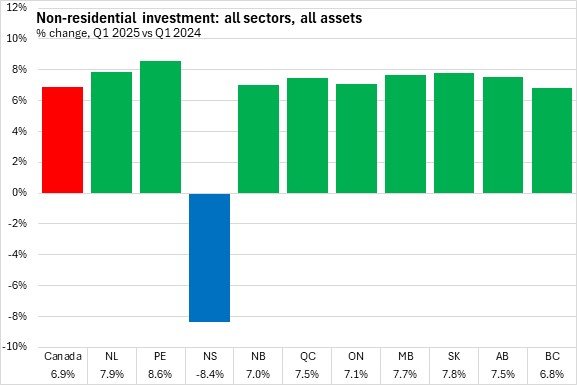
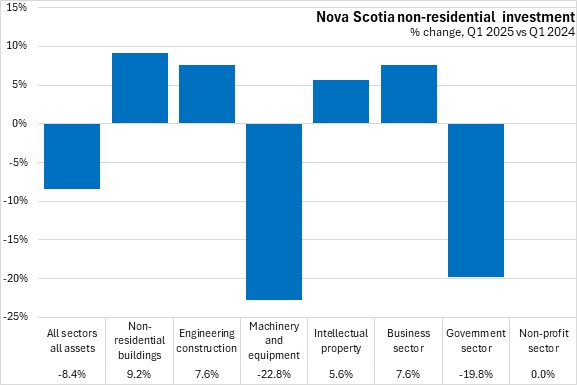
Nova Scotia non-residential investment (all sectors, all assets, current prices) declined 8.4% from Q1 2024 to Q1 2025 following 18.8% growth in the previous quarter. Nationally non-residential investment was up 6.9% with gains in all provinces except Nova Scotia. The fastest growth was reported in Prince Edward Island.
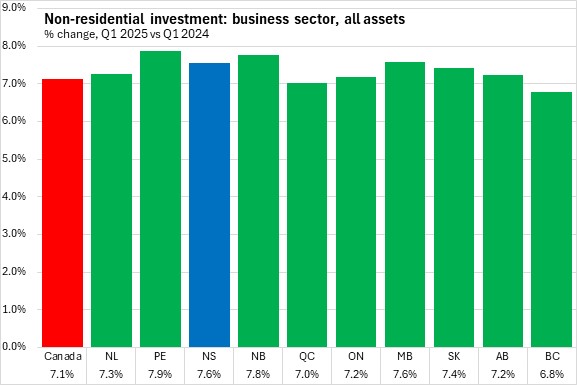
Business sector investment in Nova Scotia increased 7.6% in Q1. National business non-residential investment was up 7.1% with gains in all provinces. Prince Edward Island reported the fastest growth and British Columbia reported the slowest.
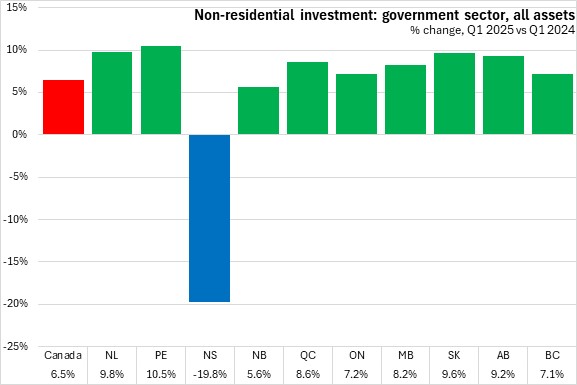
Government fixed capital investment declined 19.8% in Nova Scotia from Q1 2024 to Q1 2025 following 31.5% growth in Q4. Across Canada, government investment (which includes all orders of government) was up 6.5% with gains in all provinces except Nova Scotia. Prince Edward Island reported the fastest growth and New Brunswick the slowest.
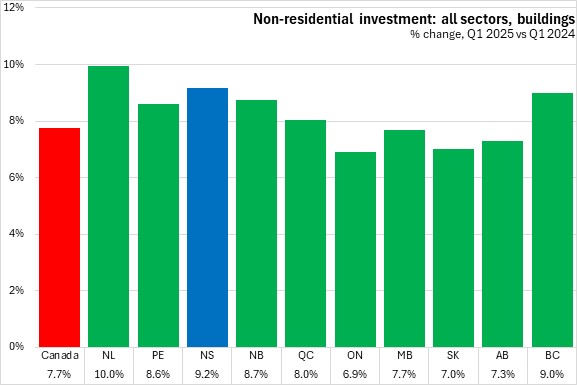
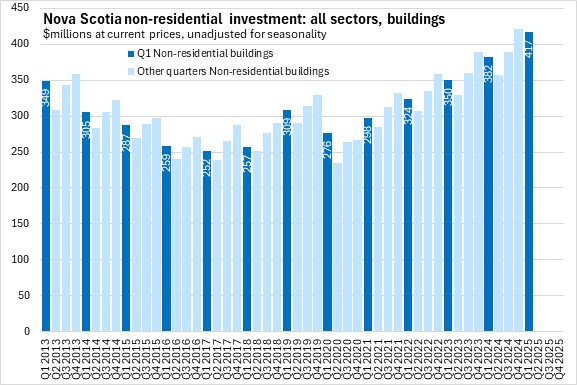
Nova Scotia non-residential building investment was up 9.2% compared to Q1 2024, the second fastest increase among provinces. Nationally, non-residential building investment was up 7.7% with gains in all provinces. The fastest growth was in Newfoundland and Labrador and slowest in Ontario.
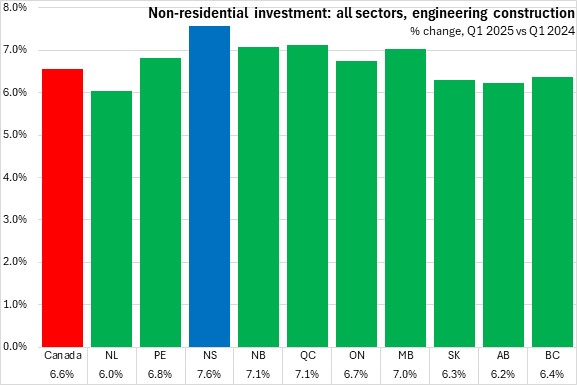
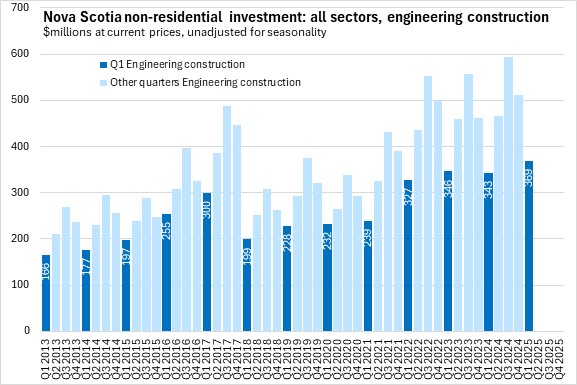
Engineering construction investment was up 7.6% in Nova Scotia, the fastest growth among provinces. Nationally, engineering construction investment was up 6.6% with gains in all provinces. Newfoundland and Labrador reported the slowest growth.
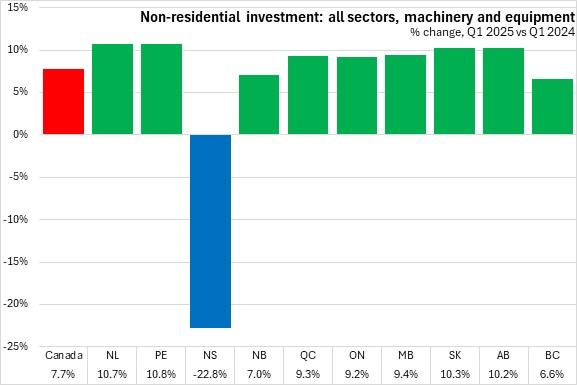
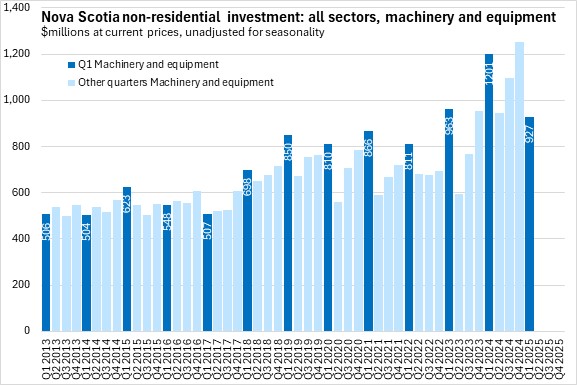
Machinery and equipment investment was down 22.8% in Nova Scotia, after growing 31.6% in the previous quarter. Nationally, machinery and equipment investment grew 7.7% with gains in all provinces except Nova Scotia. British Columbia reported the slowest growth.
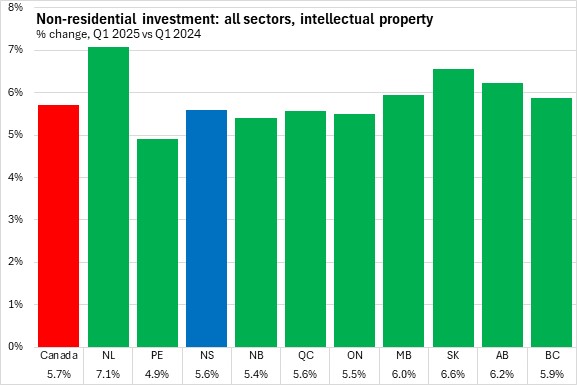
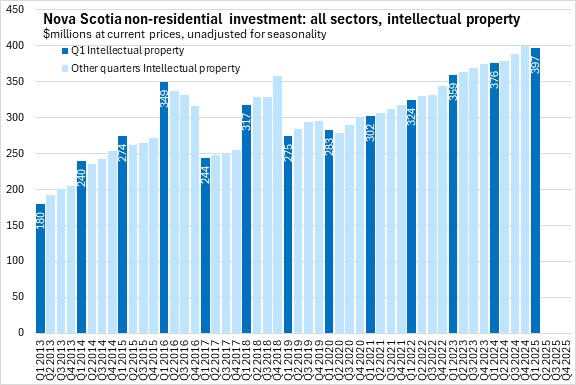
Intellectual property investment was up 5.6% in Nova Scotia compared to Q1 2024. Nationally, intellectual property investment was up 5.7% with gains in all provinces. Newfoundland and Labrador reported the fastest growth while the slowest growth was in Prince Edward Island.
Nova Scotia's investments in fixed non-residential capital were larger in government investment ($1,079 million) than business investment ($1,025 million). Machinery and equipment made up the largest asset category of investment ($927 million). Investments in non-residential buildings ($417 million) were larger than those in engineering construction ($369 million) and to intellectual property ($397 million).
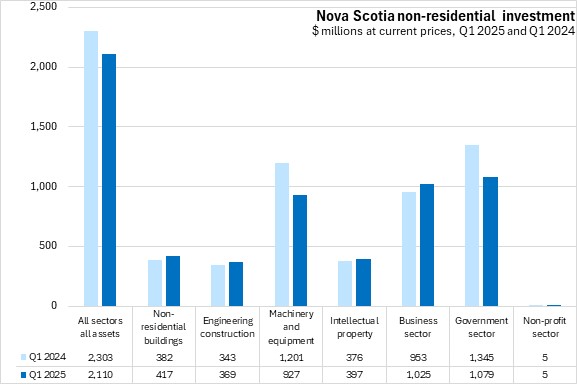
Declines in Q1 were concentrated in machinery and equipment as well as government sector investments.
Trends
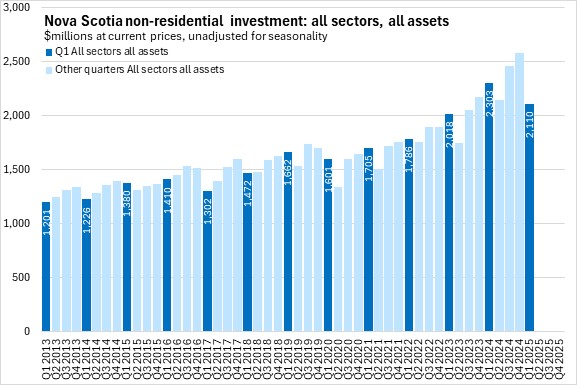
Nova Scotia's non-residential investment has generally trended up on a year-over-year basis (except 2020). Non-residential investment is down year-over-year in Q1 2025 but is at a similar level as the same quarter in 2023.
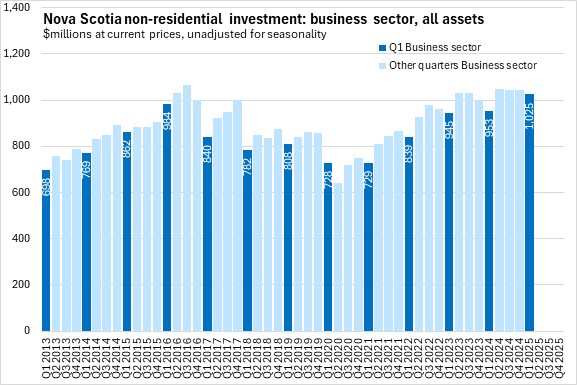
Business sector non-residential investment trended downward over 2016 to 2020, before trending upwards over 2021-2023. However, business sector investment has grown at a slower pace in 2024 and Q1 2025.
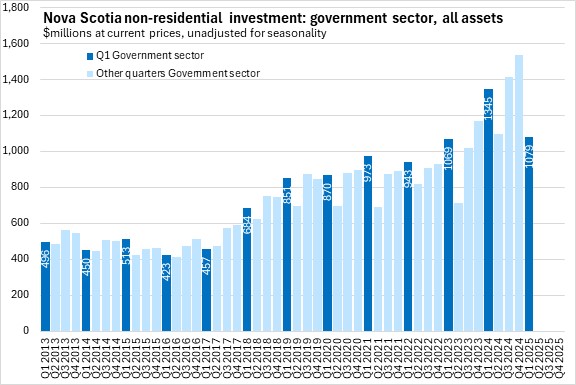
Government sector was mostly flat from 2014 through 2017, then trended upwards from 2017 to 2023, followed by a notable acceleration in the second half of 2024. Results in Q1 2025 are at similar levels from the same period of 2023.
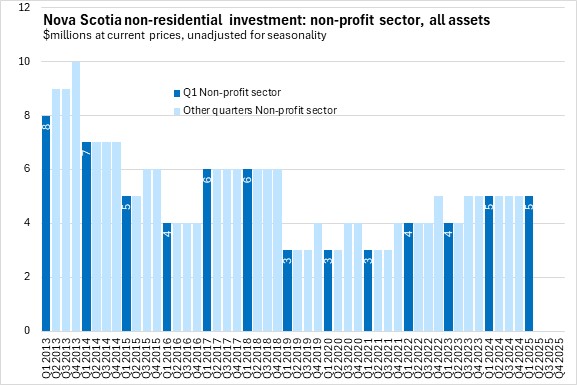
Non-profit institution serving households was little changed (at a low value) from 2019 through 2024.
Nova Scotia's investments in non-residential buildings declined from 2013 to 2017 and rose in 2018 and 2019. After a dip in 2020, Nova Scotia's investment in non-residential buildings recovered to its rising trend from 2021-2024.
Nova Scotia's investments in engineering construction assets trended up from 2018 to 2022, after which investment has grown at a slower pace. Engineering construction is typically at its lowest point for the year in Q1 periods.
Nova Scotia's investments in machinery and equipment assets were notably stronger over 2024. The result in Q1 2025 reflects a deceleration from record levels of investment in Q4 2024.
Nova Scotia's investments in intellectual property products have mostly trended up since 2013 with occasional spikes associated with specific offshore exploration projects.
Statistics Canada. Table 34-10-0163-01 Flows and stocks of fixed non-residential and residential capital, by sector and asset, provincial and territorial (x 1,000,000)
<--- Return to Archive


