The Economics and Statistics Division maintains archives of previous publications for accountability purposes, but makes no updates to keep these documents current with the latest data revisions from Statistics Canada. As a result, information in older documents may not be accurate. Please exercise caution when referring to older documents. For the latest information and historical data, please contact the individual listed to the right.
<--- Return to Archive
For additional information relating to this article, please contact:
July 16, 2025HOUSEHOLD INCOME AND CONSUMPTION, Q1 2025 Household Income and Outlay
In addition to compensation of employees, household income also includes net mixed income (generated from unincorporated businesses), property income received (generated as the result of ownership of assets) and current transfers received (generally from government).
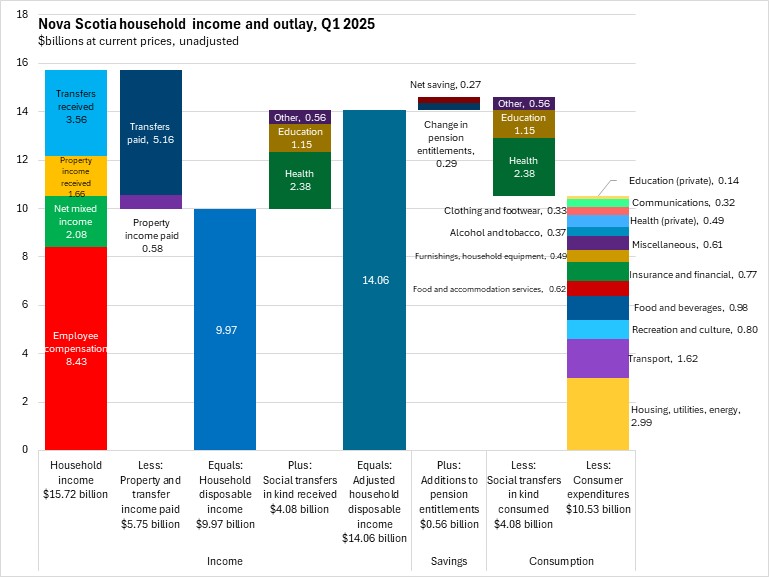
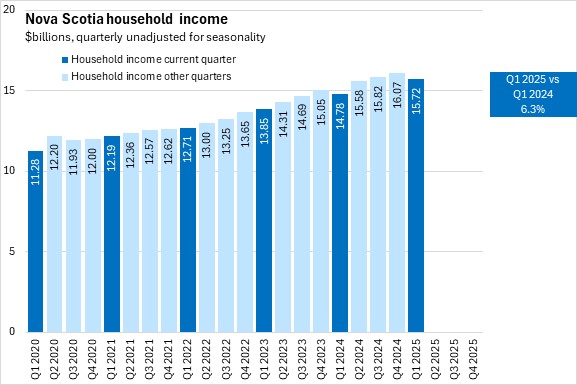
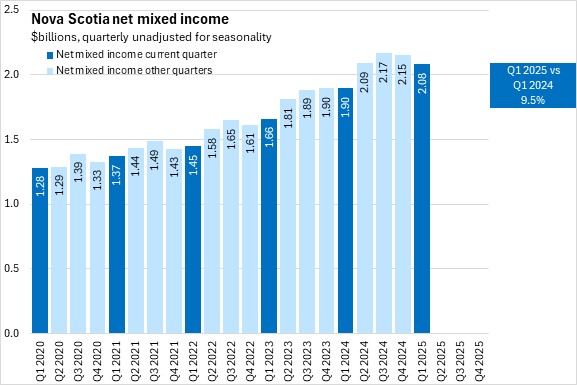
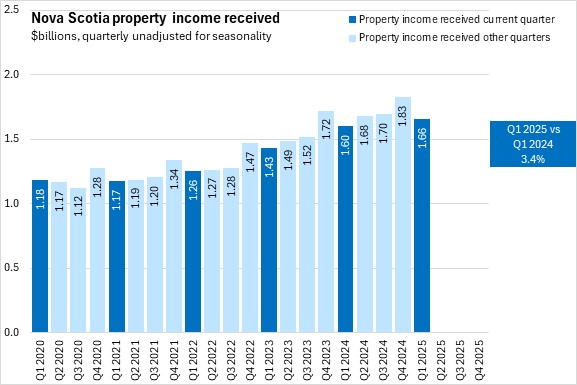
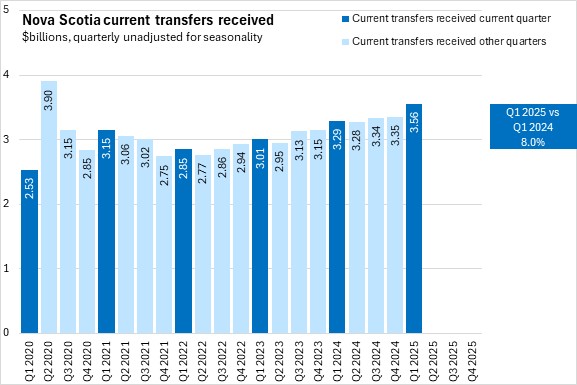
Nova Scotians received $15.72 billion in household income in Q1 2025, including $8.43 billion in employee compensation, $2.08 billion in net mixed income from unincorporated business ownership, $1.66 billion in property income receipts and $3.56 billion in current transfers received.
After paying current transfers (including income taxes) of $5.16 billion and property income of $0.58 billion, Nova Scotia disposable income was $9.97 billion in Q1 2025. Including the $4.08 billion value of social transfers in kind received from governments or non-profits in the form of services provided for households, Nova Scotia had adjusted disposable income of $14.06 billion.
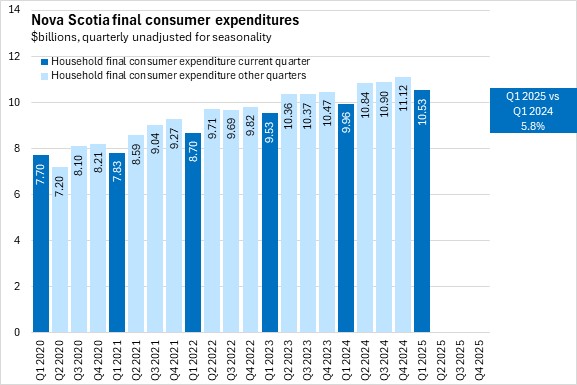
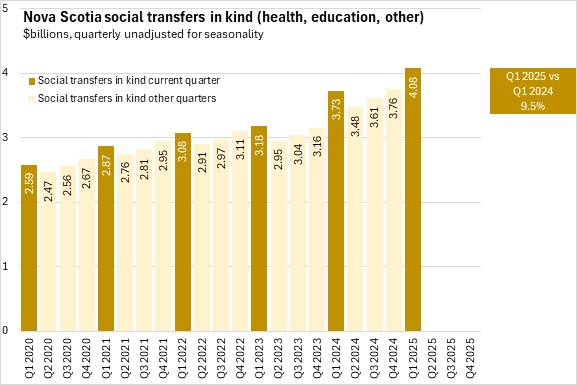
The consumption of social transfers in kind matches the value of social transfers received ($4.08 billion), while households spent $10.53 billion on consumer expenditures. The value of household final consumption expenditures and social transfers in kind was less than the adjusted household disposable income, with the surplus resulting in an increase in savings of $0.27 billion in household savings and a $0.29 billion change in pension entitlements.
Household income
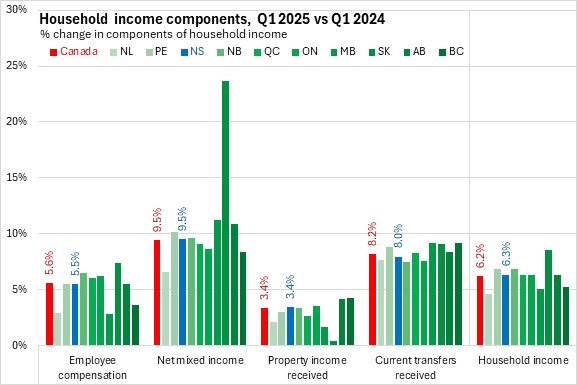
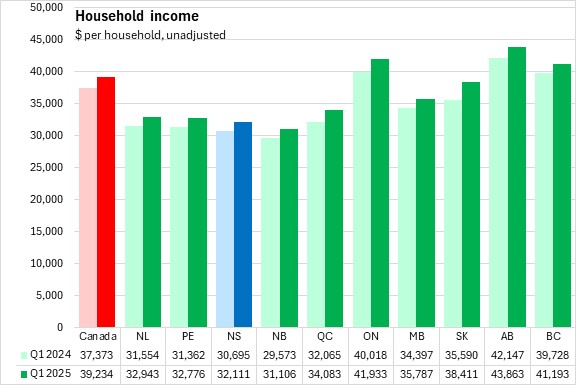
Nova Scotia's overall household income growth from Q1 2024 to Q1 2025 was 6.3%, which was just above the national growth of 6.2%. All provinces reported rising household income year-over-year, with the fastest increase in Saskatchewan and the slowest gain in Newfoundland and Labrador.
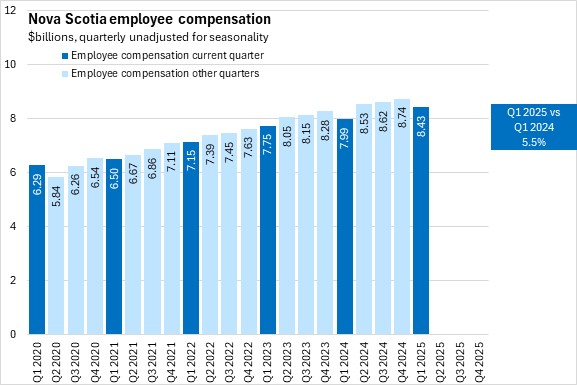
Nova Scotia's rising household income reflected employee compensation growth of 5.5%. Nationally, employee compensation was up 5.6% year-over-year with gains in all provinces. Saskatchewan had the fastest year-over-year rise in employee compensation.
Nova Scotia's net mixed income from unincorporated businesses grew 9.5% from Q1 2024 to Q1 2025, the same pace as the national average. Saskatchewan reported significantly faster growth in net mixed income (+23.7%) from Q1 2024 to Q1 2025. Newfoundland and Labrador reported the slowest growth.
Nova Scotia's growth in property income receipts was 3.4%, also matching the national pace. All provinces reported increases from Q1 2024 to Q1 2025. British Columbia and Alberta had the fastest growth in property income receipts while Saskatchewan had the slowest rise.
Current transfers received were up 8.0% in Nova Scotia from Q1 2024 to Q1 2025, slightly slower than the national pace of growth. Transfer growth was fastest in Manitoba and British Columbia.
In Q1 2025, Nova Scotia's household income was $32,111 per household or 81.8% of the national average ($39,234). The highest income per household was in Alberta and lowest in New Brunswick (followed by Nova Scotia).
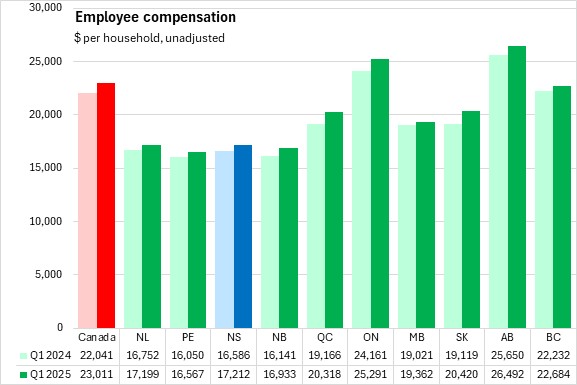
Nova Scotia's employee compensation $17,212 per household, amounting to 74.8% of the national average per household ($23,011). Alberta reported the highest employee compensation per household and New Brunswick the lowest (followed by the other Atlantic Provinces).
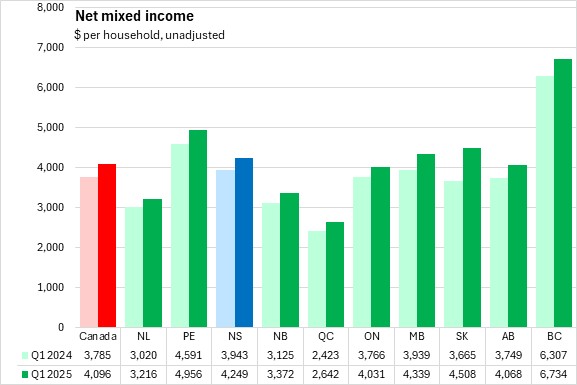
Nova Scotia's net mixed income generated by unincorporated businesses amounted to $4,249 per household, which was 103.7% of the national average per household of $4,096. Across Canada, the highest values of net mixed income per household were in British Columbia. The lowest net mixed income per household was in Québec.
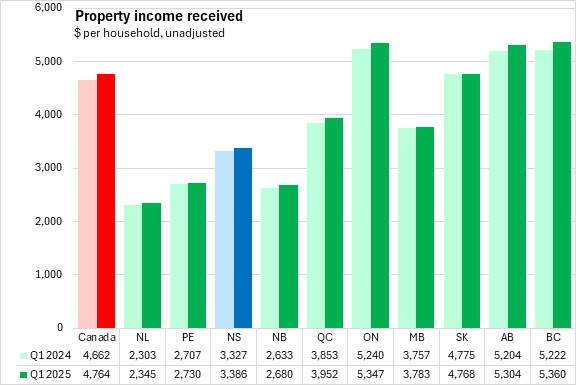
Nova Scotia property income received in Q1 2025 was $3,386 per household, which was 71.1% of the national average ($4,764 per household). The highest property income values were in British Columbia, Alberta, and Ontario. The lowest property income per household was in Newfoundland and Labrador.
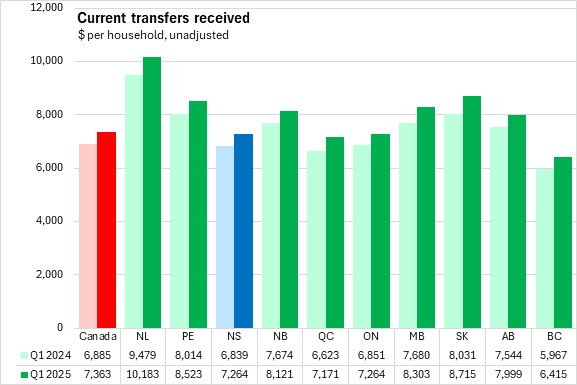
Current transfers received in Nova Scotia were $7,264 per household in Q1 2025. Current transfers received in Nova Scotia were 98.7% of the national average per household ($7,363). Transfers per household were highest in Newfoundland and Labrador and lowest in British Columbia.
Household Consumer Expenditures
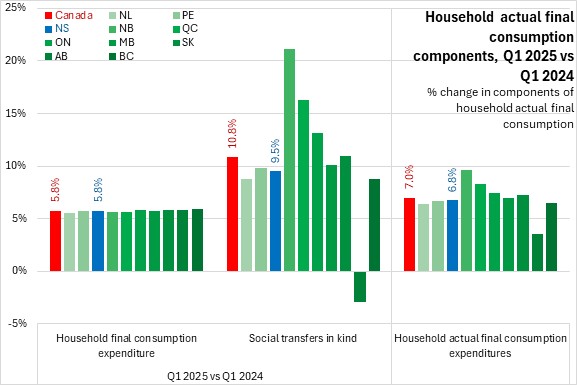
Comparing Q1 2025 with Q1 2024, Nova Scotia's household consumer expenditures increased by 5.8%, the same growth rate as the national pace. Year-over-year growth in consumer expenditures was very similar across all provinces with the fastest gain (British Columbia: 5.9%) barely outpacing the slowest increases (Newfoundland and Labrador and Québec at 5.6% each).
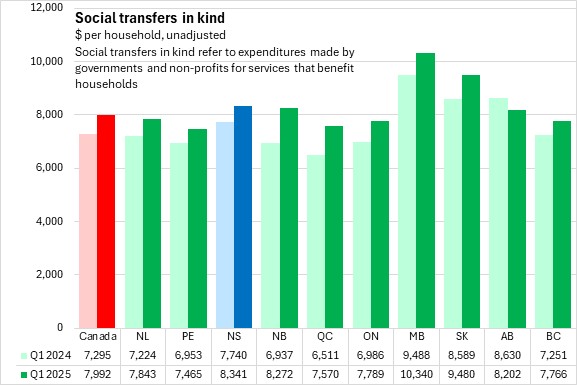
Social transfers in kind refer to services that are provided for the benefit of households but are paid for by governments and non-profits. These are primarily health and education expenditures, which add to private expenditures made on these services. Social transfers in kind increased by 9.5% in Nova Scotia from Q1 2024 to Q1 2025, slower than the national pace of growth. Social transfers in kind were up in every province except Alberta. New Brunswick (+21.1%) and Québec (+16.3%) reported markedly faster growth rates.
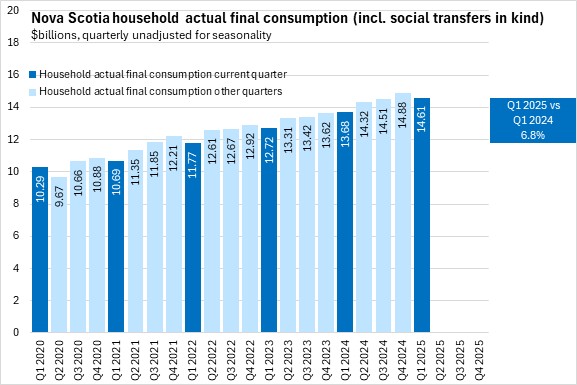
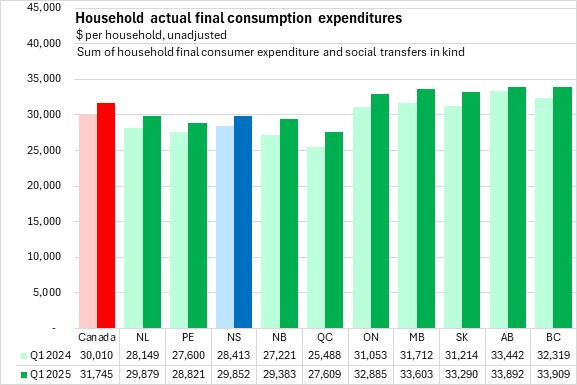
The sum of household final consumer expenditures and social transfers in kind is termed 'household actual final consumption expenditures', which reflects the benefits to households from both private expenditures as well as services provided by governments and non-profits. Combining these two components led to year-over-year household actual final consumption growth of 6.8% for Nova Scotia, which was just below the national pace of growth. All provinces reported increasing household actual final consumption expenditures from Q1 2024 to Q1 2025, with New Brunswick reporting the fastest growth and Alberta reporting the weakest growth (both due to differences in growth for social transfers in kind).
Among the categories of actual final consumption expenditures, housing/utilities/energy made up the largest category of household consumer expenditures, followed by social transfers in kind for health care, transportation, social transfers in kind for education, food/beverages and recreation/culture.
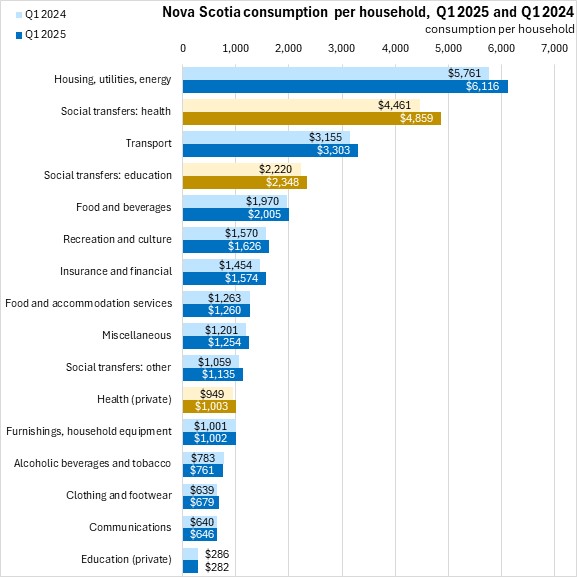
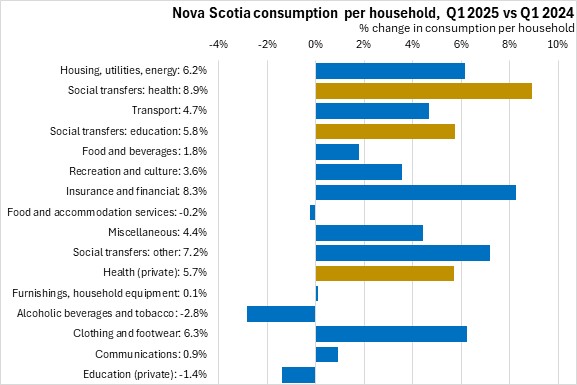
From Q1 2024 to Q1 2025, growth in per household spending was fastest in social transfers for health and insurance/financial services. Expenditures were down for food/accommodation services, alcoholic beverages/tobacco, and private (market-provided) education services.
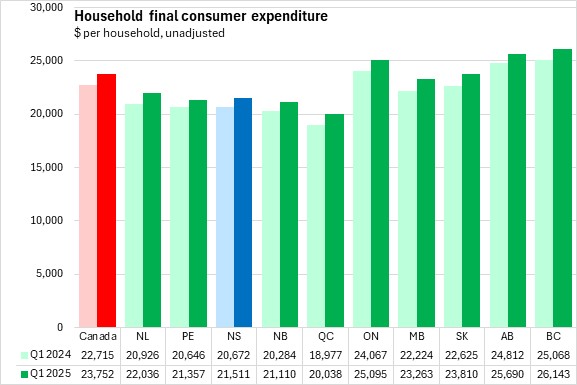
Nova Scotia's final consumer expenditures (paid for private by households) amounted $21,511 per household; 90.6% of the national average per household. Across Canada, final consumer expenditures per household were $23,752 with the highest values in British Columbia and Alberta and the lowest value in Québec.
In Q1 2025, Nova Scotian households received $8,341 per household worth of social transfers in kind (104.4% of the national average per household). Across Canada, social transfers in kind were $7,992 per household with the highest value in Manitoba and the lowest value in Prince Edward Island.
Nova Scotia's household actual final consumption expenditures in Q1 2025 were $29,852 per household (94.0% of the national average per household). National household actual final consumption expenditures were $31,745 per household with the highest values in British Columbia and Alberta. The lowest household actual final consumption expenditures were in Québec.
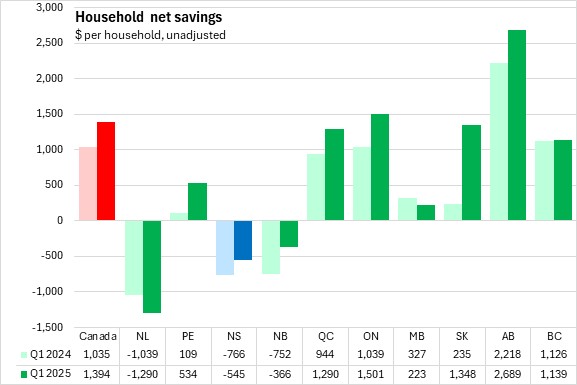
In Q1 2025, Nova Scotia's net savings per household were -$545, an improvement from the net savings of -$766 per household in Q1 2024. Only Newfoundland and Labrador, Nova Scotia and New Brunswick reported negative net savings in Q1 2025. Nationally, savings averaged $1,394 per household in Q1 2025 with notably higher savings in Alberta.
Source: Statistics Canada. Table 36-10-0663-01 Distributions of household economic accounts, income, consumption and saving, Canada, provinces and territories, quarterly (x 1,000,000)
<--- Return to Archive


