The Economics and Statistics Division maintains archives of previous publications for accountability purposes, but makes no updates to keep these documents current with the latest data revisions from Statistics Canada. As a result, information in older documents may not be accurate. Please exercise caution when referring to older documents. For the latest information and historical data, please contact the individual listed to the right.
<--- Return to Archive
For additional information relating to this article, please contact:
July 18, 2025FAMILY INCOME AND INDIVIDUAL INCOME, T1 FAMILY FILE, 2023 Statistics Canada has released estimates of family and individual income generated from 2023 T1 personal income tax returns (collected mostly in spring 2023). This data shows how income is changing over time for particular types of families as well as how it compares by type of income and geography.
The data shows median incomes for families (which often include more than one earner) as well as for persons within families (which allows for comparison with those who are not in census families). There are data available for provinces, for Census Metropolitan Areas (CMA), Census Agglomerations (CA) and areas outside CMA and CA communities. Within Statistics Canada’s estimates, there are income results for those who are in census families (couples and lone-parent families) as well as for those who are not in census families.
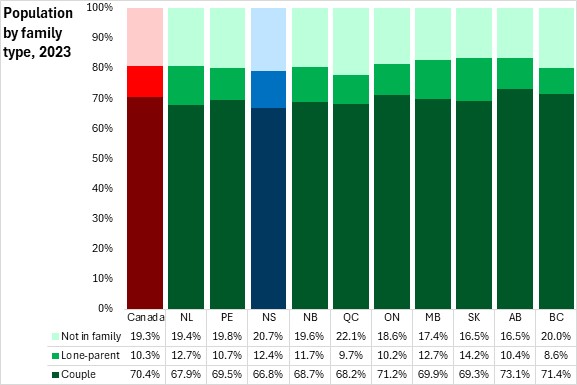
For Nova Scotia, the T1 records indicate a total of 1,015,590 persons (totals will not align with official population estimates). Of these, 66.8% were in couple families – the lowest such proportion among the provinces while there were 12.4% in lone-parent families and 20.7% not in any form of census family (second highest among provinces).
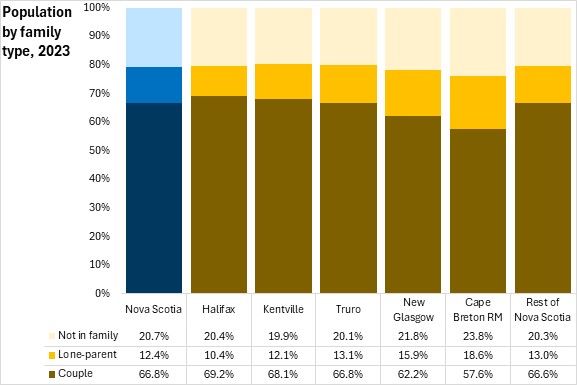
Within Nova Scotia, the portion of couple families was lower in New Glasgow and the Cape Breton Regional Municipality, where there were larger portions of lone-parent families as well as persons not in a census family.
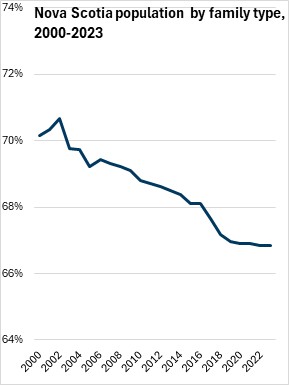
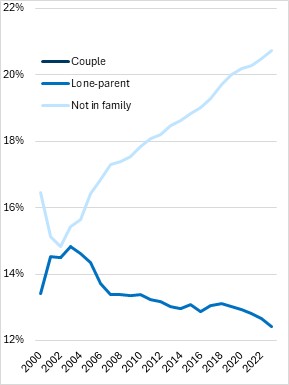
Over time, the share of Nova Scotia's population in census families has declined as has the share in lone-parent families. The population's share of persons not in a census family is rising (concentrated among older residents).
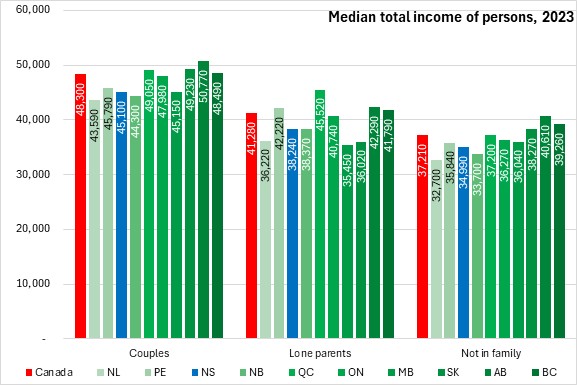
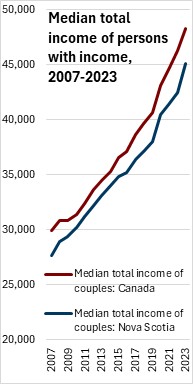
Median total income (among those who had income) for persons in couple families was $45,100 in Nova Scotia in 2023, which was 93.4% of the national medina ($48,300).
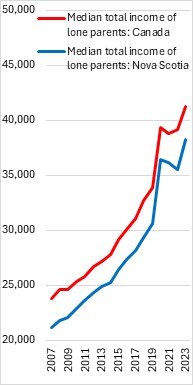
Median income from all sources among persons in lone-parent families who had income in Nova Scotia during 2023 was $38,240, 92.6% of the national median ($41,280).
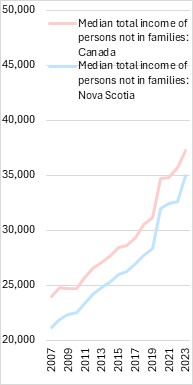
Median income from all sources among persons not in census families who had income was $34,990 or 94.0% of the national median ($37,210).
Note: median income of persons in couple families treats each person with income separately.
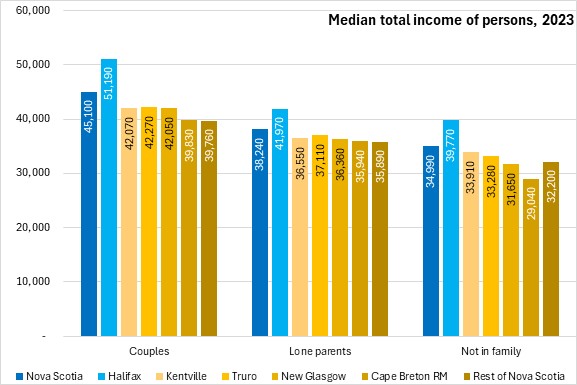
Within Nova Scotia, the Halifax CMA had higher median total income among couple families, lone-parent families, and persons not in families while areas outside of Halifax had lower median incomes across all family types. Median incomes were lowest for couple families and lone-parent families in rural areas. Median incomes for persons not in a census family were lowest in the Cape Breton Regional Municipality.
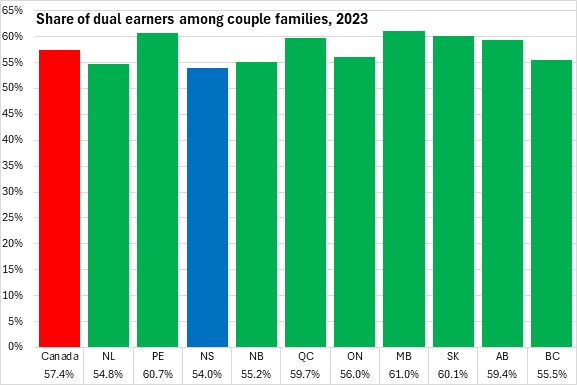
Couple families typically report higher incomes, particularly for those that have two persons earning employment income. Nova Scotia reported the lowest proportion of dual earners among couple families at 54.0%.

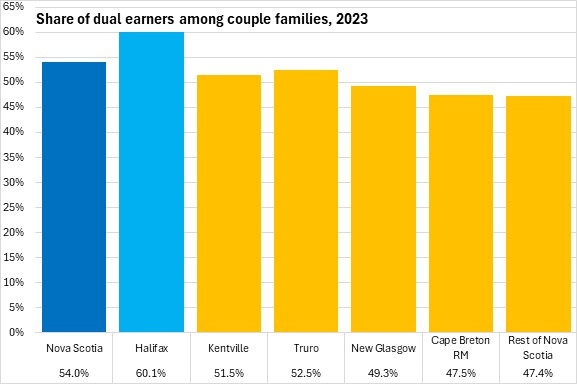
In Halifax, 60.1% of couple families had two earners. The share of dual earners among couple families was under 50% in New Glasgow, Cape Breton Regional Municipality and rural Nova Scotia outside of Halifax and the Census Agglomeration areas.
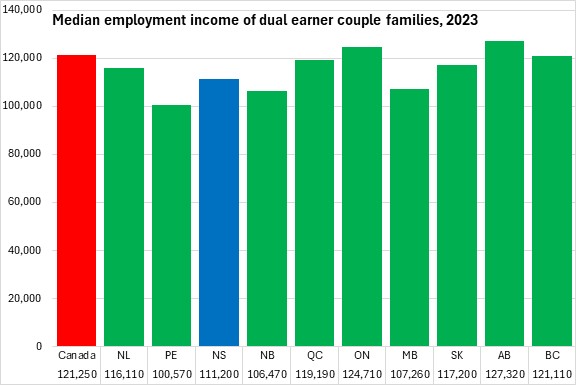
Among dual earner couples, Nova Scotia's median employment earnings (combining the incomes of both earners) were $111,200 in 2023 (91.7% of the national median).
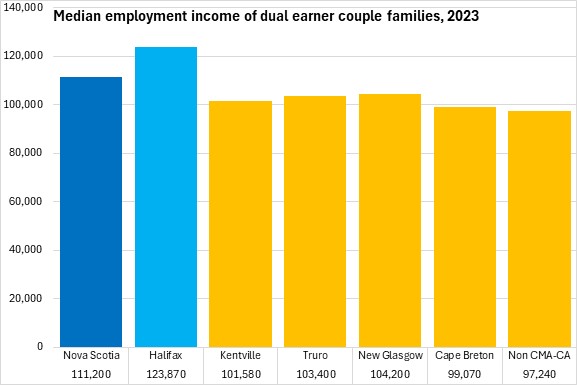
Dual earner couples' income was notably higher in Halifax ($123,870) than across the rest of the province.
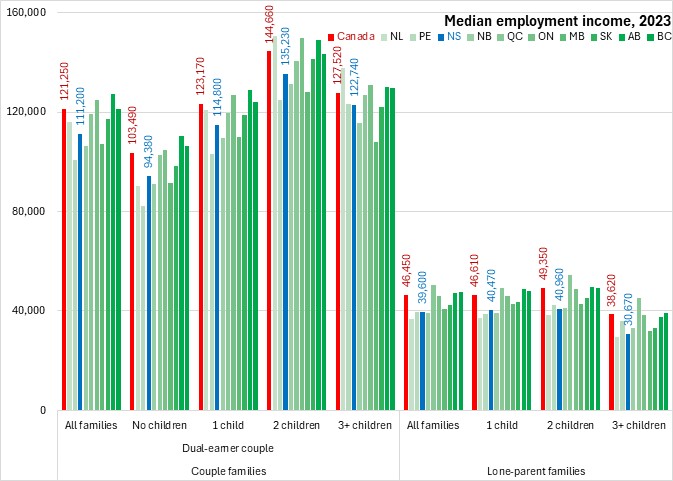
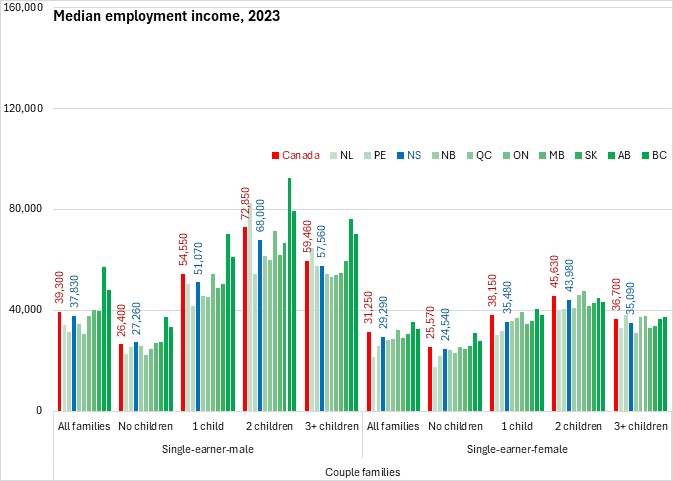
When looking at median incomes by family (summing all earners in the family), couple families have higher median incomes, particularly for those with 2 children. In comparison, lone-parent families have substantially lower median incomes; with less than half the median income of a dual earner couple family. Among couple families with only one earner, median incomes were notably higher for those families where the single earner is male as opposed to female.
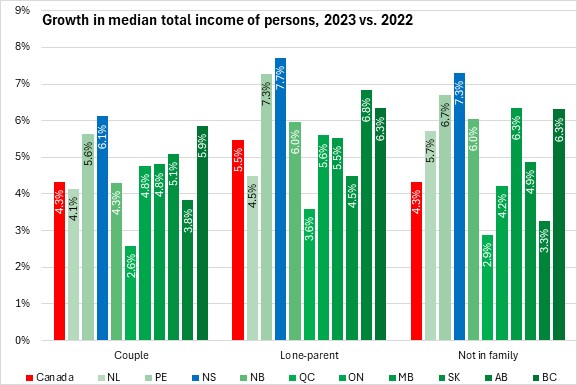
For each of the three broad categories of family structure (couples, lone-parents, persons not in census families) Nova Scotia's median income growth was the fastest among provinces. All provinces reported rising median incomes in each category of family structure.
Nova Scotia's median income of persons in couple families grew by 6.1% from 2022 to 2023, while national median incomes for couples rose 4.3%.
Incomes for Nova Scotia lone-parent families rose 7.7% in 2023, while median incomes for lone parents were up 5.5% nationaly
Among Nova Scotia's persons not in a census family, 2023 median income was 7.3% higher than in 2022. Canada's median income for persons not in a census family grew by 4.3% in 2023.
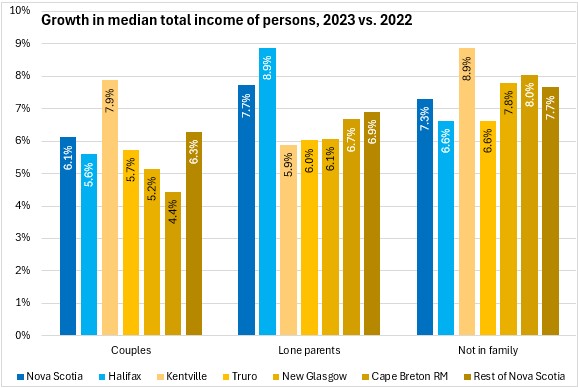
Median incomes increased for all three family structures in all regions of the province. Median incomes of lone parent families grew notably faster in Halifax, while median incomes of couples as well as persons not in a census family grew fastest in Kentville.
Incomes for lone-parent families and persons not in a census family accelerated during the pandemic. For lone parent families, these increases were partially reversed by declines in 2021 and 2022 before rebounding in 2023. For persons not in a census family, growth slowed considerably from 2020 to 2022, before accelerating again in 2023. Couple families continued to report steady growth in median incomes, with some acceleration in recent years.
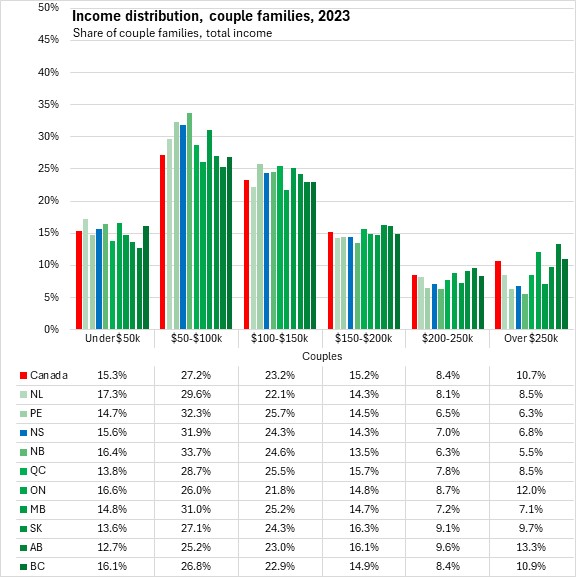
The Annual T1 Family File provides breakdowns of family income by income range.
Among couple families in 2023, there was a higher share of Nova Scotia families reporting less than $150,000 in income than the national average. There were smaller portions of Nova Scotians with incomes above $150,000.
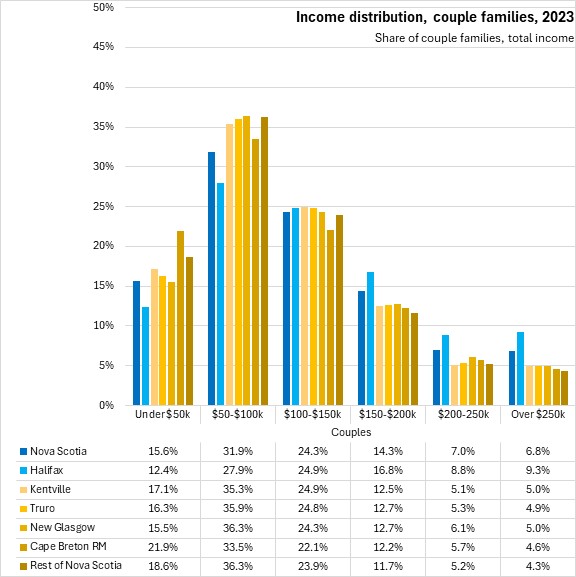
Across Nova Scotia, the share of couple families with total income over $100,000 was higher in Halifax than in the rest of the province.
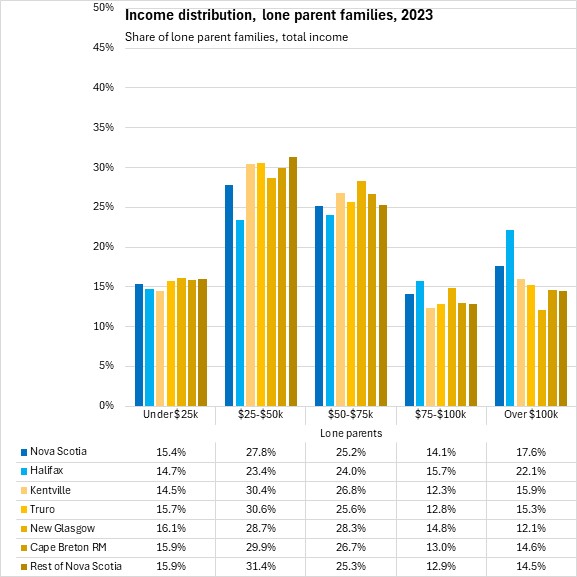
A larger portion of Nova Scotia lone parent families reported total income under $75,000, compared with the national average. A smaller portion of Nova Scotia lone parent families had incomes in excess of $75,000, when compared to the national average.
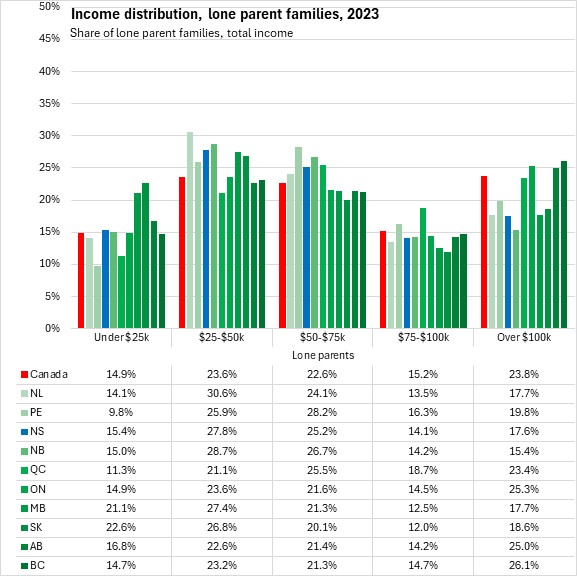
Across the province, a larger portion of lone parent families reported income over $75,000 in Halifax (compared to the provincial average). Outside the city a larger portion of lone parent families reported incomes under $75,000. The exception was New Glasgow where a higher portion of lone parents reported incomes between $75,000 and $100,000.
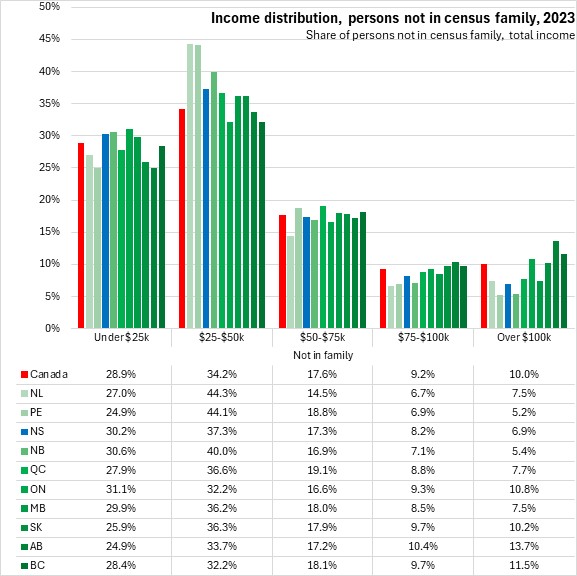
Compared to the national average, a higher portion of Nova Scotians not in a census family reported incomes less than $50,000 while a lower portion reported incomes in excess of $50,000.
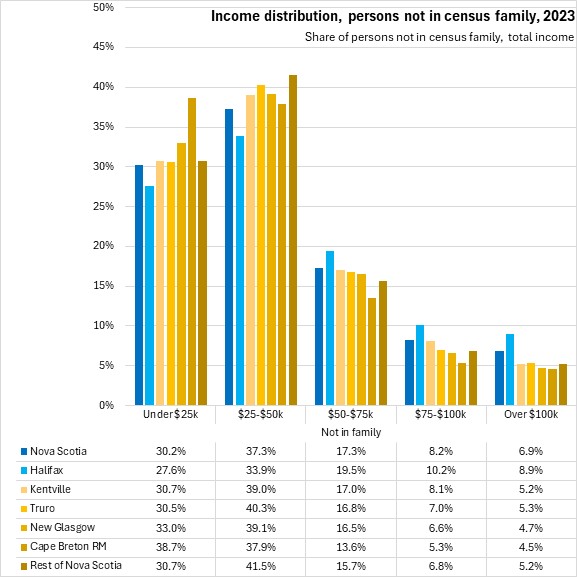
Across the province, a higher portion of Halifax's persons not in a census family report incomes in excess of $50,000 (compared to the provincial average) while a higher portion of persons not in a census family outside the city report incomes under $50,000.
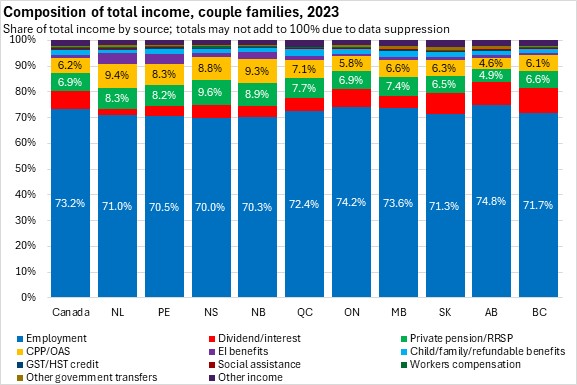
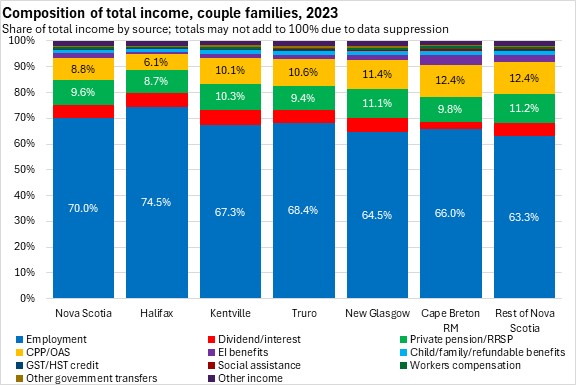
Nova Scotia couple families had the smallest share of total income from employment income in 2023 at 70.0%. Nationally, 73.2% of total income reported by couples was derived from employment income with the highest share in Alberta (74.8%).
Nova Scotia couples reported the highest share of income from pension sources (private pensions/RRSPs at 9.6% and CPP/OAS at 8.8%) . Incomes from interest and dividends were higher in British Columbia, Alberta and Saskatchewan. Couples in Newfoundland and Labrador as well as Prince Edward Island reported higher shares of total income from Employment Insurance.
Across Nova Scotia, employment made up a larger share of couple family income in Halifax (74.5%). CPP/OAS/pensions/RRSPs made up a larger share of income for couples outside Halifax.
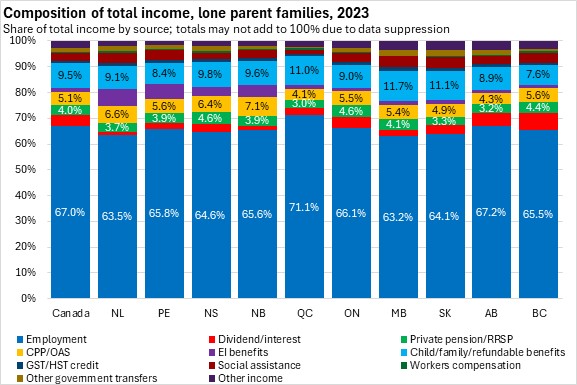
Employment income was 64.6% of the income for Nova Scotia's lone parent families in 2023 (67.0% nationally). Child, family and other refundable benefits accounted for 9.8% of the income of lone-parent families in Nova Scotia (vs 1.4% of income for Nova Scotia couple families).
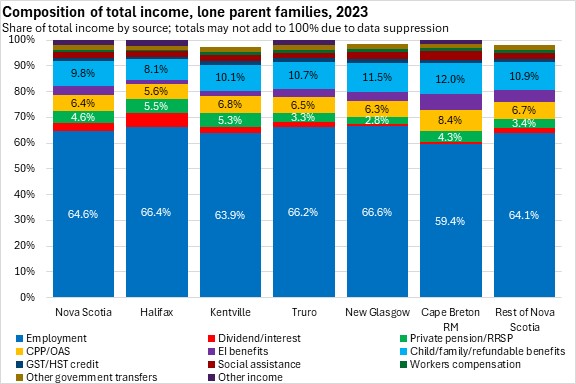
Within Nova Scotia, lone parents in Halifax reported a higher share of income from employment (66.4%) and a lower share from government transfers. Lone parents in the Cape Breton Regional Municipality reported a lower portion of income from employment (59.4%) and higher portions from child benefits, Employment Insurance and other government transfers.
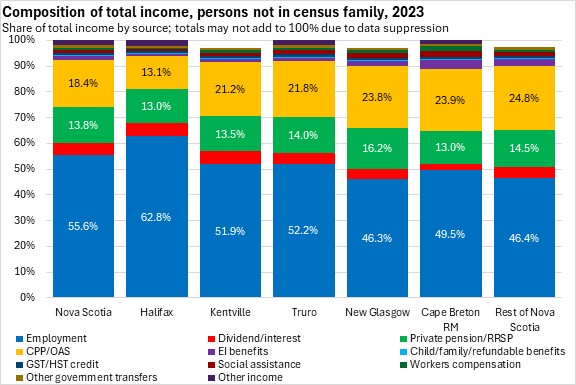
Persons not in a census family drew a much larger portion of their income from pension sources: private pensions, RRSPs, CPP and OAS. This was particularly the case in Atlantic Canada, where older populations reduced the share of the population generating income from employment.
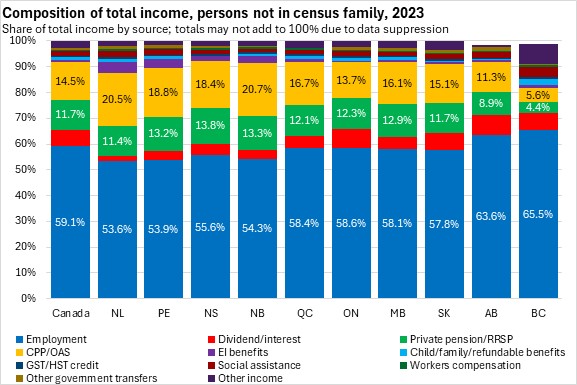
Pension incomes were particularly important as a source of income in communities outside of Halifax.
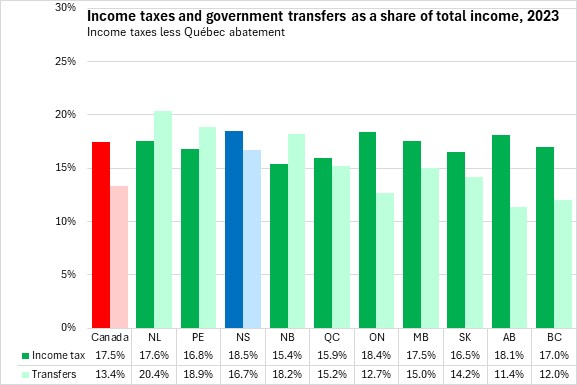
Measuring total income taxes paid to Provincial and Federal governments (and removing the Québec abatement on Federal income taxes), the average national income tax rate was 17.5% of total national income in 2023. In the same year, government transfers made up 13.4% of total incomes.
Nova Scotia's average income tax rate was 18.5% of total income in 2023 while transfers made up 16.7% of total incomes.
The highest average income tax rates were in Ontario and Nova Scotia while the lowest average income tax rate was in New Brunswick. The highest average transfer share of income was in Newfoundland and Labrador while the lowest was in Alberta.
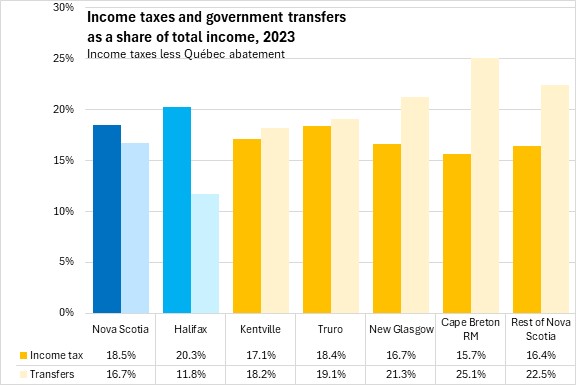
Average income tax rates were higher in Halifax than across the rest of the province. The lowest average income tax rate was in Cape Breton Regional Municipality. The pattern is reversed for transfer share of income (lowest in Halifax, highest in Cape Breton Regional Municipality).
Statistics Canada Notes: Total income includes employment income, dividend and interest income, government transfers, pension income and other income. In accordance with international standards, capital gains are excluded from total income.
This release uses the census family concept. A census family refers to a married or a common-law couple, with or without children at home, or a lone-parent family. Results also include persons not in a census family.
Statistics Canada. Table 11-10-0009-01 Selected income characteristics of census families by family type ; Table 11-10-0014-01 Sources of income by census family type ; Table 11-10-0034-01 Tax filers and dependants with income by sex, income taxes, selected deductions and benefits; Table 11-10-0028-01 Single-earner and dual-earner census families by number of children
<--- Return to Archive


