The Economics and Statistics Division maintains archives of previous publications for accountability purposes, but makes no updates to keep these documents current with the latest data revisions from Statistics Canada. As a result, information in older documents may not be accurate. Please exercise caution when referring to older documents. For the latest information and historical data, please contact the individual listed to the right.
<--- Return to Archive
For additional information relating to this article, please contact:
July 21, 2025BALTIC DRY INDEX, JULY 2025 The Baltic Dry Index (BDI) measures procurement costs of shipping raw materials by sea.
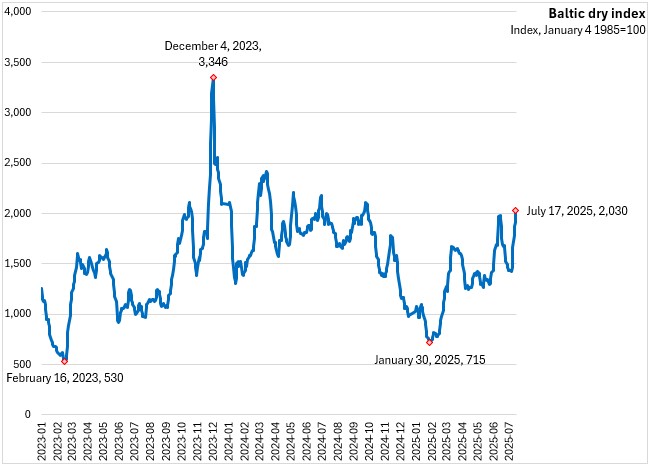
The BDI recently peaked at a value of 3,346 on December 4, 2023 - rising sharply after the index had reached a low of 530 in February of that year. In the subsequent year, the value of the index trended down (albeit with periodic increases).
By January 30, 2025 the BDI bottomed out at a value of 715. In the subsequent six months the index irebounded (with periodic declines), rising to a value of 2,030 by July 17, 2025.
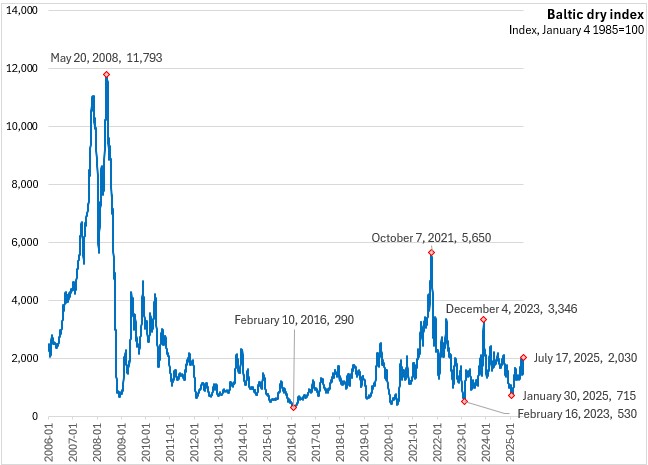
The recent peak of 5,650 in October 2021 was the highest value of the BDI since 2008, but it was less than half of the all-time peak value of 11,793 reported in May 2008. The all-time low of the BDI was a value of 290 reported in February 2016.
Notes: The Baltic Dry Index (BDI) provides a benchmark for the price of moving the major raw materials by sea. It is an index of average prices paid for the transport of dry bulk materials across more than 20 routes. When these costs go down, goods producers benefit from lower shipping costs, and consumers benefit from lower prices for finished products. Higher values indicate more costly shipping, with impacts on costs for goods producers and ultimately for consumer prices. The BDI is often viewed as a leading indicator of economic activity because changes in the index reflect supply and demand for important materials used in manufacturing. The Baltic Dry Index is reported daily by the Baltic Exchange in London.
Sources: Baltic Dry Index Commodities; Bloomberg
<--- Return to Archive


