The Economics and Statistics Division maintains archives of previous publications for accountability purposes, but makes no updates to keep these documents current with the latest data revisions from Statistics Canada. As a result, information in older documents may not be accurate. Please exercise caution when referring to older documents. For the latest information and historical data, please contact the individual listed to the right.
<--- Return to Archive
For additional information relating to this article, please contact:
July 22, 2025POLICE REPORTED CRIME STATISTICS, 2024 Statistics Canada has released the 2024 results for police-reported crime statistics collected under the Uniform Crime Reporting (UCR) Survey. This annual publication measures the volume of crime, crime rates (per 100,000 population), and crime severity index (based on sentencing data) by types of crime.
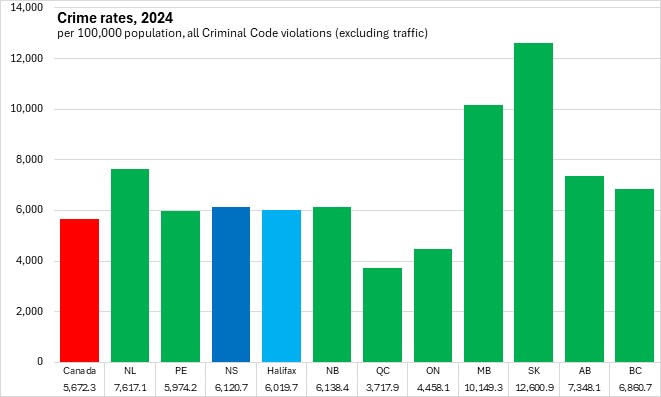
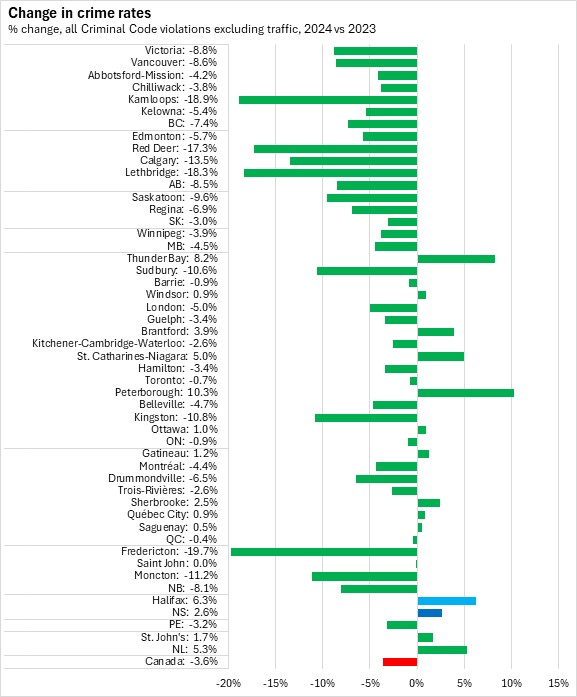
In 2024, Nova Scotia's crime rate (Criminal Code violations excluding traffic) was 6,120.7 incidents per 100,000 population. In comparison, Canada's crime rate for 2024 was 5,672.3 per 100,000 population. This was the fourth consecutive year that Nova Scotia's crime rate was higher than the national average. The lowest crime rates among provinces were in Québec and Ontario while the highest were in Manitoba and Saskatchewan.
Halifax's crime rate was 6,019.7 incidents per 100,000 population.
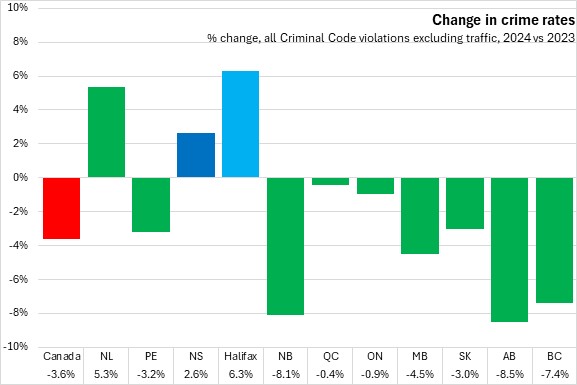
Nova Scotia's crime rate (Criminal Code violations, excluding traffic) increased 2.6% in 2024, while there was a 6.3% increase in Halifax's crime rate.
Canada's crime rate declined by 3.6% in 2024. Crime rates decreased in all provinces except Newfoundland and Labrador and Nova Scotia. The greatest declines in crime rate were reported in Alberta and New Brunswick.
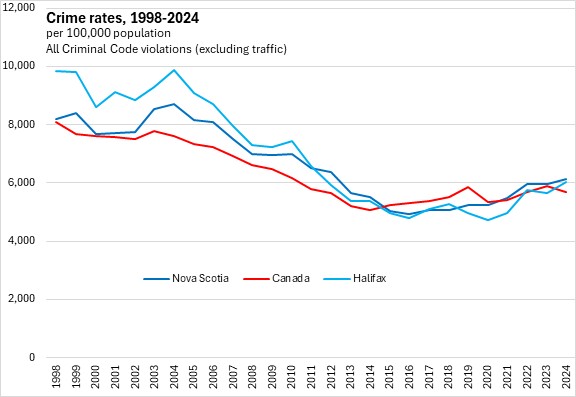
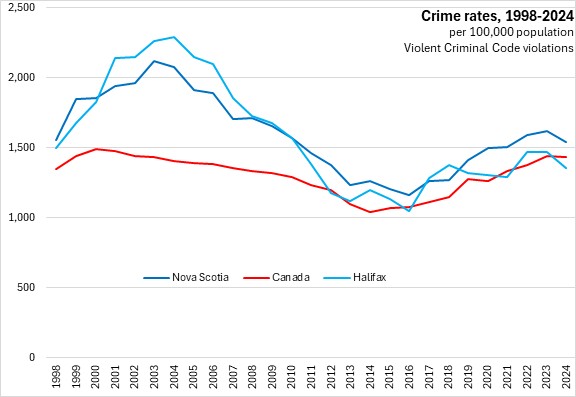
Crime rates declined steadily for many years before bottoming out around 2014 nationally and around 2016 in Nova Scotia. Since then, there has been a rising trend in crime rates (except 2020), though they have not returned to previous high levels.
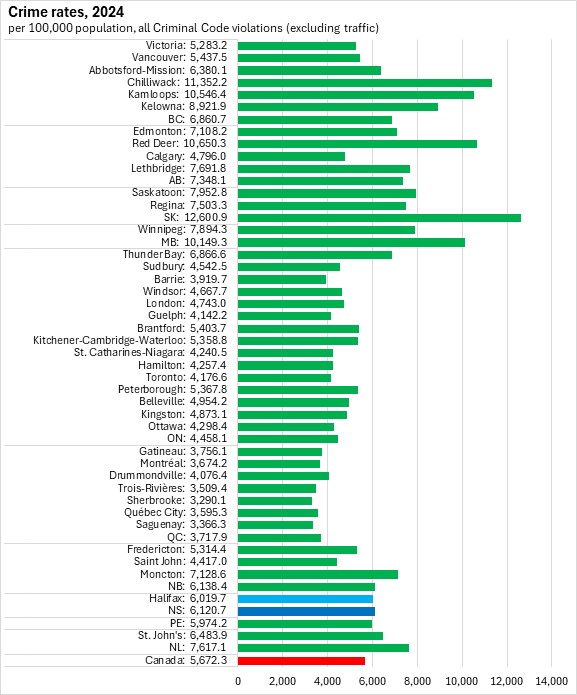
Across Census Metropolitan Areas, crime rates were notably higher in Western Canada with the highest rates in Chilliwack, Red Deer, and Kamloops. Although crime rates were higher than the national average in Saskatoon, Regina and Winnipeg, areas outside the cities account more for high crime rates in Manitoba and Saskatchewan.
Crime rates were generally lower across all cities in Ontario and Québec. In Atlantic Canada, Moncton reported a higher crime rate while Saint John's crime rate was lower than in other cities.
Compared to 2023, crime rates among major urban centres increased the most in Peterborough and Thunder Bay. There were notable decreases in crime rates in Fredericton, Kamloops, Lethbridge, and Red Deer.
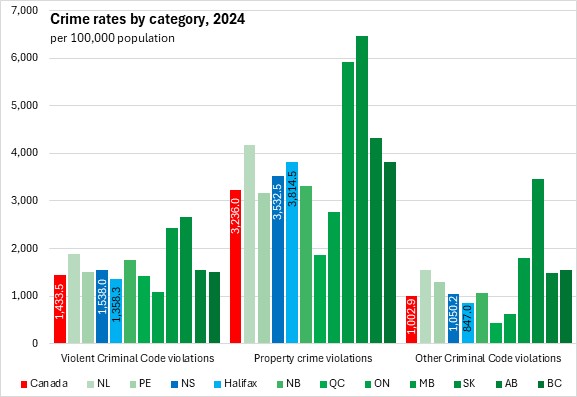
There were 1,538 police reported violent incidents per 100,000 residents in Nova Scotia during 2024. The national violent crime rate was 1,433.5 violations per 100,000 residents. Halifax reported a violent crime rate of 1,358.3 incidents per 100,000 residents.
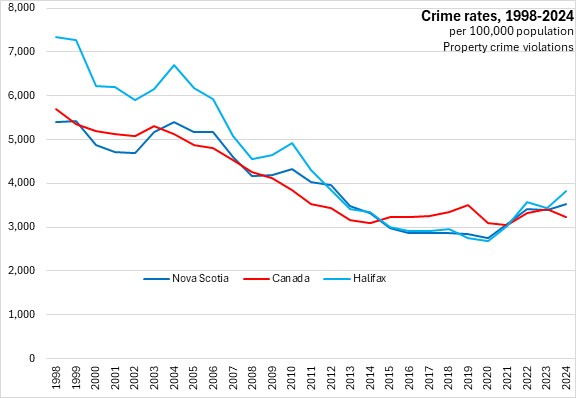
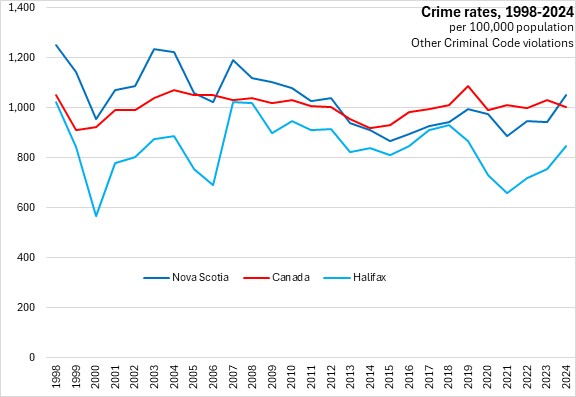
Per 100,000 residents, there were 3,532.5 property incidents in Nova Scotia and 1,050.2 other Criminal Code violations in 2024. Halifax reported 3,814.5 property crimes and 847.0 other Criminal Code violations per 100,000 residents in 2024. Nationally, there were 3,236.0 property violations and 1,002.9 other Criminal Code violations per 100,000 residents.
Manitoba and Saskatchewan reported the highest violent, property, and other crime rates in 2024. Ontario reported the lowest rates of violent crime while Québec reported the lowest rates of property and other Criminal Code violations in 2024.
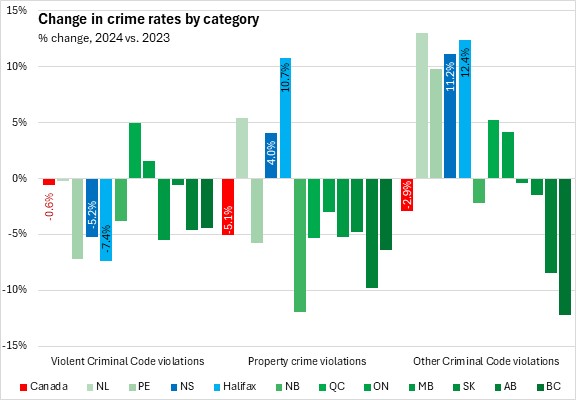
The rate of violent crimes was down 5.2% in Nova Scotia from 2023 to 2024 and down 7.4% in Halifax. Violent crime was down 0.6% nationally with declines in all provinces except Québec and Ontario. Prince Edward Island reported the fastest decline in violent crime.
Property crime rates were up 4.0% in Nova Scotia from 2023 to 2024 with a 10.7% increase in Halifax. Nationally, property crime rates were down 5.1% with the fastest decline in New Brunswick. Newfoundland and Labrador and Nova Scotia reported increases in property crime violations in 2024.
Other Criminal Code violations were up 11.2% in Nova Scotia from 2023 to 2024 with a 12.4% increase in Halifax. Nationally, other Criminal Code violations fell 2.9% with declines in five provinces. British Columbia had the fastest decline in other Criminal Code violations while Newfoundland and Labrador had the largest increase.
Despite declines in 2024, violent crime rates have trended up for several years.
Property crime rates have trended up in recent years.
Rates of other criminal code violations increased prior to the pandemic. There were notable declines in other Criminal Code violations in Nova Scotia (particularly Halifax) in 2021. Although the rate of other Criminal Code violations has risen in the past three years in Halifax, it remains below 2019 levels.
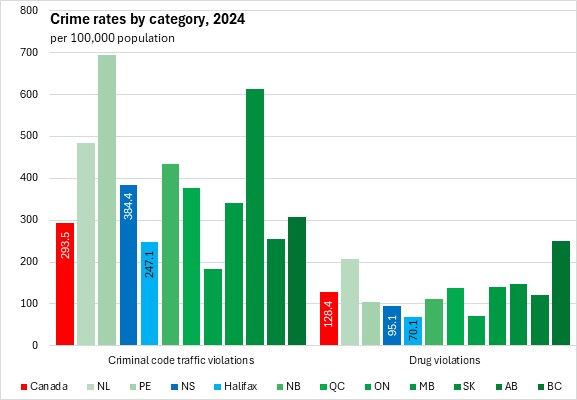
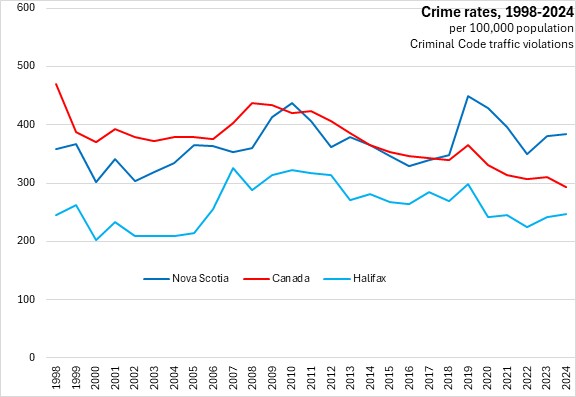
Nova Scotia reported 384.4 Criminal Code traffic violations per 100,000 residents in 2024, which was above the national average of 293.5. There were 247.1 Criminal Code traffic violations per 100,000 residents in Halifax. Criminal Code traffic violations were highest in Prince Edward Island and Saskatchewan (lowest in Ontario).
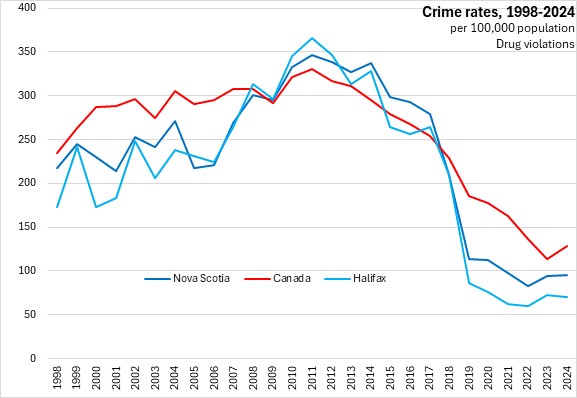
Nova Scotia's rate of drug-related offences was 95.1 per 100,000 residents while Halifax's was 70.1 per 100,000 residents. The national drug violation rate was 128.4 per 100,000 residents with the highest rates in Newfoundland and Labrador and British Columbia. The lowest drug violation rate was in Ontario.
In the last year, the rate of Nova Scotia's Criminal Code traffic violations increased by 1.0% (+2.0% in Halifax). Nationally, Criminal Code traffic violations were down 5.7% with the fastest decline in British Columbia (followed by Saskatchewan and Alberta). Criminal Code traffic violations were up in Newfoundland and Labrador and Nova Scotia in 2024.
Drug violations per 100,000 residents increased by 0.7% in Nova Scotia and dropped by 3.6% in Halifax in 2024. Nationally, drug violations were up by 13.5% on a particularly steep rise in British Columbia. Alberta reported the fastest decline in drug violations among the provinces.
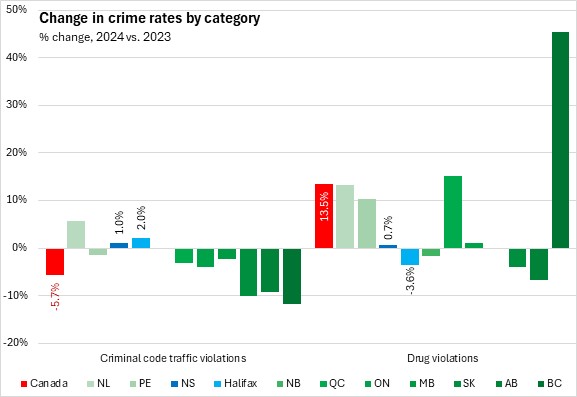
Criminal code traffic violations continued to rise in 2024 in Nova Scotia and Halifax.
Although there was a slight increase in 2024, Nova Scotia's drug crime rates remain substantially lower than they were prior to 2018.
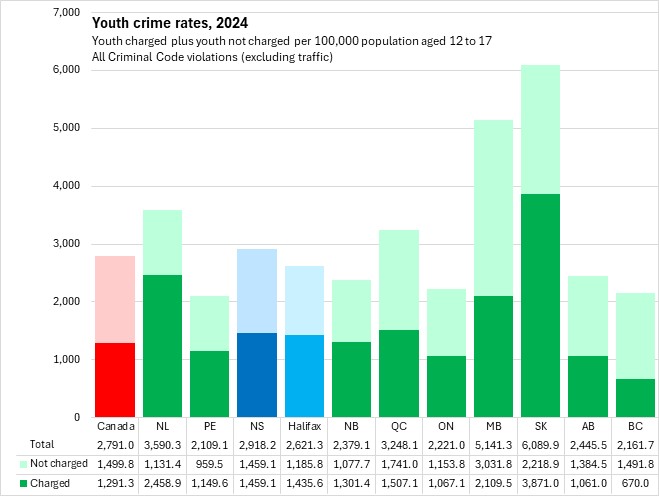
Nova Scotia's youth crime rate in 2024 was 2,918.2 violations per 100,000 residents aged 12-17, which was higher than the national youth crime rate (2,791.0). The youth crime rate was lower in Halifax (2,621.3). Youth crime rates were higher in Manitoba and Saskatchewan. Note the youth crime rates are divided into youth who are charged for a reported crime as well as youth who are not charged for a reported crime.
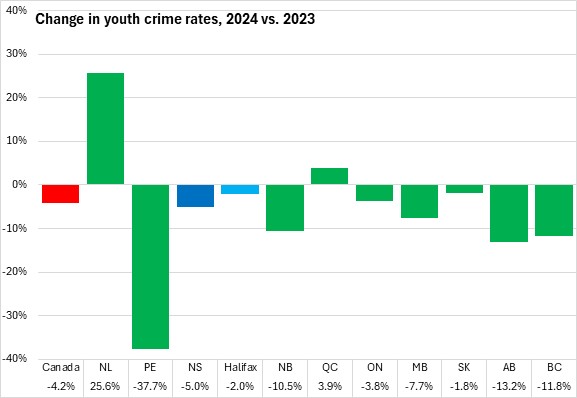
Youth crime in Nova Scotia declined by 5.0% in 2024, including a 2.0% decline in Halifax. Nationally, youth crime was down 4.2%, with declines in eight provinces last year. The fastest decline was reported in Prince Edward Island. Youth crime rose in Newfoundland and Labrador and Québec.
Crime severity
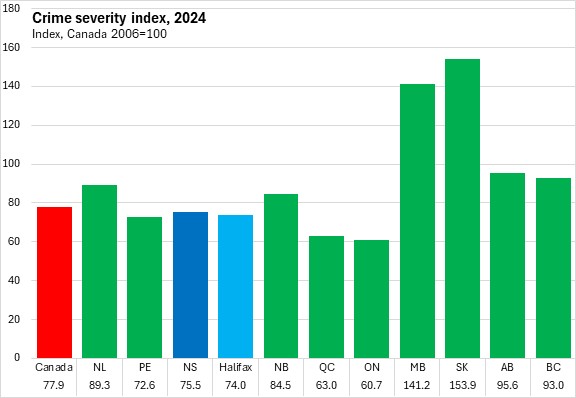
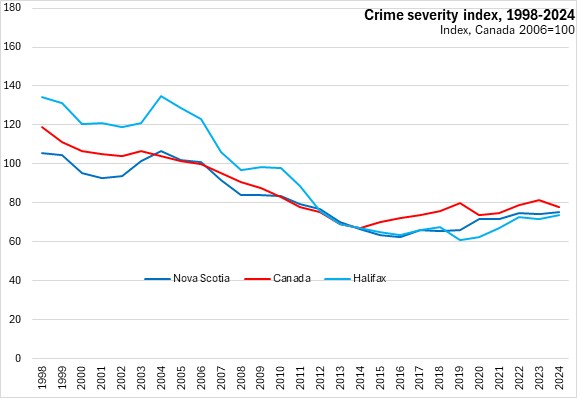
The Crime Severity Index (CSI), which measures both volume and severity of the types of crime, was 75.5 in Nova Scotia and 74.0 in Halifax. The national crime severity index was 77.9 with the highest rates in Manitoba and Saskatchewan and the lowest rates in Ontario and Québec.
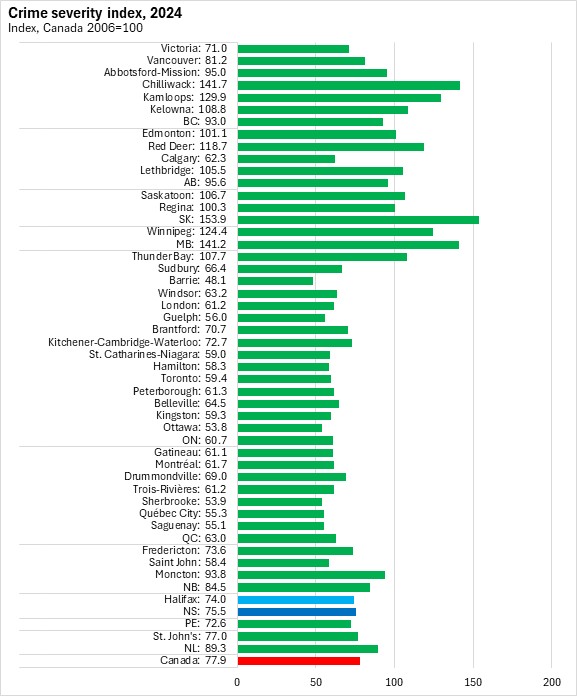
Across municipalities, Chilliwack, Kamloops, and Winnipeg reported the highest crime severity rates while Barrie reported the lowest crime severity rate. Most cities in central and Atlantic Canada reported crime severity below the national average with the exceptions of Thunder Bay and Moncton.
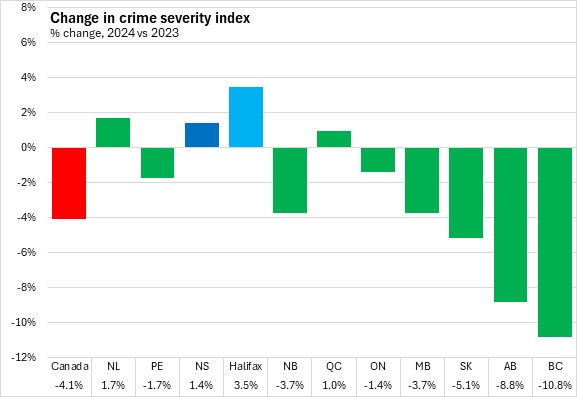
The crime severity index rose 1.4% in Nova Scotia from 2023 to 2024 and increased 3.5% in Halifax. Nationally, crime severity was down 4.1% with declines in seven provinces led by British Columbia. Crime severity rose in Newfoundland and Labrador, Nova Scotia, and Québec.
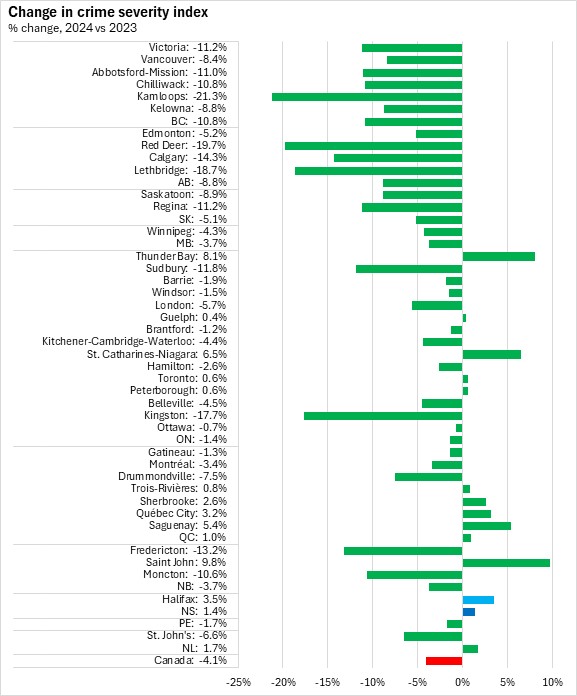
Among cities Saint John reported the fastest rise in crime severity. Kamloops and Red Deer reported the steepest declines.
Like crime rates overall, the crime severity index declined for several years before rising slowly in the most recent decade.
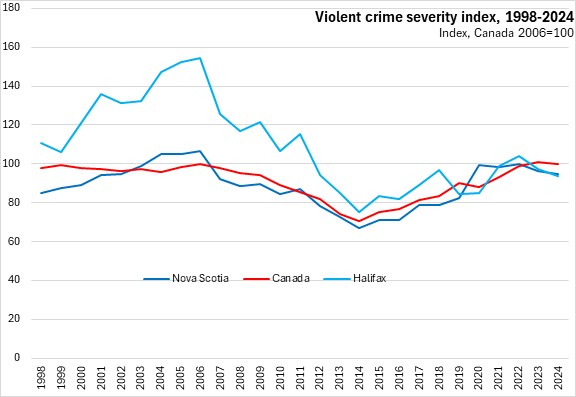
The severity of violent crimes has had a sharper increase in the last decade.
There have been increases in the severity of non-violent crimes in each of the last five years for Nova Scotia and Halifax.
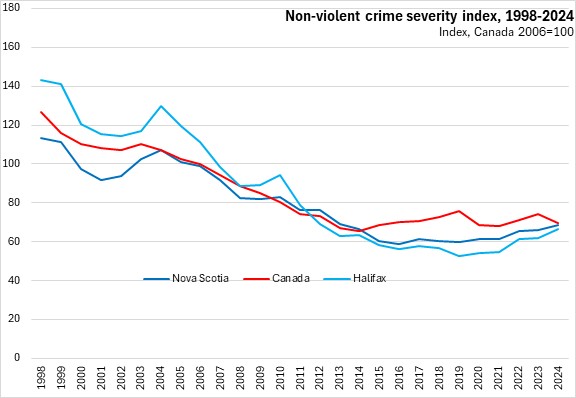
NOTE: on January 1, 2018, Statistics Canada, in collaboration with police, changed the definition of “founded” criminal incidents. With the new definition, there is the potential that police will classify more incidents as founded.
Definitions:
Incident (or Offence): A criminal incident involves one or more related offences that are committed during a single criminal event and have been reported to police. Both the crime rate and the CSI measure crime based on the most serious violation in the criminal incident.
Violent offences: Involve the use or threat of violence against a person, including homicide, attempted murder, assault, sexual assault and robbery.
Non-violent offences: Include property offences and other Criminal Code offences, as well as Criminal Code traffic offences, drug-related offences and violations of other federal statutes.
Sexual assault: Is classified by level in the Criminal Code into three separate categories—depending on the nature and severity of the incident—including level 1, assault of a sexual nature that violates the sexual integrity of the victim; level 2, sexual assault with a weapon or causing bodily harm involves sexual assault with a weapon, threats to use a weapon or causing bodily harm; and level 3, aggravated sexual assault involves sexual assault that wounds, maims, disfigures or endangers the life of the victim.
“Other” Criminal Code offences: Include crimes such as disturbing the peace and offences against the administration of justice (e.g., failure to comply with an order, failure to appear and breach of probation).
Source: Statistics Canada. Table 35-10-0026-01 Crime severity index and weighted clearance rates, Canada, provinces, territories and Census Metropolitan Areas, Table 35-10-0177-01 Incident-based crime statistics, by detailed violations, Canada, provinces, territories and Census Metropolitan Areas
<--- Return to Archive


