The Economics and Statistics Division maintains archives of previous publications for accountability purposes, but makes no updates to keep these documents current with the latest data revisions from Statistics Canada. As a result, information in older documents may not be accurate. Please exercise caution when referring to older documents. For the latest information and historical data, please contact the individual listed to the right.
<--- Return to Archive
For additional information relating to this article, please contact:
July 24, 2025BUILDING CONSTRUCTION PRICE INDEX, Q2 2025 Halifax's residential building construction prices increased by 3.2% from Q2 2024 to Q2 2025. Across Canada, residential building construction costs were up by 3.7%. Among the 15 major urban centres reported, Regina, London, and Québec City reported the fastest rise in building construction prices. Moncton and Toronto reported the slowest increases in residential building construction costs.
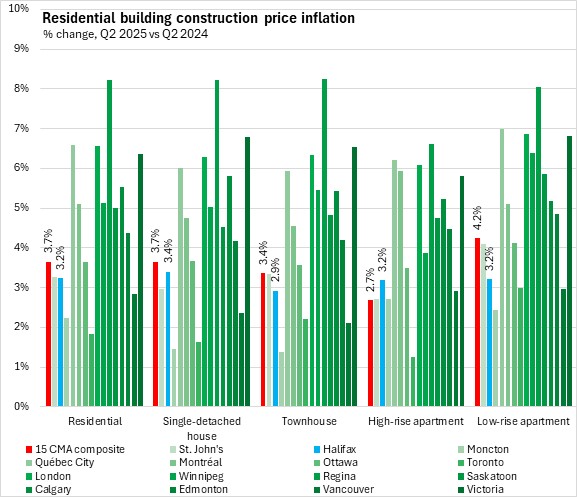
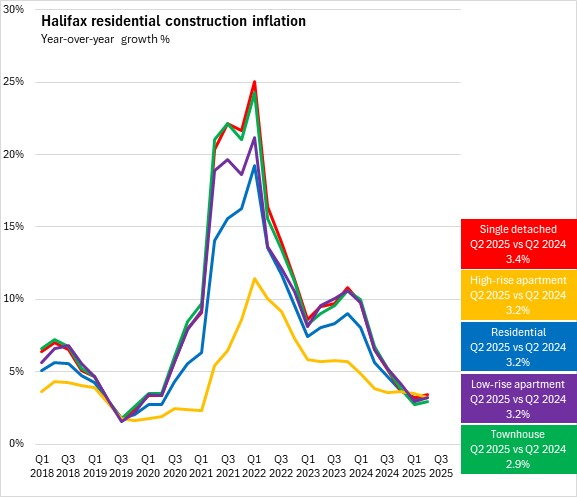
In the last quarter of data, Halifax's year-over-year construction costs growth accelerated for most categories of residential structure (exception: high-rise apartments). Building construction costs growth was similar for all categories: single-detached dwellings (+3.4%), high-rise apartment buildings (+3.2%), low-rise apartment buildings (+3.2%) and townhouses (+2.9%).
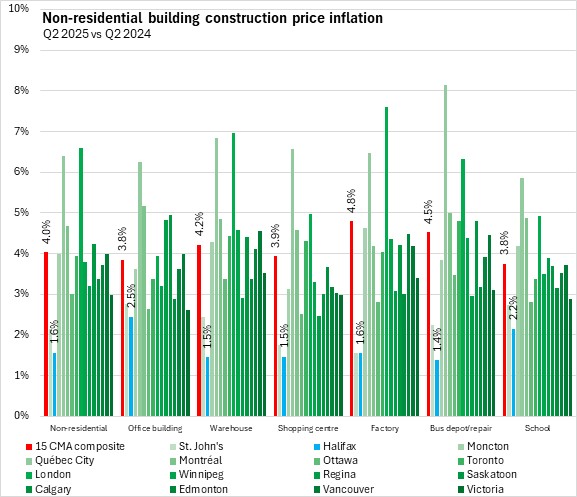
Overall non-residential building costs were up 1.6% in Halifax from Q2 2024 to Q2 2025, the slowest growth among major urban centres. Across the 15 major Census Metropolitan Areas, overall non-residential building construction costs grew 4.0%. Québec City and London reported the fastest year-over-year growth in non-residential building construction costs.
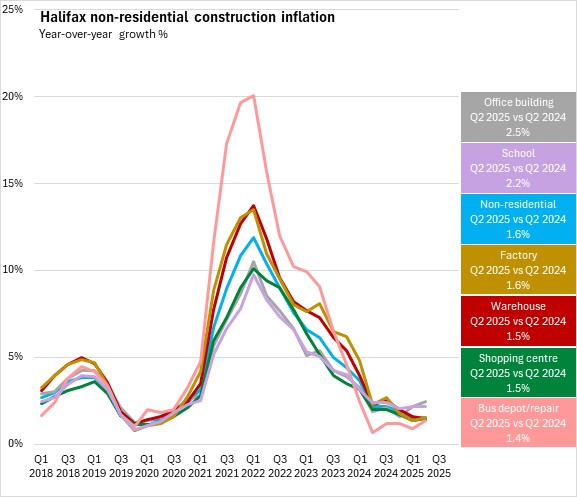
In Halifax, the pace of building cost inflation edged up for all categories of non-residential structure except schools and warehouses: office buildings (+2.5%), schools (+2.2%), factories (+1.6%), warehouses (+1.5%), shopping centres (+1.5%) and bus depot/repair buildings (+1.4%).
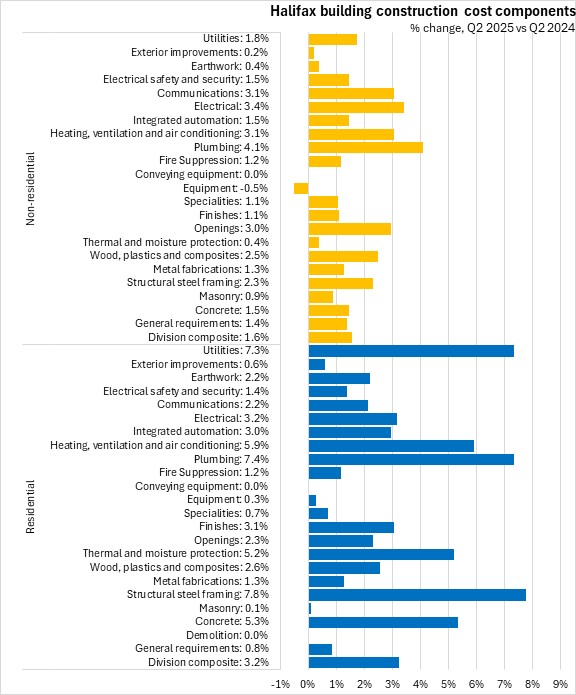
Among components of building costs, residential construction inflation is up most for: structural steel framing, plumbing, and utilities.
Non-residential building construction costs grew most rapidly for plumbing and electrical.
There were no cost components in residential building construction that reported price declines over the last year. Equipment cost declined in non-residential building construction.
Statistics Canada Notes on the Building Construction Price Index: The building construction price indexes are quarterly series that measure the change over time in the prices that contractors charge to construct a range of commercial, institutional, industrial and residential buildings in 15 census metropolitan areas: St. John's, Halifax, Moncton, Québec City, Montréal, Ottawa–Gatineau (Ontario part), Toronto, London, Winnipeg, Regina, Saskatoon, Calgary, Edmonton, Vancouver and Victoria.
These buildings include six non-residential structures: an office building, a warehouse, a shopping centre, a factory, a school, and a bus depot with maintenance and repair facilities. In addition, indexes are produced for five residential structures: a bungalow, a two-storey house, a townhouse, a high-rise apartment building (five storeys or more) and a low-rise apartment building (fewer than five storeys).
The contractor's price reflects the value of all materials, labour, equipment, overhead and profit to construct a new building. It excludes value-added taxes and any costs for land, land assembly, building design, land development and real estate fees.
With each release, data for the previous quarter may have been revised. The index is not seasonally adjusted.
Source: Statistics Canada. Table 18-10-0289-01 Building construction price indexes, by type of building and division
<--- Return to Archive


