The Economics and Statistics Division maintains archives of previous publications for accountability purposes, but makes no updates to keep these documents current with the latest data revisions from Statistics Canada. As a result, information in older documents may not be accurate. Please exercise caution when referring to older documents. For the latest information and historical data, please contact the individual listed to the right.
<--- Return to Archive
For additional information relating to this article, please contact:
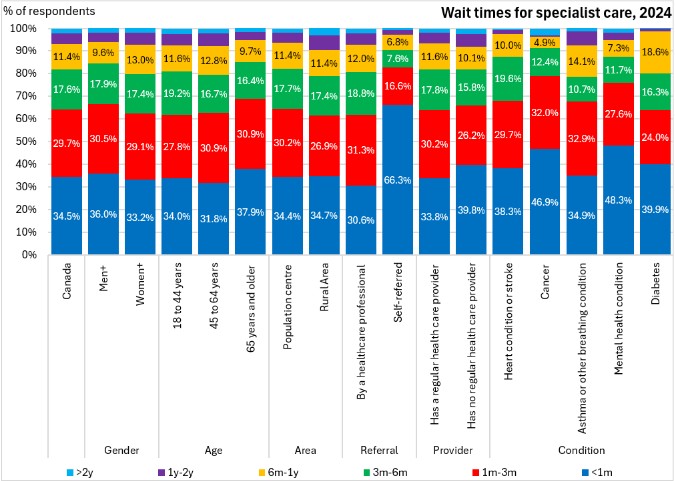
August 13, 2025SURVEY ON HEALTH CARE ACCESS AND EXPERIENCES - PRIMARY AND SPECIALIST CARE, 2024 Statistics Canada carried out a new Survey on Health Care Access and Experiences in 2024. Recently released results show the wait time for an initial consultation with a medical specialist after patient/physician decisions to seek specialist care. Respondents were also asked about their satisfaction with medical specialist wait time and whether the wait time affected their lives through conditions such as deteriorating health, new symptoms, difficulties with daily living, pain or stress/anxiety.
Across Canada, 81.8% of respondents waited 6 months or less for access to specialist care in 2024 (34.5% in less than a month, 29.7% in 1-3 months, 17.6% in 3-6 months). A further 11.4% of respondents accessed care between 6 months and 1 year after the decision to seek specialist care. Wait times between 1 and 2 years were reported by 4.7% of respondents while 2.1% reported a wait in excess of 2 years.
Men reported somewhat faster access to specialist care than women while older Canadians had shorter waits for specialist care than younger respondents. Although similar portions of respondents in urban centres and rural areas reported access to specialist care in under 1 month, wait times of greater than 1 year were more common in rural areas.
Some patients can self-refer to certain specialists in certain circumstances (e.g., when seeking a cosmetic procedure from a dermatologist) or when private clinics offer fee-based direct access to specialists under a health insurance plan. In cases of self-referral, wait times for specialist care were substantially shorter than for those referred by another healthcare professional. Wait times for specialist care were also somewhat shorter for those without a regular healthcare provider (though wait times of longer than 1 year were also more prevalent for this population).
By specific health condition, wait times were shorter for those seeking treatment for cancer and mental health conditions, compared against those seeking care for heart conditions/stroke, asthma/breathing conditions or diabetes.
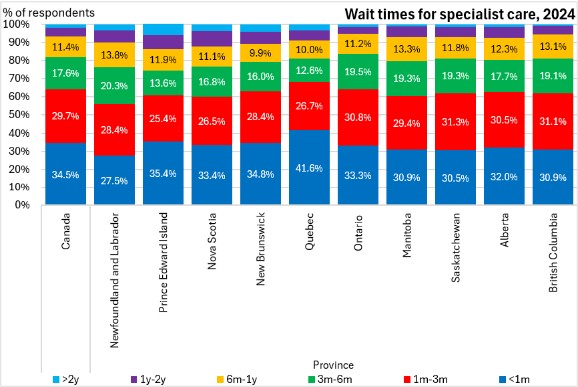
In Nova Scotia, 76.7% of those seeking specialist care had their initial consultation within 6 months (33.4% in less than a month, 26.5% in 1-3 months, 16.8% in 3-6 months). A further 11.1% saw a specialist between 6 months and 1 year while 8.5% waited between 1 and 2 years and 3.7% waited over 2 years.
Across Canada, wait times were longer (>1 year) in Atlantic Canada. Québec reported a substantially higher share of respondents that had specialist consultations in less than 1 month.
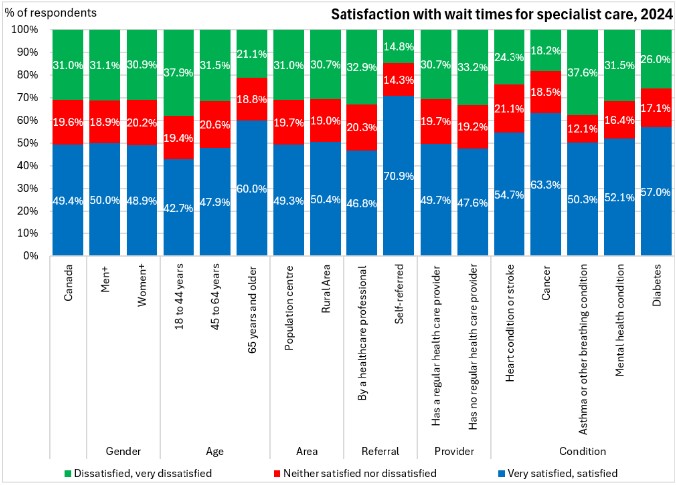
Respondents were asked about their satisfaction with their wait times to see specialist care. Across Canada, just under half (49.4%) reported being satisfied or very satisfied with their wait time while 31.0% reported being dissatisfied or very dissatisfied. Satisfaction was little different between men and women, but older Canadians (ages 65+) reported greater satisfaction than those aged 18-44. Satisfaction was similar between urban centres and rural areas.
Those who made self-referrals had substantially higher satisfaction with wait times while those with a regular healthcare provider had slightly higher satisfaction with wait times than those without a regular healthcare provider. Persons seeking specialist cancer care had higher satisfaction levels with wait times than those seeking care for other conditions.
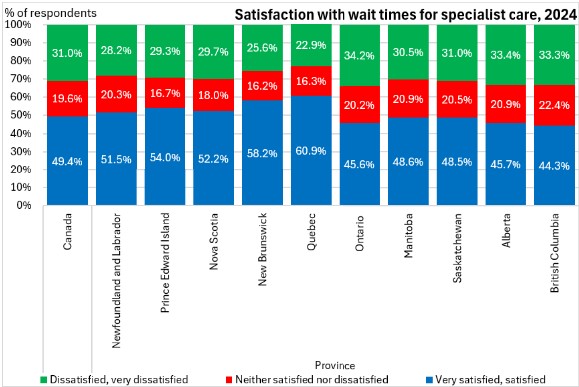
Nova Scotians' satisfaction levels with wait times were higher than the national averages. Satisfaction levels with wait times were highest in Québec and Atlantic Canada and lower for Ontario and the western provinces.
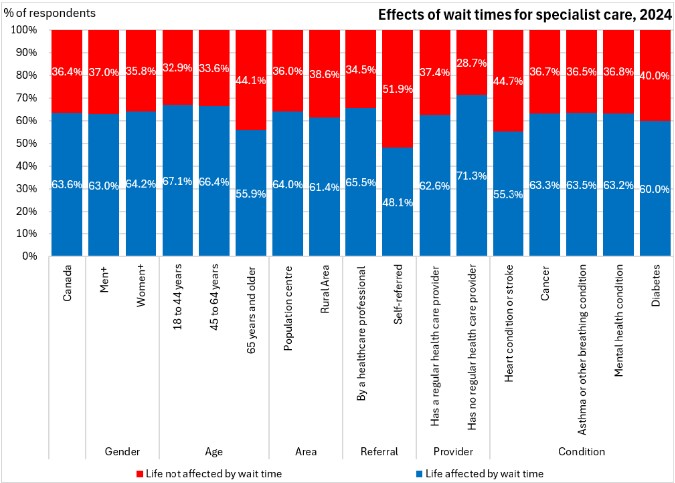
Waiting for specialist care may have effects such as stress/anxiety, pain, worsening health, additional symptoms and difficulties in daily living. Across Canada, 63.6% of respondents reported such effects from their wait time to see specialist care. These effects were not substantially different between men and women, but were notably more moderate for older Canadians (65+) as well as for those that made a self-referral. Those who were without a regular healthcare provider were notably more likely to report effects from their wait time for specialist care.
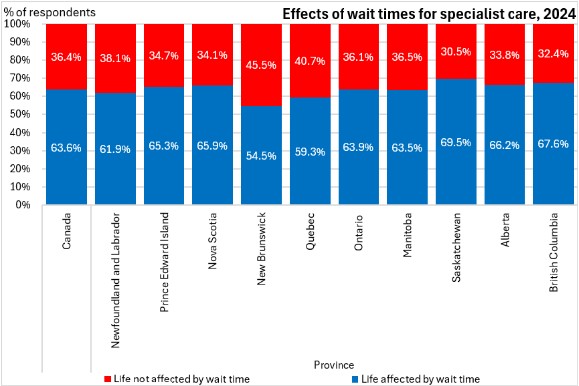
In Nova Scotia 65.9% of respondents reported effects from their wait time for specialist care. This was above the national average, but lower than in the three westernmost provinces. Those in New Brunswick reported the lowest prevalence of effects from their wait time for specialist care.
Note: Survey responses were collected from January 3-November 3, 2024 from Canadians aged 18 and older. Medical specialists are defined as: "...a medical doctor certified to practice in a specified field...", providing: "...expert care for complex conditions that require in-depth knowledge and advanced treatments."
Source: Statistics Canada. Survey on Health Care Access and Experiences - Primary and Specialist Care, 2024.
<--- Return to Archive


