The Economics and Statistics Division maintains archives of previous publications for accountability purposes, but makes no updates to keep these documents current with the latest data revisions from Statistics Canada. As a result, information in older documents may not be accurate. Please exercise caution when referring to older documents. For the latest information and historical data, please contact the individual listed to the right.
<--- Return to Archive
For additional information relating to this article, please contact:
August 15, 2025NEW MOTOR VEHICLE SALES, JUNE 2025 Year-to-date (January-June 2025 vs January-June 2024, unadjusted)
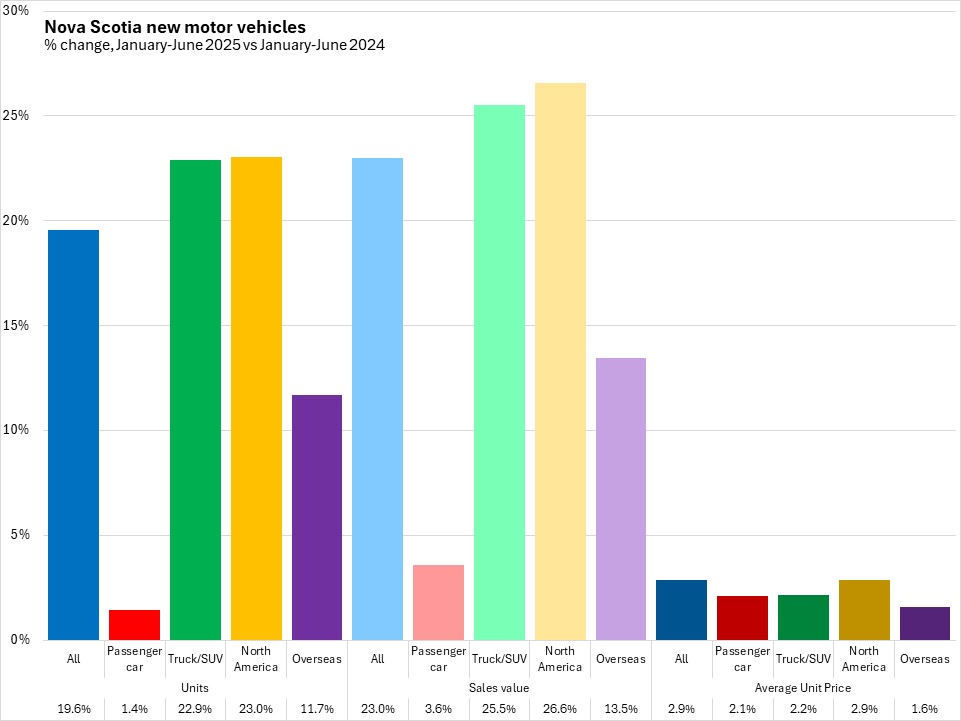
Compared with January-June 2024, Nova Scotia unit sales of new vehicles (+19.6%) reported a faster gain than the national average, with national unit sales up 4.9%. Sales were up in all provinces except Québec. Newfoundland and Labrador had the strongest gain in year-to-date unit sales, followed closely by Nova Scotia.

The sales values of new vehicles increased 23.0% in Nova Scotia from January-June 2024 to January-June 2025, the fastest gain among provinces. National sales values were up 5.3% with gains in all provinces except Québec.
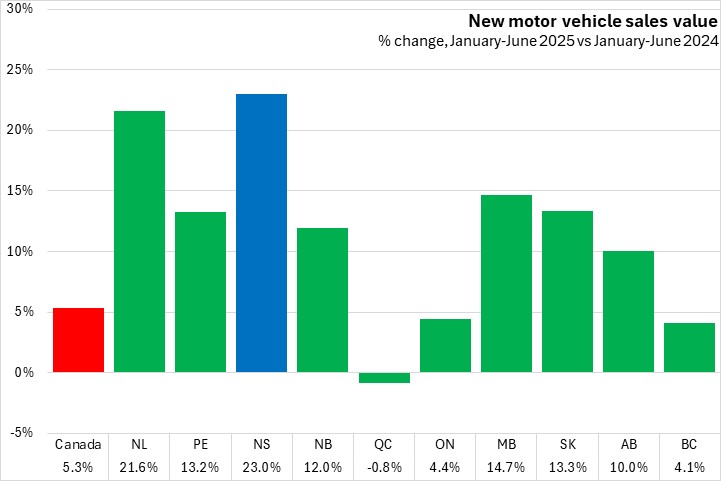
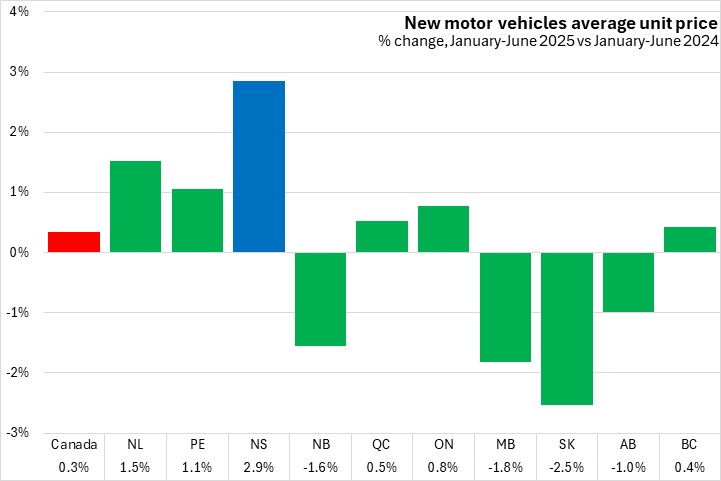
Compared to January-June 2024, average unit prices were up 2.9% in Nova Scotia in January-June 2025, the fastest gain among provinces. Average unit prices were up 0.3% nationally with increases in six provinces. Saskatchewan had the largest decline in average unit prices.
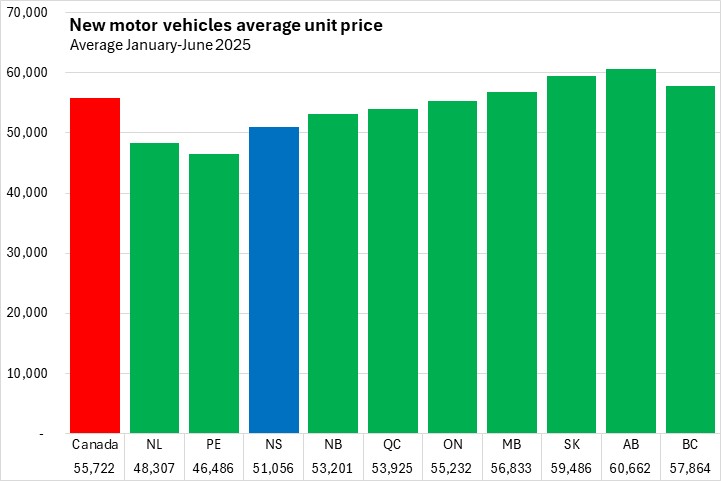
The average price of a new vehicle over January-June 2025 was $51,056 in Nova Scotia - third lowest among provinces ahead of Prince Edward Island and Newfoundland and Labrador. Nationally, the average price of a new vehicle was $55,722 in January-June with the highest value in Alberta.
Compared with January-June 2024, unit sales and sales values were up faster for Trucks/SUVs than passenger cars. North American manufacturers saw faster increases in unit sales and sales values compared to overseas manufactures. Average sales prices were up for all vehicle types and country of manufacture.
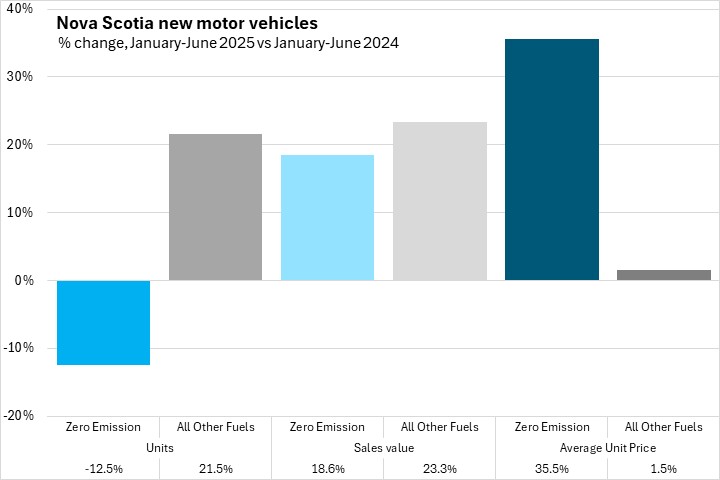
Starting with the January 2024 reference month, new data has been released on vehicle sales by fuel type. Zero emission vehicle unit sales were down 12.5% in January-June 2025 compared with January-June 2024, while sales values increased 18.6% owing to a 35.5% rise in average unit prices. Other fuel type vehicles, which account for the majority of vehicles sold, saw unit sales increase 21.5% while sales values increased 23.3%, with average unit price for other fuel type vehicles up 1.5%.

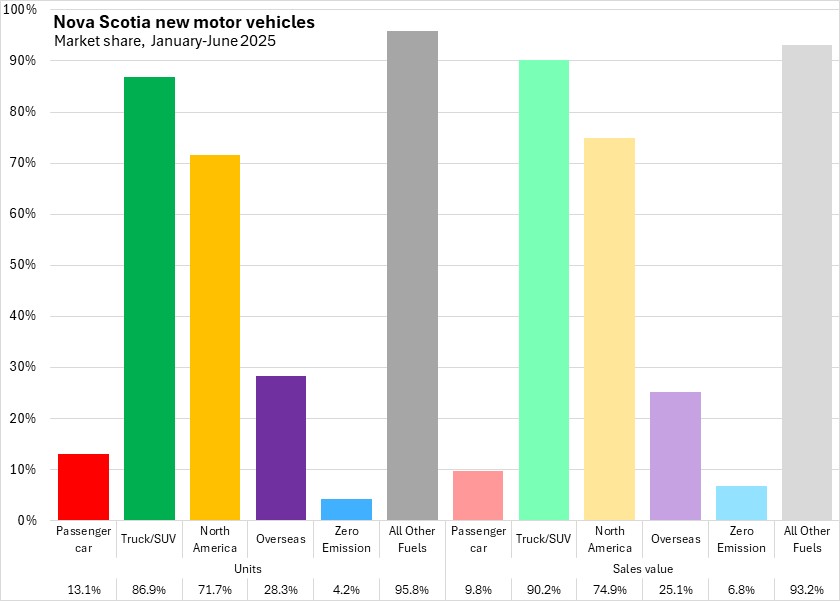
In January-June 2025, trucks/SUVs accounted for 86.9% of unit sales and 90.2% of sales values. North American manufacturers accounted for 71.7% of Nova Scotia's unit sales and 74.9% of sales values in January-June 2025. Zero emission vehicles made up 4.2% of unit sales, and 6.8% of sales values, while all other fuel types accounted for 95.8% of unit sales and 93.2% of sales values.

Year-over-year (June 2025 vs June 2024, unadjusted)
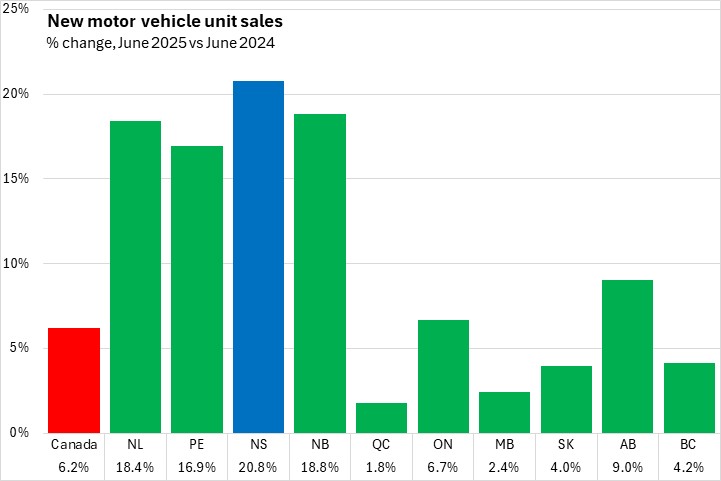
Compared with June 2024, Nova Scotia unit sales of new vehicles (+20.8%) reported a faster gain than any other province. National unit sales were up 6.2% year-over-year with gains in all provinces, with higher unit sales growth in the Atlantic region. Québec had the slowest growth compared to June 2024.
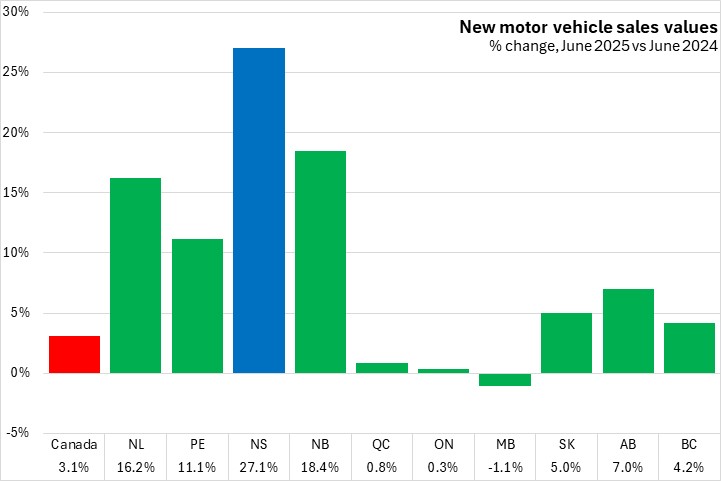
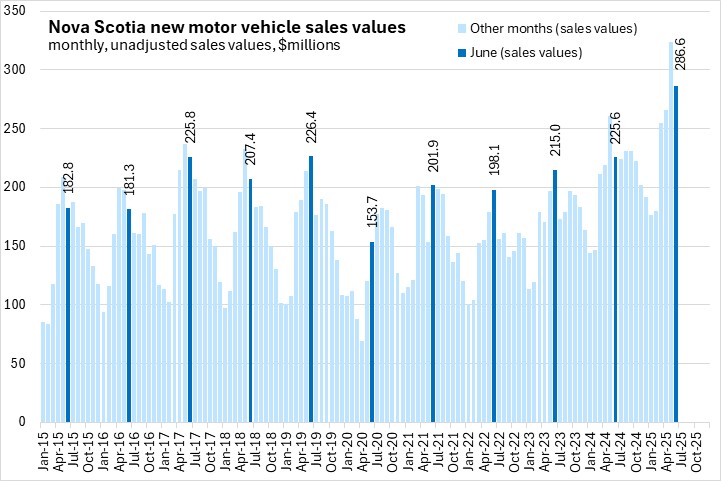
The sales values of new vehicles increased 27.1% in Nova Scotia from June 2024 to June 2025, the largest gain among provinces. National sales values were up 3.1% with gains in all provinces (and higher in the Atlantic region) except Manitoba.
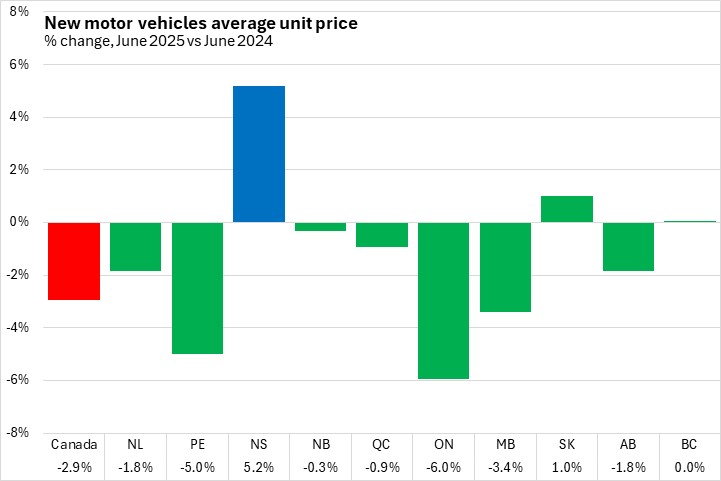
Compared to June 2024, average unit prices were up 5.2% in Nova Scotia in June 2025, the largest increase among provinces. Average unit prices were down 2.9% nationally with declines in eight provinces. Nova Scotia and Saskatchewan reported the only gains. Ontario had the steepest year-over-year decline in average motor vehicle prices.
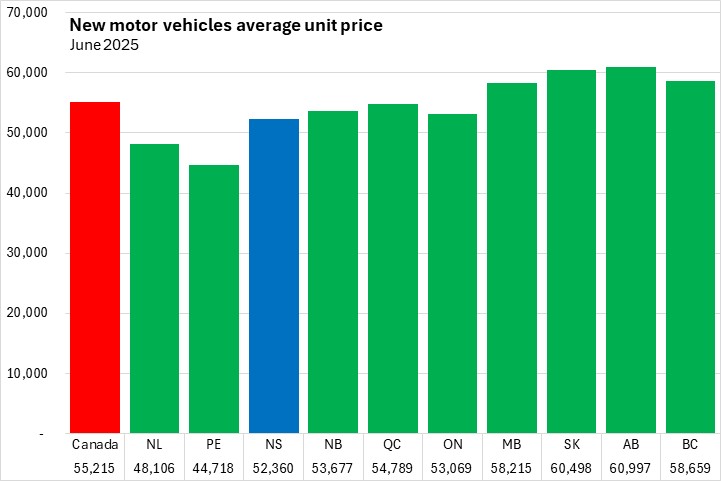
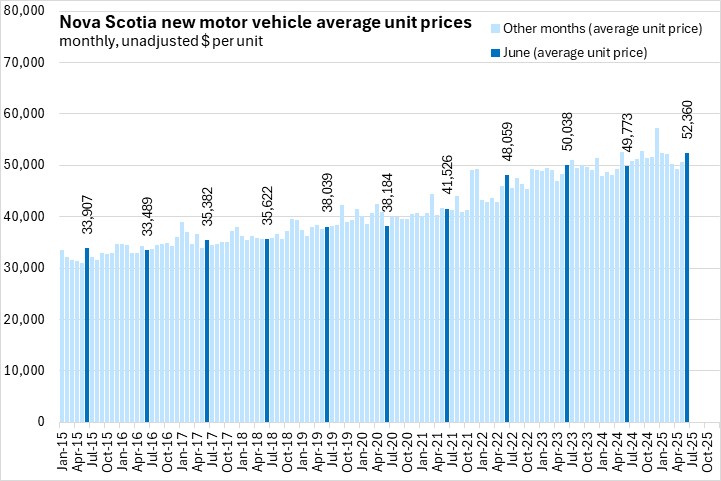
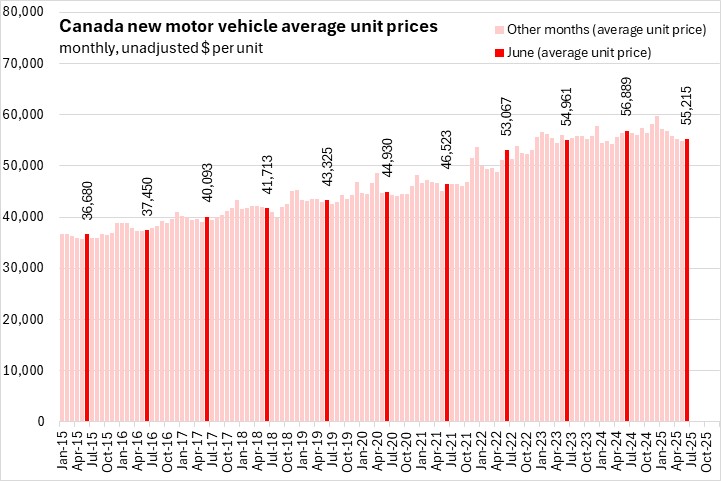
The average price of a new vehicle in June 2025 was $52,360 in Nova Scotia - third lowest among provinces ahead of Prince Edward Island and Newfoundland and Labrador. Nationally, the average price of a new vehicle was $55,215 in June with the highest value in Alberta.
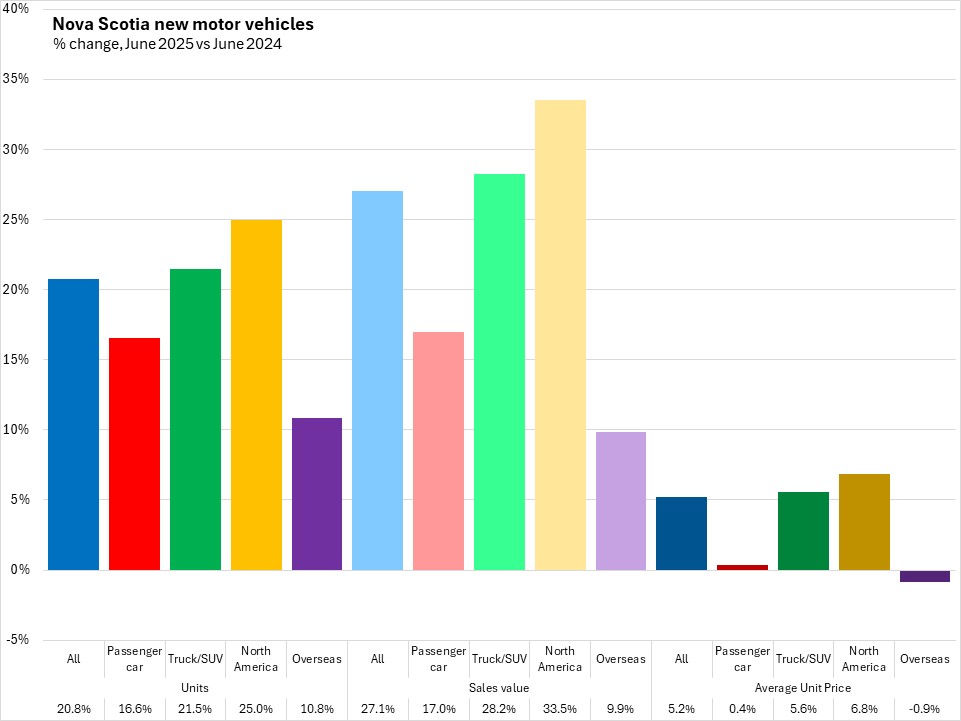
Compared with June 2024, unit sales and sales values were up for all vehicle categories, led by trucks/SUVs and North American-manufactured vehicles. Average unit prices were down for overseas manufactured vehicles, but up for all other categories.
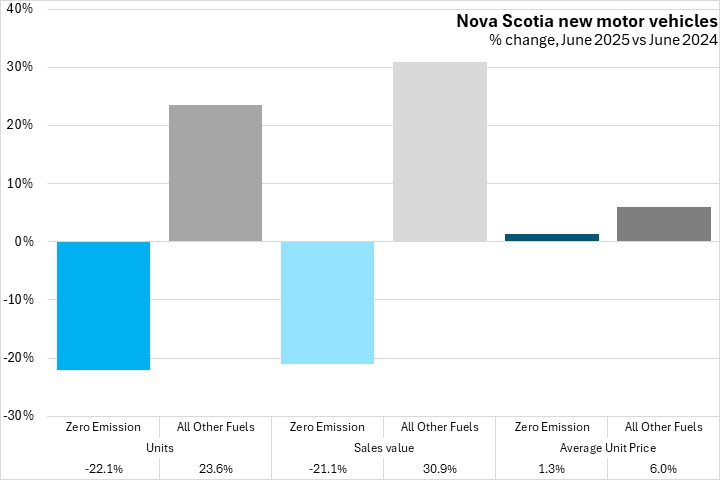
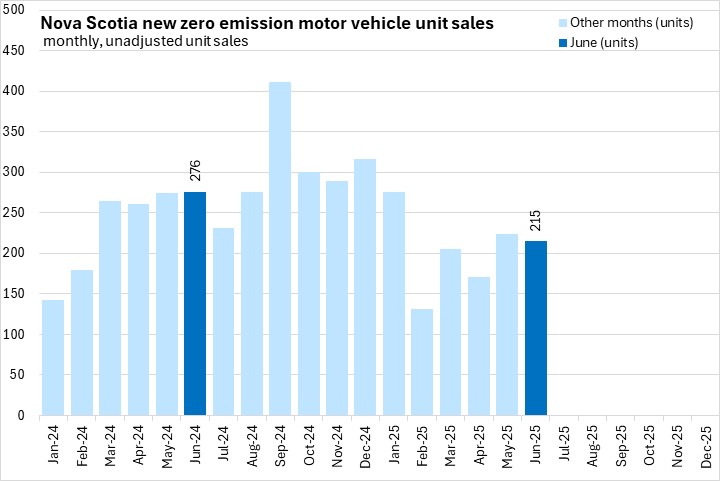
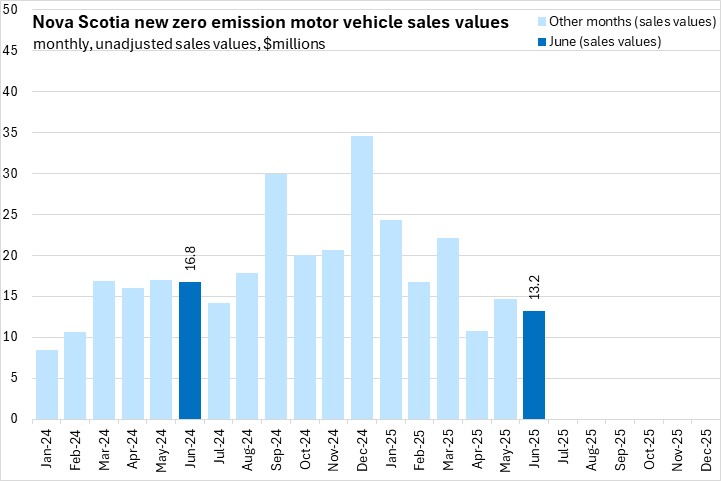
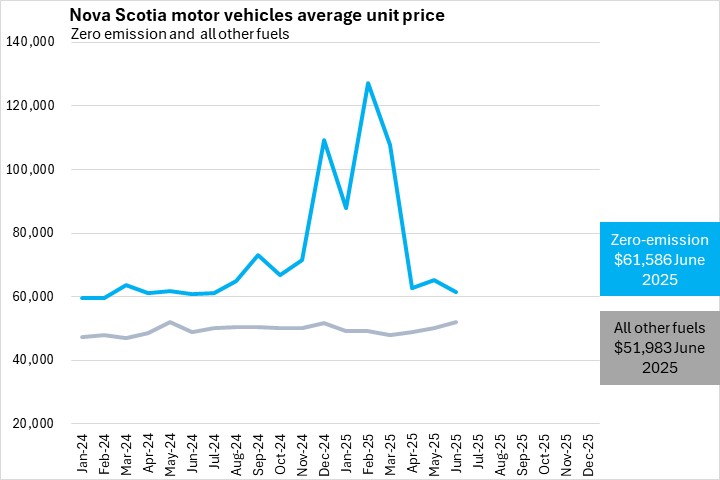
Zero emission vehicle unit sales were down 22.1% in June 2025 compared with June 2024, while sales values declined 21.1% and average unit prices increased 1.3%. The low overall number of zero emission vehicles sold in Nova Scotia (215 in June 2025) can lead to volatility in unit sales, sales values, and prices. Other fuel type vehicles, which account for the majority of vehicles sold, saw unit sales increase 23.6% while sales values increased 30.9%, and the average unit price for other fuel type vehicles increased 6.0%.
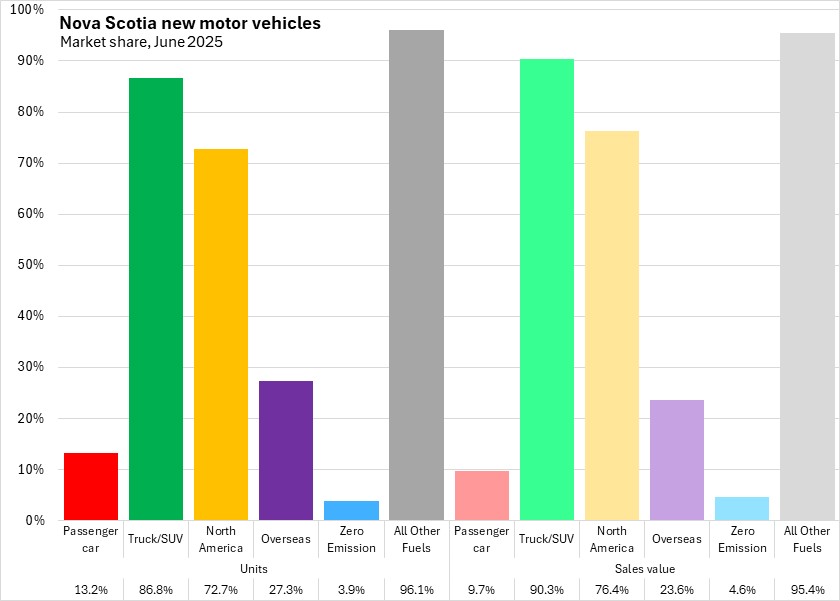
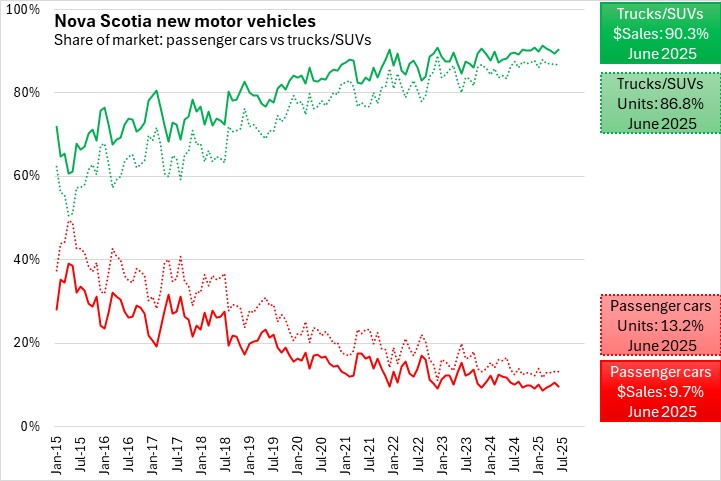
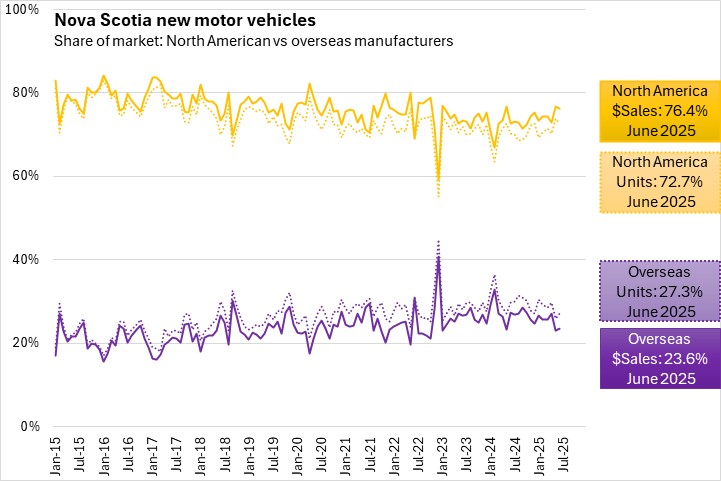
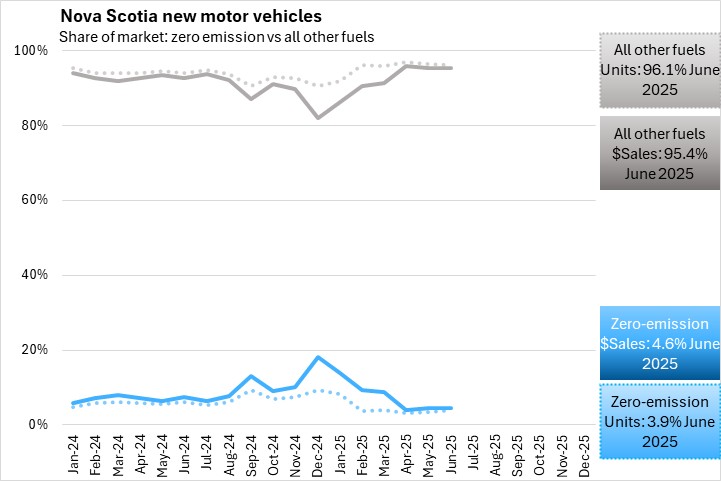
In June 2025, trucks/SUVs accounted for 86.8% of unit sales and 90.3% of sales values. North American manufacturers accounted for 72.7% of Nova Scotia's unit sales and 76.4% of sales values in June 2025. Zero emission vehicles made up 3.9% of unit sales, and 4.6% of sales values, while all other fuel types accounted for 96.1% of unit sales and 95.4% of sales values.
Trends
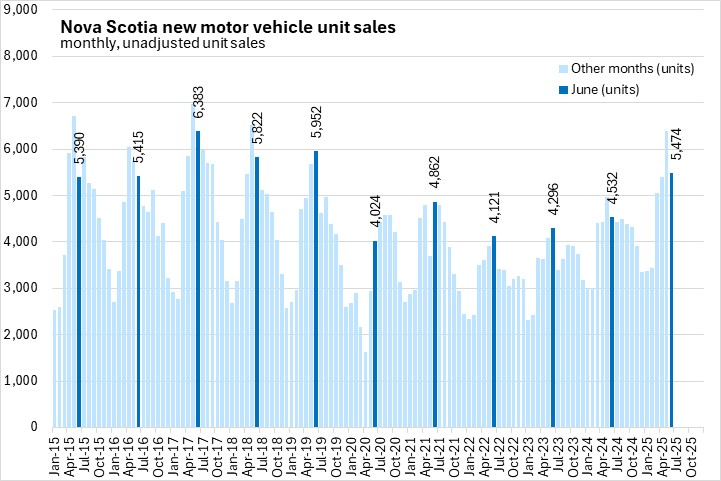
Nova Scotia's unit sales of 5,474 in June 2025 were stronger than those reported in the same month of any year since 2019.
Increased unit sales and higher average prices have resulted in June 2025 motor vehicle sales values well above comparable months in previous years.
Nova Scotia average unit prices have generally increased in the last year, despite periodic declines.
Zero-emission vehicles are currently a small share of the new motor vehicle market in Nova Scotia. Due to the small number of vehicles sold, there can be volatility in the year-over-year or year-to-date comparisons for unit sales, sales value and average prices. Nova Scotia zero-emission vehicle unit sales and sales values were down compared to June 2024.
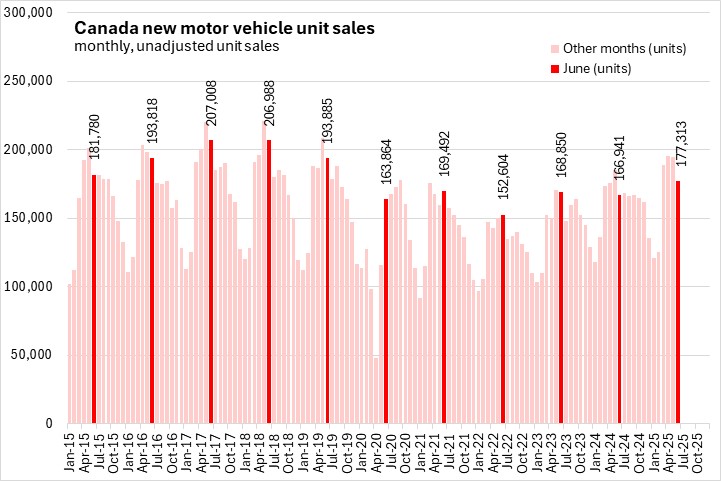
Across Canada, national unit sales are above any comparable month since 2019, but below levels observed from 2015-2019.
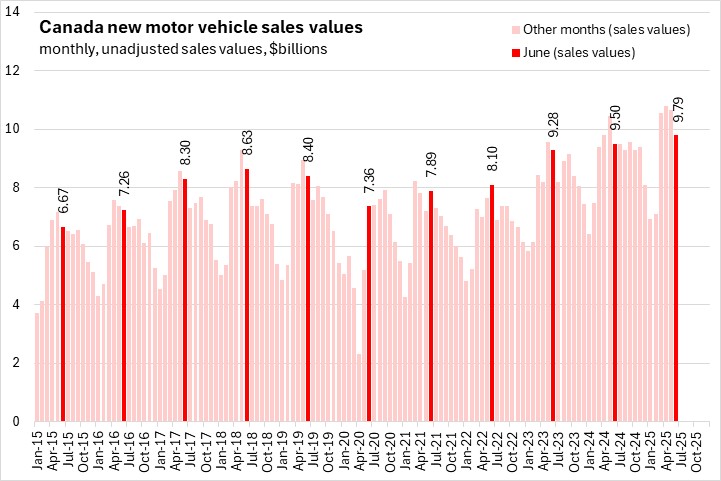
National sales values for June 2025 were above values in comparable months in recent history.
National average unit sales prices have returned to levels seen in early 2024. June 2025 average unit prices were down from June 2024.
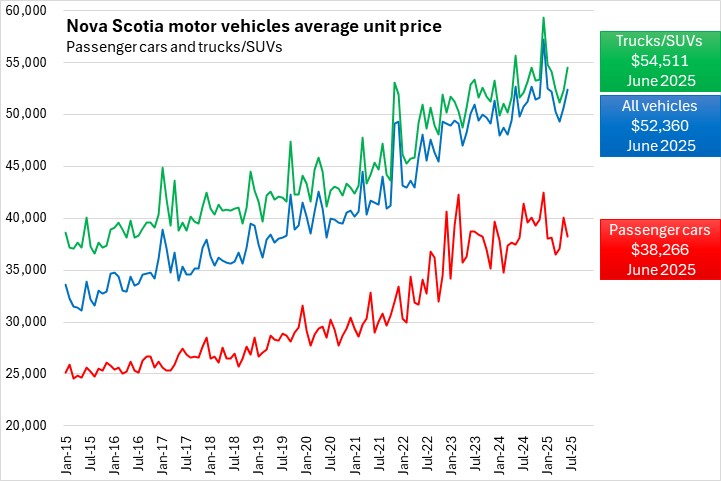
There has been a steady trend of increasing market share for trucks/SUVs while the market share of passenger cars declines. This trend has become less volatile in recent months.
Over the last twenty years, there has been a slow decline in market share for North American manufacturers while overseas manufacturers' market share rises. In recent years, market shares for North American and overseas manufactures have stabilized.
The market share for new zero-emission vehicles has been declining this year since peaking in December of 2024.
Prices for trucks/SUVs (the bulk of the market) as well as passenger cars have fallen from their recent peak at the end of 2024.
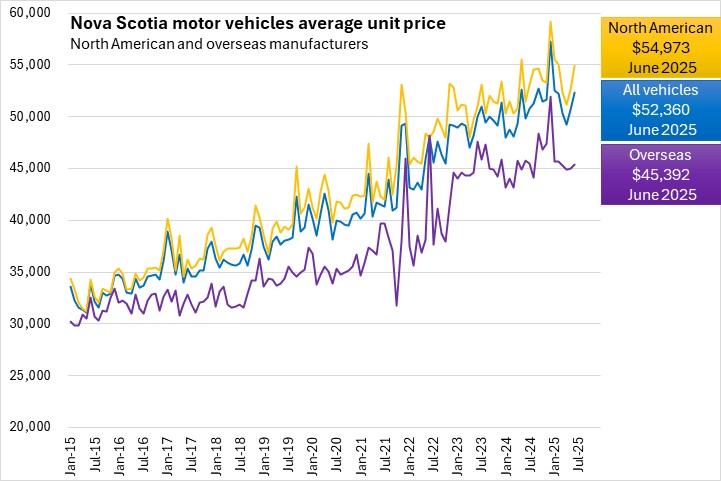
Prices for vehicles from North American manufacturers rebounded from their recent decline in June while prices for vehicles from overseas manufactures have stabilized.
Average prices for zero-emission vehicles rose sharply in late 2024 before returning to previous averages in the spring of 2025. The low overall number of zero emission vehicles sold in Nova Scotia (215 in June 2025) can lead to volatility in prices.
Source: Statistics Canada. Table 20-10-0001-01 New motor vehicle sales
<--- Return to Archive


