The Economics and Statistics Division maintains archives of previous publications for accountability purposes, but makes no updates to keep these documents current with the latest data revisions from Statistics Canada. As a result, information in older documents may not be accurate. Please exercise caution when referring to older documents. For the latest information and historical data, please contact the individual listed to the right.
<--- Return to Archive
For additional information relating to this article, please contact:
August 21, 2025EMPLOYMENT INSURANCE, JUNE 2025 Monthly (June 2025 vs May 2025, seasonally adjusted regular beneficiaries)
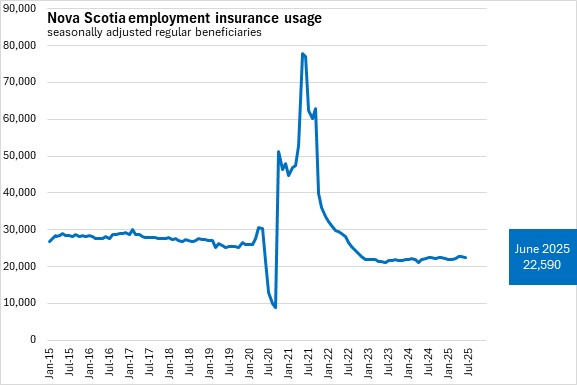
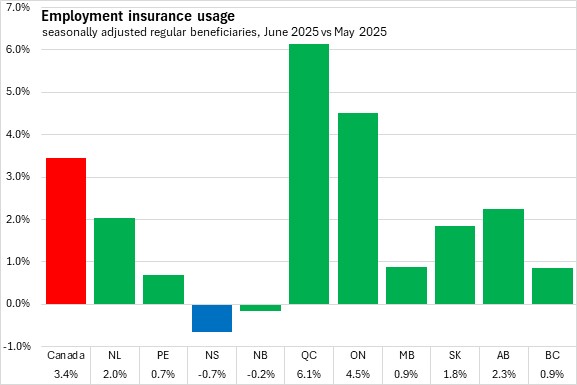
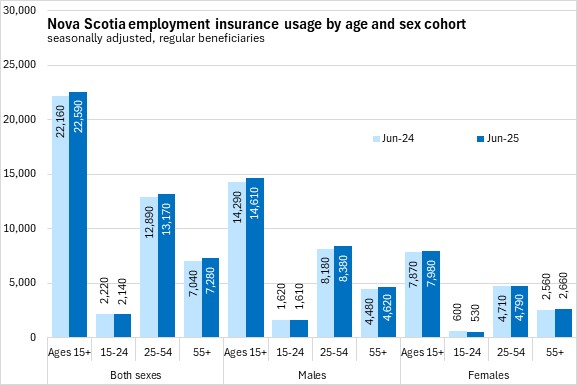
In June 2025, there were 22,590 Nova Scotians in receipt of regular employment insurance benefits (seasonally adjusted). Nova Scotia's seasonally adjusted regular employment insurance usage decreased by 150 (-0.7%) from revised May results to June.
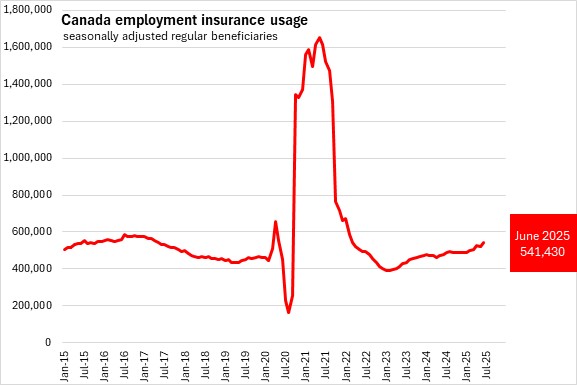
There were 541,430 Canadians that received regular employment insurance benefits in June 2025 (seasonally adjusted), an increase of 18,020 (+3.4%) from the revised May 2025 value.
Two provinces reported lower employment insurance usage in June, led by Nova Scotia. Compared to May 2025, eight provinces reported higher employment insurance usage with the fastest increase in Québec.
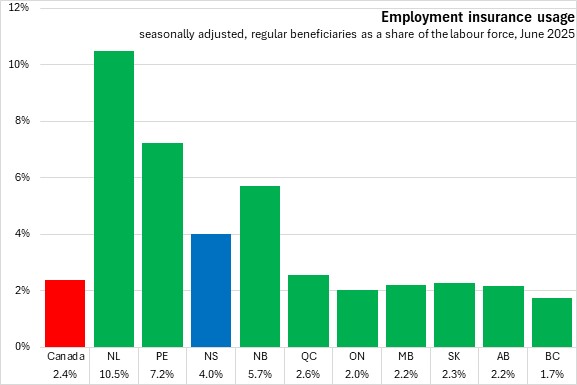
The number of employment insurance beneficiaries amounted to 4.0% of the labour force in Nova Scotia in June 2025. Nationally, the share of beneficiaries was 2.4% of the labour force. Newfoundland and Labrador had the largest share of beneficiaries of the labour force, while British Columbia had the lowest.
Year-over-year (June 2025 vs June 2024)
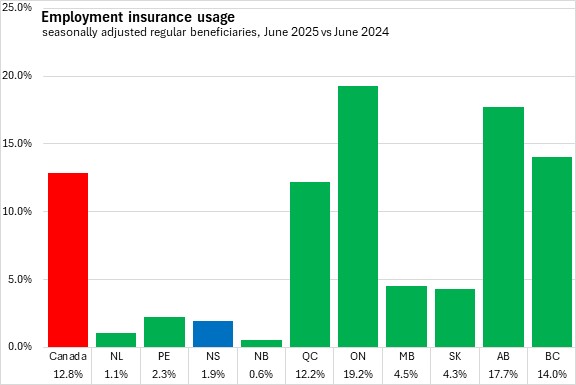
Compared to June 2024, Nova Scotia's employment insurance usage rose 1.9% (+430). National employment insurance usage increased 12.8% (+61,630) compared to June 2024. All provinces reported higher employment insurance compared to one year ago, with the fastest rise in Ontario. New Brunswick and Newfoundland and Labrador had the slowest year-over-year growth in employment insurance.
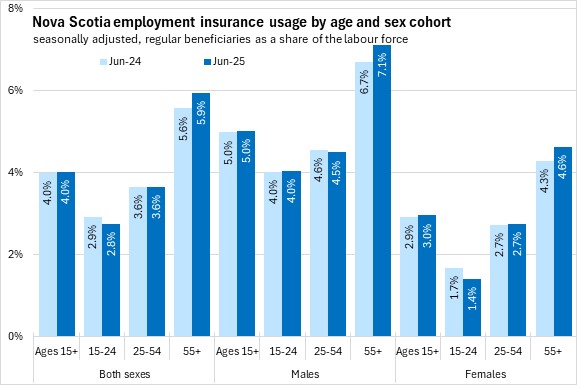
Use of employment insurance (as a share of the labour force) was lowest for youth (15-24) and highest for workers age 55 and over. Male use of employment insurance was higher as a share of the labour force than female use of employment insurance for all age cohorts in June 2025. Compared to one year ago, employment insurance usage increased for older age cohorts (for both males and females) while employment insurance usage as a share of labour force was down for female youth and core-aged males.
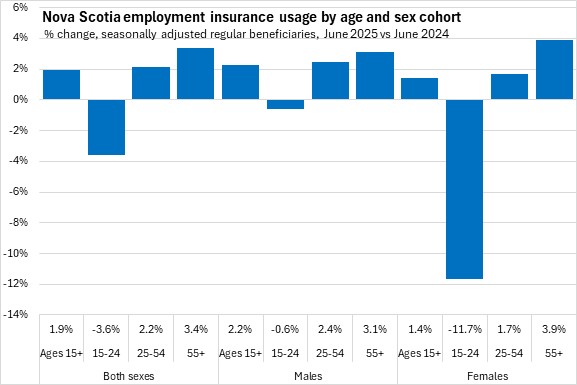
The year-over-year increase in employment insurance usage reflected increases for core aged and older cohorts. Males in core aged reported faster increases in employment insurance usage compared to females in the same cohorts. Females reported a faster rise in employment insurance usage among older workers and a faster decline among younger workers compared to males.
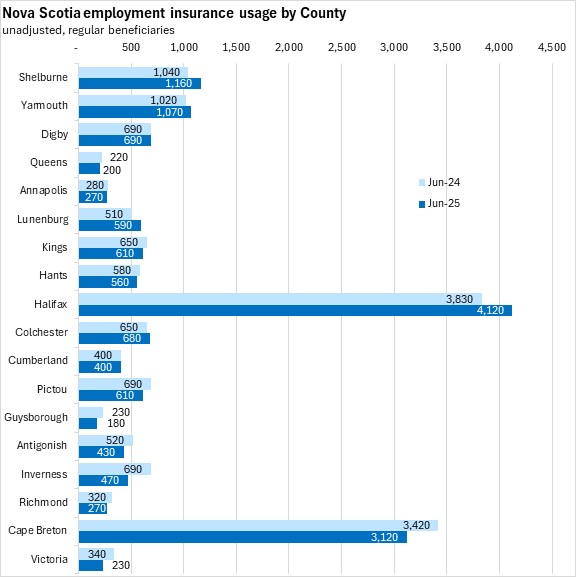
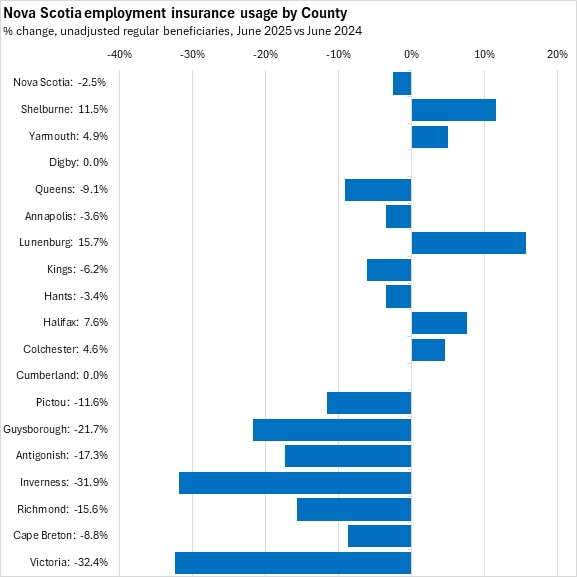
Comparing unadjusted regular beneficiaries for June 2025 against June 2024, most counties reported employment insurance declines with notable declines concentrated in the four counties on Cape Breton Island as well as Antigonish, Guysborough and Pictou counties. Employment insurance use declined the most (in percentage terms) in Inverness and Victoria counties. Employment insurance usage increased the most (in percentage terms) in Lunenburg, Shelburne, and Halifax counties.
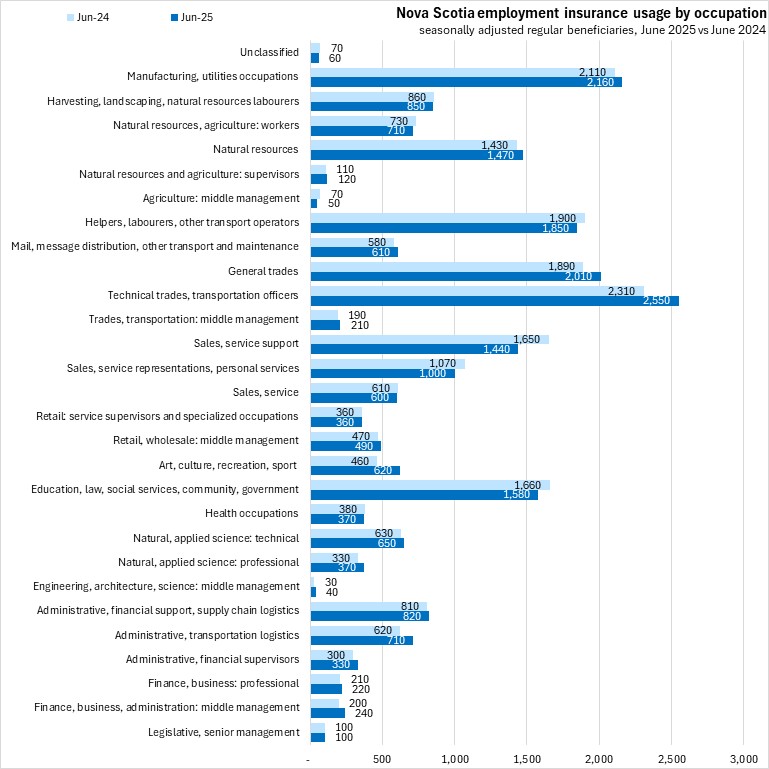
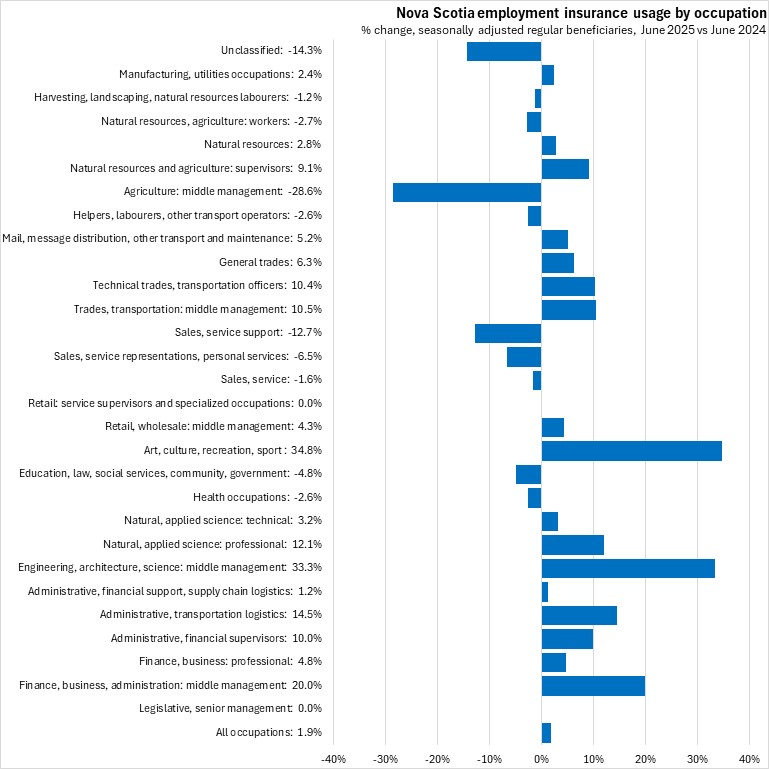
By occupation, employment insurance beneficiaries were more likely to be in technical trades/transportation, manufacturing/utilities, general trades, and helpers/labourers/other transport operators. The largest increases were among occupations in technical trades/transportation officers, general trades, art/culture/recreation and administrative/transportation logistics in June. The largest decline among occupations was for sales/service support.
Year-to-date (January-June 2025 vs January-June 2024)
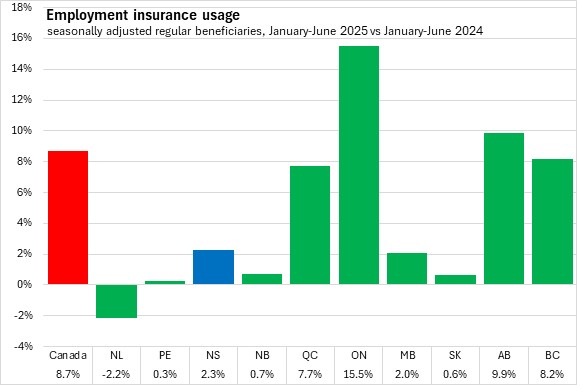
Compared to the first six months of 2024, Nova Scotia's employment insurance usage increased 2.3%. National employment insurance usage increased 8.7% compared to January-June 2024. All provinces except Newfoundland and Labrador reported higher employment insurance usage year-to-date, with the fastest increase in Ontario.
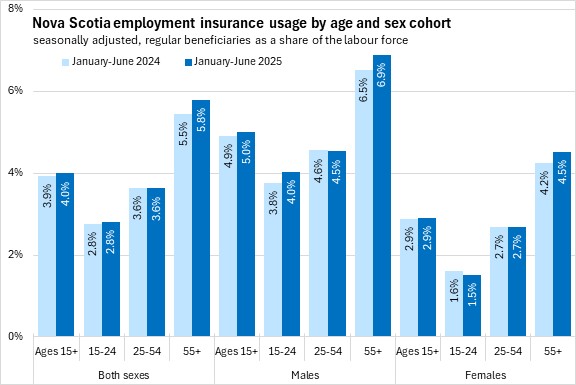
As a share of the labour force, employment insurance usage increased for older workers and males aged 15-24 in the first six months of 2025. There was a decline in employment insurance usage as a share of the labour force among male core-aged workers and females aged 15-24.
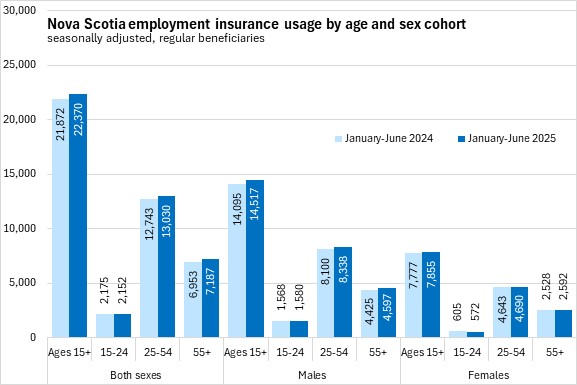
Year-to-date employment insurance usage was higher for core-aged and older workers of both sexes. Employment insurance use among those aged 15-24 was lower due to a decline among females, partially offset by higher usage for males.
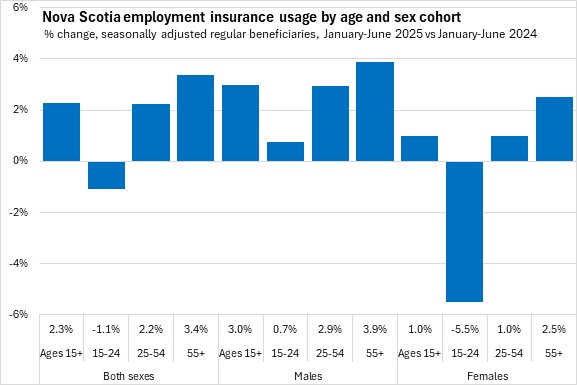
Comparing the first six months of 2025 with the same period in 2024, employment insurance usage declined in Queens, Pictou, Guysborough, and Antigonish counties along with all four counties on Cape Breton Island. Employment insurance usage increased the most (in percentage terms) in Lunenburg, Yarmouth, Digby, and Halifax counties.
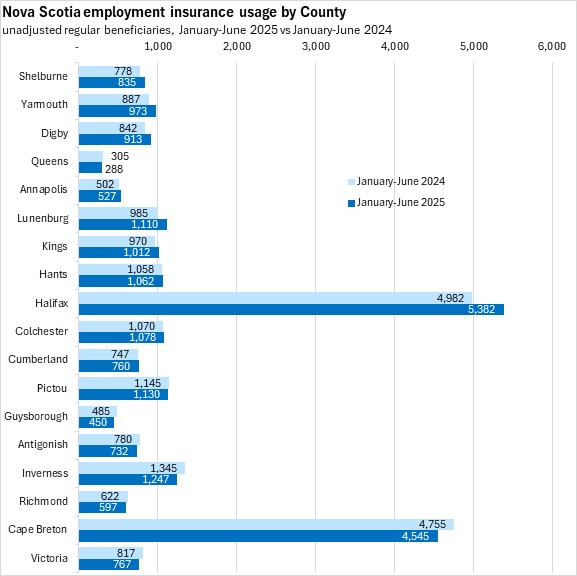
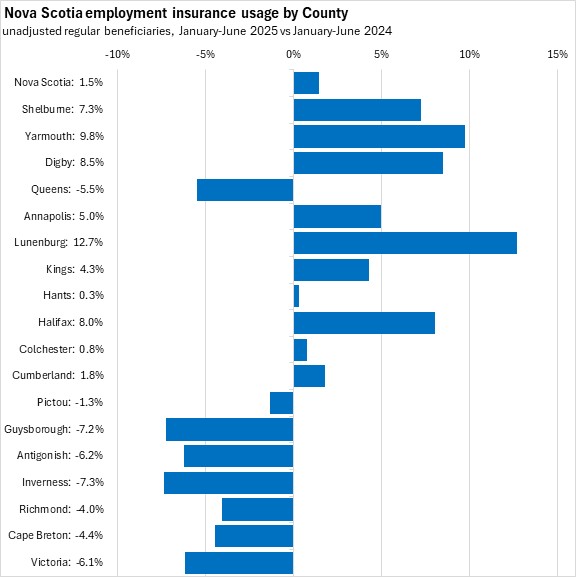
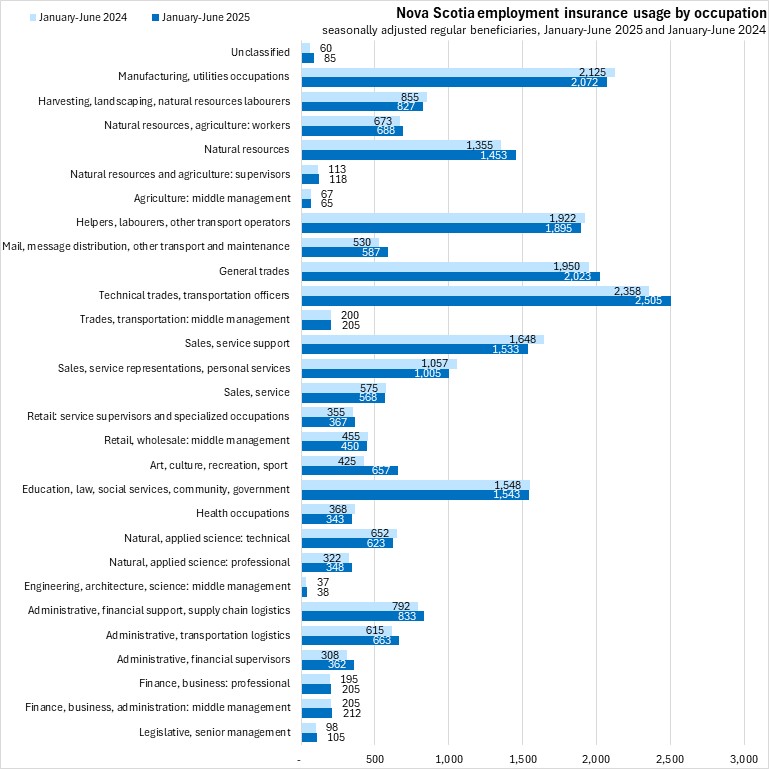
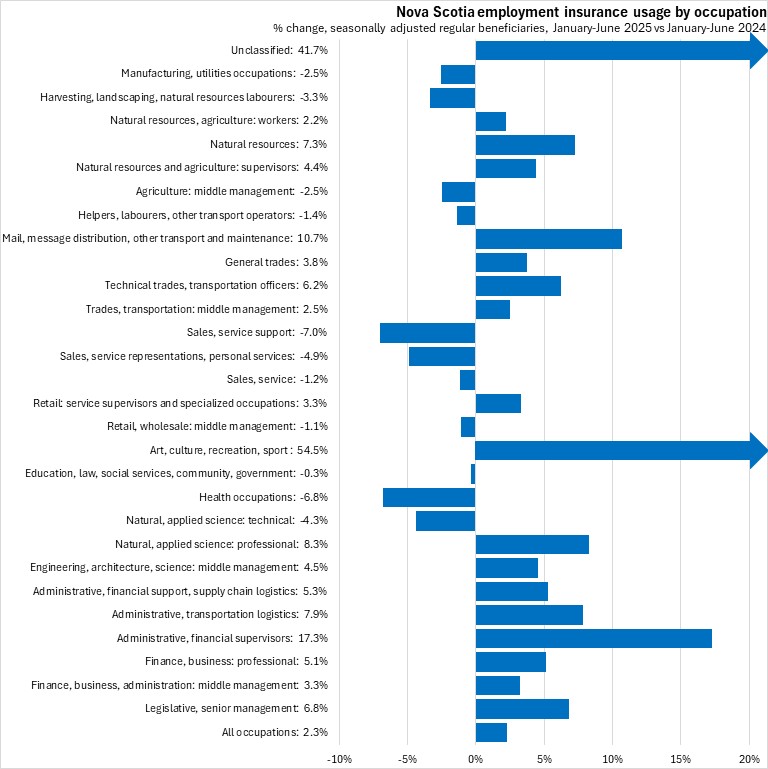
Year-to-date employment insurance usage increased the most for occupations in art/culture/recreation/sport, technical trades/transport officers, and natural resources. The largest declines were among occupations in sales/service support as well as representations/personal services, and manufacturing/utilities.
Source: Statistics Canada. Table 14-10-0011-01 Employment insurance beneficiaries (regular benefits) by province and territory, monthly, seasonally adjusted; Table 14-10-0323-01 Employment insurance beneficiaries by census division, monthly, unadjusted for seasonality; Table 14-10-0456-01 Employment insurance beneficiaries (regular benefits) by province, territory and occupation, monthly, seasonally adjusted; Table 14-10-0287-01 Labour force characteristics, monthly, seasonally adjusted and trend-cycle, last 5 months
<--- Return to Archive


