The Economics and Statistics Division maintains archives of previous publications for accountability purposes, but makes no updates to keep these documents current with the latest data revisions from Statistics Canada. As a result, information in older documents may not be accurate. Please exercise caution when referring to older documents. For the latest information and historical data, please contact the individual listed to the right.
<--- Return to Archive
For additional information relating to this article, please contact:
August 27, 2025INDUSTRIAL RESEARCH AND DEVELOPMENT, 2023-2025 Statistics Canada has recently released Industrial Research and Development (R&D) characteristics actuals for 2023 at a provincial level and preliminary/intentions for 2024/2025 at a national level. Results from 2014 and beyond are not directly comparable to earlier data.
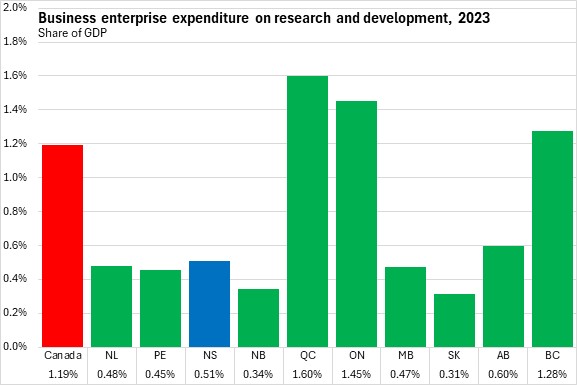
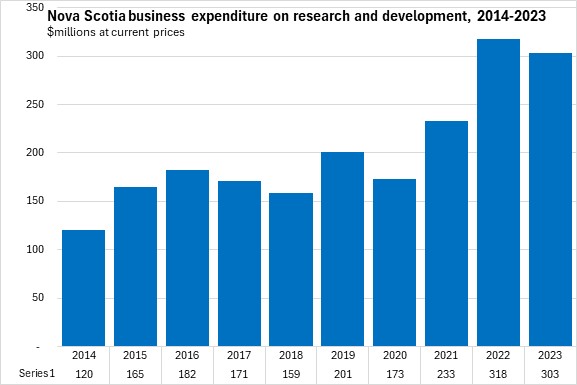
In 2023, Nova Scotia businesses spent $303 million on research and development, down 4.7% from the previous year. Nova Scotia’s total business enterprise expenditures on R&D accounted for 0.51% of its Gross Domestic Product (GDP) in 2023, down from 0.58% in the previous year.
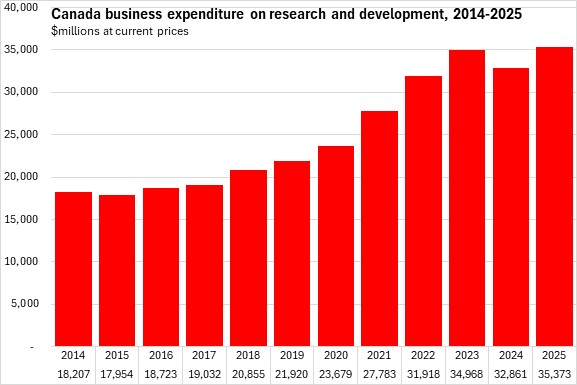
Nationally, businesses spent $35.0 billion on R&D in 2023, an increase of 9.6% over 2022 spending. Canada’s R&D spending accounted for 1.19% of its GDP in 2023, up from 1.12% in the previous year.
Québec (1.60%), Ontario (1.45%), and British Columbia (1.28%) had the largest share of their economy in research and development expenditures in 2023.
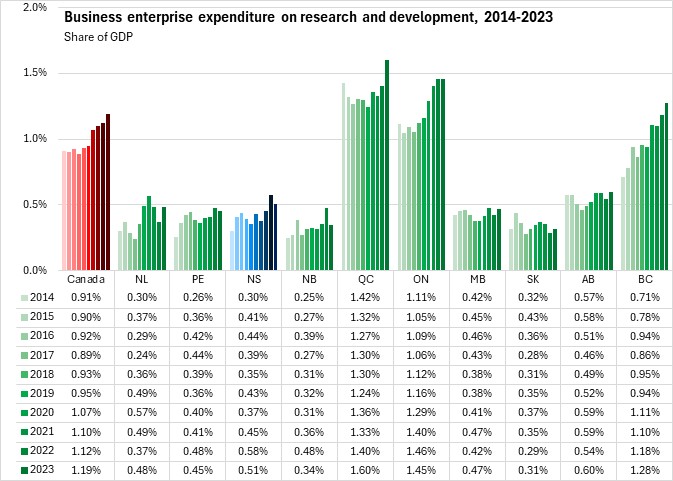
As a share of GDP, business R&D expenditures in Nova Scotia rose in 2021 and 2022, and remains above years prior to 2021, despite declining in 2023. Nationally, the share of business R&D in GDP has increased steadily since 2017.
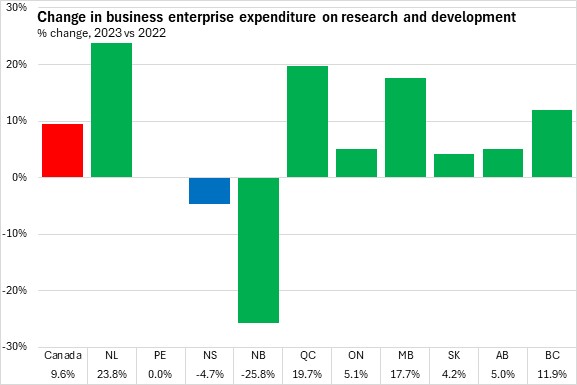
Nova Scotia's research and development spending declined 4.7% from 2022 to 2023 after increasing 36.5% in 2022. Seven provinces reported higher levels of industrial research and development spending in 2023, led by Newfoundland and Labrador. The largest decline was in New Brunswick.
Nova Scotia's industrial research and development spending declined from $318 million in 2022 to $303 million in 2023.
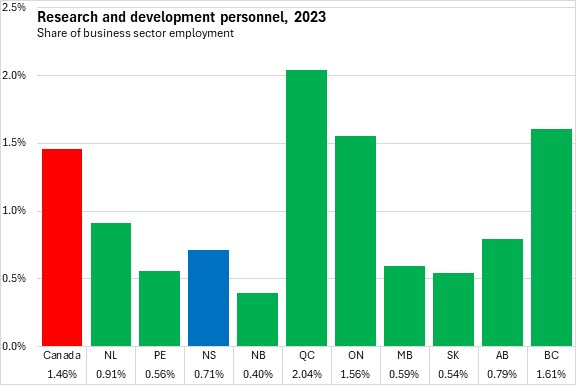
In 2023, R&D personnel accounted for 0.71% of Nova Scotia’s business sector employment. Nationally, business enterprise R&D personnel was 1.46% of Canada’s total business sector employment in 2023. The largest shares were recorded in Québec (2.04%), British Columbia (1.61%), Ontario (1.56%).
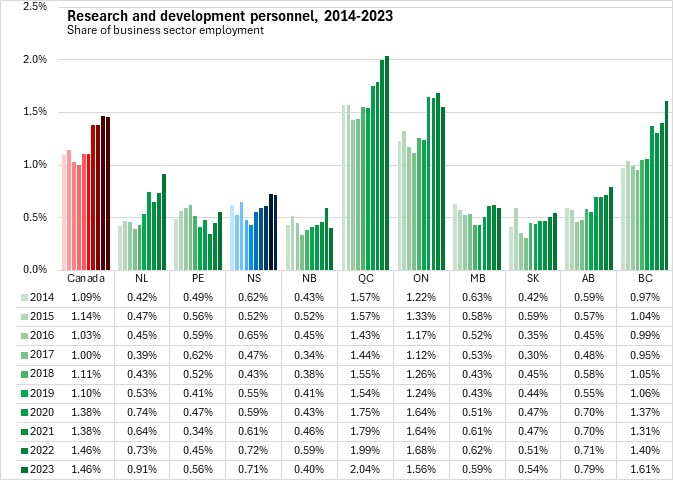
Nova Scotia's share of business sector employment in research and development personnel increased in each of the four years prior to 2023, and edged down in 2023. Nationally, research and development personnel as a share of business sector employment has remained stable for the last two years.
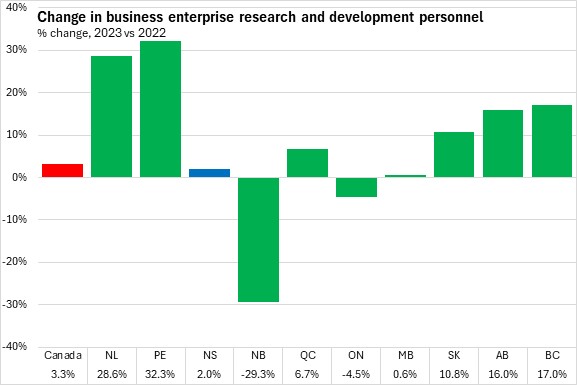
The number of business research and development personnel increased by 2.0% in Nova Scotia in 2023. Nationally, business research and development personnel increased by 3.3% with gains in all provinces except New Brunswick and Ontario. The fastest growth was in Prince Edward Island and Newfoundland and Labrador.
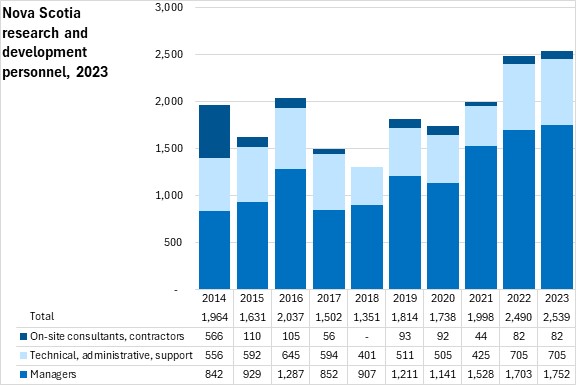
In 2023, there were 2,539 full-time equivalent (FTE) jobs for in-house research and development in Nova Scotia. This was up from 2,490 in the previous year. Researchers and research managers (1,752) was the most dominant occupational category among most Nova Scotia’s business enterprise R&D personnel in 2023. The rest of the R&D personnel was divided among research and development technical, administrative and support staff (705), and consultants and contractors (82), both unchanged from 2022 levels.
Preliminary estimates show that Canada’s business enterprise research and development spending declined by 6.0% from the previous year to $32,861 million in 2024. National research and development expenditures by businesses are expected to rebound by 7.6% to $35,373 million in 2025.
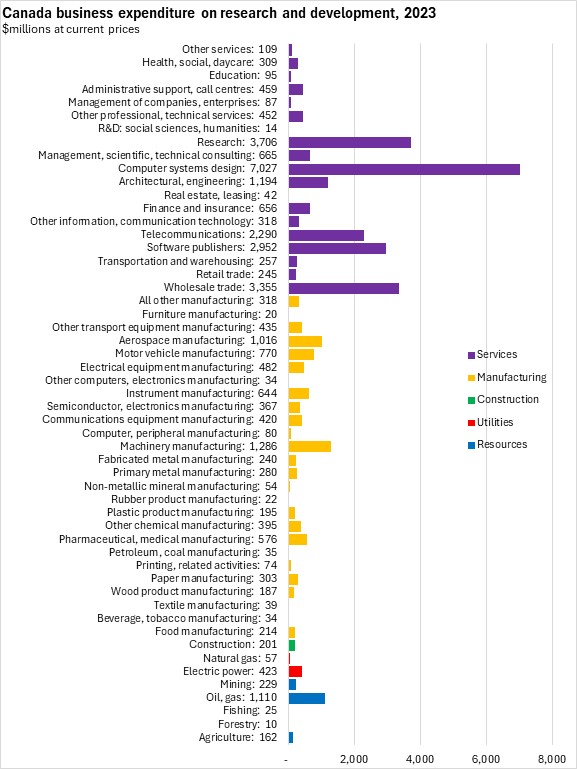
Looking at the research and development spending by industry, majority of spending in Canada was undertaken by businesses in service sectors. The computer systems design and related services sector had the largest R&D spending ($7,027 million) in 2023.
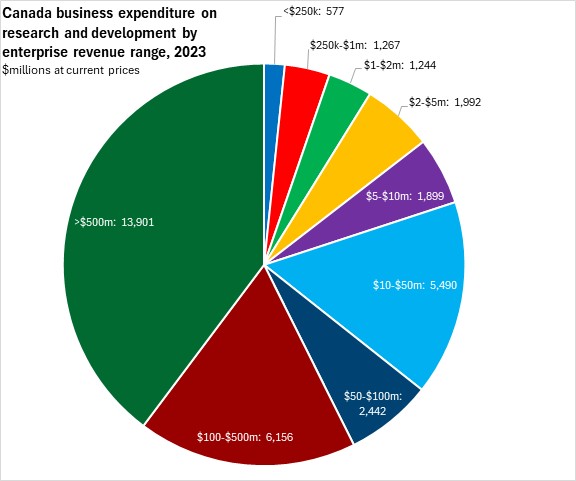
In 2023, Canadian businesses with revenues higher than $500 million had the largest share of total R&D spending accounting for 39.8% of total research and development expenditures. This was followed by businesses with revenues between $100 million and $500 million (17.6%) and revenues between $10 million and $50 million (15.7%) in 2023.
Source: Statistics Canada Table 27-10-0333-01 Business enterprise in-house research and development expenditures, by industry group based on the North American Industry Classification System (NAICS), country of control and expenditure types (x 1,000,000); Table 27-10-0334-01 Business enterprise in-house research and development expenditures, by country of control and revenue group (x 1,000,000); Table 27-10-0341-01 Business enterprise in-house research and development characteristics, by industry group based on the North American Industry Classification System (NAICS), country of control and provinces and territories; Table 36-10-0222-01 Gross domestic product, expenditure-based, provincial and territorial, annual (x 1,000,000); Table 36-10-0480-01 Labour productivity and related measures by business sector industry and by non-commercial activity consistent with the industry accounts
<--- Return to Archive


