The Economics and Statistics Division maintains archives of previous publications for accountability purposes, but makes no updates to keep these documents current with the latest data revisions from Statistics Canada. As a result, information in older documents may not be accurate. Please exercise caution when referring to older documents. For the latest information and historical data, please contact the individual listed to the right.
<--- Return to Archive
For additional information relating to this article, please contact:
December 09, 2025HOUSEHOLDS AND THE ENVIRONMENT, 2023 Statistics Canada has published recent data from surveys of households and the environment for 2023.
Energy
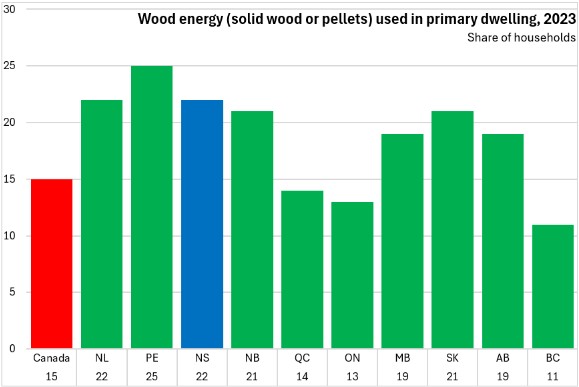
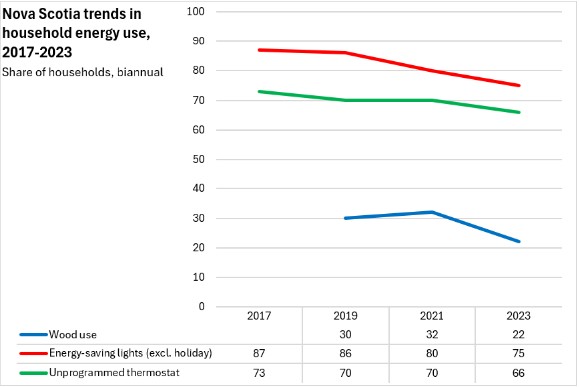
In 2023, 22% of Nova Scotia households used wood energy (solid wood or pellets) in their primary dwelling. This was tied with Newfoundland and Labrador for the second highest prevalence of wood energy use after Prince Edward Island. Nationally, 15% of households used wood energy in their primary dwelling with notably lower shares in Canada's larger urban provinces (Ontario, Québec and British Columbia).
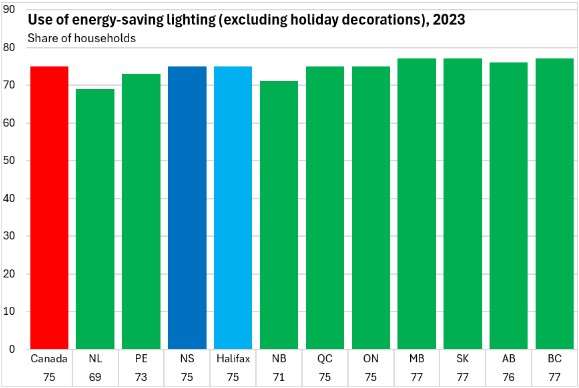
Use of energy-saving lighting devices such as fluorescent, halogen, light emitting diodes (but excluding holiday lights) was found among 75% of Nova Scotia households - the same as the national average. Use of energy savings lights was slightly more common in western provinces and less common in Newfoundland and Labrador.
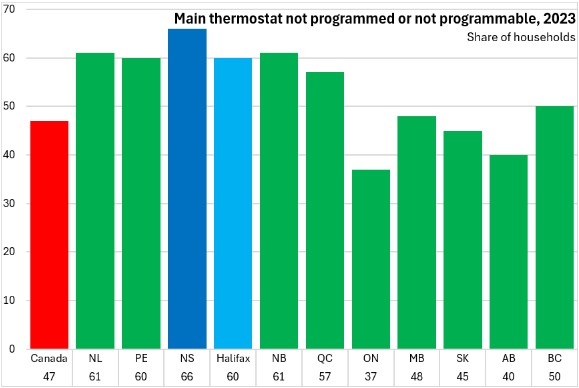
The vast majority of households have at least one thermostat. Among Nova Scotia's households with at least one thermostat, 66% do not program it (including those with non-programmable thermostats). This was the highest such share among provinces. Use of programmable thermostats was notably lower in Atlantic Canada and higher in Ontario and the prairie provinces.
Household chemicals
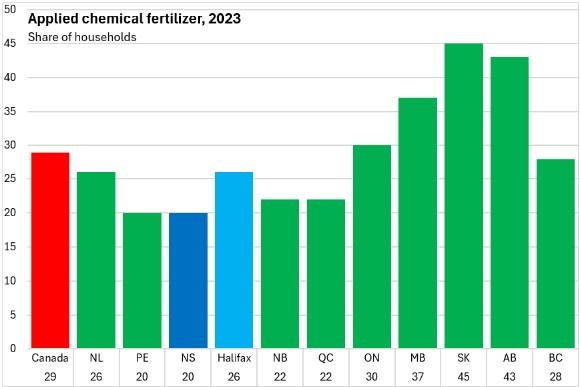
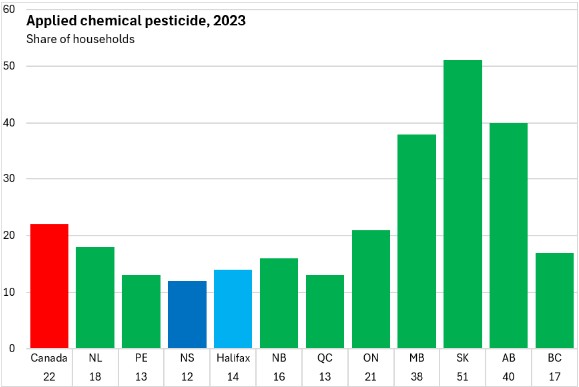
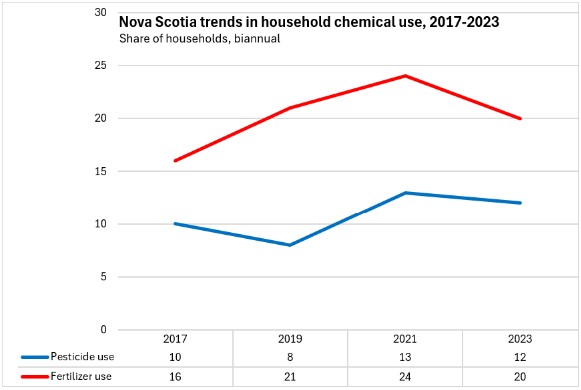
Households in Nova Scotia were the least likely among provinces to use chemical fertilizers (20%) or pesticides (12%). Nationally, 29% of households used fertilizers while 22% used pesticides. Use of fertilizers and pesticides was more prevalent in the prairie provinces.
Landscaping equipment and fuel type
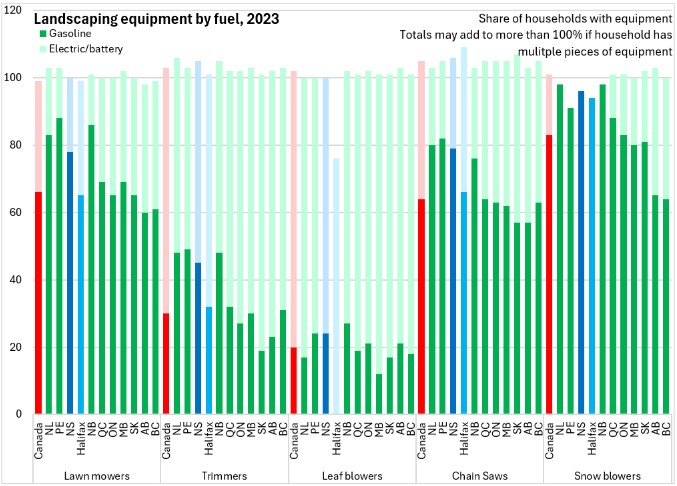
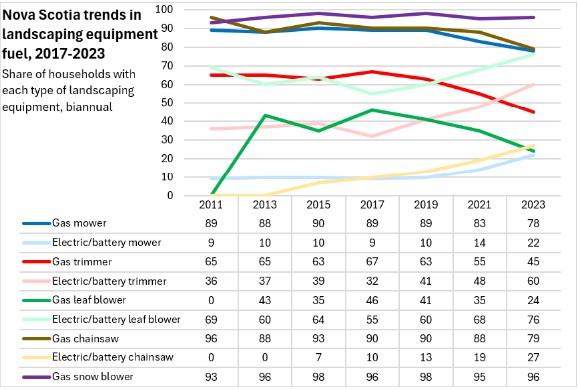
Among households with each major type of landscaping equipment (lawn mowers, lawn/grass trimmers, leaf blowers, chainsaws and snow blowers), gas-powered devices were more common for lawn mowers, chainsaws and snow blowers. Electric or battery-powered devices were more common for lawn/grass trimmers and leaf blowers. Nova Scotia generally reported higher use of gasoline-powered landscaping equipment than the national average.
In Nova Scotia, electric/battery powered lawn mowers, lawn/grass trimmers and chainsaws were notably more widely used in Halifax.
Household water usage
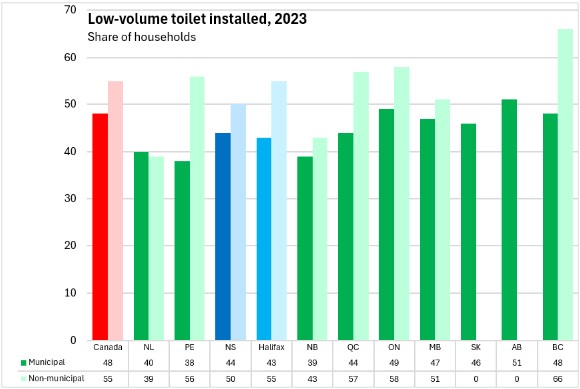
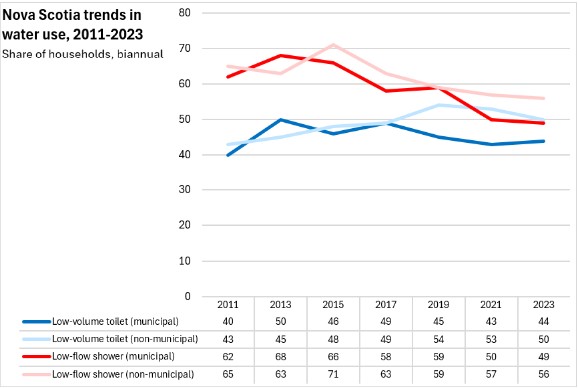
In Nova Scotia, 44% of households on municipal water service had low-volume toilets installed while 50% of households that were not on municipal water service had low-volume toilets. Across Canada, 48% of households on municipal water service had low-volume toilets while 55% of households not on municipal water service had low-volume toilets. Low-volume toilets were more prevalent for municipal-water customers in Alberta and for non-municipal water users in British Columbia. Low-volume toilets were less common among Atlantic Canadians served by municipal water utilities.
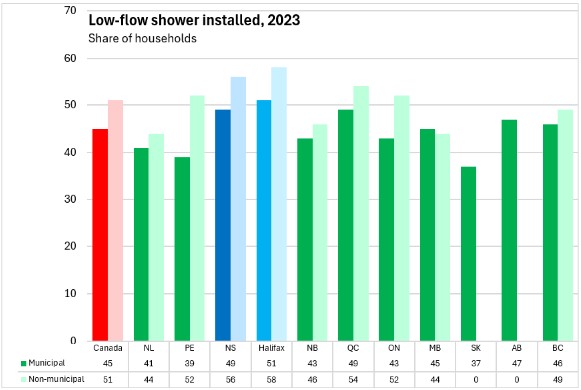
Low-flow shower heads were installed in 49% of Nova Scotia households with municipal water service (tied for highest among municipally-served households) and in 56% of households without municipal water service (highest among non-municipal water households). Nationally 45% of households on municipal water had low-flow shower heads while 51% of households not on municipal water had low-flow shower heads. Households in Saskatchewan with municipal water service had notably lower uptake of low-flow shower heads.
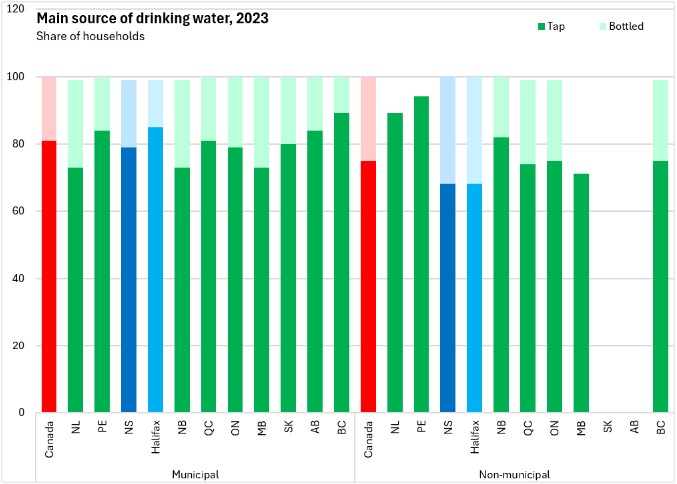
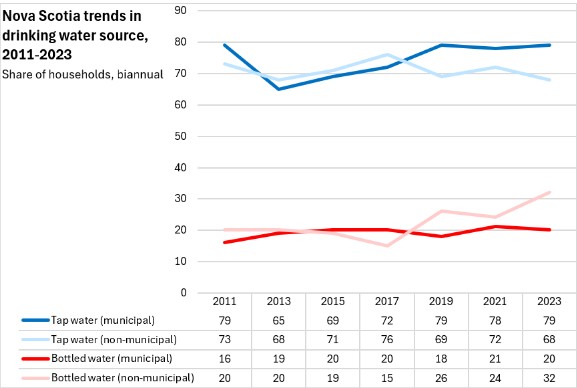
Tap water was the main source of drinking water for the majority of households (whether served by municipal utilities or not), though bottled water use was more common among those without municipal water service.
Handling used delivery boxes
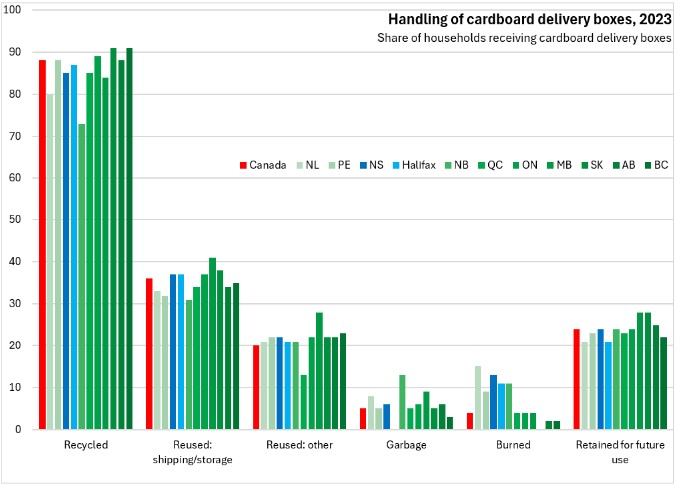
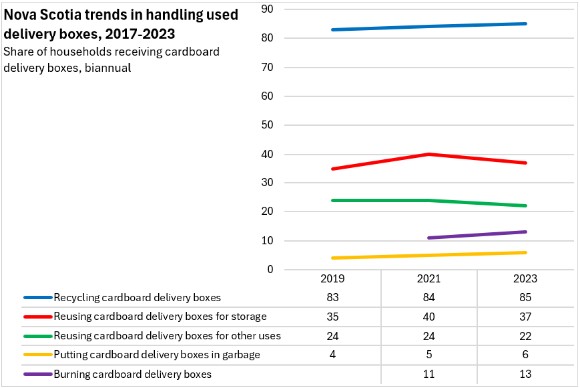
The rise of online purchasing and delivery services has substantially increased the volume of cardboard delivery boxes in Canadian households. The vast majority of households receive deliveries from one or more online shopping services. Of these, the largest share report recycling used cardboard boxes through curbside services. A substantial portion of households also reuse boxes for storage/transportation or other uses. Less than 10% of households dispose of used cardboard delivery boxes in the garbage (exception: New Brunswick). In Atlantic Canada, burning cardboard delivery boxes was more common than in other provinces.
Trends
Surveys of households and the environment are conducted every two years. Some data are only available for recent years in Nova Scotia.
Use of wood energy dropped substantially in Nova Scotia from 2021-2023. Use of energy-saving lights has declined since 2017 while adoption of programmable thermostats has risen slowly.
Use of pesticides and fertilizers among Nova Scotia households declined from 2021 to 2023, but each products' use remains up compared to 2017.
For all major types of landscaping equipment except snow blowers, use of gasoline-powered devices has declined in recent years while electric/battery powered devices have become more common in Nova Scotia. Notably, the share of households reporting electric/battery chainsaws (27%) and gas-powered chainsaws (79%) suggests households may own more than one of these devices.
Nova Scotia's use of low-flow showerheads has trended down in recent years - for both municipal water customers and those without municipal water service. Use of low-volume toilets has declined among households with municipal water service since 2017 (though with a slight increase from 2021-2023). Installation of low-volume toilets among households without municipal water service rose from 2011-2019, but has declined since then.
Use of tap water as the main drinking source among households with municipal water service has risen since 2013, though there has not been a substantial decline in bottled water use among these households. Bottled water use has increased among households without municipal water service while tap water use has declined.
Recycling has been the main method of handling used delivery boxes since 2019. There have been small declines in re-use of used delivery boxes along with slight increases in burning delivery boxes and disposing of them in the garbage.
Source: Statistics Canada. Table 25-10-0083-01 Residential use of wood and wood pellets; Table 38-10-0275-01 Households and the environment survey, primary type of drinking water consumed; Table 38-10-0148-01 Lawn care and landscaping equipment; Table 38-10-0142-01 Disposal of boxes from online purchases; Table 38-10-0102-01 Indoor water conservation practices; Table 38-10-0052-01 Use of fertilizer and pesticides; Table 38-10-0049-01 Use of thermostats; Table 38-10-0048-01 Use of energy-saving lights, Canada and provinces
<--- Return to Archive


