The Economics and Statistics Division maintains archives of previous publications for accountability purposes, but makes no updates to keep these documents current with the latest data revisions from Statistics Canada. As a result, information in older documents may not be accurate. Please exercise caution when referring to older documents. For the latest information and historical data, please contact the individual listed to the right.
<--- Return to Archive
For additional information relating to this article, please contact:
February 03, 2026VALUE OF OCEAN SERVICES, 2023 Statistics Canada has released data from the Census of Environment on the value of ecosystem services Canadians received from oceans and coastal areas in 2023 and 2024. These services occurred across three categories: carbon sequestration, harvested wild fish and seafood, and nature-based tourism, with data available for each of the three oceans bordering Canada. Data on the value of carbon sequestration services is also available by individual body of water, while seafisheries landings and nature-based ocean tourism data is provided at the province level.
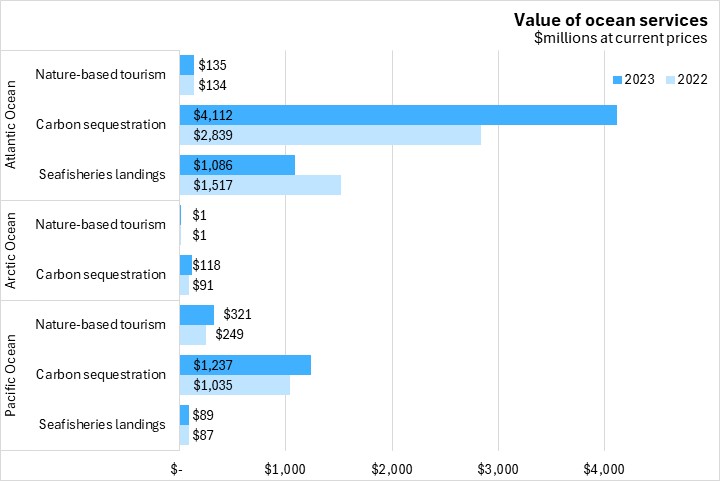
In 2023, Canadians received $7.1 billion in ecosystem services from oceans and coastal areas. Of this, carbon sequestration provided the most value in each of the three oceans bordering Canada. The Atlantic Ocean provided the most total value to Canadians, leading the country in carbon sequestration and seafisheries landings values. The Pacific Ocean provided the most nature-based tourism value. Values increased in every category in 2023 vs 2022, with the exception of a decline in seafisheries landings value in the Atlantic Ocean, and no change in nature-based tourism values in the Arctic Ocean.
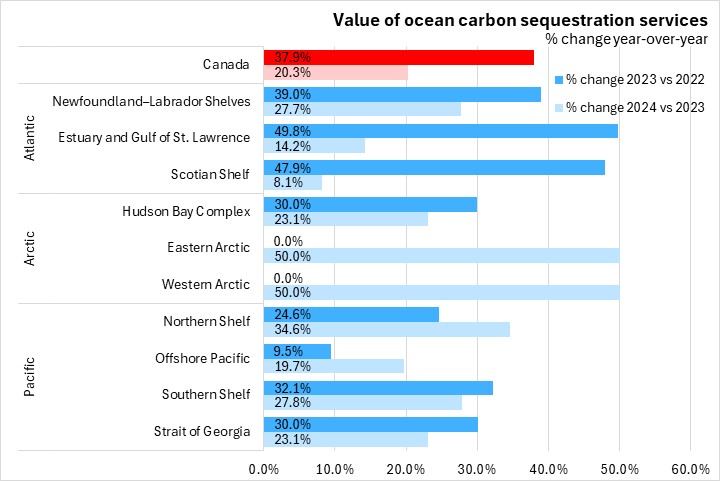
The value of carbon sequestration services Canada receives from its oceans is further provided by individual body of water. Statistics Canada has provided the following map of the below waters for reference.
Carbon sequestration services value rose for every body of water in 2023 vs 2022, with the exception of the Eastern and Western Arctic which reported no change. The fastest increase occurred in the three Atlantic bodies of water, led by the Estuary and Gulf of St. Lawrence. Data is also available on the value of carbon sequestration in 2024, (but not for seafisheries landings or ocean tourism) with slower growth rates observed for six of the ten bodies of water in 2024 compared to 2023, with the fastest growth observed in the Eastern and Western Arctic, and the slowest growth in carbon sequestration values in the Scotian Shelf.
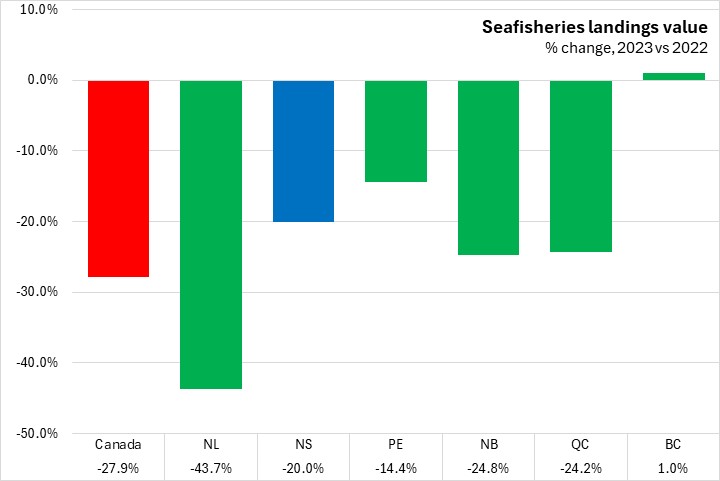
The value of Nova Scotia seafisheries landings fell 20.0% in 2023, slower than the Canadian national average decline of 27.9%. The largest decline in seafisheries landings value was reported in Newfoundland and Labrador, and the only increase in British Columbia.
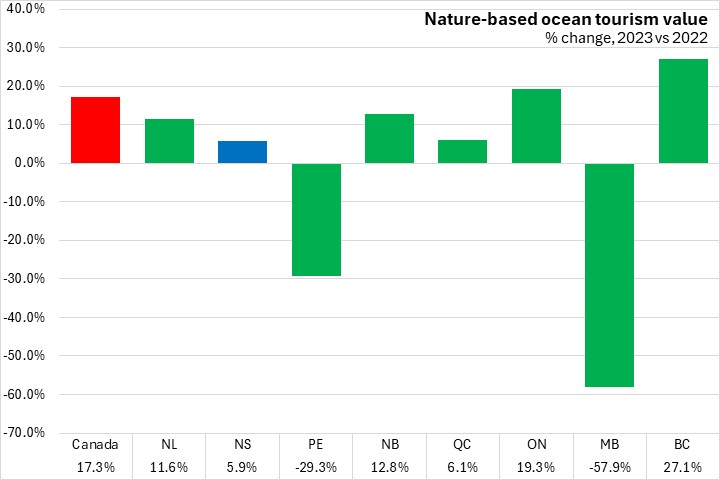
Nature-based ocean tourism values increased 17.3% in Canada in 2023 compared to 2022, with the fastest growth observed in British Columbia (+27.1%), and the largest decline in Manitoba (-57.9%). The value of Nova Scotia nature-based ocean tourism increased 5.9% in 2023 vs 2022.
TRENDS
Increases in the ocean ecosystem services value Canadians receive has been primarily driven by higher estimates of carbon sequestration values. Nova Scotia carbon sequestration value from its surrounding waters (the Scotian Shelf and Estuary and Gulf of St. Lawrence) has increased 611.7% since 2018, while Canadian ocean carbon sequestration values have increased 518.9% over the same period. The estimated amount of carbon sequestered by Canada's oceans has remained relatively constant from 2018 to 2023, with increases in values reflecting higher price estimates per tonne of carbon sequestered.
Canadian seafisheries landings (+2.2%) and ocean tourism (+12.4%) have increased since 2018, while Nova Scotia seafisheries landings (-8.9%) and ocean tourism (-21.1%) have declined.
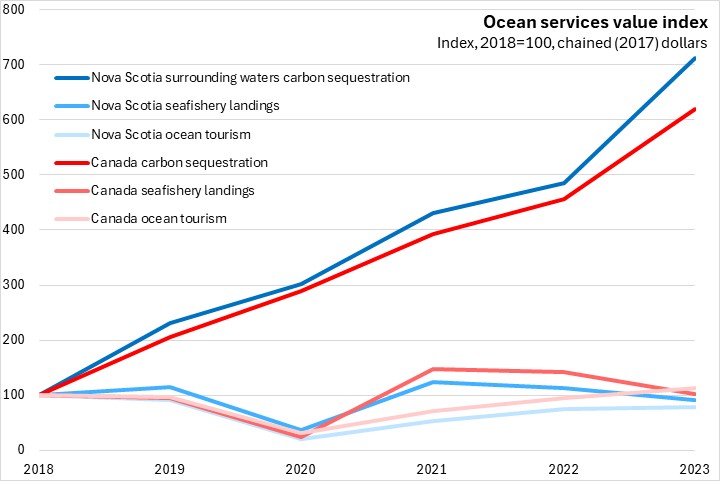
Statistics Canada. Table 38-10-0190-01 Ocean and coastal ecosystem services: Experimental monetary measures, Canada and ocean regions (x 1,000)
Statistics Canada. Table 38-10-0189-01 Ocean and coastal ecosystem services: Physical measures by marine bioregion.
<--- Return to Archive


