The Economics and Statistics Division maintains archives of previous publications for accountability purposes, but makes no updates to keep these documents current with the latest data revisions from Statistics Canada. As a result, information in older documents may not be accurate. Please exercise caution when referring to older documents. For the latest information and historical data, please contact the individual listed to the right.
<--- Return to Archive
For additional information relating to this article, please contact:
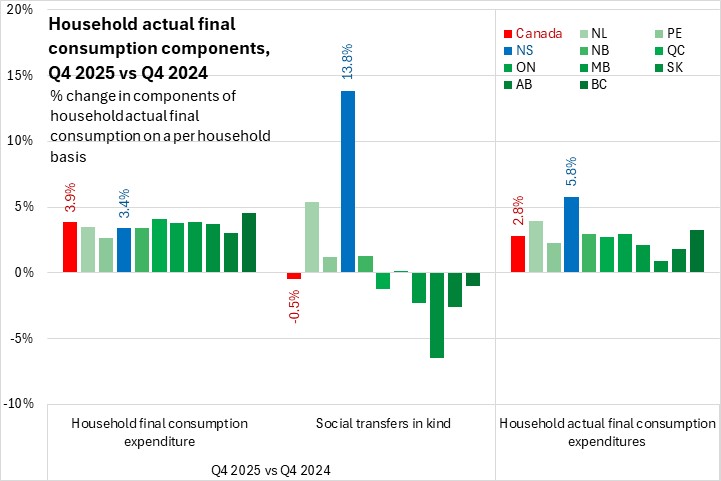
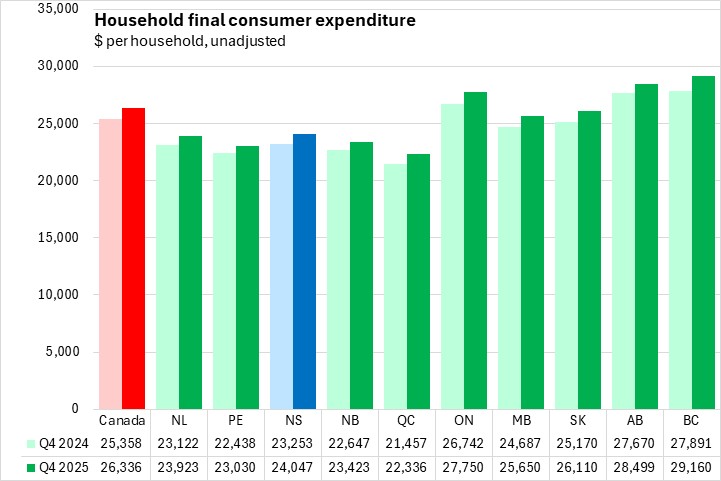
April 13, 2026HOUSEHOLD CONSUMPTION, Q4 AND ANNUAL 2025 Comparing Q4 2025 with Q4 2024, Nova Scotia's household consumer expenditures increased by 3.4% on a per household basis. Across Canada, year-over-year household consumer expenditures were up 3.9% on a per household basis , with the strongest gain in British Columbia.
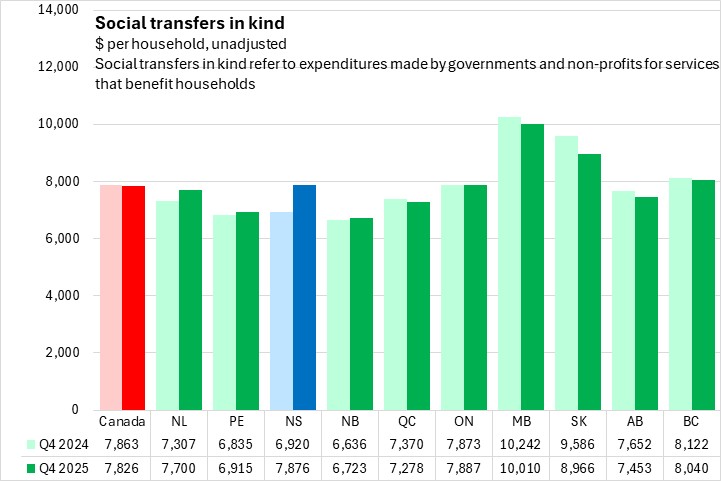
Social transfers in kind refer to services that are provided for the benefit of households but are paid for by governments and non-profits. These are primarily health and education expenditures, which add to private expenditures made on these services. Social transfers in kind increased by 13.8% in Nova Scotia from Q4 2024 to Q4 2025 on a per household basis, the fastest growth among provinces. Social transfers in kind were up in Ontario and the Atlantic provinces while they were down for Québec and the four Western provinces. Nationally, social transfers in kind fell 0.5%.
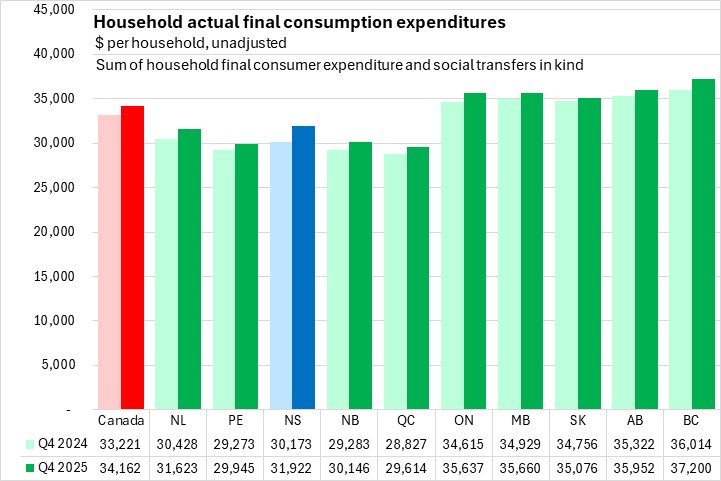
The sum of household final consumer expenditures and social transfers in kind is termed 'household actual final consumption expenditures', which reflects the benefits to households from both private expenditures as well as services provided by governments and non-profits. Combining these two components led to year-over-year household actual final consumption growth of 5.8% for Nova Scotia on a per household basis, the fastest growth among provinces and outpacing the national gain of 2.8%. All provinces reported increasing household actual final consumption expenditures from Q4 2024 to Q4 2025, with Saskatchewan reporting the slowest growth due to the largest decline in social transfers in kind.
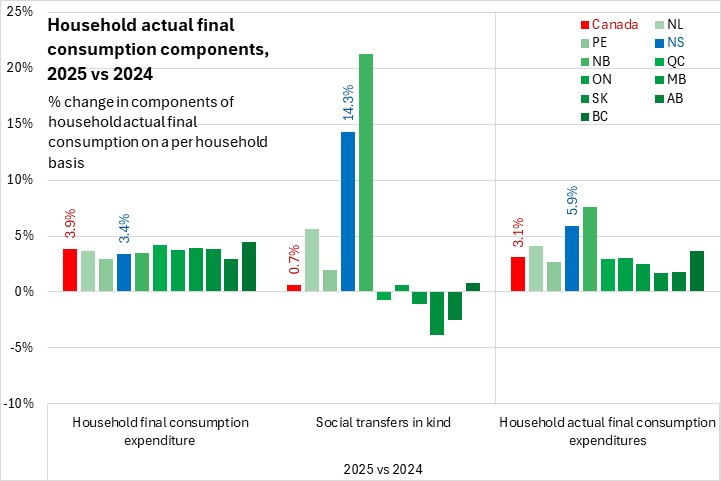
Compared to 2024, in 2025 Nova Scotia's household final consumption expenditures were up 3.4% on a per household basis. National household final consumption expenditures were up 3.9% with the fastest growth in British Columbia.
Nova Scotia's social transfers in kind were up 14.3% on a per household basis in 2025 compared to 2024, the second largest annual gain after New Brunswick. National social transfers in kind rose 0.7% on a per household basis with declines in all three prairie provinces and Québec.
Overall, Nova Scotia's household actual final consumption expenditures (combining households' market final consumption expenditures with social transfers in kind) were up 5.9% on a per household basis- outpacing the 3.1% national average and the second-largest increase among provinces. All provinces reported annual growth in household final consumption expenditures on a per household basis, led by New Brunswick (slowest: Saskatchewan).
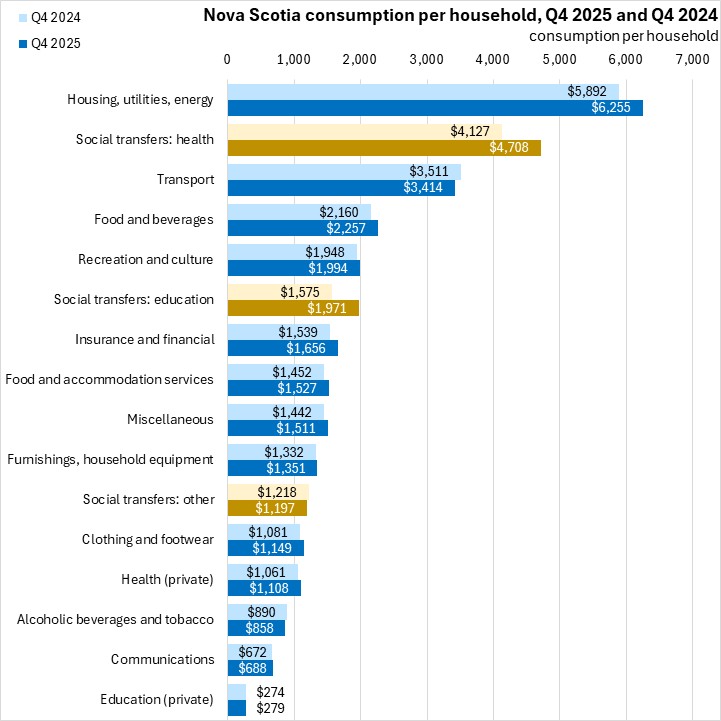
Among the categories of actual final consumption expenditures, housing/utilities/energy made up the largest category of household consumer expenditures, followed by social transfers in kind for health care, transportation, food/beverages, recreation/culture and social transfers in kind for education.
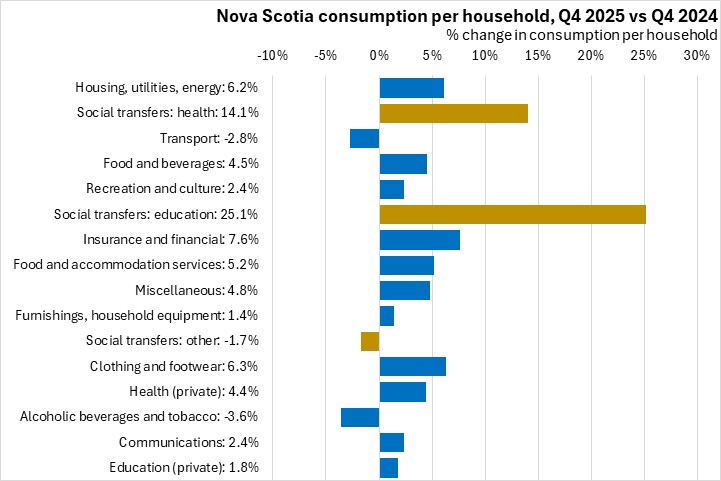
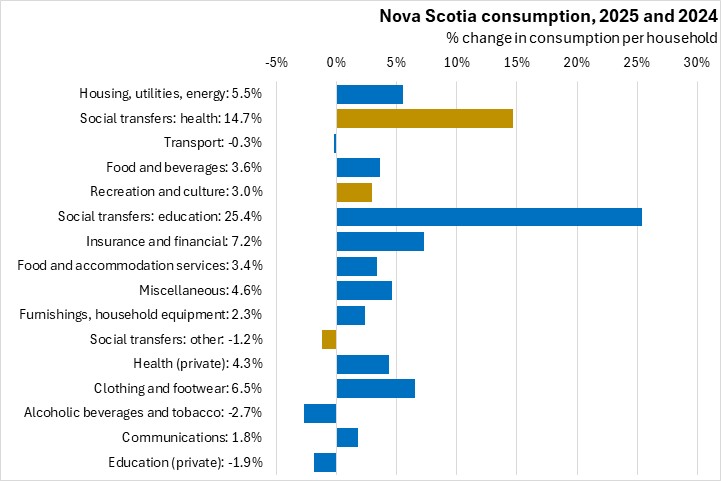
From Q4 2024 to Q4 2025, growth in per household spending was fastest in social transfers for education as well as social transfers for health. Insurance and financial spending had the fastest household consumer expenditure growth. Expenditures were down for transportation, other social transfers in kind, and alcoholic beverages/tobacco.
In 2025, housing/energy/utilities, social transfers for health and transportation were the largest categories of household expenditure.
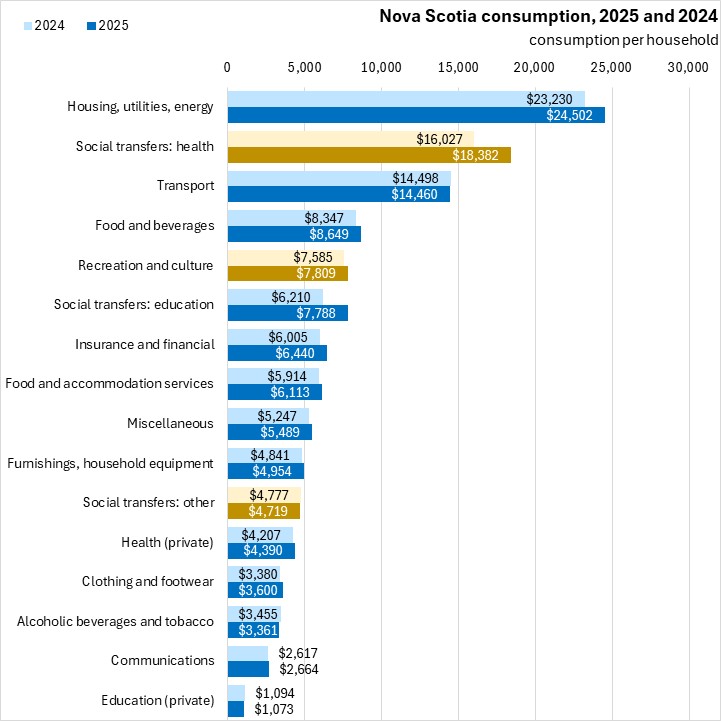
Household expenditures for health and education social transfers grew faster in 2025 than for other categories. Expenditures were down for private (market-provided) education services, alcoholic beverages/tobacco products, transportation and other social transfers in kind.
Nova Scotia's final consumer expenditures (paid for private by households) amounted $24,047 per household in Q4 2025; 91.3% of the national average per household. Across Canada, final consumer expenditures per household were $26,336 with the highest values in British Columbia and Alberta and the lowest value in Québec.
In Q4 2025, Nova Scotian households received $7,876 per household worth of social transfers in kind (100.6% of the national average per household of $7,826). Across Canada, social transfers in kind were highest in Manitoba and lowest in New Brunswick.
Nova Scotia's household actual final consumption expenditures in Q4 2025 were $31,922 per household (93.4% of the national average per household). National household actual final consumption expenditures were $34,162 per household with the highest value in British Columbia. The lowest household actual final consumption expenditures were in Québec.
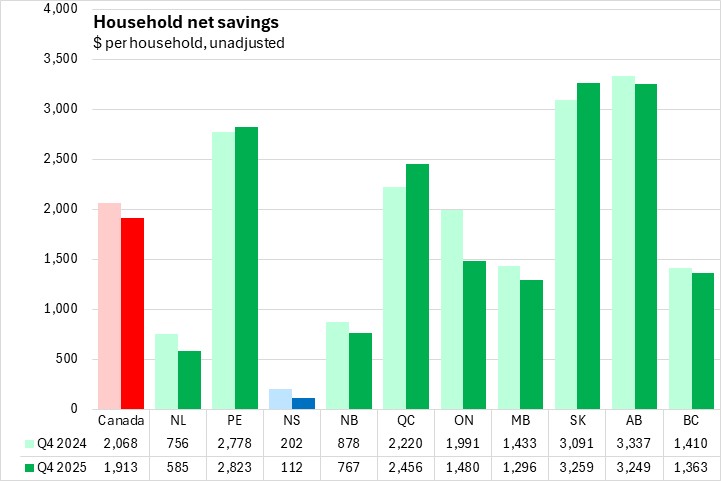
In Q4 2025, Nova Scotia's net savings per household were $112, a decline from the net savings of $202 per household in Q4 2024 and the lowest among provinces. National net savings fell to $1,913 per household. Saskatchewan reported the largest positive net savings.
Source: Statistics Canada. Table 36-10-0663-01 Distributions of household economic accounts, income, consumption and saving, Canada, provinces and territories, quarterly (x 1,000,000)
<--- Return to Archive


