The Economics and Statistics Division maintains archives of previous publications for accountability purposes, but makes no updates to keep these documents current with the latest data revisions from Statistics Canada. As a result, information in older documents may not be accurate. Please exercise caution when referring to older documents. For the latest information and historical data, please contact the individual listed to the right.
<--- Return to Archive
For additional information relating to this article, please contact:
April 14, 2026NATURAL RESOURCES, 2024 Statistics Canada has produced Provincial and Territorial Natural Resource Indicators (PTNRI) as an extension to the Natural Resources Satellite Account. The account defines natural resource activities as those that result in goods and services originating from naturally occurring assets used in economic activity, as well as their initial processing (primary manufacturing). The Natural Resources Satellite Account reports provincial output, GDP, exports, imports, employment for certain industries in natural resource extraction (energy, forestry, mining/minerals and hunting/fishing/water) as well as downstream processing (only for forestry and mining/minerals).
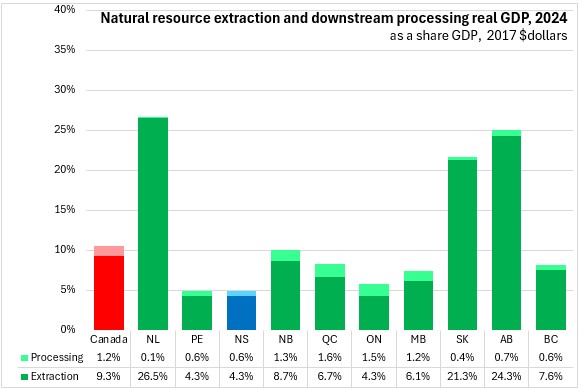
Nova Scotia natural resources sector accounted for 4.3% of real GDP in 2024. Downstream processing industries accounted for 0.6% of real GDP in 2024. The natural resources sector accounted for 9.3% of national GDP in 2024. Nationally, downstream processing sector accounted for 1.2% of real GDP. The natural resource sector accounted for over 20% of the economies of Newfoundland and Labrador, Alberta, and Saskatchewan, and less than 5% of GDP in Prince Edward Island, Nova Scotia and Ontario.
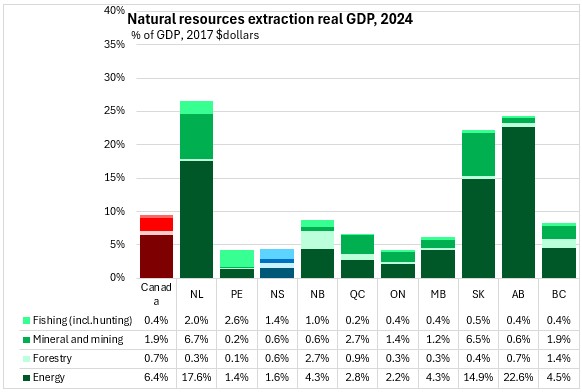
In Nova Scotia, the contributions of natural resource sub-sectors are: energy (1.6%), forest (0.6%), mineral and mining (0.6%) and hunting, fishing and water (1.4%).
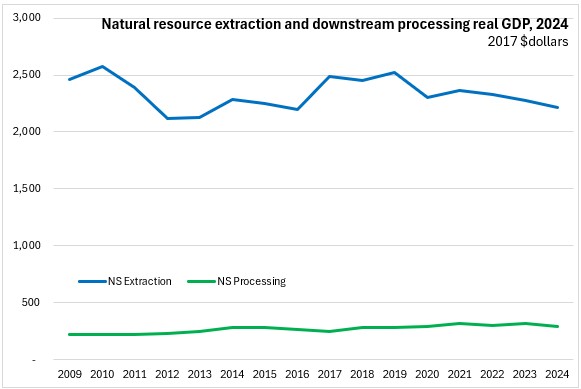
Nova Scotia natural resources real GDP declined from $2.5 billion in 2009 to $2.2 billion in 2024. Nova Scotia downstream resource processing industries real GDP gradually increased from $221 million in 2009 to $287 million.
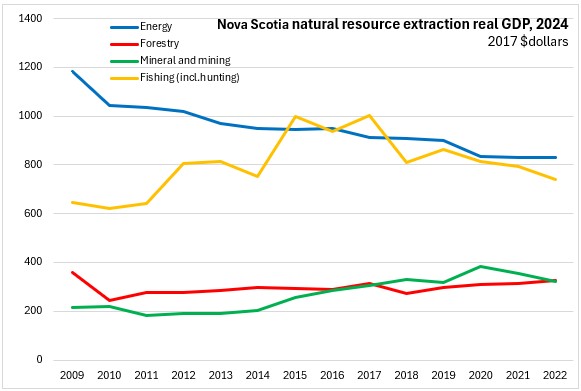
The energy sub-sector decreased 38.8% in 2024 compared with 2010, with declining natural gas extraction. Closure of the Dartmouth refinery further reduced activity in the energy sub-sector. The forestry subsector saw a decline between 2010-2012 and 2020 following the closures of pulp and paper mills. Real GDP of the hunting, fishing and water sub-sector has seen growth of 42.9% since 2009. Real GDP of the mineral and mining sub-sector has seen growth of 33.5% since 2009.
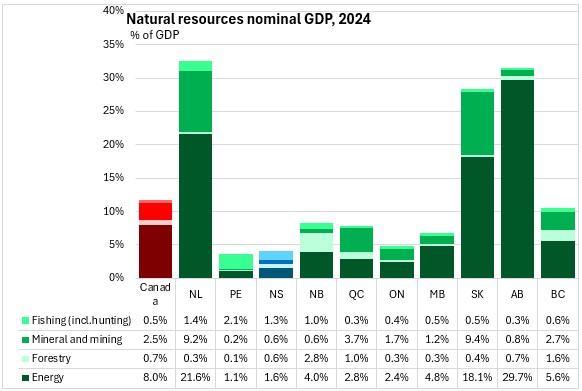
Nova Scotia natural resources sector accounted for 4.0% of nominal GDP in 2024. Nationally, natural resources sector accounted for 11.4% of nominal GDP. The natural resource sector accounted for over 30% of the economies of Newfoundland and Labrador and Alberta (over 25% for Saskatchewan), and less than 5% of GDP in Prince Edward Island, Nova Scotia and Ontario. In Nova Scotia, the contributions of natural resource sub-sectors are: energy (1.6%), forest (0.6%), mineral and mining (0.6%) and hunting, fishing and water (1.3%).
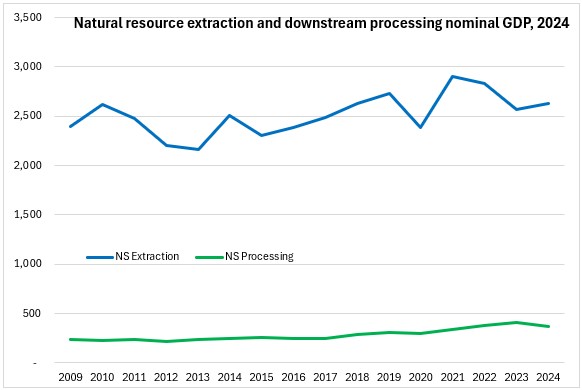
Nova Scotia natural resources nominal GDP rose from $2.4 billion in 2009 to $2.6 billion in 2024. Nova Scotia downstream resource processing industries nominal GDP gradually increased from $237 million in 2009 to $370 million.
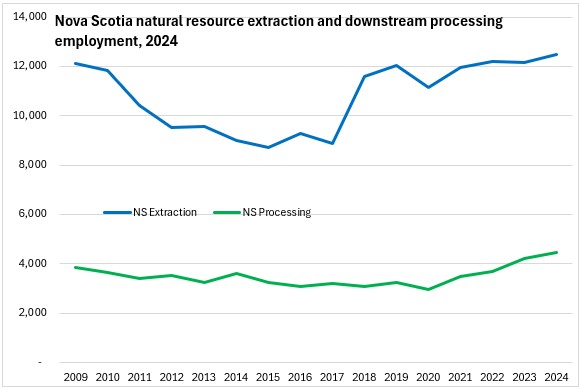
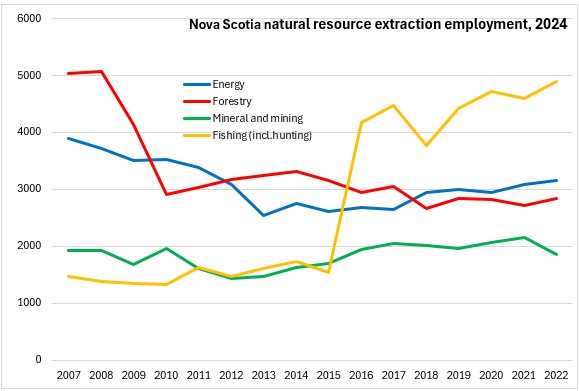
Nova Scotia's employment in these natural resource industries has declined since 2009, particularly after the closure of large forest products producers (2011-2012, 2020). In recent years, natural resource industries as well as downstream processing industries employment has a rising trend. Energy employment rising modestly following a decline. In recent years, there has been growth in employment for fishing including hunting and mining/mineral extraction (except 2024).
Sources: Statistics Canada. Table 36-10-0624-01 Provincial and territorial natural resource indicators, Natural resources sector (main indicators) (x 1,000,000)
<--- Return to Archive


