The Economics and Statistics Division maintains archives of previous publications for accountability purposes, but makes no updates to keep these documents current with the latest data revisions from Statistics Canada. As a result, information in older documents may not be accurate. Please exercise caution when referring to older documents. For the latest information and historical data, please contact the individual listed to the right.
<--- Return to Archive
For additional information relating to this article, please contact:
May 26, 2026TOURISM SATELLITE ACCOUNT, 2022 Statistics Canada has updated the Provincial and Territorial Satellite Account, a measure of the size of provincial tourism as measured by expenditures, GDP and employment. The Provincial and Territorial Tourism Satellite Account contains some important definitions. "Tourism industries" are industries which would cease to exist or would exist at significantly reduced levels of activity in the absence of tourism (e.g. air transportation, accommodation). "Tourism products" are those for which a significant part of their total demand comes from tourists. Tourism expenditures also include spending by tourists on other products that are not considered to be tourism products.
Data collection and tourism activity itself were distorted in 2022 by the COVID-19 pandemic and associated restrictions on travel.
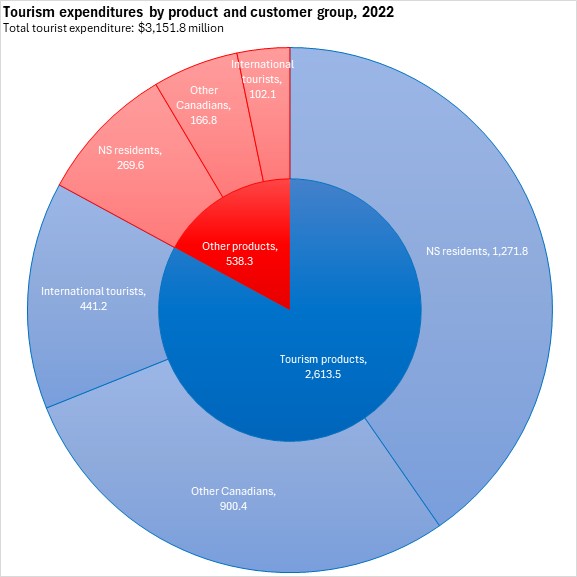
In Nova Scotia's Tourism Satellite Accounts for 2022, there was $3.1518 billion in tourism expenditures in the province. Tourism products accounted for $2.6135 billion while other products purchased by tourists amounted to $538.3 million.
Nova Scotia residents spending within the province were the largest part of tourism expenditures. Domestic tourism expenditures were $1.5414 billion in 2022: $1.2718 billion on tourism products along with $269.6 million on other products.
Visitors to Nova Scotia from other provinces spent $1,067.2 million in 2022: $900.4 million in tourism products and $166.8 million in other products.
International visitors to Nova Scotia made $543.3 million in tourism expenditures in 2022: $441.2 million in tourism products and $102.1 million in other products.
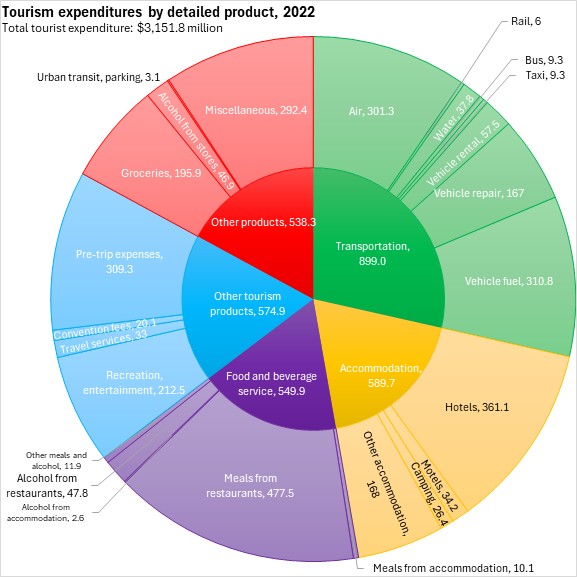
Tourism products can be broken down into four main categories: transportation, accommodations, food and beverage services and other tourism products. The largest parts of transportation expenditures were air travel and vehicle fuel, followed by vehicle repair/parts and vehicle rentals. Hotels made up the largest part of accommodation expenditures while restaurant meals make up the bulk of food and beverage service expenditures. Recreation and entertainment spending along with pre-trip expenses were the largest tourism product categories outside of transportation, accommodation and food/beverage services. Among specific tourism-related "other products", groceries were the largest individual item.
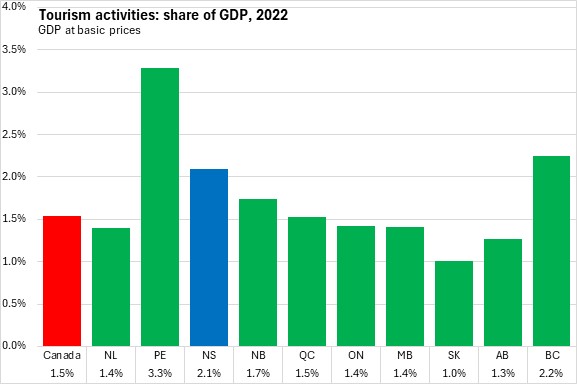
Tourism expenditures of $3.1518 billion generated Gross Domestic Product (GDP) of $1.0651 billion, which was 2.1% of Nova Scotia's total GDP in 2022. Across Canada, tourism GDP accounted for an average of 1.5% of GDP. Tourism share of GDP was highest in Prince Edward Island and British Columbia (followed by Nova Scotia). The lowest share of tourism in GDP was in Saskatchewan.
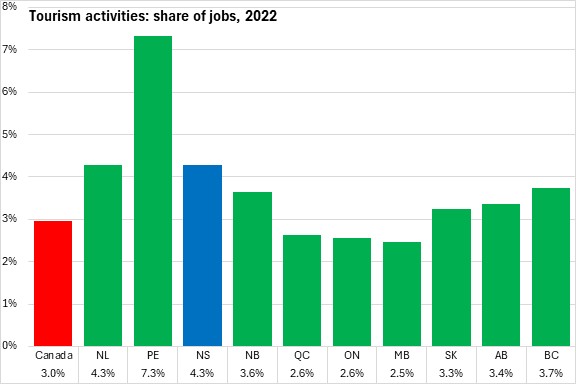
Tourism accounted 4.3% of total employment in 2022 - tied with Newfoundland and Labrador for second highest among provinces. This employment figure includes both full time and part time employment. Nationally, tourism accounted for 3.0% of employment. As with GDP, tourism had the highest portion employment in Prince Edward Island, followed by Nova Scotia and Newfoundland and Labrador. Tourism as a share of employment was lowest in Manitoba, Ontario and Québec.
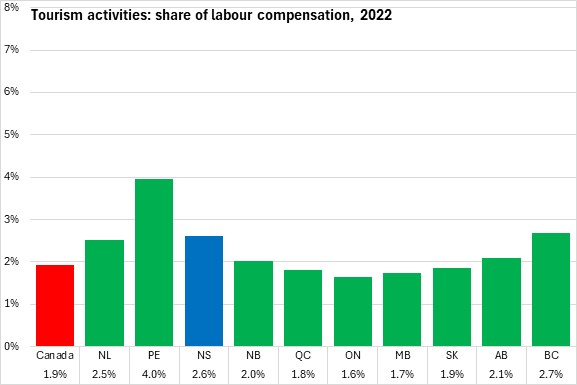
Tourism jobs accounted for 2.6% of Nova Scotia's labour income (third highest after Prince Edward Island and British Columbia). Tourism generated 1.9% of national labour income.
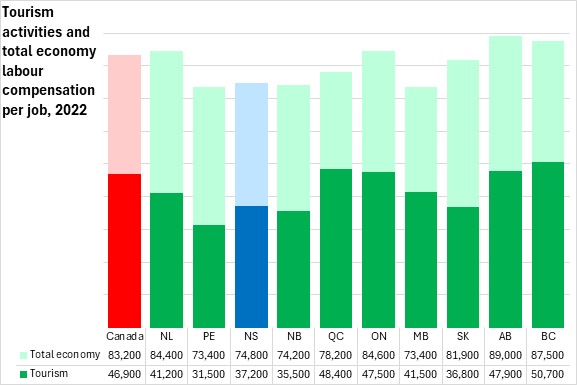
Part time and lower wage employment is more common in tourism industries than in the rest of the economy. Average labour income per tourism job was $37,200 in Nova Scotia, about 50% of the provincial average labour income per job.
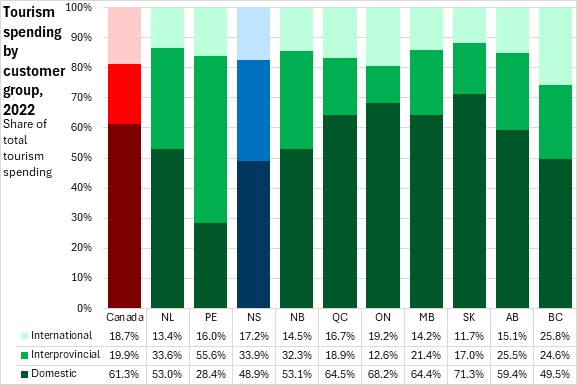
Domestic Demand (travel by residents from within a province) accounted for just under half of tourism product spending (48.9%), with the balance made up between interprovincial exports (visitors from another province in Canada: 33.9%) and international exports (visitors from another country: 17.2%).
The domestic share of tourism expenditures was highest in Saskatchewan. The lowest domestic share of tourism expenditure was in Prince Edward Island.
The interprovincial shares of tourism expenditures were highest in Prince Edward Island and lowest in Ontario.
International share of tourism expenditure was highest in British Columbia. The lowest shares of international expenditures in tourism were in Saskatchewan.
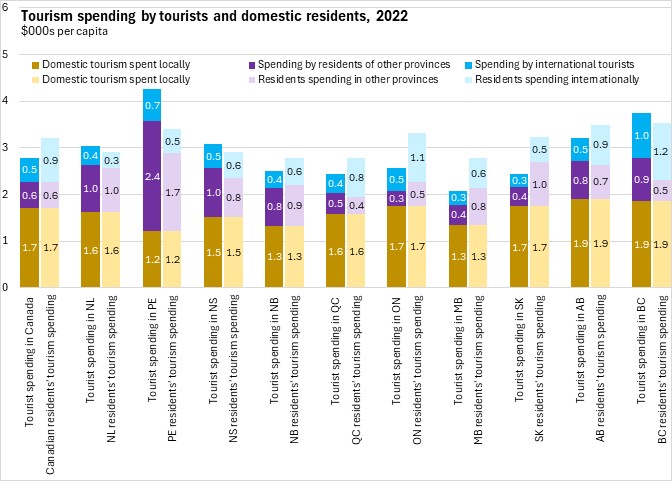
Looking at tourism expenditures by residents of each province, only Newfoundland and Labrador, Nova Scotia, Prince Edward Island and British Columbia reported more inbound tourism spending per capita than outbound tourism spending by residents.
Source: Statistics Canada. Table 24-10-0004-01 Provincial and territorial tourism supply and expenditure (x 1,000,000); Table 24-10-0042-01 Provincial and territorial gross domestic product (GDP) and employment generated by tourism and related measures (x 1,000,000); Table 24-10-0044-01 Interprovincial tourism expenditures (x 1,000,000)
<--- Return to Archive


