The Economics and Statistics Division maintains archives of previous publications for accountability purposes, but makes no updates to keep these documents current with the latest data revisions from Statistics Canada. As a result, information in older documents may not be accurate. Please exercise caution when referring to older documents. For the latest information and historical data, please contact the individual listed to the right.
<--- Return to Archive
For additional information relating to this article, please contact:
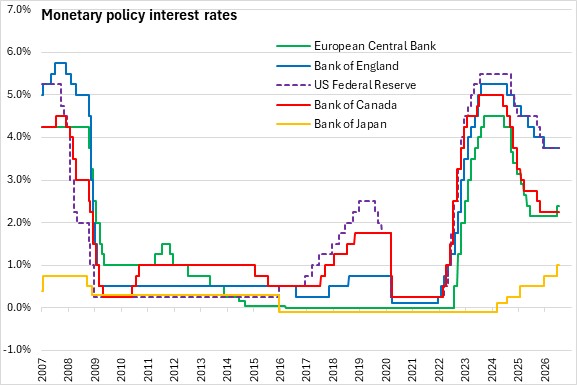
July 15, 2026BANK OF CANADA MONETARY POLICY The Bank of Canada maintained its target for the overnight rate at 2.25%, with the Bank rate at 2.50% and the deposit rate at 2.20%.
The global economic outlook has weakened due to higher oil prices linked to the conflict in the Middle East. Investment in Artificial Intelligence (AI) is supporting economic growth, particularly in the US and China. While oil prices remain below their April peak, the situation in the Middle East is still unstable, and the outlook for global inflation will depend heavily on how the conflict evolves. The Bank of Canada is projecting global GDP to ease from 3.5% in 2025 to 2.8% in 2026, then rise to 3.2% in 2027 and 2028.
US economic growth remains strong at 2.5% in the first half of the year, supported by consumption and AI-related investment. With lower oil prices in the second half of 2026, inflation is expected to ease but remain elevated. Labour markets have seen monthly job gains in the first half of 2026 and job growth has been more widespread across industries. Economic growth is expected to remain strong at 2.4% in 2026-2028.
High energy prices have slowed economic growth in the Euro Area in the first half of the year. Growth is projected to strengthen in second part of the year as energy prices come down and government spending on defense and infrastructure increases. The Bank of Canada estimates that the economic growth in the Euro Area will be 0.4% in 2026, 1.2% in 2027 and 1.3% in 2028.
China’s economy has been growing at a solid pace in first half of 2026 driven by fiscal support and exports of AI-related products. The property sector continues to weigh on growth. The Bank of Canda forecasts China’s GDP to grow 4.7% in 2026, 4.2% in 2027 and 4.1% in 2028.
Despite the Canadian economy showing signs of improvement, there are still risks and uncertainties related to the war in the Middle East and US trade policy.
Labour demand remains weak and job turnover is low. Businesses are keeping existing workers but remain cautious about hiring due to uncertainty and soft demand, and expect hiring to stay modest. Labour supply growth has also slowed because of weak population growth and rising retirements. Wage growth remains near 3%.
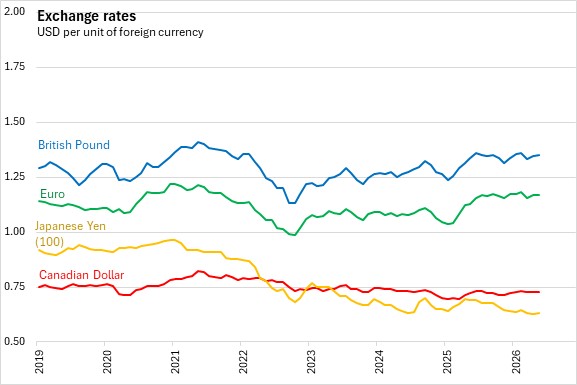
Canadian financial conditions have loosened further since the April Monetary Policy Report. Equity markets globally have stayed firm, bond yields have shown ongoing volatility, and the Canadian dollar has depreciated against the US dollar partly due to a widening spread between US and Canadian government bond yields.
Second-quarter growth is estimated to have rebounded to 2.5% after stalling in the first quarter, largely as temporary drags fade and growth became more broad-based. Exports are expected to pick up over the projection period, while consumer and government spending remain key drivers. Business and residential investment are also projected to recover modestly, however, housing activity is hampered by affordability challenges, slow population growth and elevated economic uncertainty. The Bank of Canada expects economic growth to outpace potential output over the projection horizon. GDP is projected to grow 0.7% in 2026, then rise to 1.8% in 2027 and 2028.
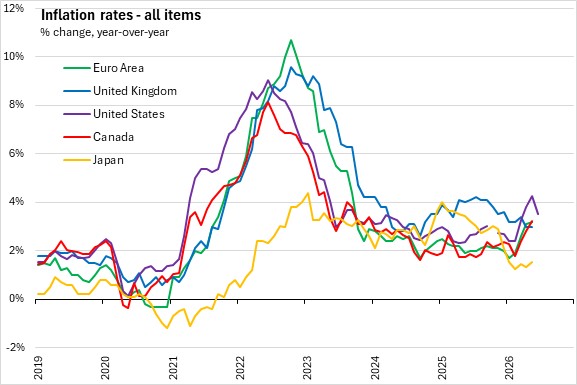
CPI inflation rose further to 3.2% in May, which reflects high energy prices. Excluding gasoline, inflation was 2.2% and measures of core inflation remained close to 2%. Inflation is expected to ease from about 3% in the second quarter of 2026 to about 2.5% over the second half of the year. Food price inflation is expected to remain elevated and shelter price inflation is expected to further ease. The Bank of Canada projects CPI inflation to average 2.5% in 2026, 2.0% in 2027 and 2.1% in 2028.
The Governing Council sees the current policy rate at about the right level to keep inflation close to 2.0% while closely monitoring the impact of the conflict in the Middle East and trade policy uncertainty. If the outlook changes, they are prepared to respond and will be assessing incoming data carefully relative to the Bank’s forecast.
The next scheduled date for announcing the overnight rate target is September 2, 2026 and the Bank’s next Monetary Policy Report will be released October 28.
Source: Monetary Policy press conference; Monetary Policy press release; Monetary Policy Report, July 2026
<--- Return to Archive


