The Economics and Statistics Division maintains archives of previous publications for accountability purposes, but makes no updates to keep these documents current with the latest data revisions from Statistics Canada. As a result, information in older documents may not be accurate. Please exercise caution when referring to older documents. For the latest information and historical data, please contact the individual listed to the right.
<--- Return to Archive
For additional information relating to this article, please contact:
August 28, 2026CANADIAN ECONOMIC ACCOUNTS, Q2 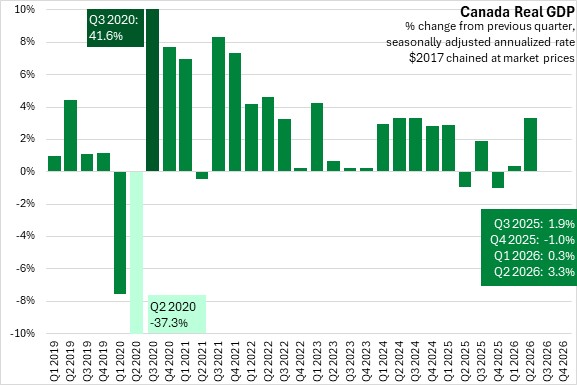
Canada’s Real Gross Domestic Product (GDP) expanded at a seasonally adjusted annualized rate of 3.3% (all figures seasonally adjusted at annual rates) in the second quarter of 2026, following growth of 0.3% in Q1. Canada's real GDP expanded for two consecutive quarters for the first time since Q1 of 2025.
The 3.3% expansion was primarily driven by higher exports (15.1%) and investment in both residential (10.4%) and non-residential (12.3%) structures. Household consumption and government consumption were also contributors. Inventory drawdown represented the largest drag on Q2 real GDP growth.
On a per capita basis, real GDP increased 1.0% as Canada's population declined for a third consecutive quarter.
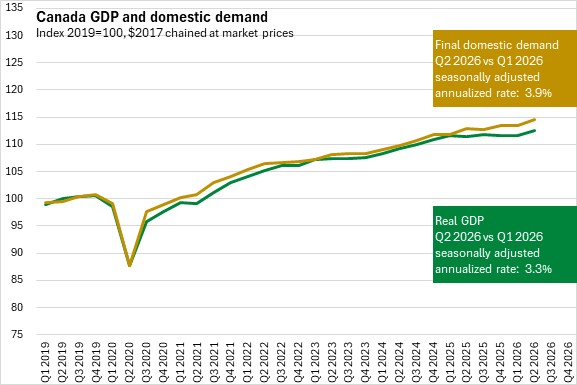
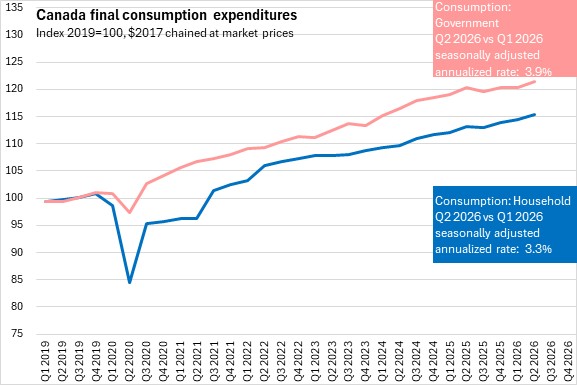
Household consumption expenditures increased 3.3% (seasonally adjusted annualized rate) in Q2 2026, led by higher spending on mutual funds and other investment services, passenger vehicles and rent.
Government consumption expenditures rose 3.9%, while overall final domestic demand increased 3.9% during the second quarter.
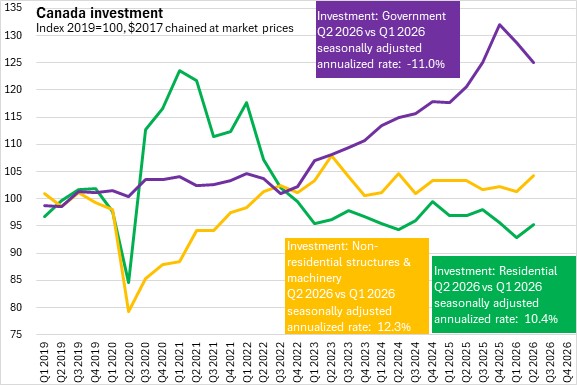
Residential investment rebounded, increasing 10.4% (seasonally adjusted annualized rate) in Q2 2026. Gains were broad-based, with ownership transfer costs associated with housing resale activity increasing alongside higher new construction.
Non-residential investment in structures, machinery and equipment rose 12.3%, supported by higher spending on engineering structures, machinery and equipment, particularly computers and data-centre related equipment.
Government investment fell 11.0%, partially offsetting gains elsewhere in the economy.
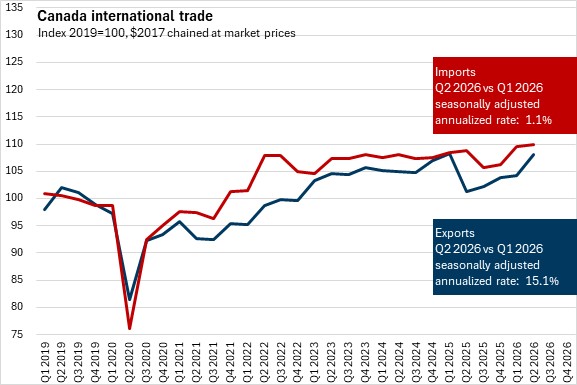
Exports increased by 15.1% in Q2 2026, the strongest quarterly gain since early 2023. Growth was driven primarily by a rebound in exports of passenger cars and light trucks following earlier production disruptions, along with higher exports of energy products, metals, and industrial machinery and equipment.
Imports rose by 1.1%, a much slower pace than in the first quarter. As a result, net exports made a significant positive contribution to economic growth.
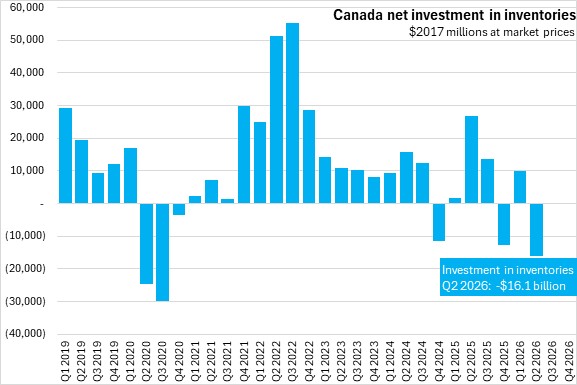
Investment in inventories reversed course in Q2 2026, as businesses withdrew approximately $17.0 billion from inventories following substantial stock accumulation in the previous quarter.
Drawdowns were led by manufacturers, wholesalers and farm operators, while higher exports of gold and precious metals also contributed to inventory reductions. The inventory decline partially offset strong growth in exports, consumption and investment.
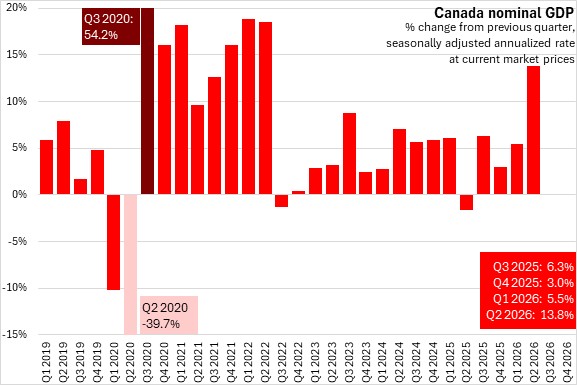
Nominal GDP increased 13.8% (seasonally adjusted annualized rate) in Q2 2026, following a 5.5% increase in Q1 2026.
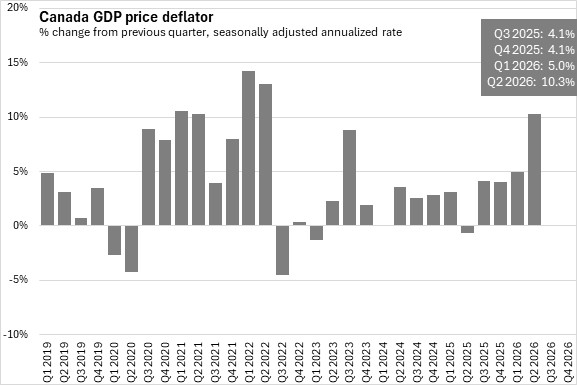
The overall GDP deflator, which reflects the prices of domestically produced goods and services, increased 10.3% (seasonally adjusted annualized rate) in Q2 2026, the strongest increase since 2022. Rising export prices, particularly for energy products, outpaced import prices, resulting in a 3.3% increase in Canada's terms of trade.
Employee compensation (measured in current prices, not real volumes) increased by a seasonally adjusted annualized rate of 6.0% in Q2 2026. Wage growth was led by finance, real estate, company management and trade industries, contributing to gains in household spending and overall economic activity during the quarter.
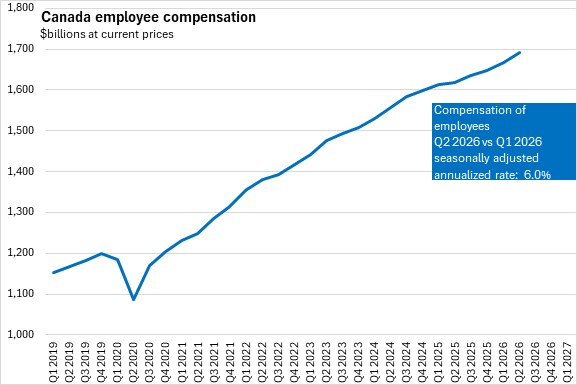
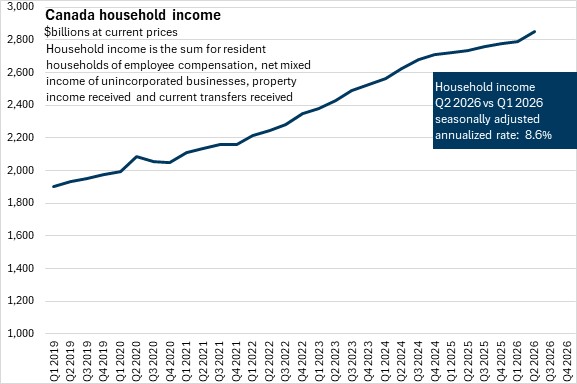
Including mixed income from unincorporated businesses, property income (such as interest and dividends from financial assets), current transfers (such as CPP and EI) with employee compensation, Canada's overall household income grew at a seasonally adjusted annualized rate of 8.6% in Q2 2026. Growth was supported by higher wages and salaries as well as increased government transfers.
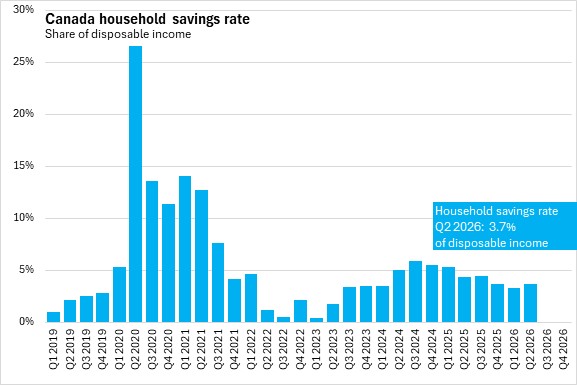
The household savings rate increased by 0.4 percentage points to 3.7% of disposable income in Q2 2026, as household income growth outpaced consumer spending. While the savings rate remained below levels recorded through most of 2024, it increased from the 3.3% recorded in Q1 2026.
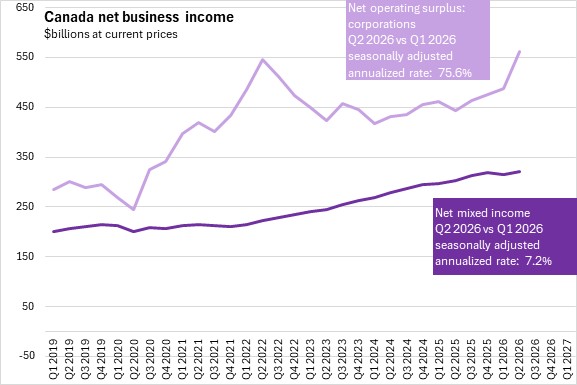
Net operating surplus of corporations increased by a seasonally adjusted annualized rate of 75.6% in Q2 2026, reflecting a sharp rise in corporate profits. Higher energy prices boosted incomes in the energy sector, while financial corporations also benefited from stronger investment activity. Net mixed income of unincorporated businesses rose 7.2%, reversing the decline recorded in Q1 2026.
Source: Statistics Canada. Table 36-10-0103-01 Gross domestic product, income-based, quarterly (x 1,000,000), Table 36-10-0104-01 Gross domestic product, expenditure-based, Canada, quarterly (x 1,000,000), Table 36-10-0112-01 Current and capital accounts - Households, Canada, quarterly; Table: 36-10-0106-01 Gross domestic product price indexes, quarterly
<--- Return to Archive


