The Economics and Statistics Division maintains archives of previous publications for accountability purposes, but makes no updates to keep these documents current with the latest data revisions from Statistics Canada. As a result, information in older documents may not be accurate. Please exercise caution when referring to older documents. For the latest information and historical data, please contact the individual listed to the right.
<--- Return to Archive
For additional information relating to this article, please contact:
April 17, 2026PRINCE EDWARD ISLAND BUDGET 2026-27 The Province of Prince Edward Island released its provincial budget for 2026-27 on April 14, 2026.
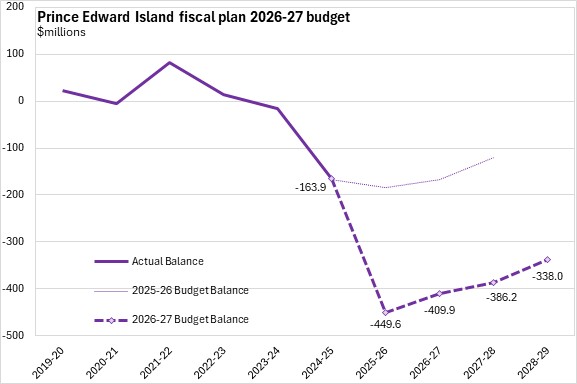
Prince Edward Island's 2026-27 budget anticipates a deficit of $409.9 million, slightly smaller than the $449.6 million deficit now forecast for the 2025-26 fiscal year. Prince Edward Island expects to the deficit to fall to $386.2 million in 2027-28 and $338.0 million in 2028-29.
Prince Edward Island's provincial government revenues are projected to grow by 3.5% in 2026-27 while expenditures are projected to rise by 2.0%. Prince Edward Island's revenue growth is projected to accelerate to 4.4% in 2027-28 and to 4.7% in 2028-29 while expenditures grow by 3.3% in 2027-28 and by 3.0% in 2028-29.
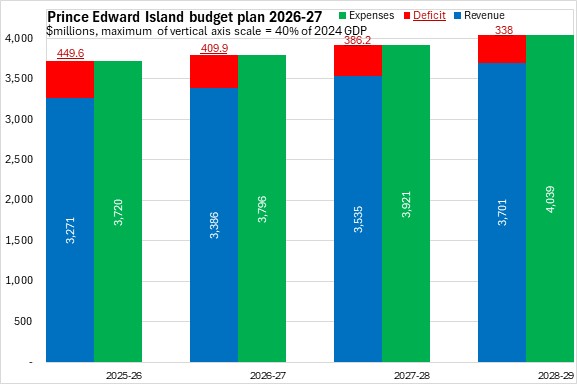
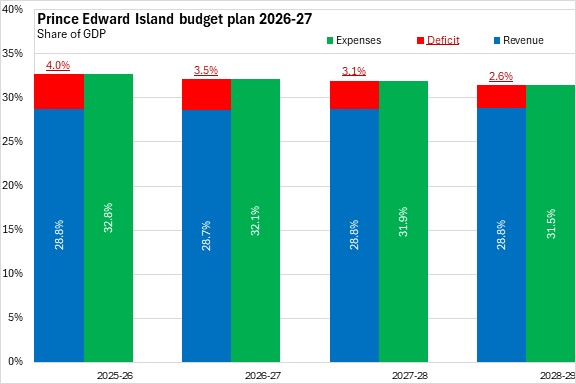
Measured as a share of GDP, the footprint of provincial government in Prince Edward Island's economy amounts to 32.1% of GDP in 2026-27. This is projected to shrink somewhat to 31.5% of GDP by 2028-29. Prince Edward Island's deficit for 2026-27 amounts to 3.5% of projected 2026 nominal GDP.
Prince Edward Island's net debt is expected to be 38.1% in the planning projection for 2026-27, growing to 39.8% of GDP in 2027-28, and 39.9% in 2028-29.
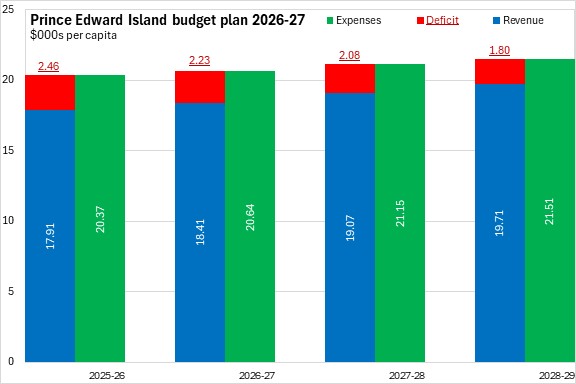
Prince Edward Island's 2026-27 Budget expenditures amount to $20,639 per capita, funded by revenues of $18,410 per capita and a deficit of $2,228 per capita. Expenditures per capita are projected to rise by $868 by 2028-29 while per capita revenues rise $1,297 and the per capita deficit decreases to $1,800 per capita.
Compared with last year's fiscal plan, Prince Edward Island now anticipates weaker revenues with higher expenditures.
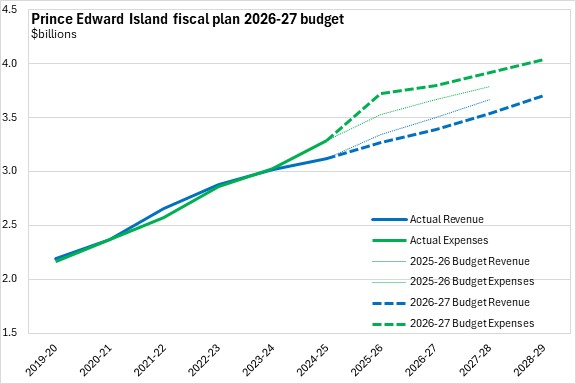
Prince Edward Island's budget position has deteriorated compared to the previous fiscal plan.
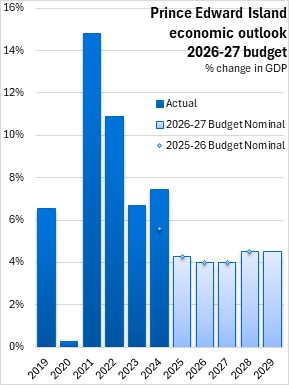
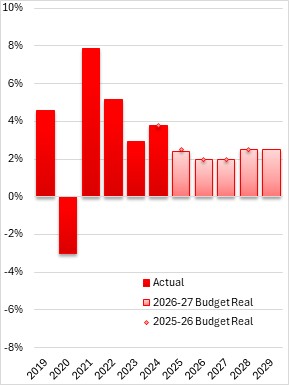
Population growth is expected to slow from recent years due to changes in Federal and Provincial migration policies. Employment growth is expected to slow in line with slower population growth. Limited growth in the working-age population is expected to result in wage growth in higher earning occupations, as well as planned minimum wage increases and increases in collective agreements. Prince Edward Island's construction sector is expected to continue to grow as housing starts remain elevated. The Prince Edward Island Budget assumes real GDP growth of 2.0% in 2026 and 2027 (4.0% in nominal terms), picking up to 2.4% in 2028 and 2029 (4.5% nominal for both years).
Key Measures and Initiatives
Prince Edward Island's budget initiatives can be summarized through three key themes: affordability, community, land and economy, healthcare and education. Key measures include:
Affordability for Islanders
- $81.6 million to reach $10/day childcare
- Social Assistance program, including community care facilities support ($69.3 million)
- Support for those with disabilities, including AccessAbility Supports program and residential services ($68.5 million)
- Island Essentials Benefit for low income Islanders to offset the cost of essential household expenses ($26 million)
- Housing supports, including mobile vouchers for tenants and rent supplement program, transitional housing and shelter supports ($25.4 million)
- $8.3 million for the PEI School Food program
- PEI Home Heating program to assist with home heating costs ($7.2 million)
- Enhanced PEI Child Benefit to address cost of living pressures ($4.5 million)
- Support for seniors, including the Seniors Independence Initiative ($3.4 million)
- Reducing taxes by increasing (as of Jan 1 2026) the basic personal amount, spousal and equivalent amount, and income threshold for the low-income tax reduction ($3.2 million)
- Maintaining existing personal income tax rates for Islanders earning less than $200,000/year
- Free universal pre-k ($1.6 million)
- Free K-9 school supplies ($985,000)
Communities, Land and Economy
- Business development, innovation, and export programs ($61.4 million)
- Infrastructure grants to communities ($54.6 million)
- Oil-to-Heat Pump Affordability program ($15.6 million)
- Home Insulation programs ($10.1 million)
- $7.5 million for the Rural Growth Initiative, which will support community-led projects in rural communities
- Sustainable Canadian Agriculture Partnership programs ($7.0 million)
- Aquaculture contingency fund ($6.0 million)
- Rural transit routes ($3.0 million)
- Trade and market development initiatives ($2.3 million)
- Watershed management fund ($2.1 million)
- Protected areas fund ($1.5 million)
- Home Energy Assessments ($1.3 million)
- Interim Coastal Policy Recommendation fund ($987,000) to implement recommendations to guide shore development and adapt to climate change
- $819,000 for the Joint Enforcement Team to support community safety initiatives
- Energy Strategy Phase 1 implementation ($125,000)
Healthcare
- Continuing Pharmacare programs ($76 million)
- Advancing the patient medical home model, increasing access to more holistic care ($57.8 million)
- Recruitment and retention of healthcare workers ($30.9 million), and support 5 internationally trained physicians to be practice ready for PEI, in partnership with Nova Scotia ($875,000)
- $25.8 million for UPEI Faculty of Medicine and Health Sciences Centre
- Continuing seniors at-home healthcare support programs, including Self-Managed Care and At-Home Caregiver Support program ($15 million)
- $9.3 million to address MRI testing, lab results and cataract surgeries wait times
- $5 million for 85 new long-term care beds
- $4 million for Prince County Hospital Foundation Learning and Innovation Centre
- Enhanced fertility supports for families ($705,000)
Education
- Post-secondary bursaries for Island students ($12 million)
Training PEI/LMDA, including 100% tuition subsidy programs for health professions ($10 million)
- 400 new early years spaces ($4.2 million)
- Additional educational assistants and youth service workers ($3.7 million)
- Jenkins report response ($1.4 million)
- Implement the Cyberviolence Prevention Strategy ($410,000)
Prince Edward Island Budget 2026-27
<--- Return to Archive


