The Economics and Statistics Division maintains archives of previous publications for accountability purposes, but makes no updates to keep these documents current with the latest data revisions from Statistics Canada. As a result, information in older documents may not be accurate. Please exercise caution when referring to older documents. For the latest information and historical data, please contact the individual listed to the right.
<--- Return to Archive
For additional information relating to this article, please contact:
October 27, 2025RESIDENTIAL HEATING FUEL AND EQUIPMENT, 2023 As part of the 2023 Survey of Households and the Environment, Statistics Canada surveyed Canadian households on the type of energy used primarily for residential heat as well as the type of equipment used as the main heating source.
Residential heating energy source, 2023
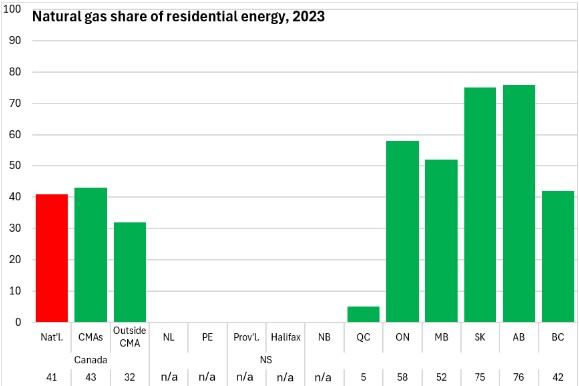
Across Canada, natural gas was the most commonly used energy source for residential heating in 2023. At 41% of residential energy, natural gas was ahead of electricity (35%). However, use of natural gas was primarily in Ontario and the western provinces. Natural gas made up only a small share of residential heating energy in Quebec and the Atlantic provinces. Data on Nova Scotia use of natural gas was unavailable.
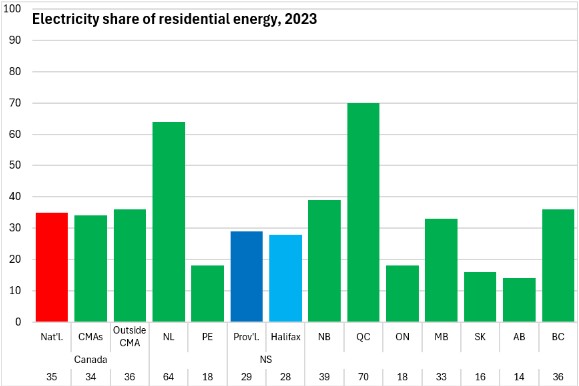
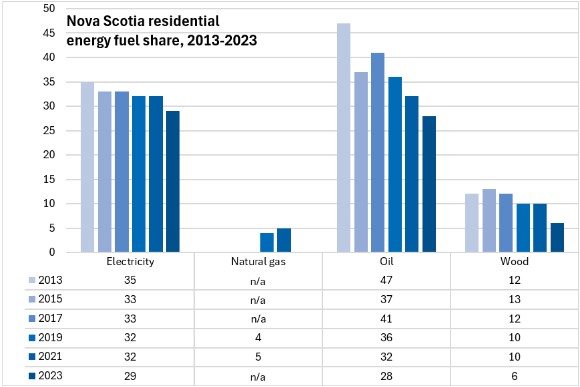
Electricity was Canada's second most common source of residential heating energy in 2023 (35%). This was notably higher in Quebec as well as in Newfoundland and Labrador. Electricity accounted for 29% of Nova Scotia's residential heating energy in 2023.
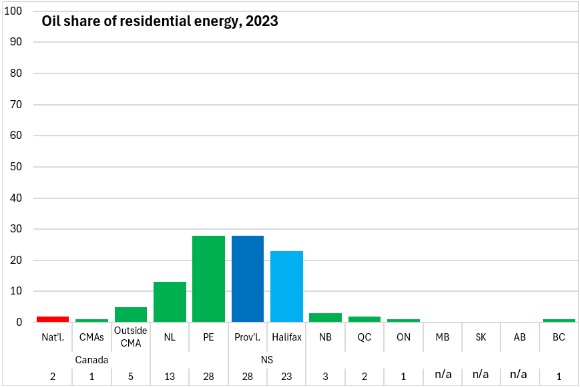
Unlike the rest of Canada, fuel oil makes up a large share of residential heating energy in Nova Scotia at 28% - just behind electricity as the most widely used residential heating energy in the province. Prince Edward Island (28%) also depends more heavily on fuel oil for residential heating. Across Canada, fuel oil makes up just 2% of residential heating energy, with very low usage in all provinces from New Brunswick to British Columbia.
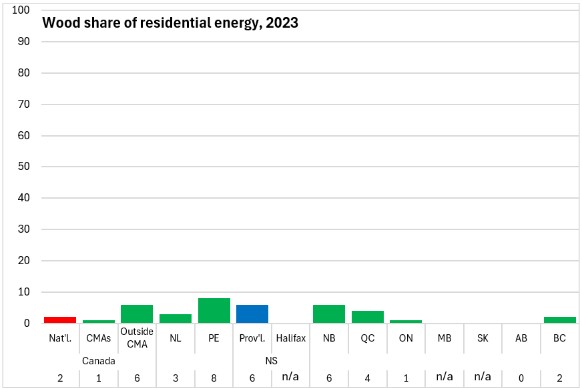
Although wood was a less commonly-reported source of residential heating energy (2% of the national total), it was more widely used in Atlantic Canada. Including solid wood as well as pellets, 6% of Nova Scotia's residential heating energy was fuelled by wood.
Residential heating equipment, 2023
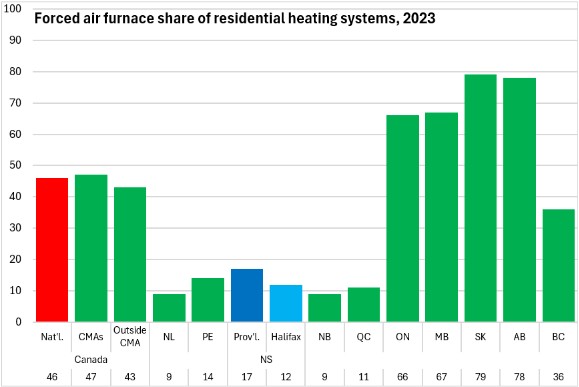
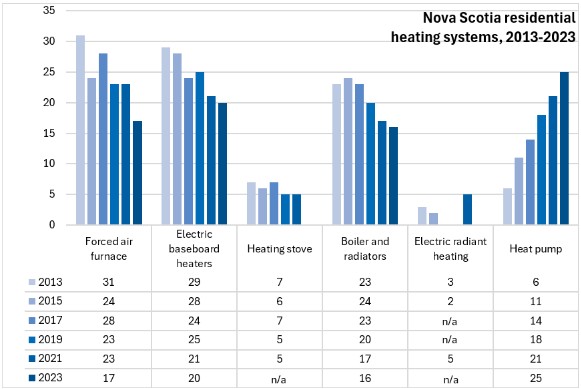
The forced air furnace was the most common appliance used to generate residential heating across Canada. Forced air furnaces made up 46% of residential heating equipment in Canada with notably higher shares in Ontario and Western Canada. Forced air furnaces were used in 17% of Nova Scotia residences in 2023 and were less commonly used across Quebec and the rest of Atlantic Canada.
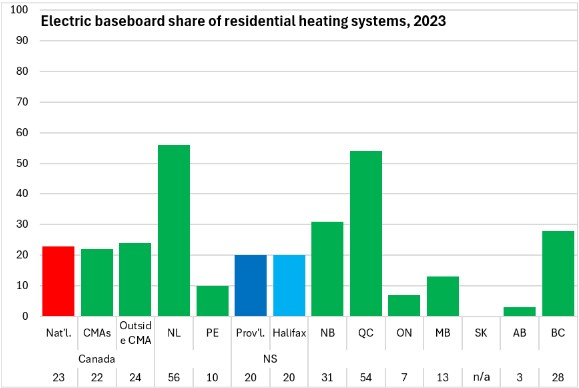
Electric baseboard heaters amounted to 23% of Canada's residential heating equipment. The share of electric baseboard heaters was higher in Quebec and Newfoundland and Labrador. In Nova Scotia 20% of residences used electric baseboard heaters.
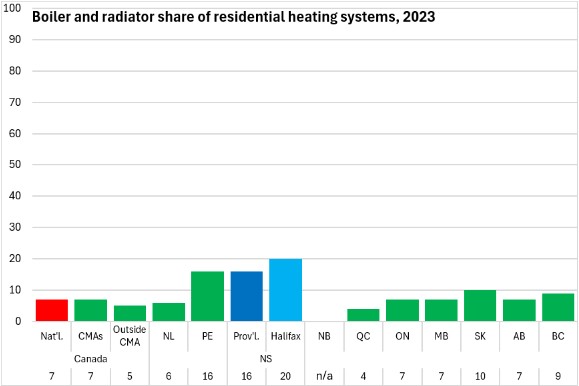
Boilers with water or steam radiators were used in only 7% of Canadian residences, but this was higher in both Nova Scotia (16%) and Prince Edward Island (16%).
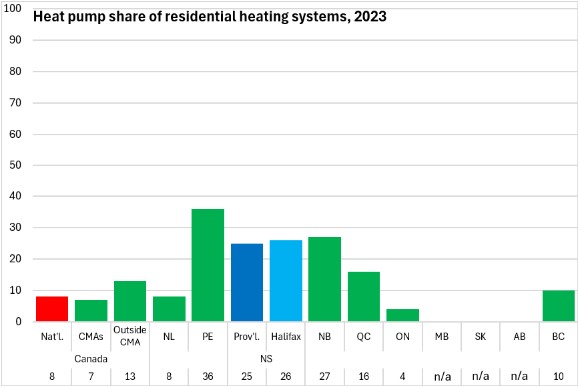
In Nova Scotia, 25% of residences used a heat pump as the primary energy equipment. Heat pumps were also more widely used in the Maritime provinces than across the rest of Canada (8% share nationally).
Trends
Since 2013, there has been a notable decline in the shares of residential heating provided by wood, oil and electricity. Data are unavailable on use of natural gas or other heating fuels in Nova Scotia.
Since 2013, there has been a substantial rise in the share of residences equipped with a heat pump in Nova Scotia. There have been declines in the use of forced air furnaces, electric baseboard heaters and boilers/radiators. As of 2023, the share of residences using heat pumps (25%) rose above that of electric baseboards (20%), forced air furnaces (17%) and boilers/radiators (16%). Data on the use of heating stoves and electric radiant heating were unavailable for Nova Scotia in 2023.
Source: Statistics Canada. Table 38-10-0286-01 Primary heating systems and type of energy
<--- Return to Archive


