The Economics and Statistics Division maintains archives of previous publications for accountability purposes, but makes no updates to keep these documents current with the latest data revisions from Statistics Canada. As a result, information in older documents may not be accurate. Please exercise caution when referring to older documents. For the latest information and historical data, please contact the individual listed to the right.
<--- Return to Archive
For additional information relating to this article, please contact:
November 27, 2025RESEARCH AND DEVELOPMENT SPENDING 2023 (FINAL), 2024 (PRELIMINARY) & 2025 (INTENTIONS) Today, Statistics Canada released gross domestic expenditures on research and development (R&D), for actual spending in 2023 at the provincial level as well as 2024 (preliminary) and 2025 (intentions) at national level.
Characteristics of research and development spending, 2023 (actual)
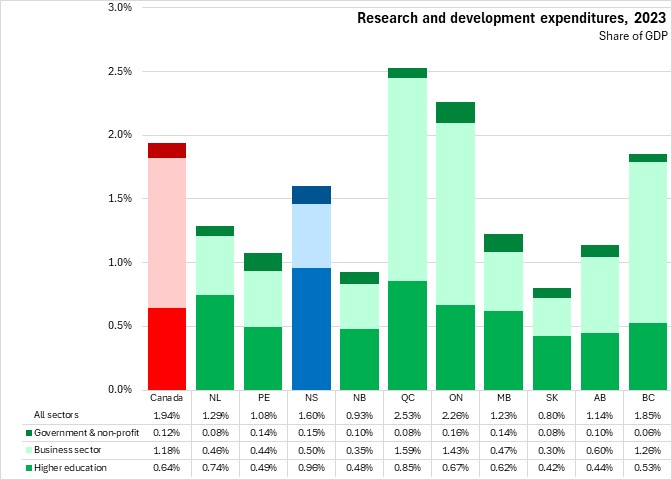
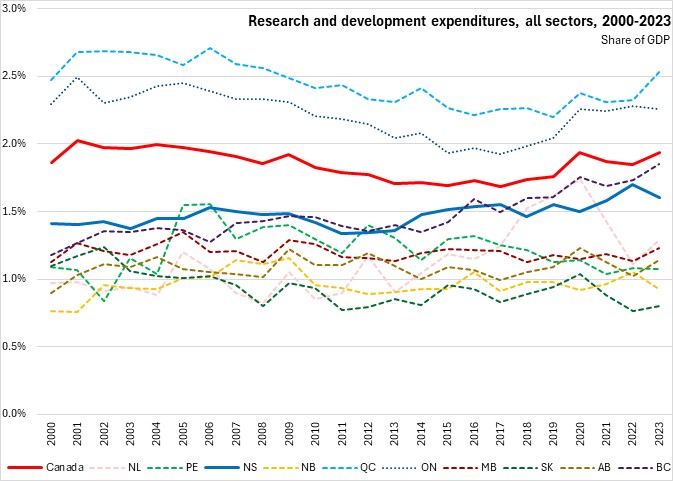
Nova Scotia's R&D expenditures as a share of GDP were 1.6% in 2023. Nationally, 1.9% of Canada's GDP is spent on R&D. R&D expenditures as a share of GDP were largest in Quebec at 2.5% and Ontario at 2.3%, while the lowest was in Saskatchewan (0.8%) in 2023.
In 2023, over 90% of national R&D spending occurred in four provinces: Ontario, Québec, British Columbia, and Alberta. Ontario alone reflected 44.8% of R&D expenditures in 2023 with the business enterprise sector reflecting 63% of all R&D in the province. Québec accounted for 25.7% of R&D expenditures, followed by British Columbia (13.4%) and Alberta (9.0%).
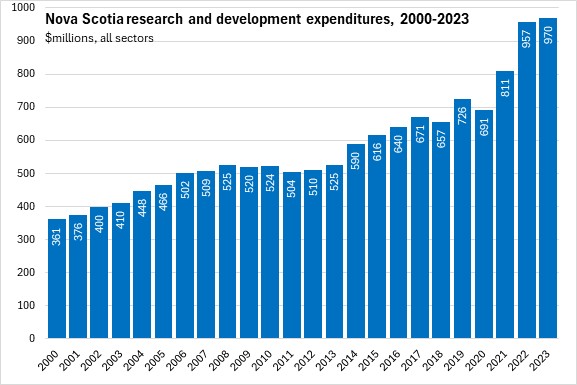
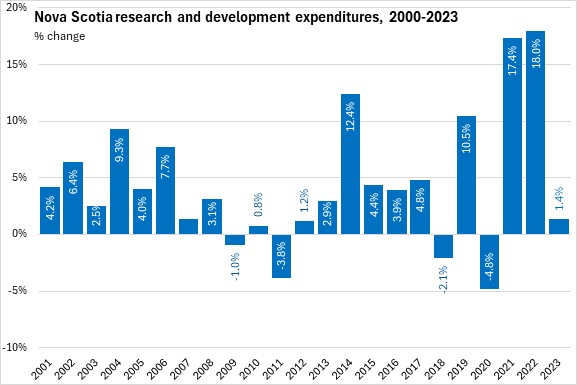
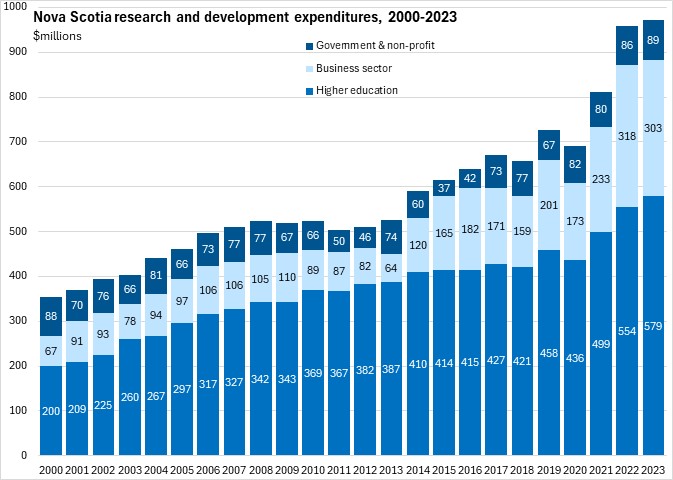
Nova Scotia's R&D spending in 2023 was $970 million for all sectors, 1.4% higher than the 2022 level of $957 million. Nova Scotia accounted for 1.7% of Canada's R&D though its economy was 2.0% of the national total in 2023.
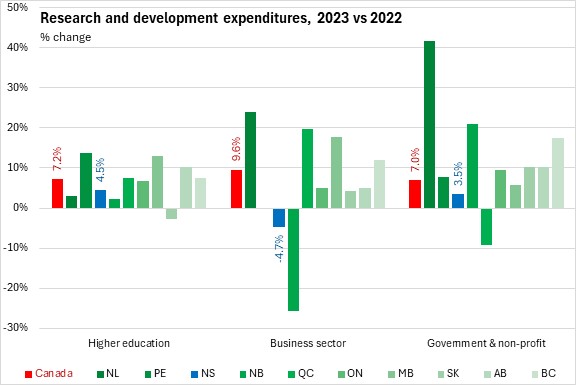
Nationally, gross R&D spending increased 8.6% in 2023. All provinces except New Brunswick reported growth in R&D expenditures. Québec and Manitoba reported the fastest growth over 2022.
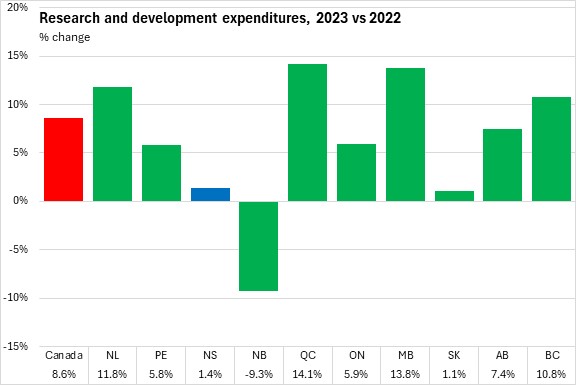
Nova Scotia reported increases in higher education (+4.5%) spending and government/non-profit (+3.5%) spending in 2023. All provinces except Saskatchewan reported increased higher education R&D spending in 2023. R&D spending by government and non-profits was up for all provinces except Québec in 2023. Business sector spending on R&D declined 4.7% in Nova Scotia in 2023, with seven provinces reporting increases. The fastest decline in business sector spending was in New Brunswick in 2023.
Nova Scotia's R&D spending is largely in the higher education sector, with $579 million in 2023. Business sector contributed $303 million to R&D spending in 2023. Government and non-profit are the smallest share of R&D spending with $89 million in 2023.
Nova Scotia's R&D as a share of GDP increased in each year from 2011 to 2017. Nova Scotia's R&D as a share of GDP peaked at 1.7% in 2022.
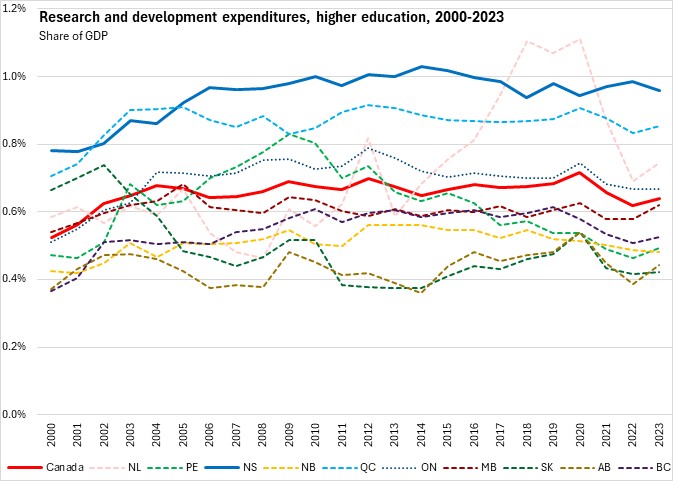
Higher education R&D spending has risen from around 0.8% in the early 2000s to around 1.0%. As a share of GDP, Nova Scotia has the highest R&D spending by higher education of all the provinces. The national average was 0.6% of GDP in 2023.
Business sector R&D increased from a recent low of 0.2% in 2013 to 0.6% in 2022, subsequently falling to 0.5% in 2023. Nationally, business sector R&D spending as a share of GDP averaged 1.2% in 2023. Ontario, Quebec and British Columbia have the highest business sector R&D spending as a share of GDP.
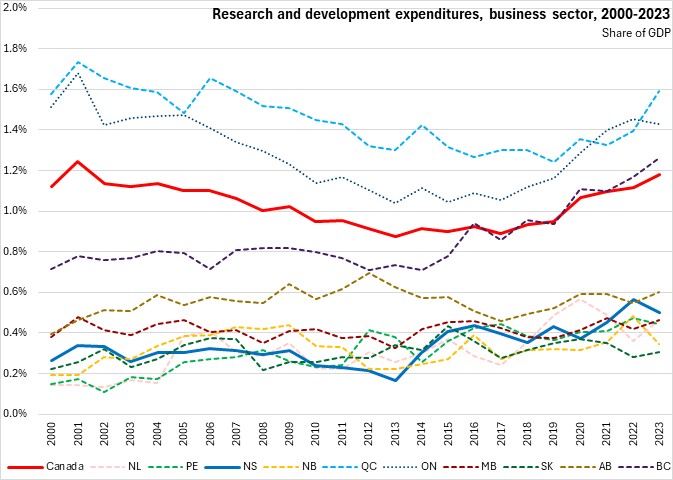
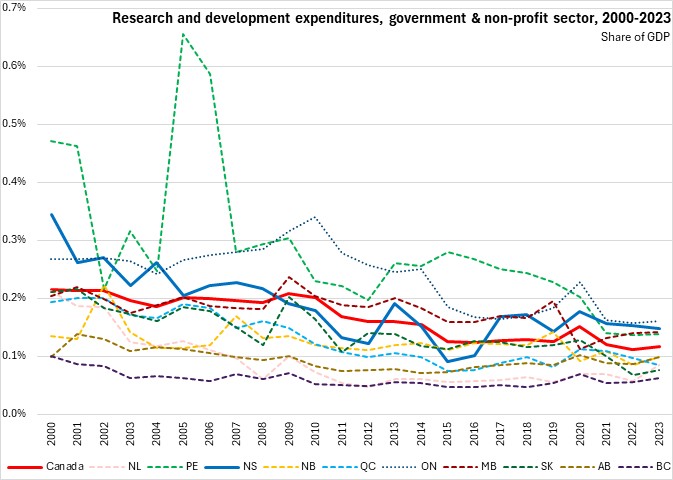
Nova Scotia's government and non-profit R&D spending was 0.15% of GDP in 2023. This sector reflects the smallest share of R&D spending in all provinces and has been steadily trending down as a share of GDP across the country. Nationally, government and non-profit R&D spending as a share of GDP was 0.1% in 2023.
National spending on research and development, 2025 (intentions)
Canada's expenditures on research and development (R&D) increased 8.6% in 2023 to $57.4 billion. Preliminary spending for 2024 is estimated to have fallen 2.9% to $55.7 billion, reflecting 1.8% of GDP. The intentions for 2025 are estimated to be $58.6 billion, an increase of 5.1%. Canada's R&D spending intentions for 2025 are up for higher education, business sectors and government while intentions are down in the non-profit sector.
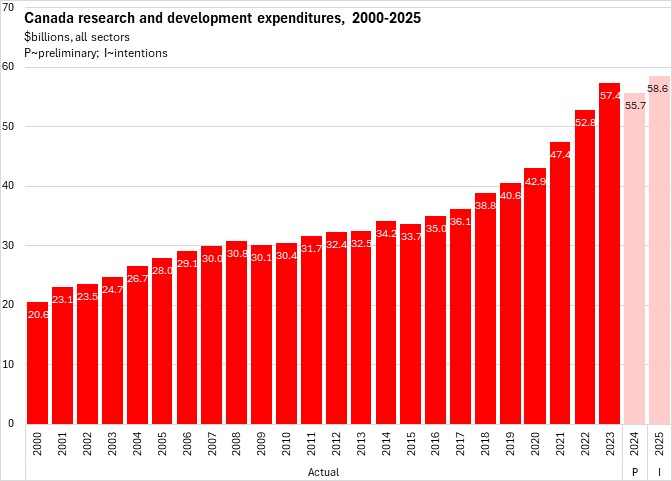
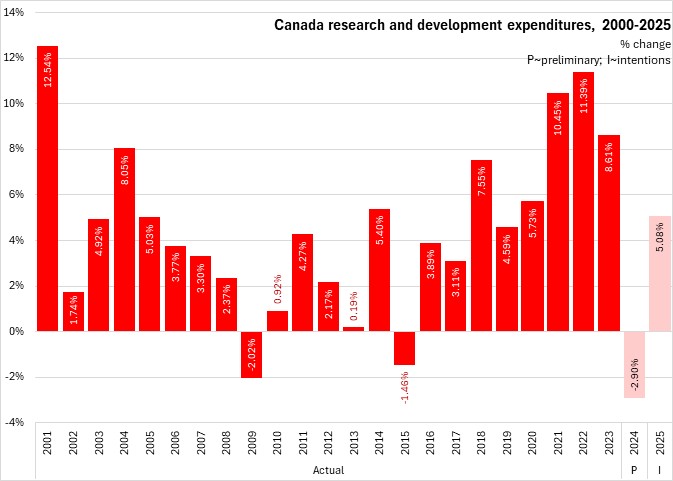
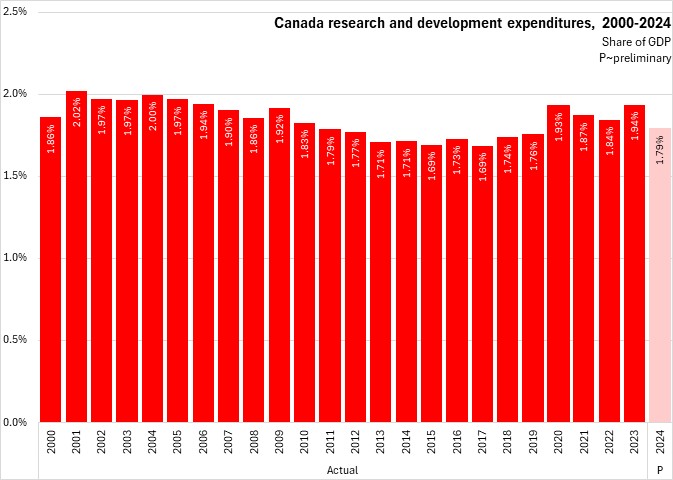
Source: Statistics Canada. Table 27-10-0273-01 Gross domestic expenditures on research and development, by science type and by funder and performer sector (x 1,000,000); Table 36-10-0222-01 Gross domestic product, expenditure-based, provincial and territorial, annual (x 1,000,000)
<--- Return to Archive


