The Economics and Statistics Division maintains archives of previous publications for accountability purposes, but makes no updates to keep these documents current with the latest data revisions from Statistics Canada. As a result, information in older documents may not be accurate. Please exercise caution when referring to older documents. For the latest information and historical data, please contact the individual listed to the right.
<--- Return to Archive
For additional information relating to this article, please contact:
January 07, 2026HOUSING DEVELOPMENT AND TRANSIT ACCESS, 2023 Data was recently released on housing development, recorded by the Canada Mortgage and Housing Corporation (CMHC), located within areas that had access to public transit. This data is further disaggregated by construction status, location (total, urban, and rural), dwellings, and market type of housing.
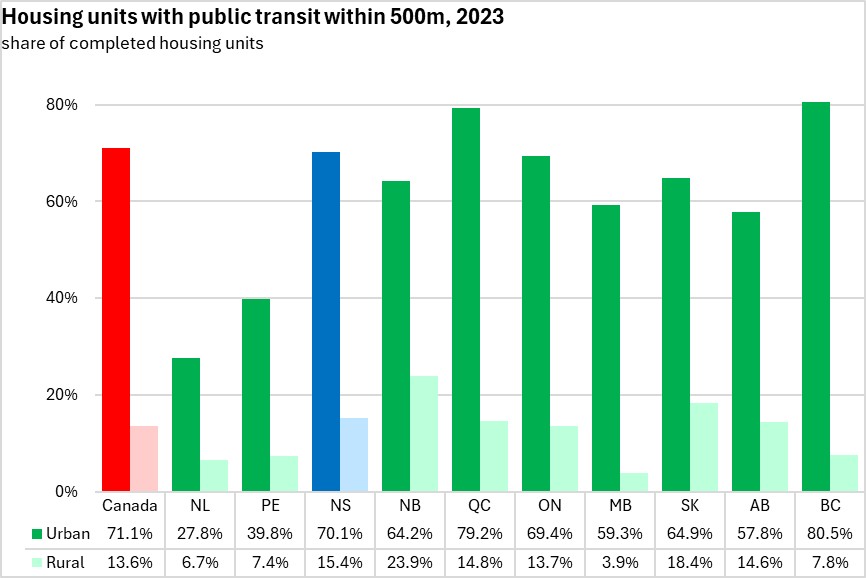
Across Canada, housing completions in urban areas were more likely to be located near public transit than in rural areas across all provinces. The provinces with the highest proportions of urban housing completions within 500m of public transit were British Columbia (80.5%), Québec (79.2%), and Nova Scotia (70.1%). Newfoundland and Labrador had the lowest proportion of urban housing completions near public transit at 27.8%. Provincial rural housing completions with access to public transit were most common in New Brunswick (23.9%), and least common in Manitoba (3.9%).
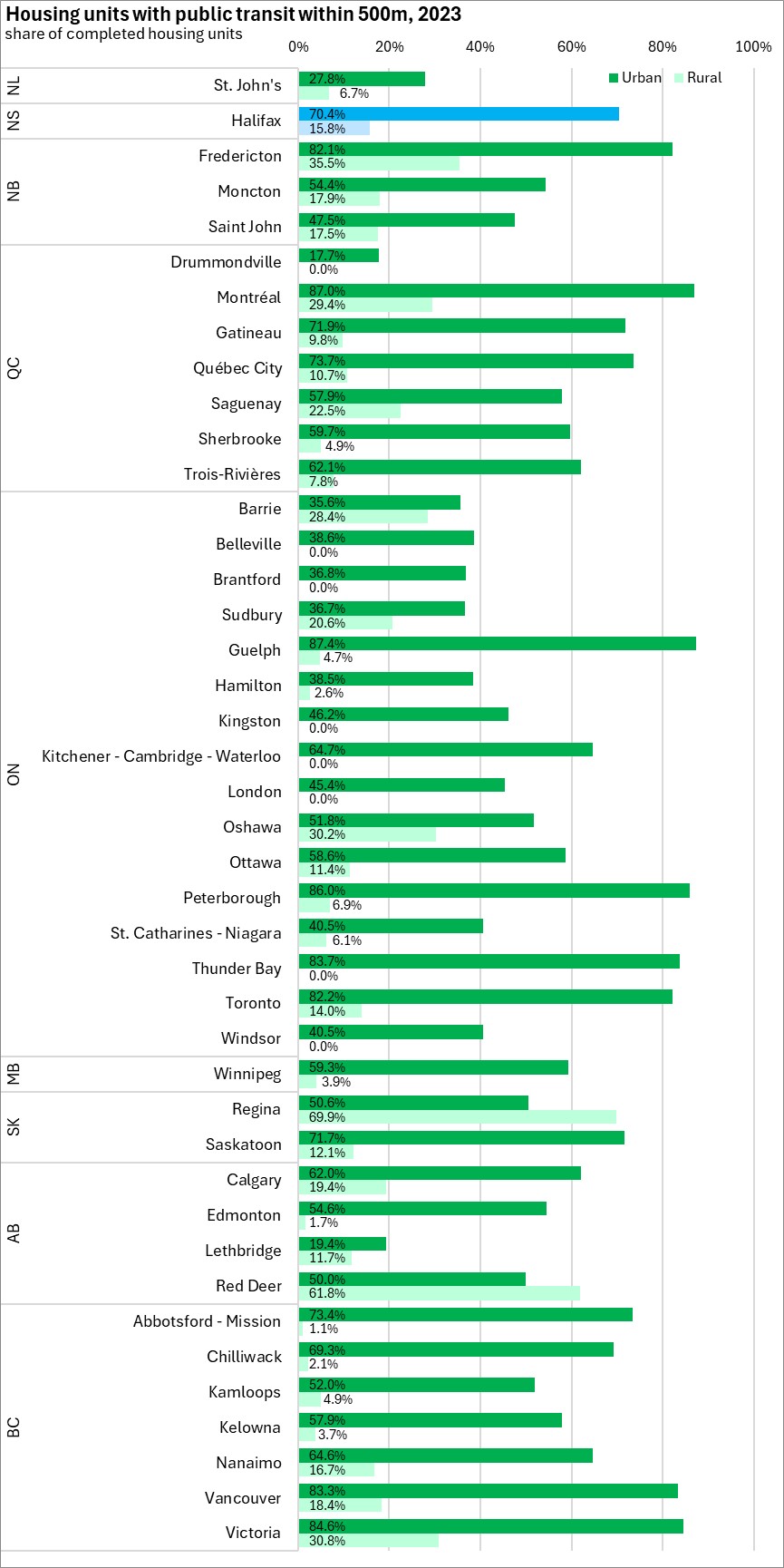
More than two-thirds (70.4%) of Halifax urban housing completions were within 500m of public transit, while 15.8% of urban completions had public transit access.
Urban housing completions with transit access were highest in Guelph, followed by Montréal and Peterborough. Urban transit access was lowest in Drummondville and Lethbridge.
Rural housing completions with transit access were highest in Regina and Red Deer, which were also the only two Census Metropolitan Areas (CMAs) which had a higher proportion of rural completions with transit access than urban.
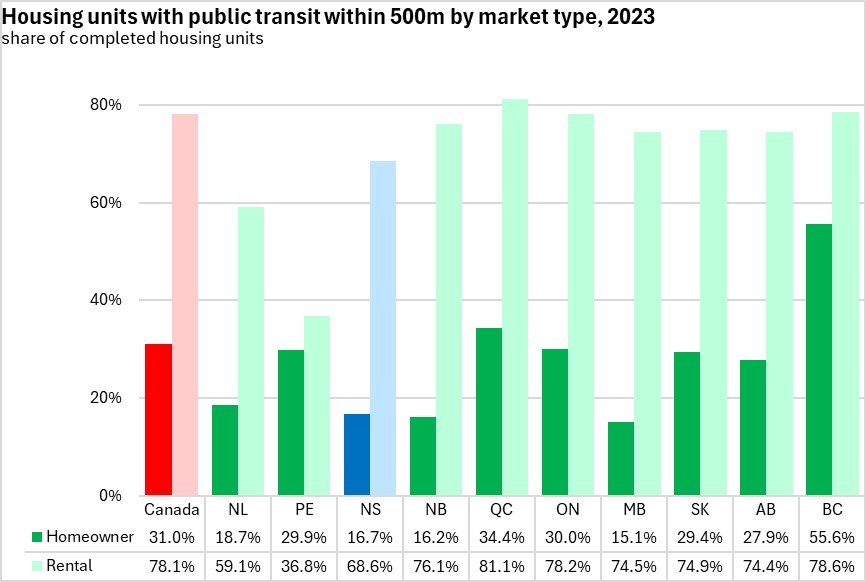
Across Canada, rental housing completions were more likely to occur within 500m of public transit than homes built for owner occupancy. In Nova Scotia, 68.6% of rental completions were near public transit, compared to 16.7% of owner-occupied completions. Among provinces Québec had the highest proportion of rental housing completions occurring near public transit, while Prince Edward Island had the lowest. Owner-occupied completions near public transit were most common in British Columbia, and least common in Manitoba.
In Halifax, 68.6% of rental housing completions were within 500m of public transit, compared to 16.8% of owner-occupied housing completions. Among CMA's, Belleville, Brantford, Guelph, Kingston and Peterborough saw all rental housing completions occurring within 500m of public transit. Sudbury and Red Deer saw the lowest proportions of rental housing being constructed near public transit, and alongside Kamloops were the only CMAs to observe higher levels of owner-occupied completions near transit than rental completions. Owner-occupied housing completions were most common in Red Deer and Vancouver, and the least common in Drummondville and Brantford.

Source: Statistics Canada. Table 34-10-0296-01 Residential housing development by access to public transport areas, geography, construction status, dwelling and market type, annual
<--- Return to Archive


