The Economics and Statistics Division maintains archives of previous publications for accountability purposes, but makes no updates to keep these documents current with the latest data revisions from Statistics Canada. As a result, information in older documents may not be accurate. Please exercise caution when referring to older documents. For the latest information and historical data, please contact the individual listed to the right.
<--- Return to Archive
For additional information relating to this article, please contact:
January 12, 2026HEALTH-ADJUSTED LIFE EXPECTANCY, 2023 Statistics Canada has recently released new data on the health-adjusted life expectancy of Canadians.
Health-adjusted life expectancy (HALE) is a measure that indicates the number of years in good health an individual is expected to live given their current health and overall life expectancy. HALE incorporates scores from the Health Utilities Index (Mark 3), which measures health-related quality of life across eight attributes, including vision, hearing, speech, ambulation, dexterity, emotion, cognition and pain. Health Utilities Index scores range from 1.0 (perfect health) to -.36 (respondent considers state worse than death). HALE is measured at birth and at age 65, representing the expected number of healthy years an individual has remaining.
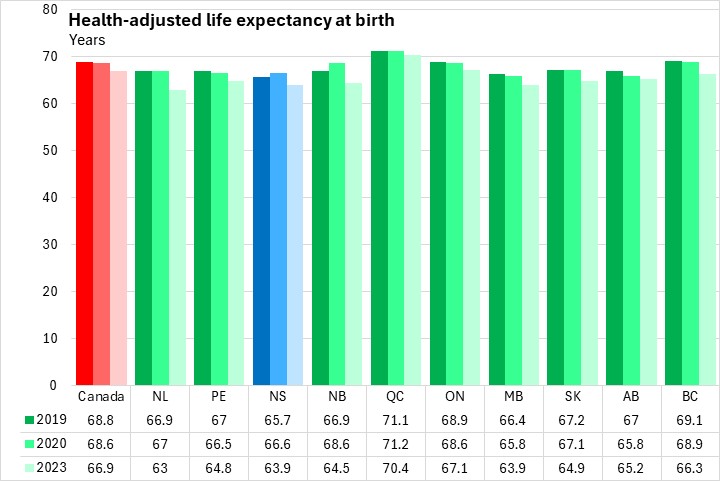
In Canada, health-adjusted life expectancy (HALE) at birth declined 1.7 years on average between 2020 and 2023, with declines in all provinces. In Nova Scotia, HALE at birth declined by 2.7 years between 2020 and 2023. The most notable decline between 2020 and 2023 occurred in New Brunswick (-4.1 years) and Newfoundland and Labrador (-4.0 years), while the smallest decline occurred in Alberta (-0.6 years).
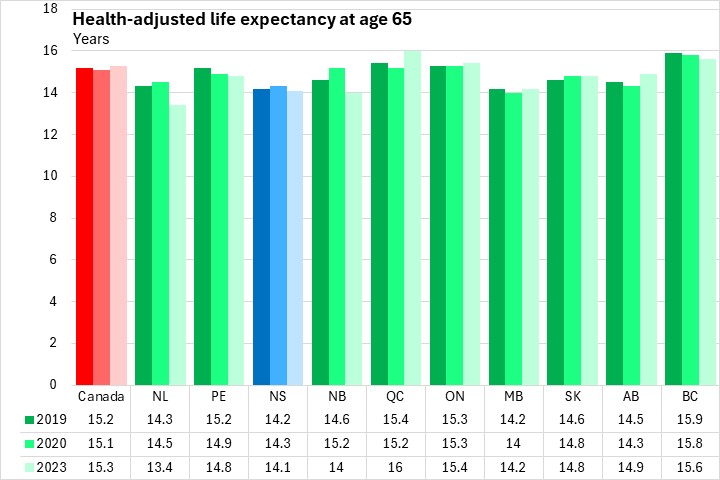
Nationally, HALE at age 65 increased 0.2 years on average between 2020 and 2023. Declines in HALE at age 65 were reported in the Atlantic provinces and British Columbia, with the largest decline reported in New Brunswick (-1.1 years) and Newfoundland and Labrador (-1.2 years). The largest increases in HALE at age 65 from 2020 to 2023 were reported in Québec (+0.8 years) and Alberta (+0.6 years).
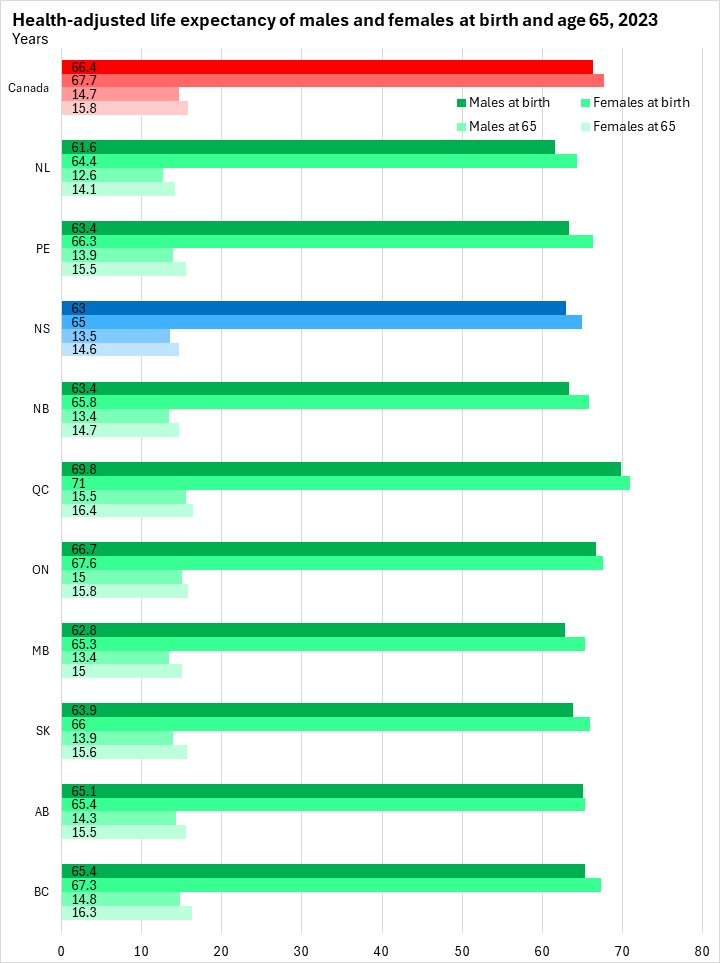
On a national level, HALE was higher for females than males in 2023, both at age 65 and at birth. At birth and at age 65, both male and female HALE's were highest in Québec and lowest in Newfoundland and Labrador. Prince Edward Island observed the largest gap between male and female HALE at birth and at age 65.
HALE at birth in 2023 generally increased with income, with the highest birth HALE occurring in the top income quintile in every province except New Brunswick, where the fourth income quintile had a HALE at birth 0.8 year's longer than the top income quintile. Other notable exceptions occurred in Newfoundland and Labrador and Prince Edward Island, where the third income quintile had a higher HALE at birth than the fourth income quintile.
Québec had the highest HALE at birth for both the top and bottom income quintiles, while the lowest HALE for the top income quintile occurred in Newfoundland and Labrador, and the lowest HALE at birth for the bottom income quintile occurred in Manitoba.
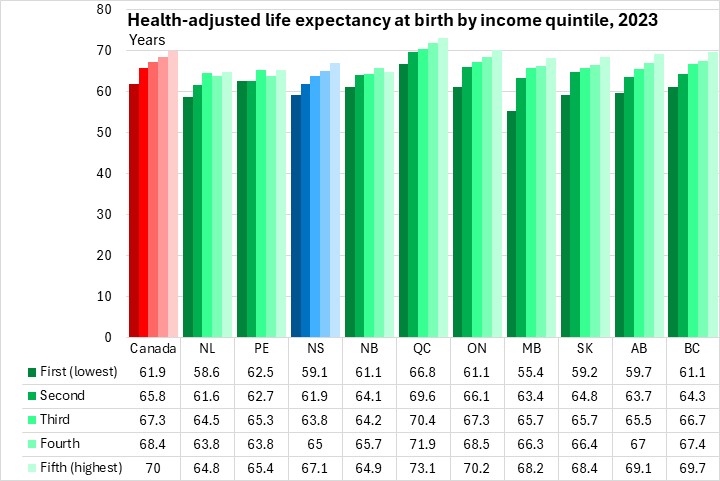
HALE's at age 65 were again generally highest for the top quintile of income earners, with exceptions in New Brunswick and Manitoba. In New Brunswick, HALE at age 65 was highest for the third income quintile. Lower income quintiles having a higher HALE than higher quintiles was more common at age 65 than at birth.
The highest HALE for the top and bottom income quintiles occurred in Québec. The lowest HALE for the top quintile of income earners occurred in Newfoundland and Labrador, while the lowest HALE for the bottom quintile of income earners was reported in Manitoba.
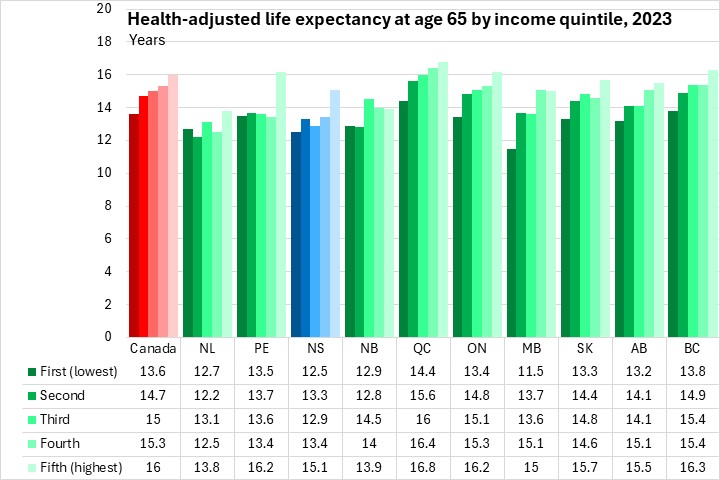
Source: Statistics Canada. Table 13-10-0971-01 Health-adjusted life expectancy, by sex and income quintile
<--- Return to Archive


