The Economics and Statistics Division maintains archives of previous publications for accountability purposes, but makes no updates to keep these documents current with the latest data revisions from Statistics Canada. As a result, information in older documents may not be accurate. Please exercise caution when referring to older documents. For the latest information and historical data, please contact the individual listed to the right.
<--- Return to Archive
For additional information relating to this article, please contact:
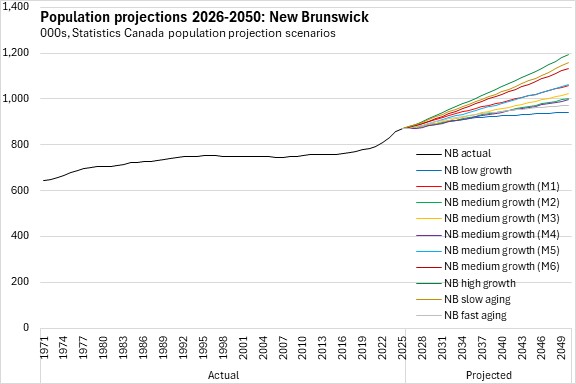
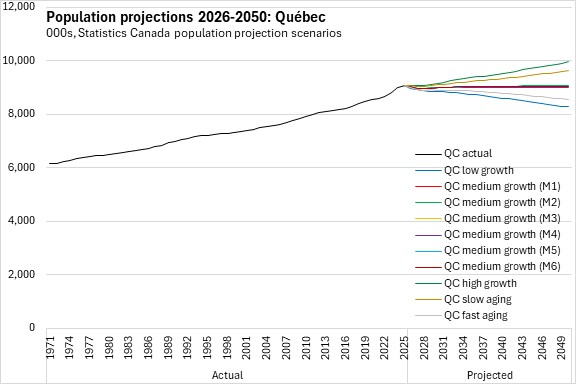
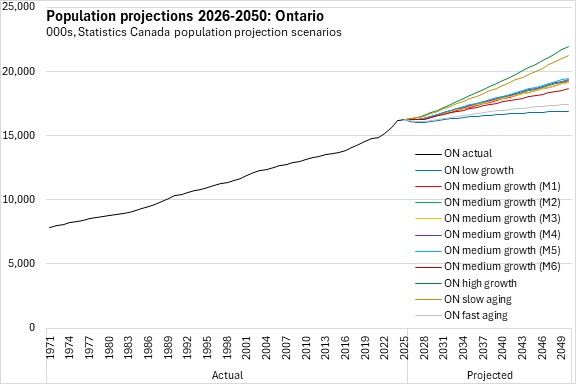
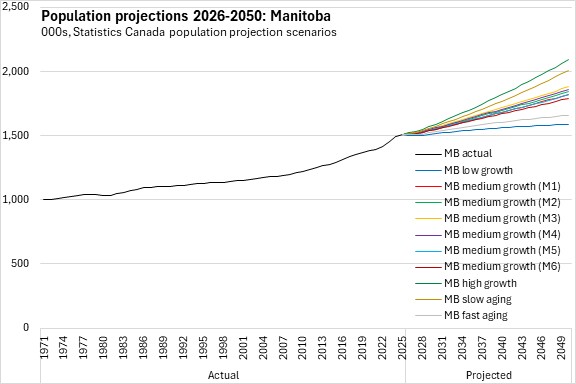
January 27, 2026STATISTICS CANADA POPULATION PROJECTIONS, 2025-2050 Statistics Canada has revised and updated its population projections. Projections for provincial population are available through 2050. Statistics Canada cautions that its projections: "...are not intended to be interpreted as predictions about what will happen in the future. They should instead be understood as an exercise designed to investigate what the Canadian population might become in the years ahead according to various scenarios of possible future change. For this reason, Statistics Canada always publishes several scenarios and formulates several explicit assumptions regarding the main components of population growth. Accordingly, users are encouraged to consider several scenarios when they analyze the projection results. It is also worth noting that the accuracy of the projections produced depends on several factors. Various events—for example, economic crises, pandemics, wars or natural catastrophes—are difficult (or impossible) to anticipate and can affect the growth and composition of the Canadian population."
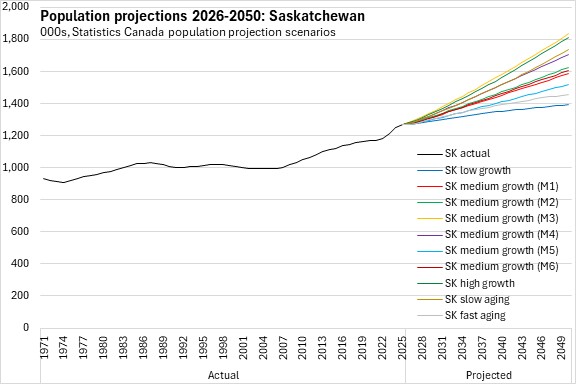
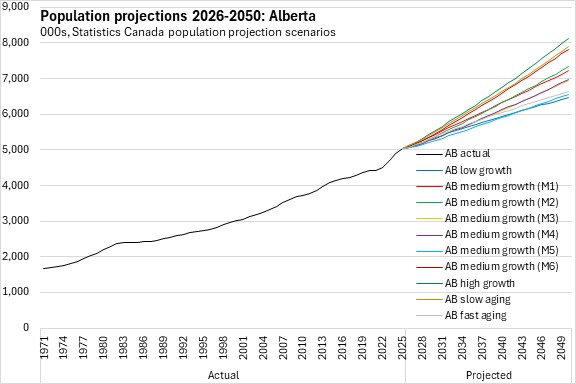
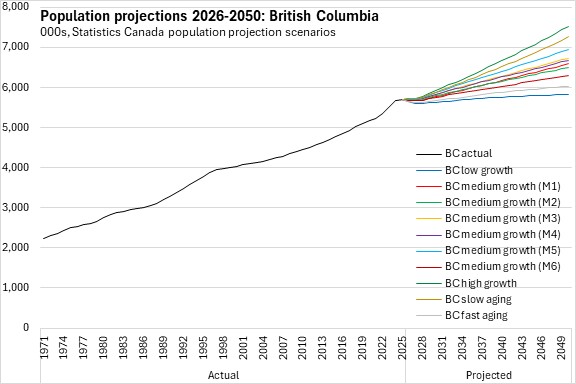
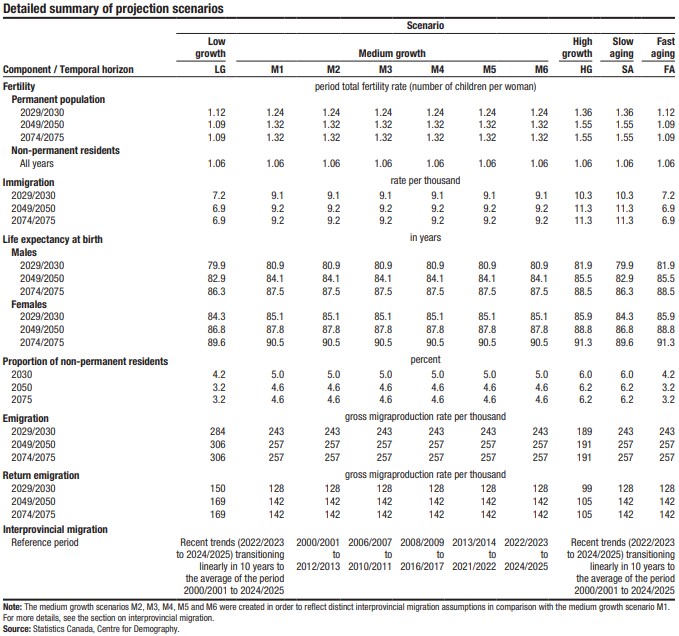
Statistics Canada's population projections are based on different assumptions about: fertility, life expectancy, immigration, emigration, non-permanent residents and interprovincial migration. These assumptions are combined into low, medium and high growth scenarios as well as slow- and fast-aging scenarios. Medium scenarios are further divided by assumptions for interprovincial migration. The M1 medium growth scenario, along with low-growth, high-growth, slow-aging and fast-aging scenarios assume that recent interprovincial migration trends transition to a long-run average (2001-2025). Other medium growth scenarios assume interprovincial migration follows patterns from different eras in recent history: 2000-2013 (M2), 2006-2011 (M3), 2008-2017 (M4), 2013-2022 (M5) and 2025-2025 (M6).
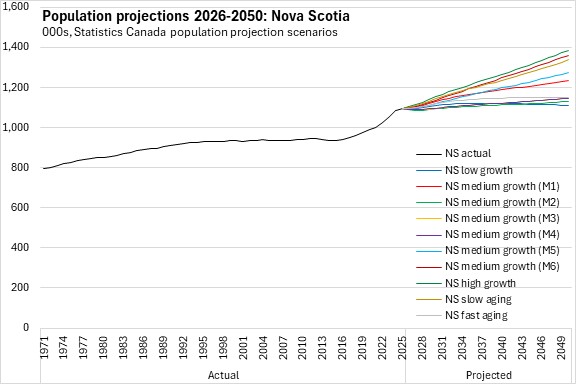
Under all scenarios, Nova Scotia's population is projected to be larger in 2050 than it was at 1.09 million in 2025. Nova Scotia's population in 2050 under Statistics Canada's scenarios ranges from 1.11 million (Low Growth) to 1.39 million (High Growth).
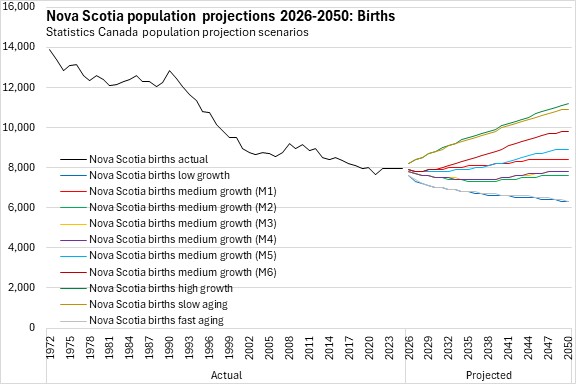
Among the components of population change, births in Nova Scotia are assumed to decline over the entire projection horizon for the low growth and fast aging scenarios. Births are projected to decline in the near term and then to grow again in the M2, M3 and M4 scenarios. Births are assumed to rise in the M1, M5, M6 scenarios as well as under high growth and slow aging scenarios.
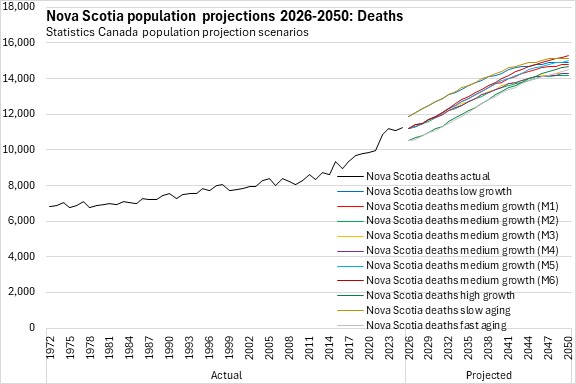
In all scenarios, Statistics Canada estimates that the number of deaths will rise over time and that natural population change will be negative in every year from 2026-2050.
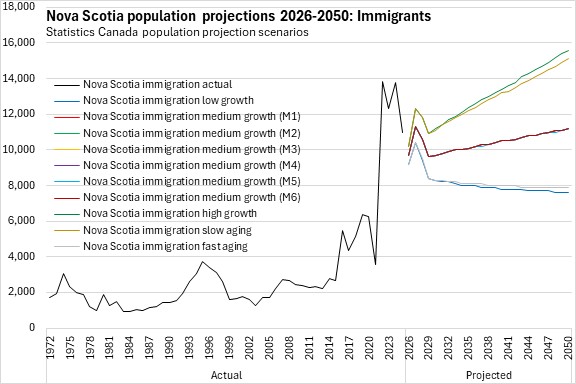
Nova Scotia's immigration levels are assumed to fall, then rise and then decline again over the next 5 years. After this volatility, immigration to Nova Scotia is assumed to rise under all scenarios except low growth and fast aging. Even under low growth and fast aging scenarios, Nova Scotia's immigration is expected to be well above pre-pandemic levels.
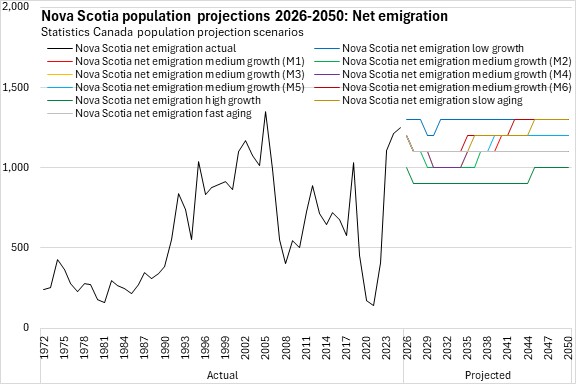
Statistics Canada assumed that net emigration from Nova Scotia to other countries will be stable in a range from 900 to 1,300 over the projection horizon.
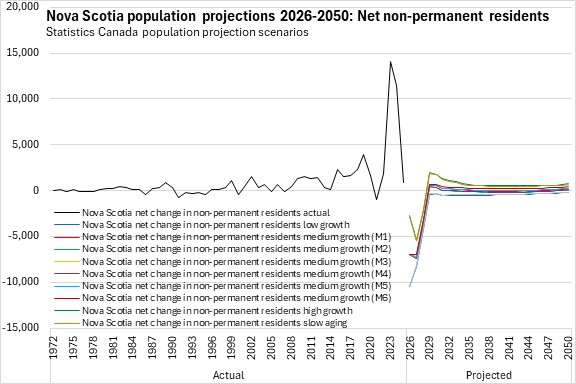
After recent increases in the number of non-permanent residents in Nova Scotia, Statistics Canada assumes that the province will experience a near-term outflow of non-permanent residents. Over the remainder of the projection horizon, only modest net changes in non-permanent residents are assumed.
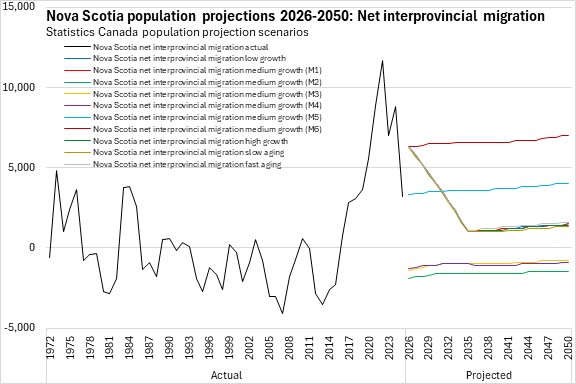
Statistics Canada's assumptions about net interprovincial migration have the widest ranges. However, all these scenarios are projected based on different prior periods of interprovincial migration and make no assumption about the actual determinants of migration decisions.
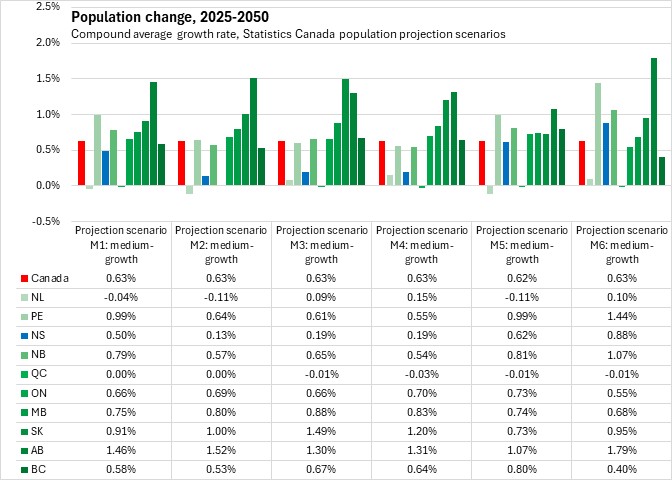
From 2025-2050, Statistics Canada's population projection scenarios for Nova Scotia range from compound average growth rates of 0.07% per year (low growth) to 0.96% per year (high growth).
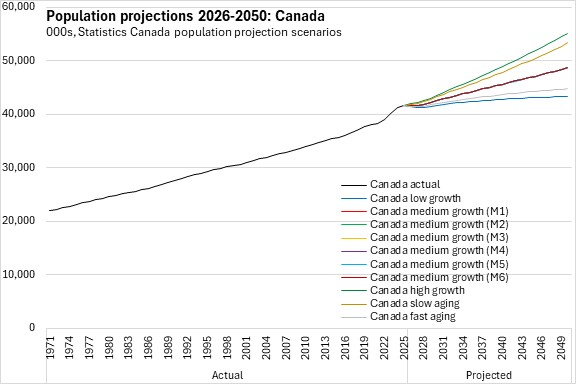
National population growth is projected to grow between 0.16% per year (low growth) and 1.13% per year (high growth).
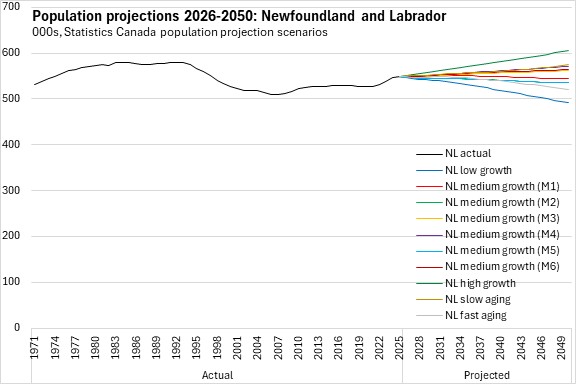
Under almost all scenarios, Alberta is projected to have the fastest population growth from 2025-2050 (exception: M3 in which Saskatchewan has the fastest growth). Under all scenarios, Québec and Newfoundland and Labrador are projected to have the least population growth or steepest population declines.
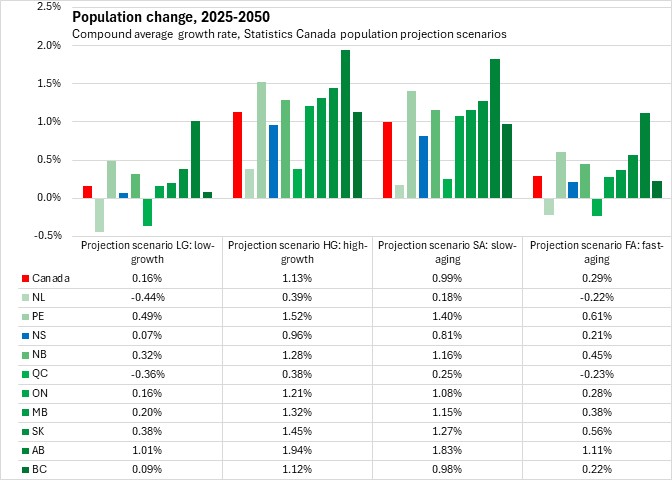
Statistics Canada's projections from Nova Scotia's population change under medium growth scenarios ranges from 0.13% per year to 0.88% per year, highlighting the sensitivity of these projections to assumptions about net interprovincial migration.
Sources: Statistics Canada. Table 17-10-0057-01 Projected population, by projection scenario, age and gender, as of July 1 (x 1,000); Table 17-10-0058-01 Components of projected population growth, by projection scenario (x 1,000); Table 17-10-0005-01 Population estimates on July 1, by age and gender; Table 17-10-0014-01 Estimates of the components of international migration, by age and gender, annual; Table 17-10-0015-01 Estimates of the components of interprovincial migration, by age and gender, annual; Table 17-10-0006-01 Estimates of deaths, by age and gender, annual; Table 17-10-0016-01 Estimates of births, by gender, annual; Population Projections for Canada (2025 to 2075), Provinces and Territories (2025 to 2050): Technical Report on Methodology and Assumptions
<--- Return to Archive


