The Economics and Statistics Division maintains archives of previous publications for accountability purposes, but makes no updates to keep these documents current with the latest data revisions from Statistics Canada. As a result, information in older documents may not be accurate. Please exercise caution when referring to older documents. For the latest information and historical data, please contact the individual listed to the right.
<--- Return to Archive
For additional information relating to this article, please contact:
February 11, 2026BUILDING PERMITS, DECEMBER AND ANNUAL 2025 Monthly (seasonally adjusted, December 2025 vs November 2025)
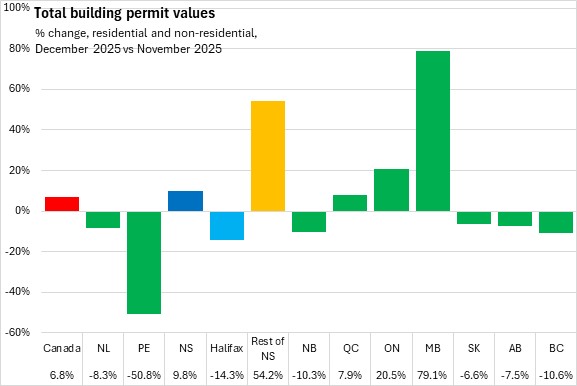
Changes in monthly building permit values are typically very volatile, with large swings from one month to the next.
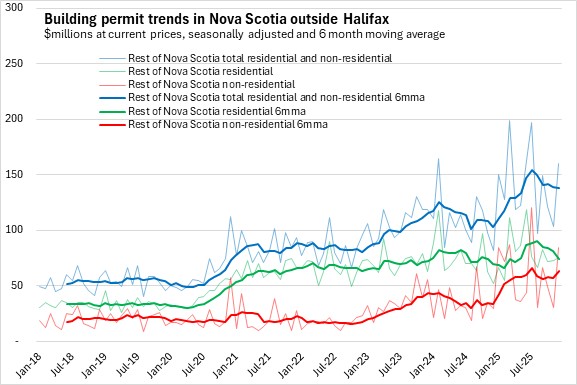
Nova Scotia's total building permits (residential and non-residential) rose 9.8% to $323.9 million. Halifax permits fell 14.3% to $163.6 million while permits outside the city rose 54.2% to $160.3 million. National permits grew 6.8% to $12.8 billion despite declines in six provinces. Manitoba reported the largest gain while Prince Edward Island reported the steepest decline.
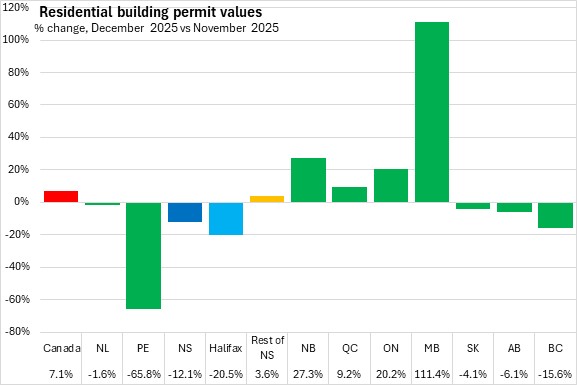
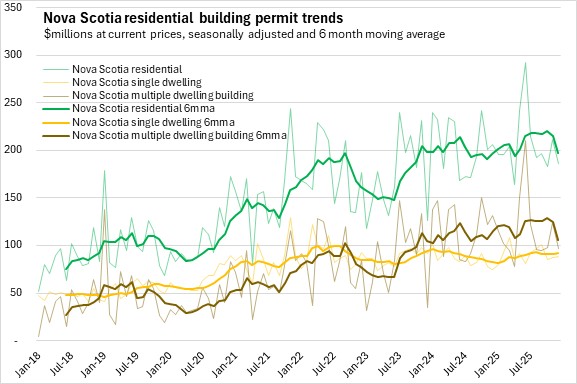
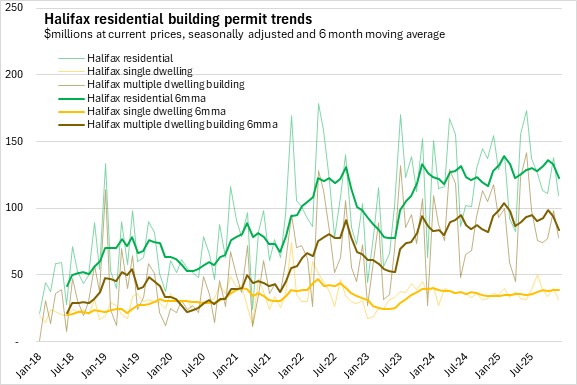
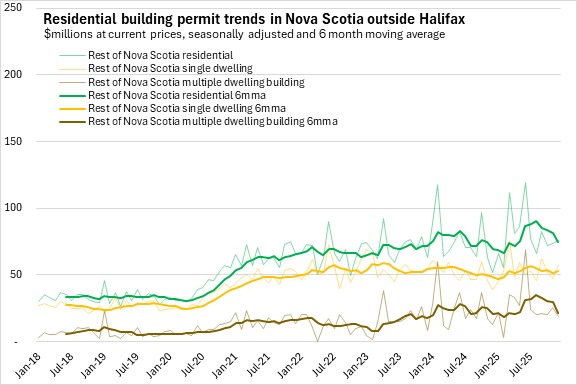
Nova Scotia's residential building permits dropped 12.1% to $185.6 million. Halifax residential permits decreased 20.5% to $109.8 million. Outside the city, residential permit values grew 3.6% to $75.8 million. National residential building permit values rose 7.1% to $8.0 billion despite declines in six provinces. Residential permit values were up most in Manitoba while Prince Edward Island reported the fastest percentage decline.
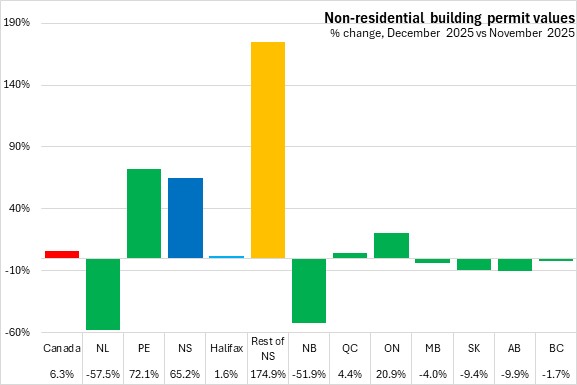
Nova Scotia's non-residential building permits rose 65.2% to $138.2 million, the second fastest gain among provinces. Halifax non-residential permits rose 1.6% to $53.8 million. Outside the city, non-residential permit values accelerated by 174.9% to $84.4 million. National non-residential building permit values rose 6.3% to $4.8 billion despite declines in six provinces. Prince Edward Island reported the fastest gain while Newfoundland and Labrador and New Brunswick reported the steepest declines.
Annual (2025 vs 2024)
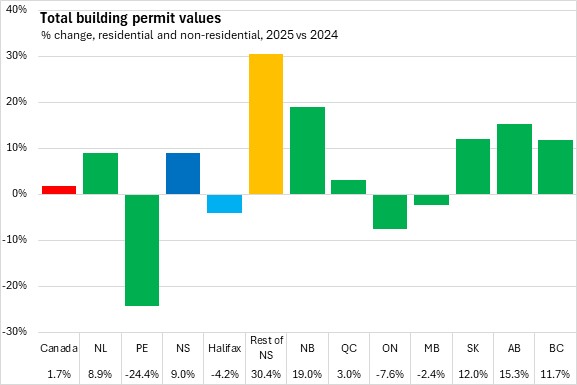
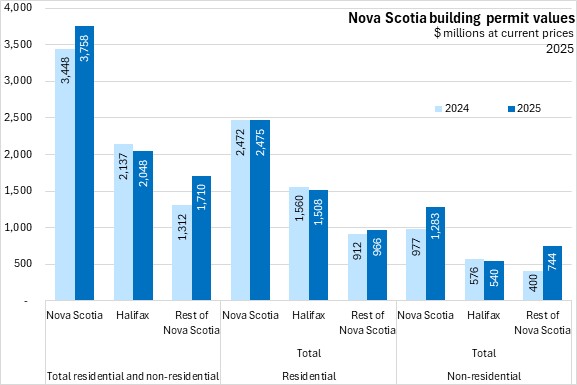
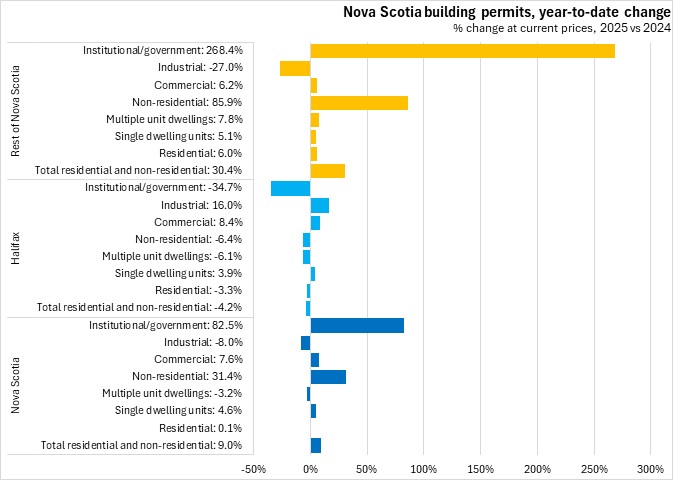
Nova Scotia's total building permits (residential and non-residential) were up 9.0% in 2025 comparing with 2024. Halifax permits declined 4.2% and outside the city permit values increased 30.4%. National permits were up 1.7%. Building permit values were up in seven provinces, with New Brunswick and Alberta reporting the fastest increases. Prince Edward Island reported the fastest decline.
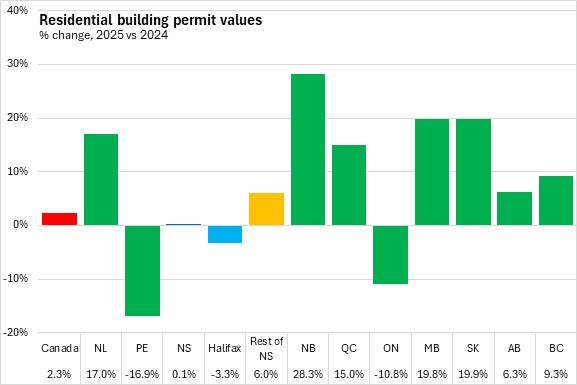
In 2025, Nova Scotia's residential building permits rose 0.1% compared to 2024. Halifax residential permits declined 3.3% and outside the city residential permit values increased 6.0%. National residential building permit values increased 2.3%. Residential permit values were up in all provinces except Prince Edward Island and Ontario, with the fastest increase in New Brunswick.
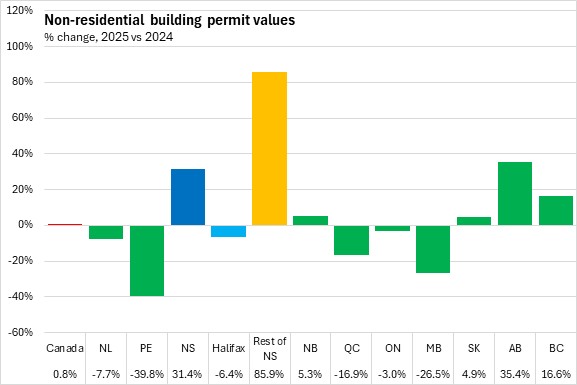
Nova Scotia's non-residential building permits rose 31.4% in 2025 (compared to 2024), the second fastest rise in non-residential permit values among provinces after Alberta. Halifax permits declined 6.4% while non-residential permits outside the city rose 85.9%. National non-residential building permit values rose 0.8% on gains in five provinces. Prince Edward Island reported the steepest decline in non-residential permit values.
Growth in total permits in 2025 was concentrated outside of Halifax. Higher residential and non-residential permits outside of Halifax were partially offset by lower residential and non-residential permits in Halifax.
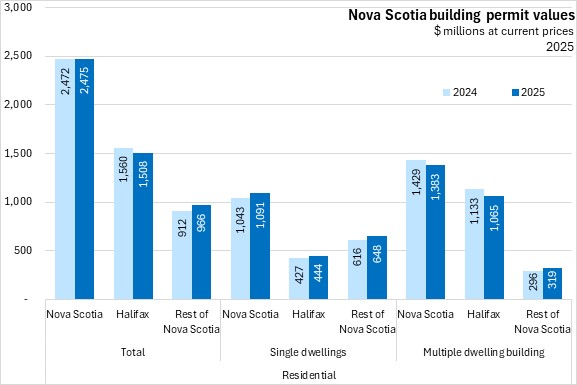
Permit values for single dwelling units were up across the province. Halifax multiple unit permit values decline offset the rise in the rest of the province.
Non-residential permit values were up due to notable growth in institutional/government (outside of Halifax) as well as a small increase in commercial permits. Halifax industrial permit values rise partially offset the decline in the rest of the province.
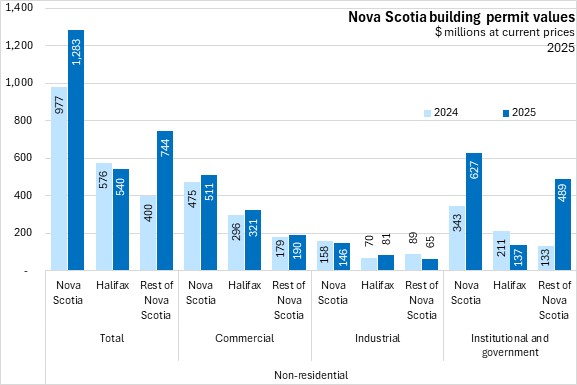
In 2025, growth in building permit values was notably stronger for areas outside Halifax. Outside the city, there was very strong growth in institutional/government and commercial building permits as well as increases in residential units. Halifax institutional/government permit values decline offset the gains in commercial and industrial building permits. Halifax multiple unit permit values decline offset the rise in single unit dwelling projects.
Trends
Overall building permit values have generally been on a rising trend for several years, though there have been periods of declining values over this period. Rising permit values are mostly driven by higher residential permits within Halifax, as well as outside the city, to a smaller degree.
Residential permits followed a stable trend in late 2023 and early 2024, and had trended upward through most of 2025 though declining in recent months.
Nova Scotia's non-residential building permit values also reached a plateau from late 2023 through 2024. Non-residential permits have trended up through the first half of 2025 due to notable growth outside the city. In recent months, non-residential building permit values are declining.
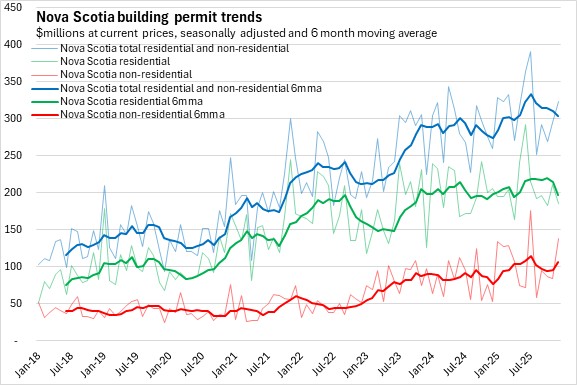
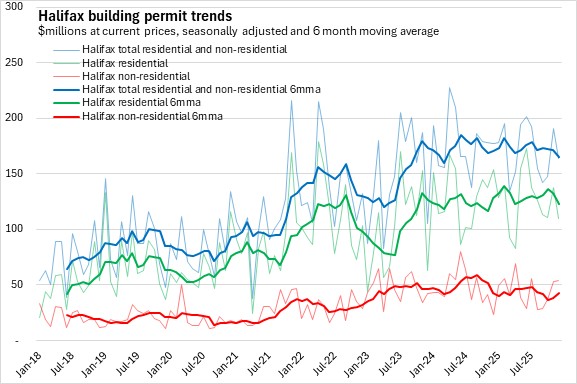
Trends in residential permit values reflect the differences in housing markets for Halifax and the rest of the province. In Halifax, growth in permit values for multi-unit dwellings has outpaced growth in single-dwelling unit permits. Outside the city, single dwelling unit permits are more common than permits for multi-unit structures. In recent months, there has been a decline in multi-unit building permits across the province.
Non-residential building permits have lower values than residential permits. In Halifax, non-residential permits have increased on higher commercial and industrial projects in recent months. Outside the city, permits have exhibited a rise in recent months due to sharp growth in institutional/government permits.
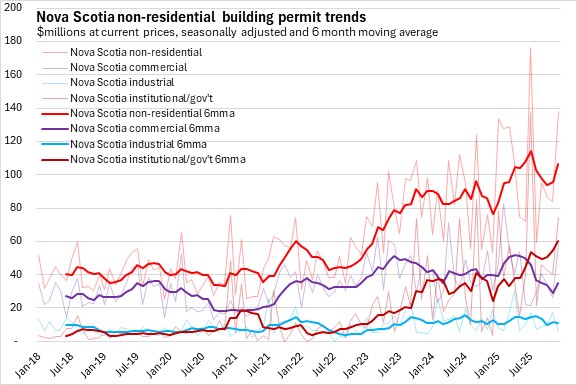
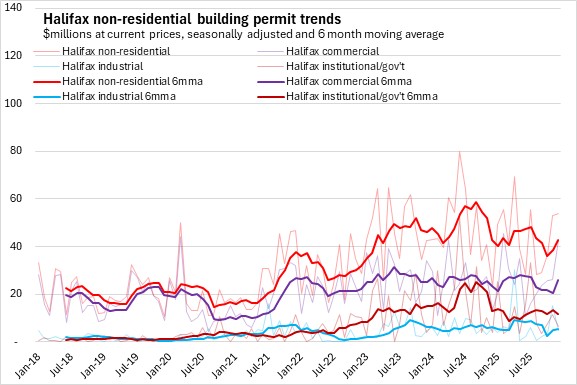
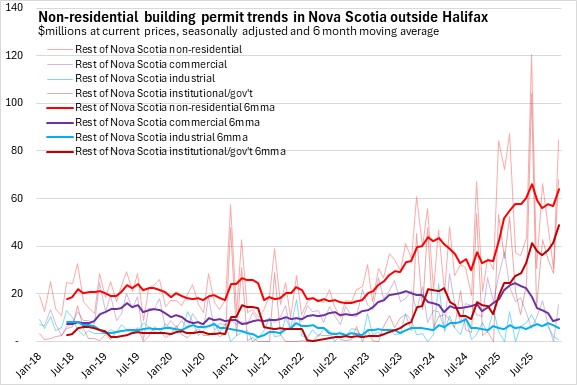
Source: Statistics Canada. Table 34-10-0292-01 Building permits, by type of structure and type of work (x 1,000)
<--- Return to Archive


