The Economics and Statistics Division maintains archives of previous publications for accountability purposes, but makes no updates to keep these documents current with the latest data revisions from Statistics Canada. As a result, information in older documents may not be accurate. Please exercise caution when referring to older documents. For the latest information and historical data, please contact the individual listed to the right.
<--- Return to Archive
For additional information relating to this article, please contact:
February 12, 2026BUSINESS AND EMPLOYMENT DYNAMICS, 2023 Statistics Canada has released 2023 results for provincial and territorial business and employment dynamics. This covers incorporated and unincorporated businesses in the private sector that issue at least one T4 slip in any given calendar year, but excludes self-employed individuals or partnerships where the participants do not draw salaries.
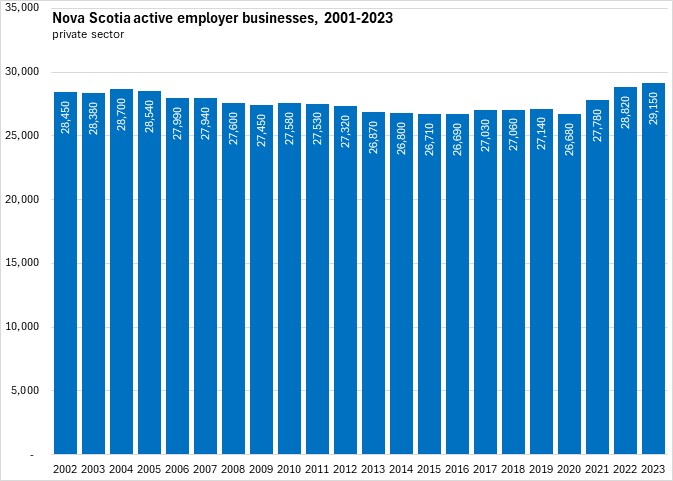
The number of active employer businesses in Nova Scotia rose by 1.1% (+330) to 29,150 in 2023 - the highest number of active businesses in records that date back to 2001. The last three years of data have shown a marked departure from the trend of declining active businesses since 2002.
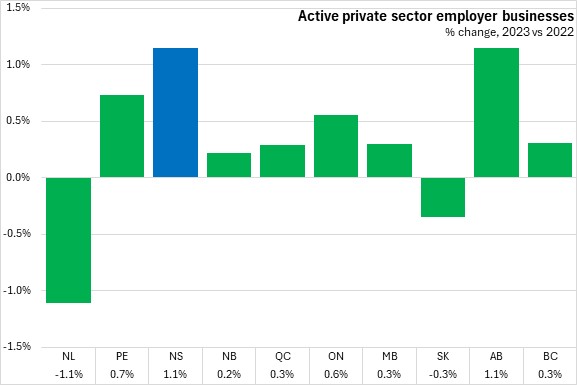
Among provinces, Nova Scotia reported the second fastest growth in active private sector employer businesses in 2023 - only slightly slower than Alberta. All provinces except Newfoundland and Labrador and Saskatchewan reported growing numbers of active businesses from 2022 to 2023.
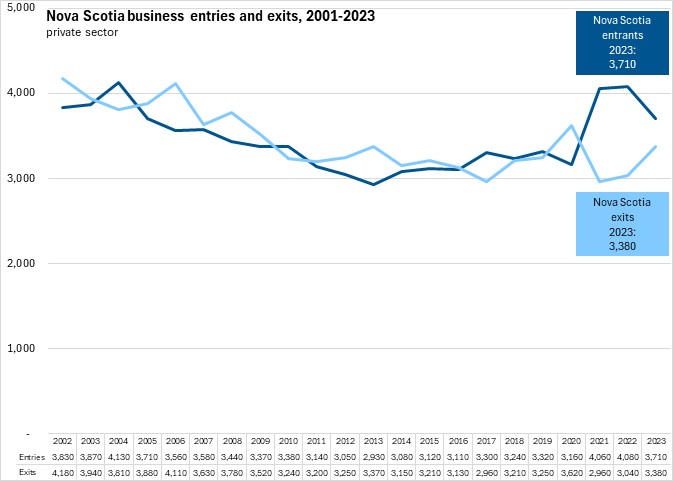
Among the 29,150 active private sector businesses, there were 25,430 incumbent businesses (continuing operations from previous years) as well as 3,710 new entrants. This was offset by exit of 3,380 firms from the numbers of previous incumbents.
Entrants in any given year are enterprises that have current payroll data, but that did not have payroll data in the previous year. Similarly, exits in any given year are identified by the absence of current payroll data, where such data had existed in the previous year.
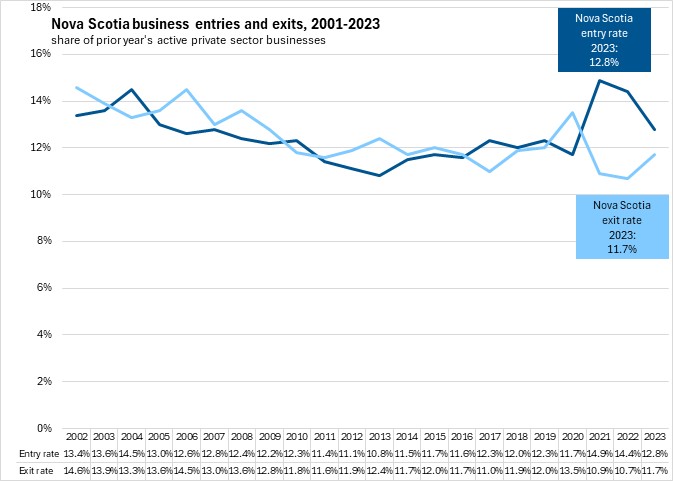
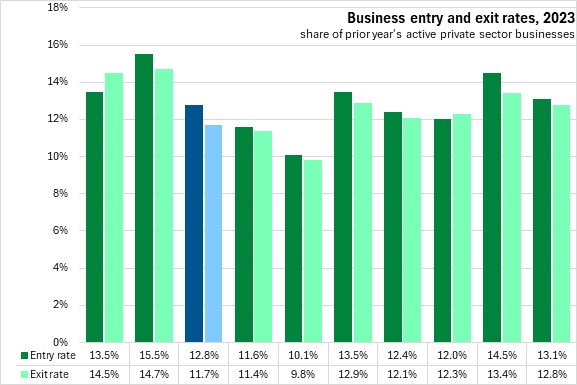
Measured in percentage terms (relative to an average of prior and current year totals), the entry rate for new firms slipped to 12.8 % in 2023, down from 14.4% in 2022. The exit rate for firms rose to 11.7% in 2023, from 10.7% in 2022.
Eight provinces reported higher entrants than exits in 2023. Prince Edward Island reported the highest rates for both business entry and business exit. Québec reported the lowest business entry and business exit rates.
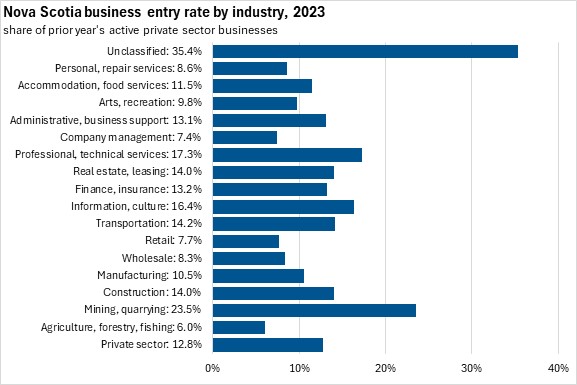
By industry, unclassified businesses accounted for a notably faster entry rate. Among classified industries, the fastest entry rates were reported in mining/quarrying (though this was from a small number of businesses), professional/technical services and information/culture. Entry rates were slowest in agriculture/forestry/fishing, retail and company management.
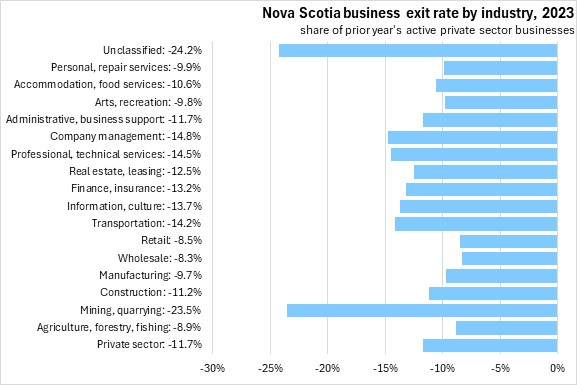
The fastest exit rates were also reported among unclassified businesses as well as mining/quarrying. The slowest exit rates were observed in wholesale trade, retail trade and agriculture/forestry/fishing.
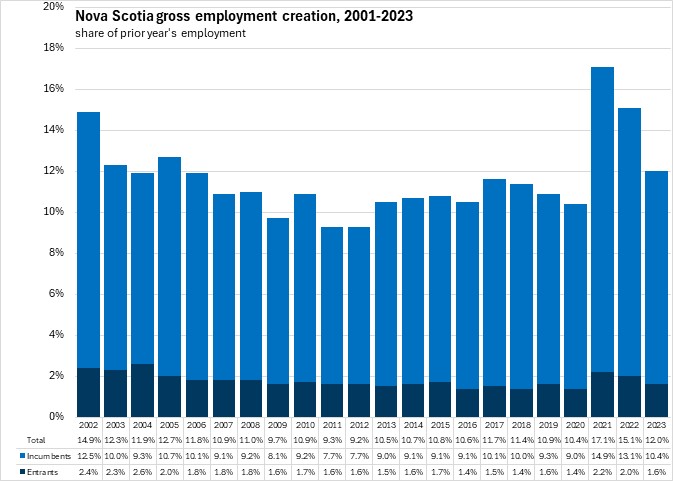
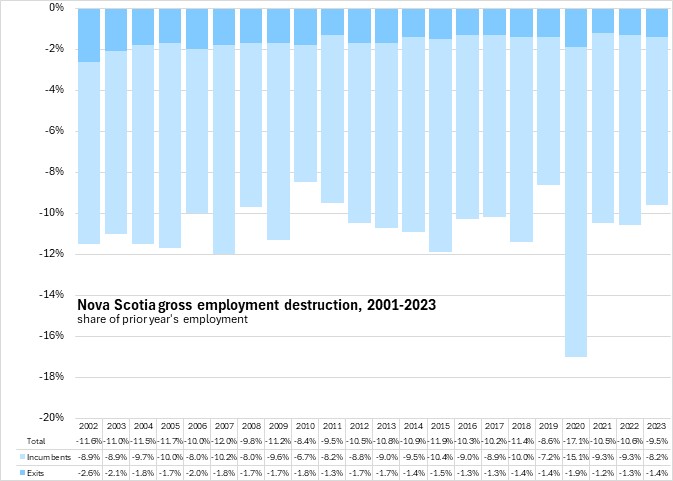
Statistics Canada's business employment dynamics data also examines employment changes in the private sector. In 2023, there was net private sector employment creation of 2.4% in Nova Scotia, representing gross employment creation of 12.0% against gross employment destruction of 9.5%.
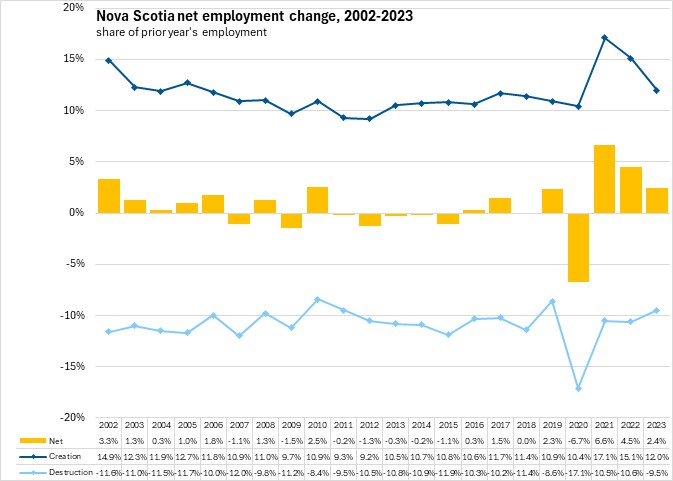
Net employment growth is broken down into four subcomponents of gross employment creation and destruction: employment creation by entrants (1.6%), employment creation by growing incumbents (10.4%), employment destruction by exits (1.4%), and employment destruction by declining incumbents (8.2%).
In all years since 2000, most net private sector employment change is explained by employment creation or destruction by incumbents rather than by new entrants or exiting firms.
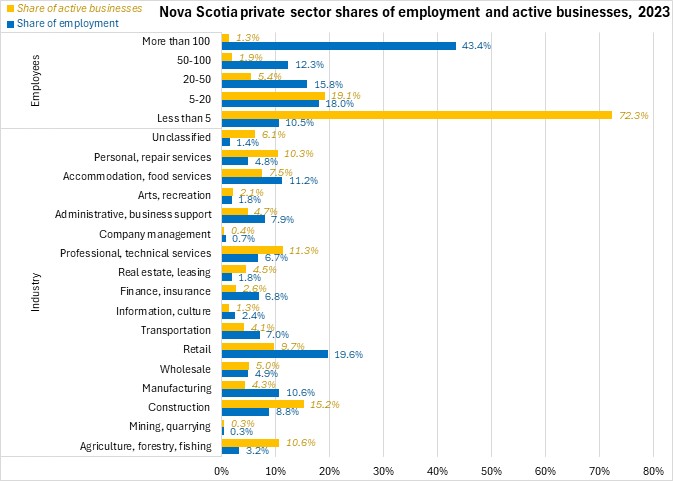
The contribution that each industry makes to overall employment dynamics depends on its share of overall employment and its gross employment creation or destruction.
Industries such as manufacturing, retail, finance/insurance, administrative and support services, information and culture, and accommodation/food account for a larger share of total employment than their share of active businesses (indicating a larger number of employees per business).
Agriculture/forestry/fishing, construction, real estate/leasing, personal/repair services and professional/technical services are examples of industries with a greater share of active businesses than their share of employment (fewer employees per business).
The share of businesses by firm size (as measured by number of employees) is highest for those firms employing fewer than 5 people. However, these small firms account for 10.5% of private sector employment. In contrast, firms with over 100 employees make up just 1.3% of all firms in Nova Scotia, but employ 43.4% of private sector employees.
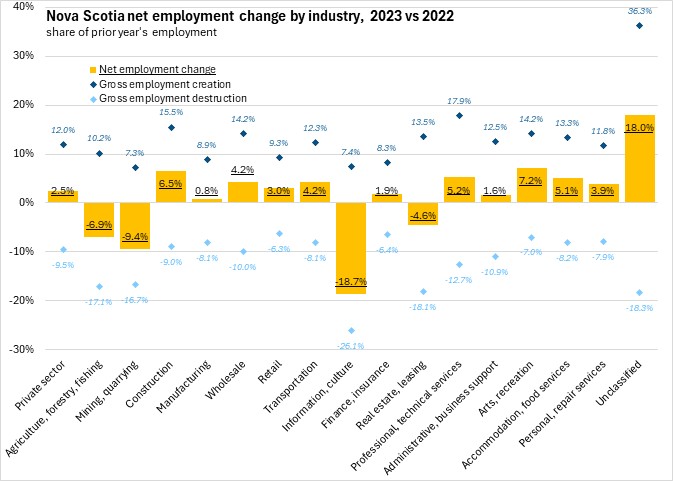
Net employment creation was strongest among unclassified businesses. Among identified industries for which full information was available, net private sector employment growth was strongest in arts/recreation and construction. Among reporting industries, only agriculture/forestry/fishing, mining/quarrying, information/culture and real estate/leasing reported net employment declines.
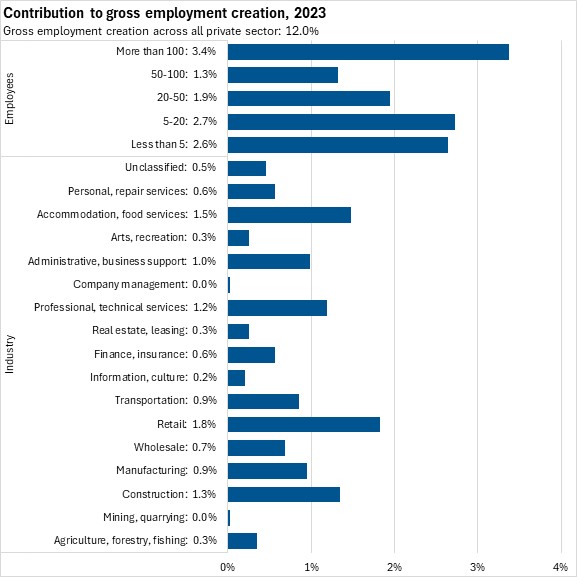
Among industries, the largest contributions to Nova Scotia's gross employment creation in 2023 came from retail and accommodation/food services. By employment size, private sector businesses with over 100 employees made the largest contribution to gross employment creation.
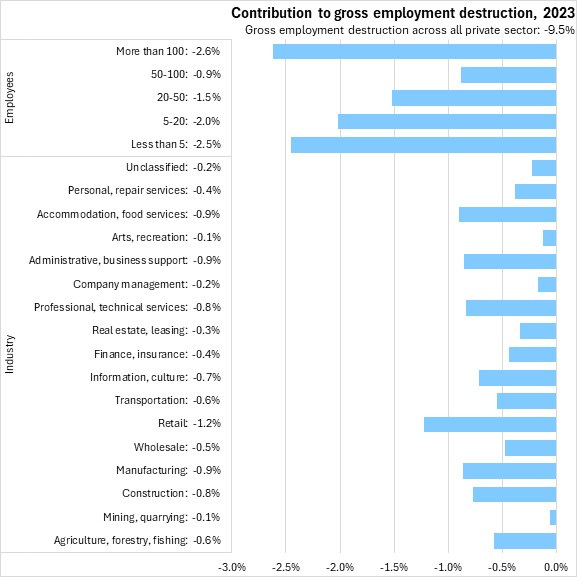
Among industries, retail, manufacturing and accommodation/food services had the largest contribution to Nova Scotia's private sector gross employment destruction in 2023. By size of employment, businesses with between more than 100 employees as well as those with fewer than 5 employees made the largest contributions to gross employment destruction in Nova Scotia in 2023.
Source: Statistics Canada. Table 33-10-0087-01 Business Dynamics measures, by industry, per province or territory; Table 33-10-0088-01 Business Dynamics measures, by firm size, per province or territory; Table 33-10-0090-01 Business Sector employment flow rates by firm size, provinces and the territories; Table 33-10-0089-01 Business Sector employment flow rates, by industry, provinces and the territories; Table 33-10-0091-01 Contribution to private sector employment, gross employment creation and destruction, by Industry, per province or territory; Table 33-10-0093-01 Contribution to private sector employment, gross employment creation and destruction by firm size, provinces and the territories
<--- Return to Archive


