The Economics and Statistics Division maintains archives of previous publications for accountability purposes, but makes no updates to keep these documents current with the latest data revisions from Statistics Canada. As a result, information in older documents may not be accurate. Please exercise caution when referring to older documents. For the latest information and historical data, please contact the individual listed to the right.
<--- Return to Archive
For additional information relating to this article, please contact:
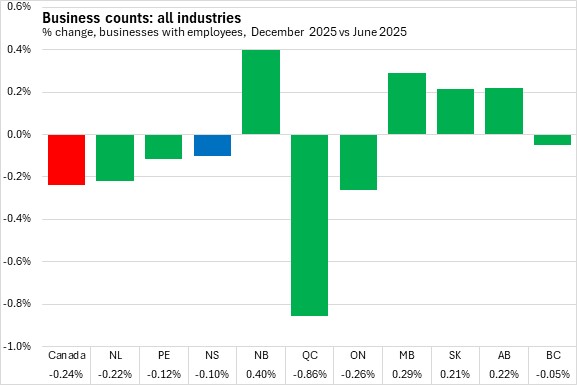
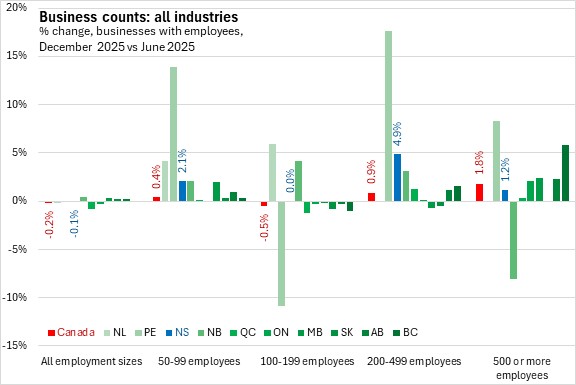
February 13, 2026BUSINESS COUNTS, DECEMBER 2025 The number of business locations in Nova Scotia with employees contracted 0.1% between June 2025 and December 2025, largely due to a decline in the number of businesses unclassified by industry. Across Canada, business counts fell by 0.24% with declines in six provinces, led by Québec. New Brunswick reported the fastest growth in business counts over this period.
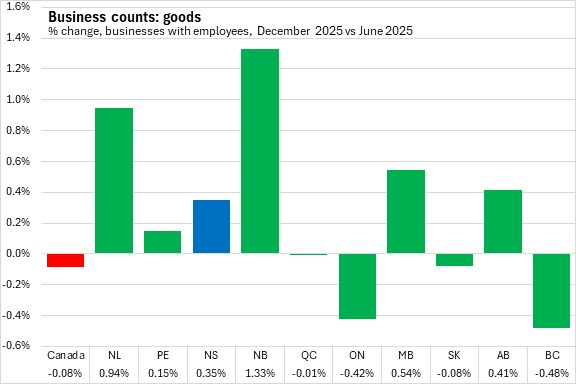
The number of goods producing locations increased 0.35% in Nova Scotia. Nationally, the count of goods producing businesses was down 0.08% despite gains in six provinces. New Brunswick reported the fastest growth while Ontario and British Columbia had the steepest declines.
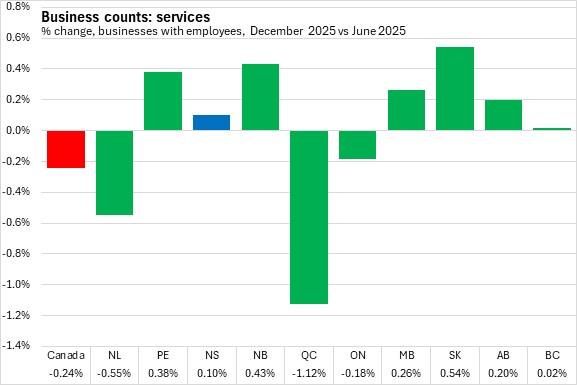
The number of service businesses was up 0.10% in Nova Scotia. The number of service businesses contracted by 0.24% nationally despite gains in seven provinces (led by Saskatchewan). Québec reported the steepest decline in the number of service businesses.
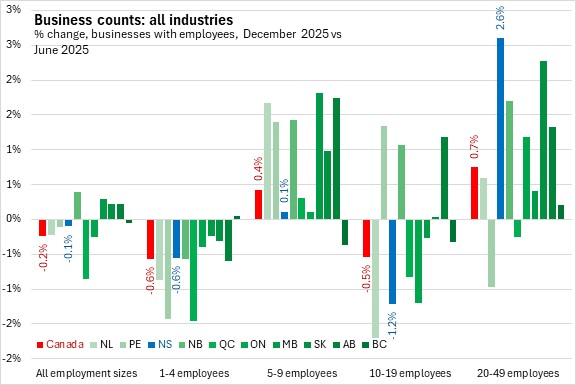
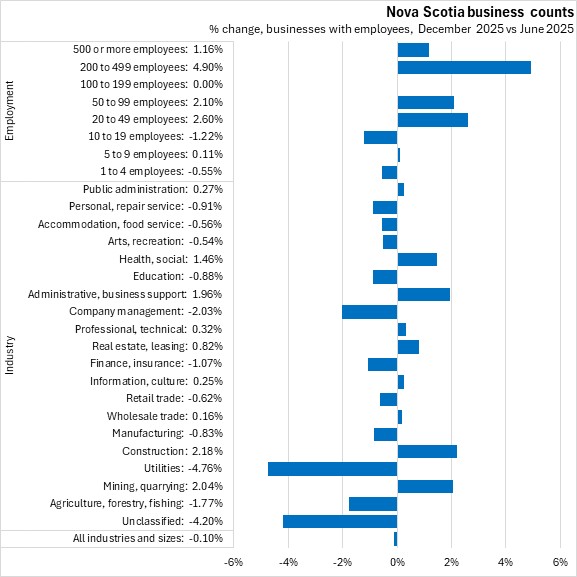
Grouping business counts by employment size, Nova Scotia reported growth in businesses with 5-9 employees, 20-49 employees, 50-99 employees, 200-499 employees (strongest among Nova Scotia's size categories) and 500 or more employees. Business counts were down in Nova Scotia among those with 1-4 employees and 10-19 employees (steepest decline among Nova Scotia's size categories). There was no change in the count of Nova Scotia businesses with 100-199 employees.
Across Canada, business counts were up for those with 5-9 employees, 20-49 employees, 50-99 employees, 200-499 employees and 500 or more employees (strongest among Canada's size categories). Business counts were down across Canada among those with: 1-4 employees (steepest decline among Canada's size categories), 10-19 employees and 100-199 employees.
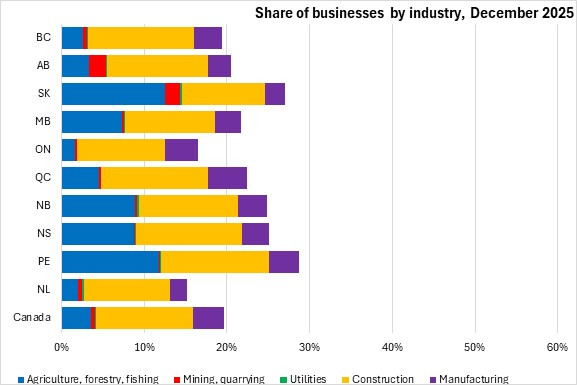
The number of businesses in a particular industry or location is not an indicator of its economic significance; employment, output and income generated are better indicators of economic contributions. However, in addition to growth rates, the relative share of businesses by industry provides some insight on the economic structure of a particular location, relative to other jurisdictions.
Across Canada, businesses in goods industries make up a larger share of all businesses in Saskatchewan and the Maritime provinces. Goods businesses are a lower share of all businesses in Ontario and Newfoundland and Labrador.
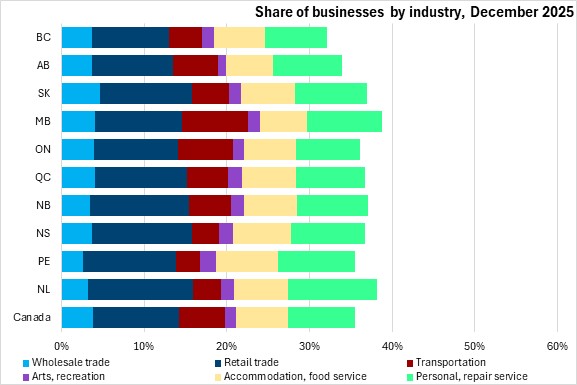
Distribution (wholesale, retail, transportation) and personal service industries make up a more consistent share of business counts across the country, with somewhat higher shares in Newfoundland and Labrador and Manitoba.
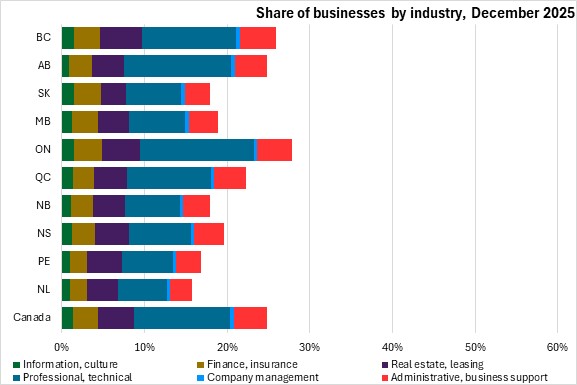
Real estate, finance, professional services, information and culture, company management as well as administrative and business support businesses are notably more concentrated in Canada's four most urban provinces: Ontario, British Columbia, Alberta and Québec.
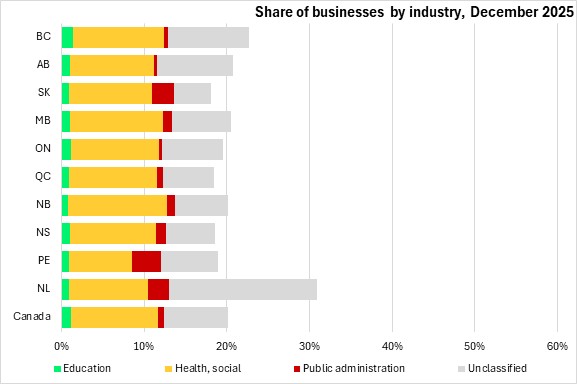
Health, social, education and public administration businesses make up a similar share of business counts across most provinces. Newfoundland and Labrador reported a higher portion of unclassified businesses.
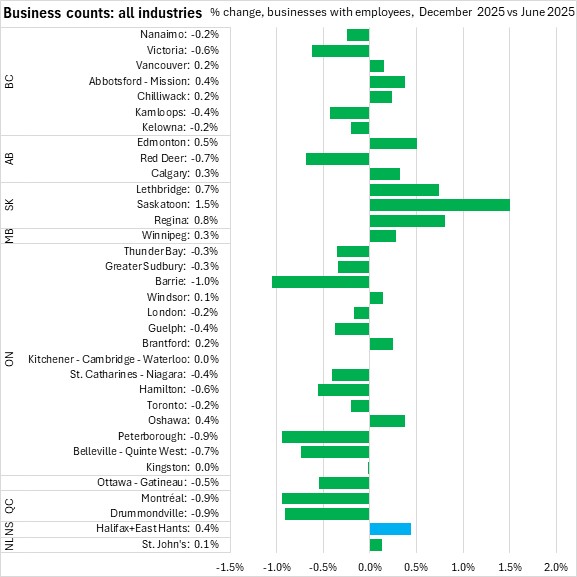
Among Canada's Census Metropolitan Areas (CMA), Halifax and East Hants reported a 0.4% increase in business counts across all industries and sizes. Most CMAs across Ontario and Québec reporrted lower business counts (exceptions: Oshawa, Brantford, Windsor). Barrie, Peterborough, Montréal and Drummondville reported the steepest declines in business counts. Saskatoon reported the fastest growth in business counts among CMAs from June to December.
Among Nova Scotia's industries (apart from unclassified businesses), business counts declined across many sectors, led by utilities. Business counts grew fastest in Nova Scotia's construction, mining/quarrying and administrative/business support (including call centre) industries.
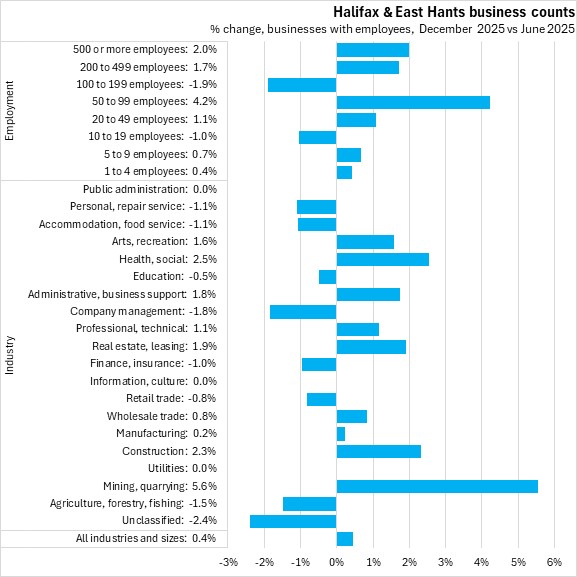
In the Halifax and East Hants Census Metropolitan Area, mining/quarrying had the fastest growth in business counts while counts of company management and agriculture/forestry/fishing businesses had the steepest declines.
Counts grew faster for Halifax and East Hants businesses with 50-99 employees as well as for those with over 200 employees. The numbers of businesses with 10-19 employees and with 100-199 employees were down in Halifax and East Hants from June to December.
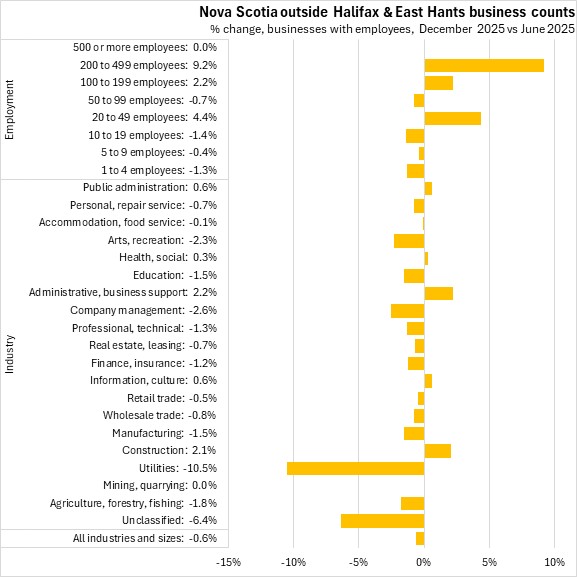
Across Nova Scotia outside Halifax and East Hants, business count declined most sharply for utilities, well outpacing the declines reported across most other industries. Construction and administrative/support businesses (including call centres) otuside Halifax reported faster growth in business counts from June to December.
Counts outside Halifax grew faster for businesses with 200-499 employees.
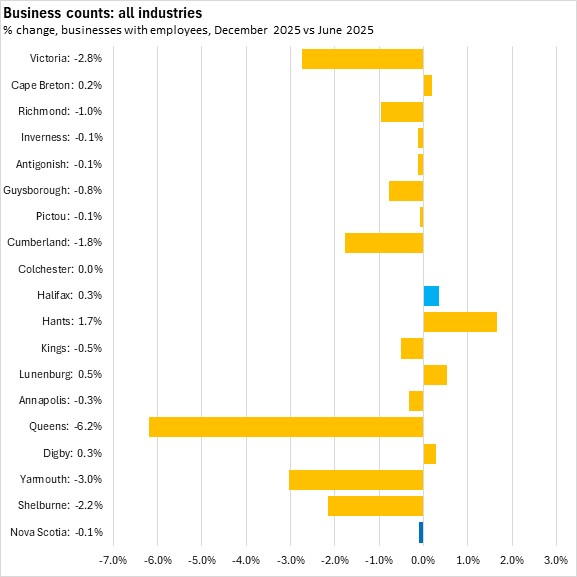
Among Nova Scotia's counties, only Cape Breton, Hants, Halifax, Lunenburg and Digby reported growth in business counts from June 2025 to December 2025. Queens, Yarmouth, Victoria and Shelburne Counties reported the sharpest declines in business counts.
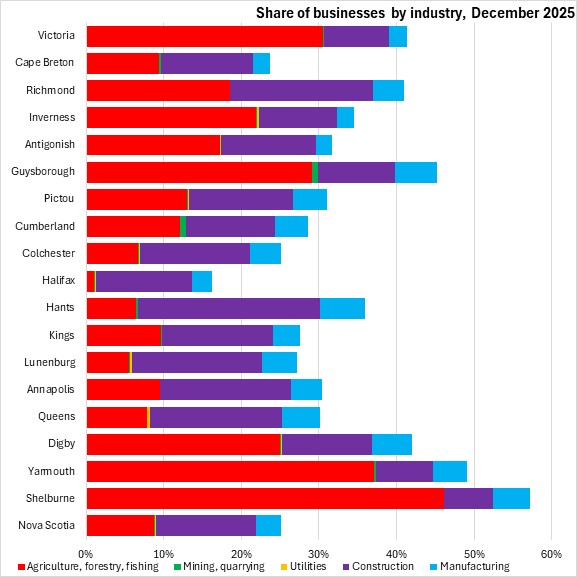
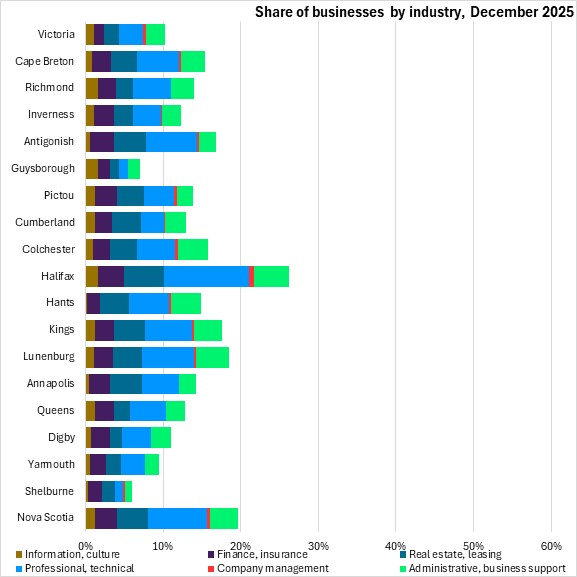
Among Nova Scotia's counties, goods-businesses are a larger share of total business counts in Shelburne, Yarmouth, Digby, Guysborough, Richmond and Victoria counties (notably from agriculture, forestry and fishing).
Distributive and personal services businesses are more uniformly distributed across Nova Scotia's counties, though with somewhat larger concentrations in Annapolis, Colchester, and Cumberland counties and smaller concentrations in Shelburne and Yarmouth counties.
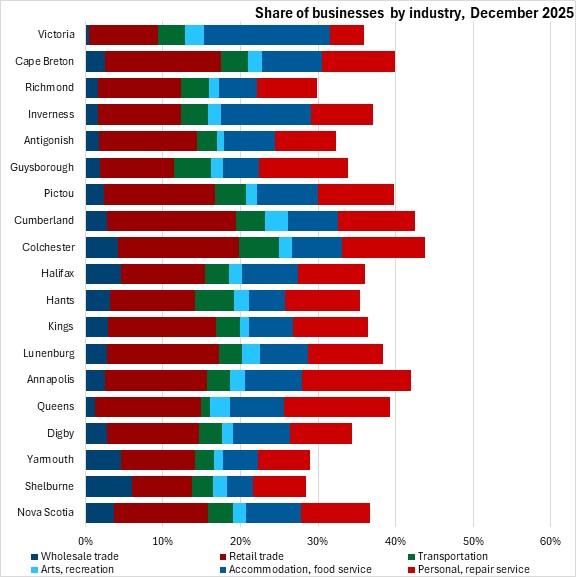
Financial, real estate, professional and administrative services were more concentrated in Halifax - particularly for professional and technical services as well as real estate and leasing. Guysborough and Shelburne Counties had notably lower shares of businesses in these industries.
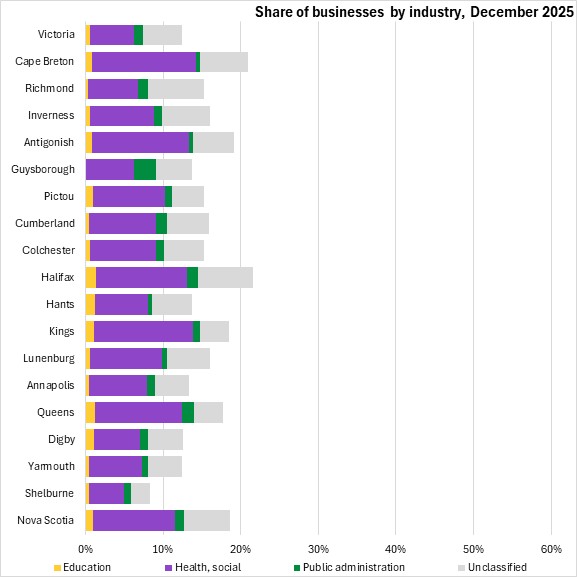
Health, social, education and public administration businesses were larger shares of all businesses in Halifax, Antigonish, Cape Breton, Kings and Queens counties.
Key definitions for Statistics Canada's Business Register:
Statistical Enterprise
An enterprise is the legal operating entity at the top of the operating structure. There is only one enterprise per operating structure. It is associated with a complete set of financial statements.
Statistical Establishment
A statistical establishment is the production entity or the smallest grouping of production entities which:
- Produces a homogeneous set of goods or services;
- Does not cross provincial boundaries; and
- Provides data on the value of output together with the cost of principal intermediate inputs used along with the cost and quantity of labour resources used to produce the output.
- For example, a plant in the manufacturing industry which provides accounting information regarding the value of shipments (sales), direct costs and labour costs is considered a single establishment. However, two stores in the retail industry may be considered one establishment if the accounting information, described in item (c) above, is not available separately, but is combined at a higher level.
Statistical Location
The location is an operating entity, specifically a production entity which:
- Conducts economic activity at or from a single physical location or group of locations;
- Resides within the smallest standardized geographical area;
- Is able to provide employment data at a minimum.
- Multiple locations can be found under a single enterprise.
Sources: Statistics Canada. Table 33-10-1014-01 Canadian Business Counts, with employees, December 2025; Table 33-10-1016-01 Canadian Business Counts, with employees, census metropolitan areas and census subdivisions, December 2025; Table 33-10-0764-01 Canadian Business Counts, with employees, June 2025; Table 33-10-0766-01 Canadian Business Counts, with employees, census metropolitan areas and census subdivisions, June 2025
<--- Return to Archive


