The Economics and Statistics Division maintains archives of previous publications for accountability purposes, but makes no updates to keep these documents current with the latest data revisions from Statistics Canada. As a result, information in older documents may not be accurate. Please exercise caution when referring to older documents. For the latest information and historical data, please contact the individual listed to the right.
<--- Return to Archive
For additional information relating to this article, please contact:
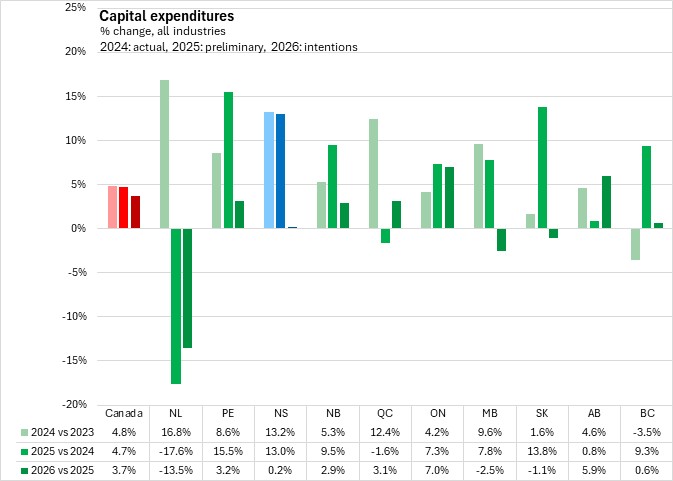
February 25, 2026CAPITAL EXPENDITURES, 2024 (ACTUAL), 2025 (PRELIMINARY) AND 2026 (INTENTIONS) Statistics Canada has released preliminary estimates for 2025 and intentions for 2026 (along with revised actuals for 2024) from the annual survey of capital expenditures for non-residential construction and machinery and equipment.
Nova Scotia's capital expenditures were $6.7 billion in 2024, a 13.2% gain over 2023. Nova Scotia's preliminary estimates for capital expenditures in 2025 were $7.58 billion, a further 13.0% increase over 2024. For 2026, capital investment intentions amounted to $7.60 billion, an increase of 0.2% over 2025 preliminary values.
Across Canada, capital expenditure growth remained largely stable at 4.8% growth in 2024 and 4.7% in 2025, with intentions decelerating to 3.7% in 2026.
In 2024, all provinces except British Columbia reported rising capital investments, led by increases in Newfoundland and Labrador, Nova Scotia and Québec. For 2025, preliminary investment data indicate gains in eight provinces, led by Prince Edward Island, Saskatchewan and Nova Scotia. Newfoundland and Labrador and Québec reported declines in the preliminary data. Capital investment intentions in 2026 are up for seven provinces, led by Ontario and Alberta. Three provinces report lower intentions in 2026, led by Newfoundland and Labrador.
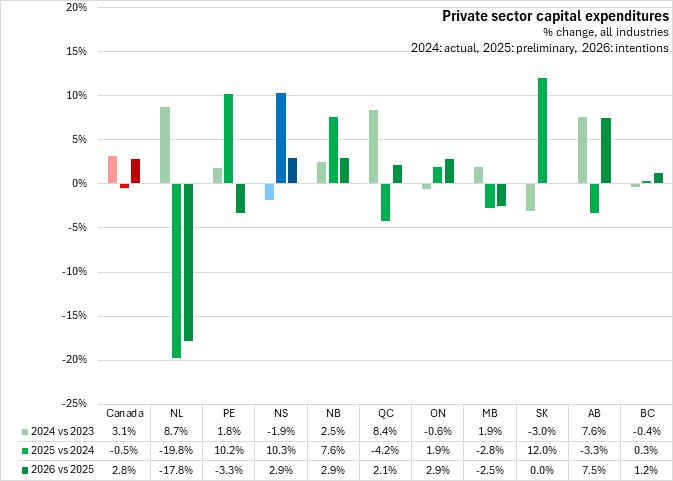
Nova Scotia's private capital expenditures were $3.40 billion in 2024, down 1.9% from 2023. Nova Scotia private capital expenditures increased by 10.3% to $3.79 billion in 2025 with investment intentions slated to grow to $3.90 billion (+2.9%) for 2026.
Nationally, private capital expenditure was up 3.1% in 2024 before declining 0.5% in 2025, with 2.8% growth in investment intentions for 2026. Six provinces reported higher private sector capital expenditures in 2024, with the fastest growth in Newfoundland and Labrador while Saskatchewan reported the fastest decline. In the preliminary data, private sector capital expenditures grew fastest in Saskatchewan, Nova Scotia and Prince Edward Island in 2025, while Newfoundland and Labrador reported the fastest decline. Private sector intentions in 2026 are led by growth in Alberta, with the steepest decline in Newfoundland and Labrador.
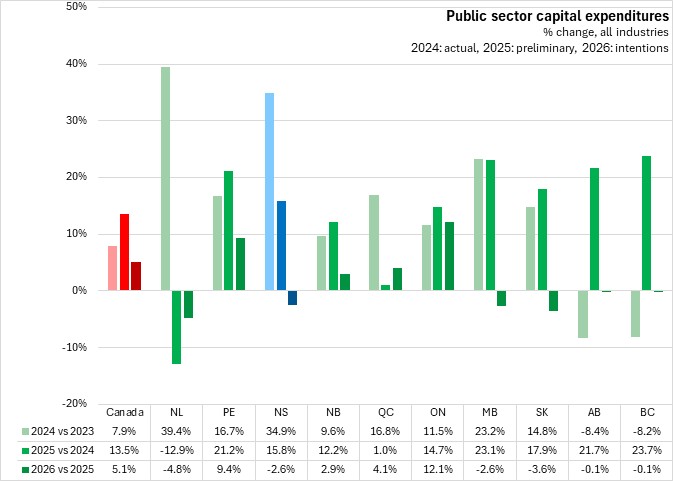
Nova Scotia's public capital expenditures reached $3.28 billion in 2024, up 34.9% from 2023 (second fastest growth among provinces). Public capital spending in Nova Scotia continued to grow with a further 15.8% increase in 2025, rising to $3.79 billion. For 2026, public capital expenditure intentions are expected to be $3.70 billion, a 2.6% decline over 2025.
National public capital spending increased by 7.9% in 2024 and by 13.5% in 2025. Public capital expenditure intentions in Canada are projected to slow to growth of 5.1% in 2026. Growth in intentions for 2026 at the national level is due to growth in four provinces: Prince Edward Island, New Brunswick, Québec and Ontario.
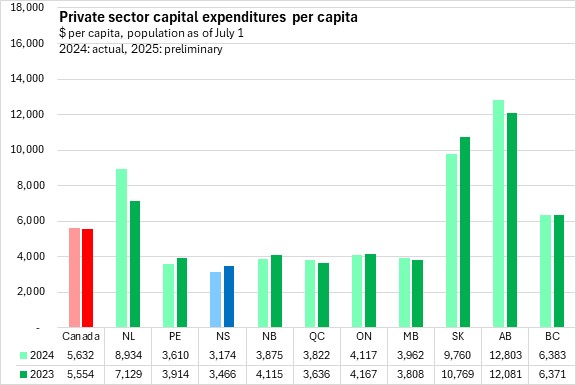
Despite continued growth in capital expenditures, Nova Scotia reported the lowest per capita capital spending of any provinces in either 2024 or 2025. Capital expenditures per capita were notably higher in resource-producing provinces (Alberta, Saskatchewan and Newfoundland and Labrador) as well as in British Columbia.
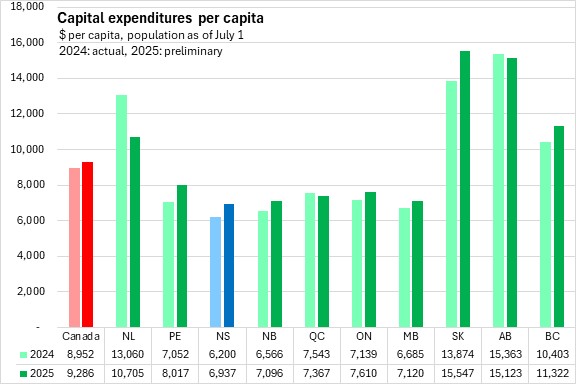
Nova Scotia's private capital expenditures were the lowest per capita values among provinces in each of 2024 and 2025. Private capital investments per capita were highest in Alberta, Saskatchewan and Newfoundland and Labrador.
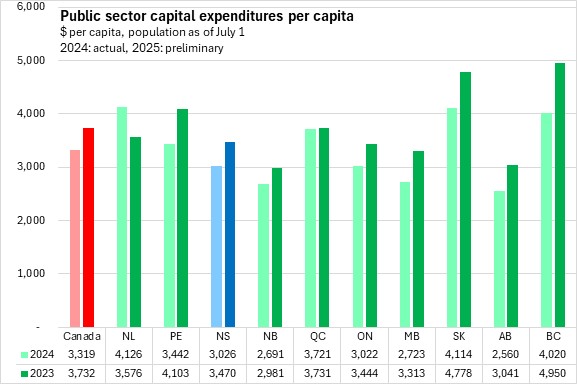
With accelerating growth in 2024, Nova Scotia's per capita public investments moved up to fifth among provinces and remained there in 2025. Newfoundland and Labrador reported the highest per capita public investments in 2024, surpassed by British Columbia in 2025.
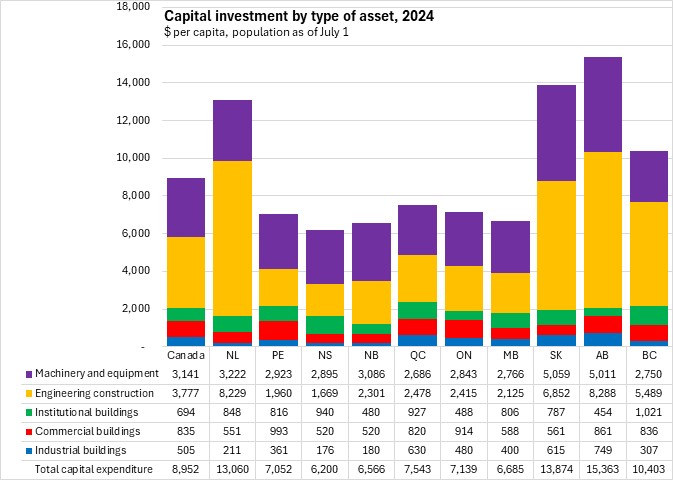
The difference in capital expenditures per capita among provinces is primarily explained by engineering construction (marine, transportation, water/sewage, communications, electric power, oil/gas and mining) as well as machinery and equipment (transportation equipment, industrial/processing equipment, computers, telecommunications equipment, commercial/service industry equipment and scientific instruments).
Trends
Nova Scotia's actual capital spending in 2024 was the highest reported in data going back to 2006, reflecting notable increases in spending on engineering construction, machinery and equipment, and institutional buildings since 2020.
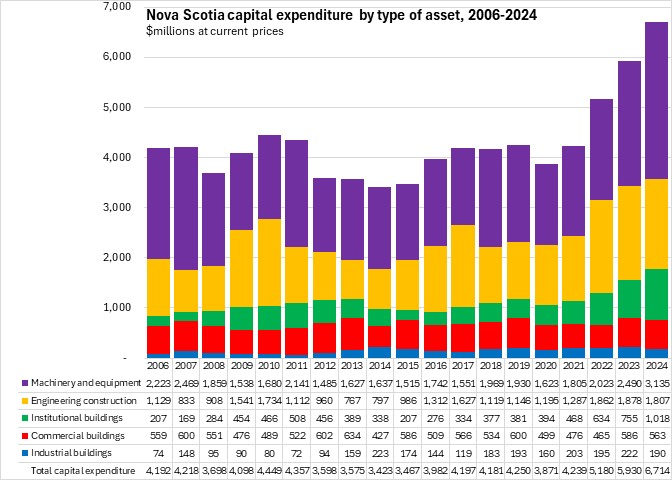
Nova Scotia's private capital expenditures peaked in 2023. Public capital expenditures in 2024 were nearly twice their levels in 2021.
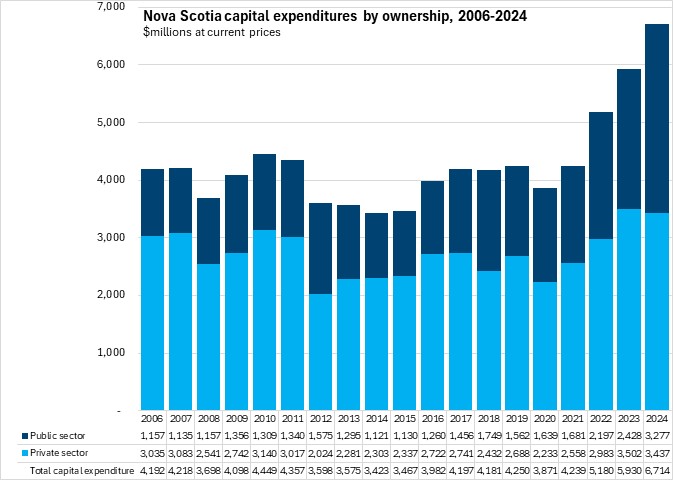
Source: Statistics Canada. Table 34-10-0035-01 Capital and repair expenditures, non-residential tangible assets, by industry and geography (x 1,000,000); Table 34-10-0038-01 Capital and repair expenditures, non-residential tangible assets, by type of ownership and geography (x 1,000,000);Table 34-10-0063-01 Capital expenditures, non-residential tangible assets, by type of asset and geography (x 1,000,000); Table 17-10-0009-01 Population estimates, quarterly
<--- Return to Archive


