The Economics and Statistics Division maintains archives of previous publications for accountability purposes, but makes no updates to keep these documents current with the latest data revisions from Statistics Canada. As a result, information in older documents may not be accurate. Please exercise caution when referring to older documents. For the latest information and historical data, please contact the individual listed to the right.
<--- Return to Archive
For additional information relating to this article, please contact:
March 17, 2026JOB VACANCIES AND WAGES, Q4 2025 Quarter-over-quarter (Q4 2025 vs Q3 2025)
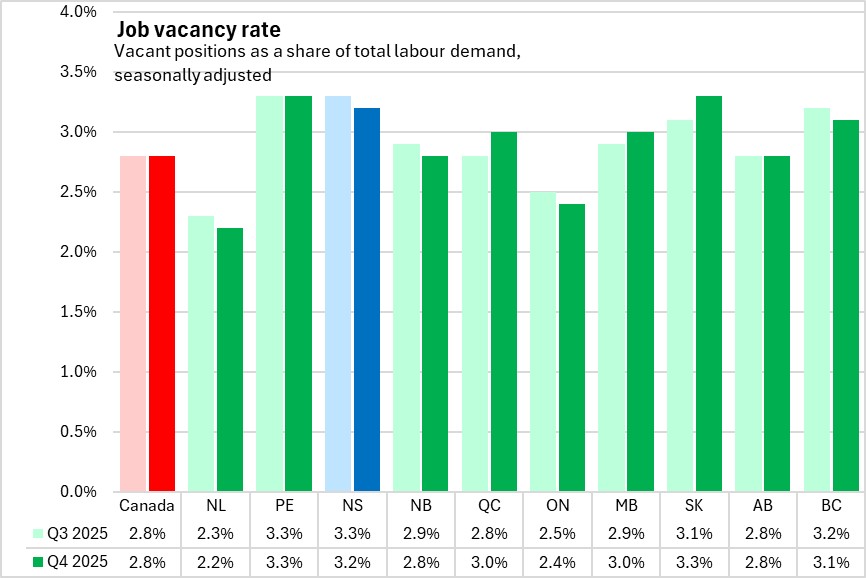
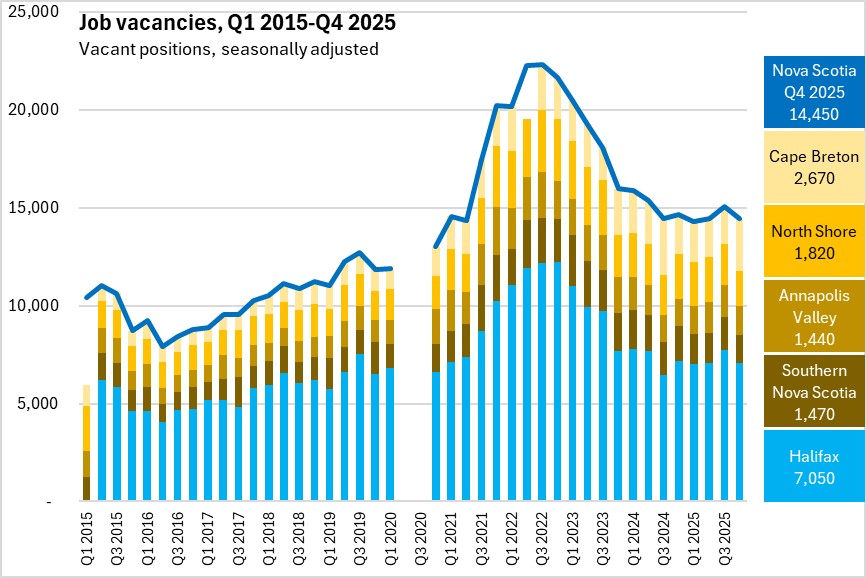
Nova Scotia's job vacancy rate (seasonally adjusted) decreased 0.1 percentage point to 3.2% in Q4 2025, representing 14,450 job vacancies.
Nationally, the job vacancy rate was 2.8%, unchanged from Q3 2025. The highest job vacancy rates were reported in Prince Edward Island and Saskatchewan, while the lowest job vacancy rate was in Newfoundland and Labrador.
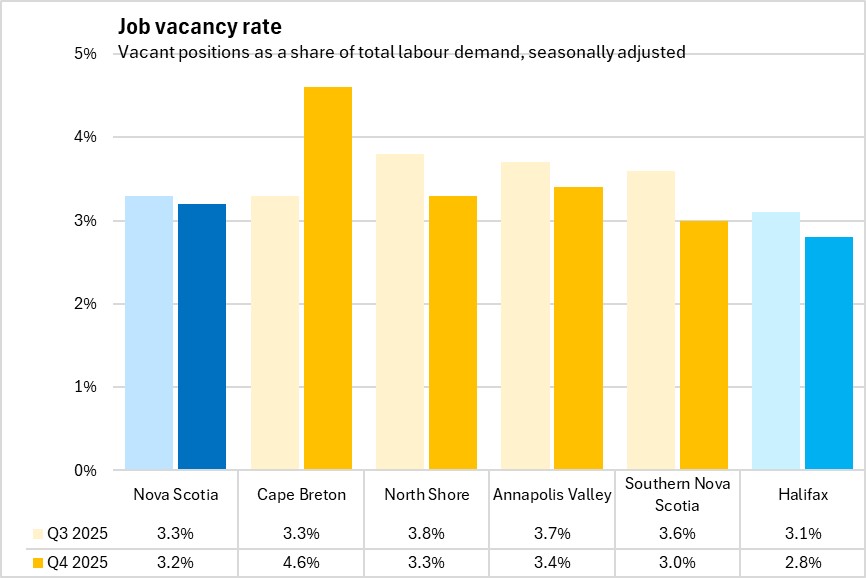
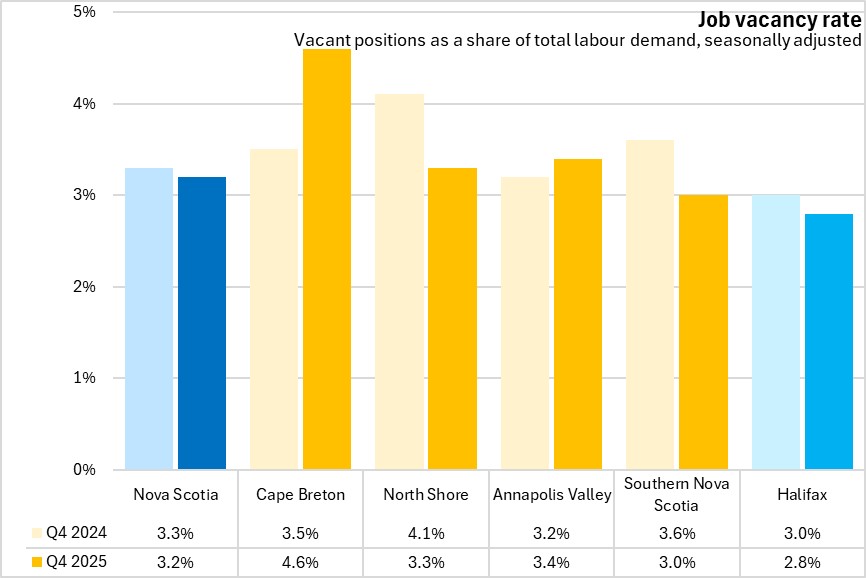
In Nova Scotia, Cape Breton reported the highest job vacancy rate at 4.6% while Halifax reported the lowest at 2.8%. All regions except Cape Breton reported lower job vacancy rates compared to the previous quarter.
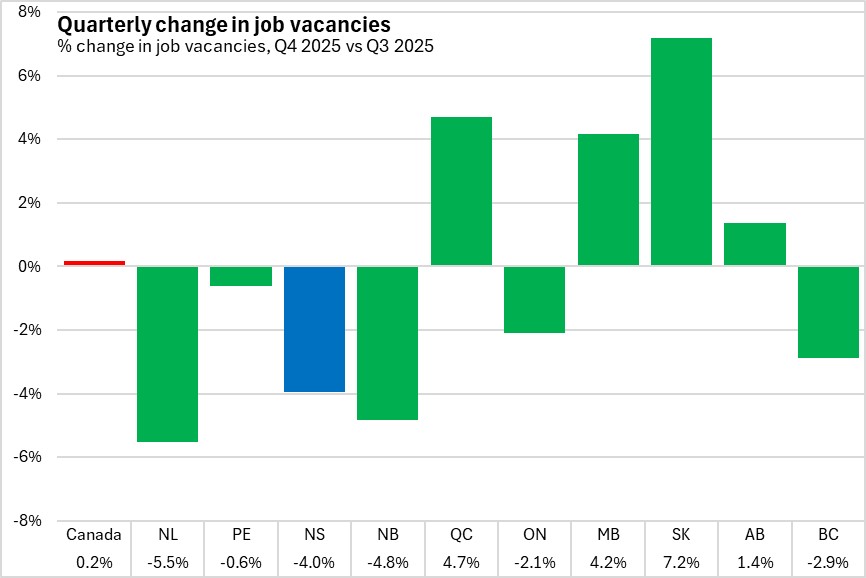
The number of job vacancies in Nova Scotia fell by 4.0% from Q3 2025 to Q4 2025. Nationally, job vacancies rose 0.2%, with six provinces reporting declines led by Newfoundland and Labrador. Saskatchewan reported the largest gain in job vacancies.
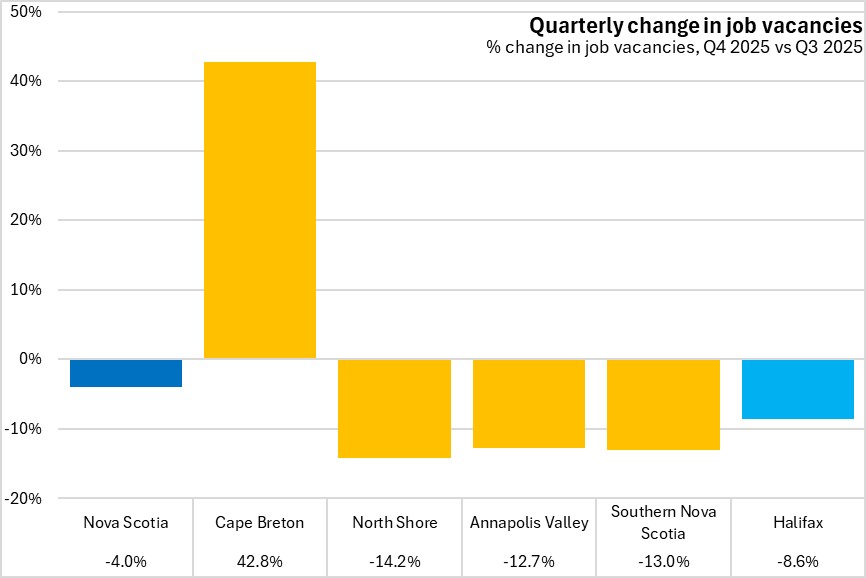
In Nova Scotia, job vacancies were down in all regions except Cape Breton. North Shore reported the largest decline in job vacancies in the fourth quarter of 2025.
Year-over-year (Q4 2025 vs Q4 2024)
Compared with Q4 2024, Nova Scotia's job vacancy rate was down by 0.1 percentage points. Nationally, the job vacancy rate was down 0.2 percentage points, with all provinces, except New Brunswick that had no change, reporting declining job vacancy rates from Q4 2024 to Q4 2025. Newfoundland and Labrador and British Columbia had the largest drop in job vacancy rates.
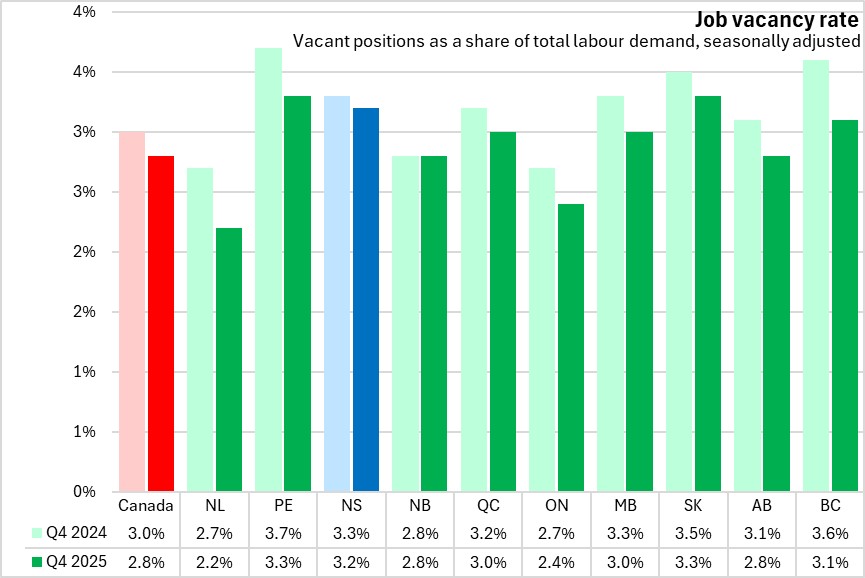
Within Nova Scotia, Cape Breton and Annapolis Valley were the only regions to report a higher job vacancy rate from Q4 2024 to Q4 2025.
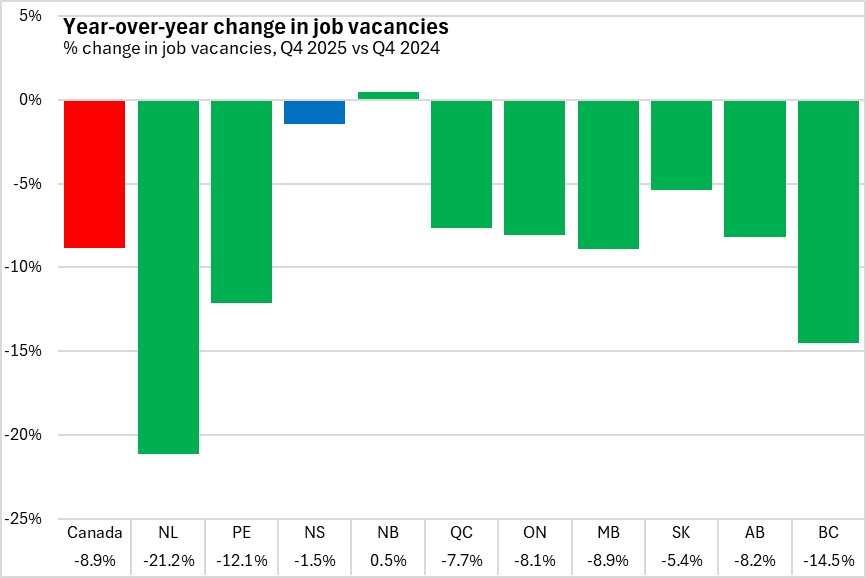
The number of job vacancies decreased by 1.5% in Nova Scotia from Q4 2024 to Q4 2025, the smallest decline in job vacancies among provinces. Nationally, the number of job vacancies fell by 8.9% led by Newfoundland and Labrador with declines in all provinces, except New Brunswick which had gains in job vacancies.
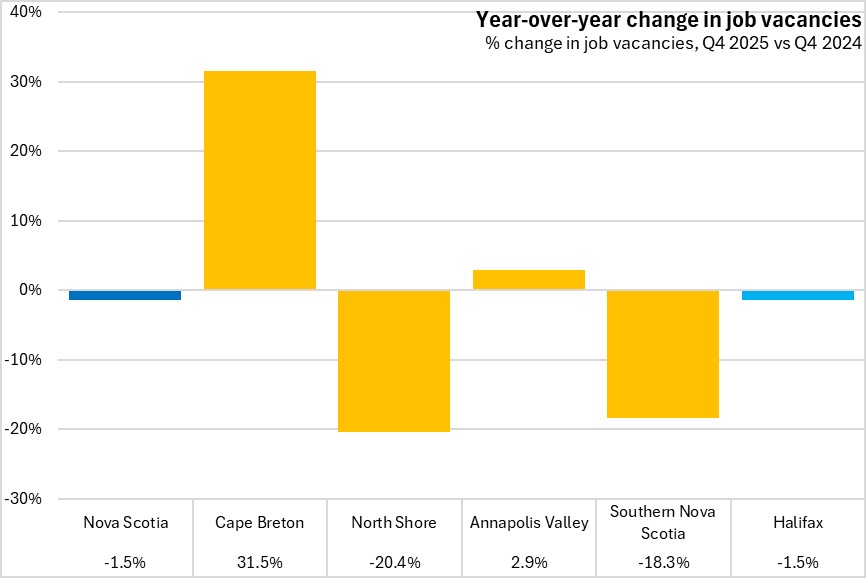
Among Nova Scotia's economic regions, Cape Breton and Annapolis Valley reported the only year-over-year gains in job vacancies, while North Shore region reported the fastest decrease.
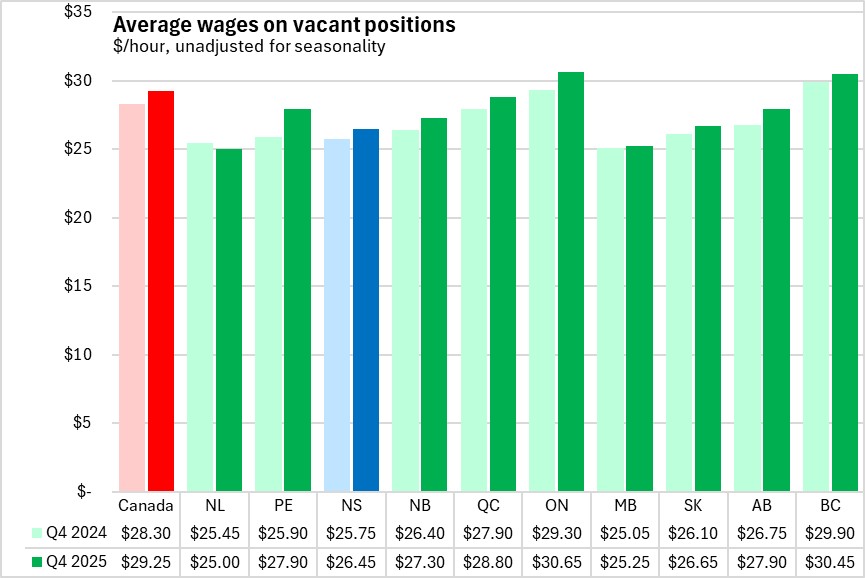
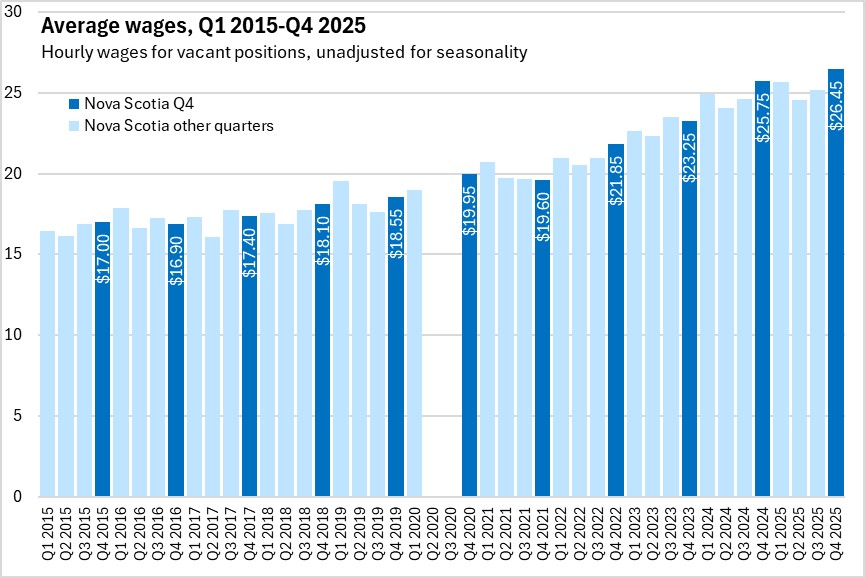
The average hourly wage offered on vacant positions (unadjusted for seasonality) was $26.45 in Nova Scotia during Q4 2025, up from $25.75 a year earlier. All provinces, except Newfoundland and Labrador, reported higher average hourly wages on vacant positions compared with Q4 2024.
Average hourly wages on vacant positions were $29.25 nationally, with the highest values in Ontario. Manitoba and Newfoundland and Labrador reported the lowest average wages on vacant positions in Q4 2025.
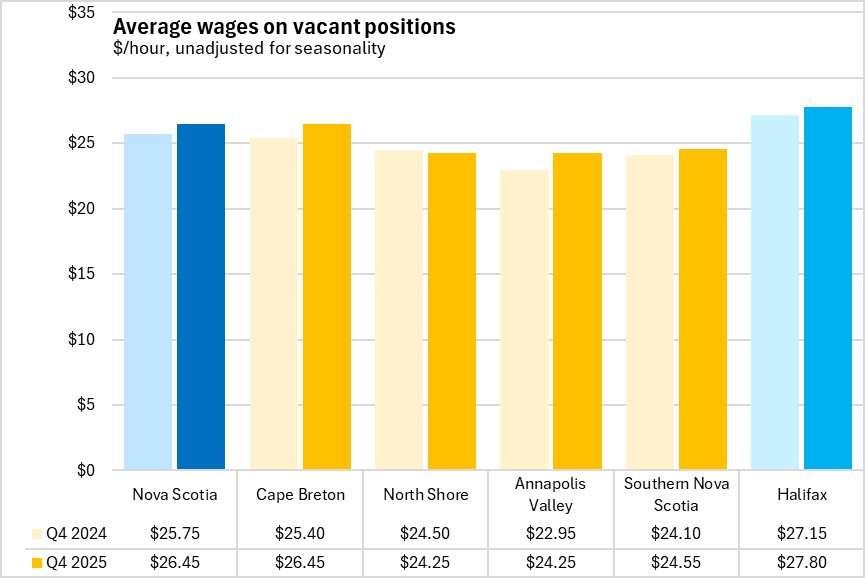
Across Nova Scotia, average hourly wages on vacant positions were up for all regions except North Shore. Q4 2025 wages were highest in Halifax and lowest in the North Shore and Annapolis Valley economic regions.
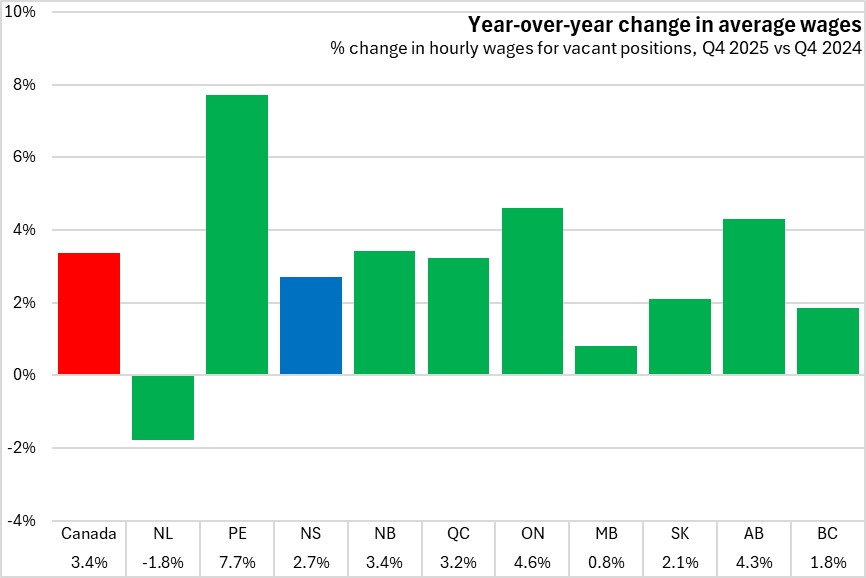
Average wages on vacant positions grew by 2.7% in Nova Scotia from Q4 2024 to Q4 2025. Nationally, average wages on vacant positions were up 3.4% over this period with gains in all provinces, except Newfoundland and Labrador. Prince Edward Island reported the largest increase in average wages on vacant positions.
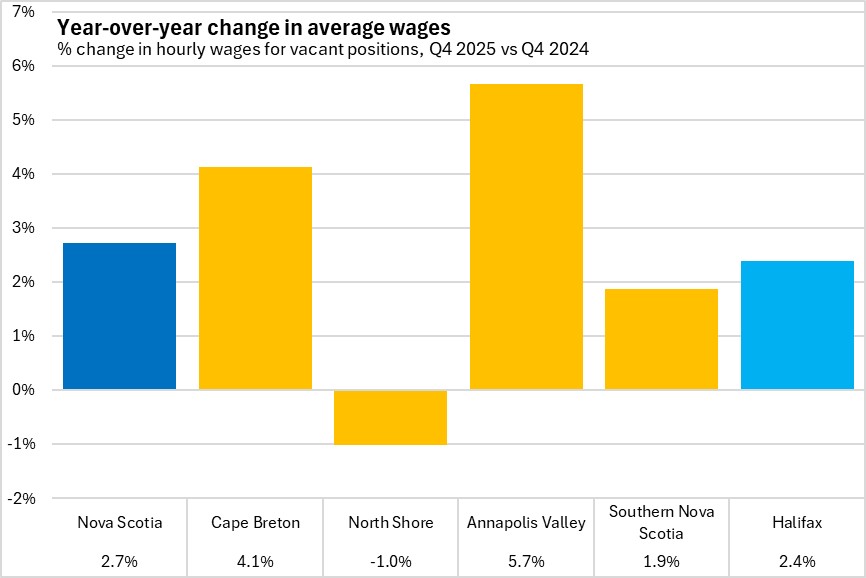
Annapolis Valley reported the fastest year-over-year growth in average wages for vacant positions while the North Shore region reported the only decline.
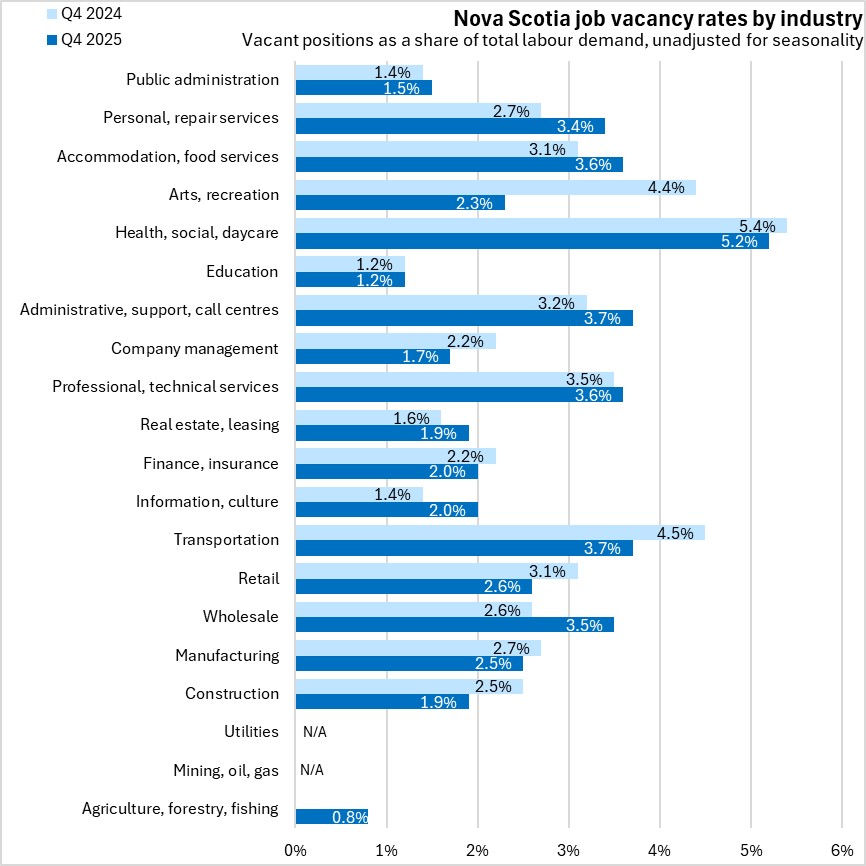
In unadjusted job vacancy rates by industry in Nova Scotia, health/social assistance/daycare reported the highest job vacancy rate in Q4 2025. Agriculture/forestry/fishing reported the lowest job vacancy rate. (Note: no data were available for utilities or mining/oil/gas for Q4 2025).
Compared with Q4 2024, there was a notable decline in the job vacancy rates for Nova Scotia's arts/recreation sector and a notable increase for wholesale vacancy rates.
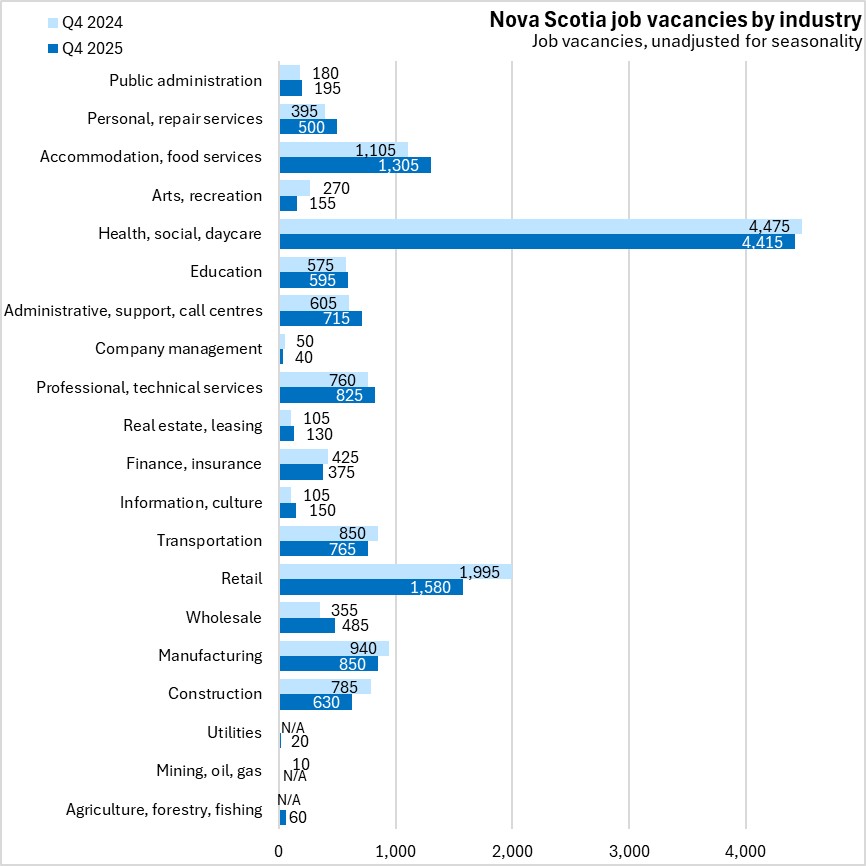
Despite a decline, the number of job vacancies remained highest in health/social/daycare in Nova Scotia in Q4 2025.
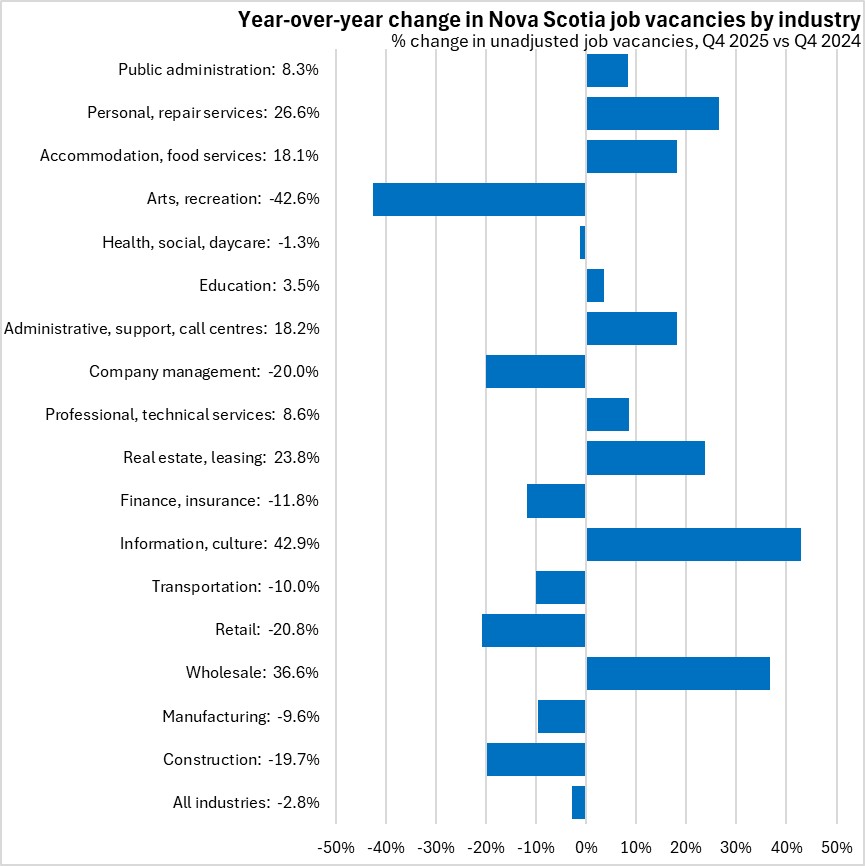
Across all industries, job vacancies were down 2.8% in unadjusted results when comparing Q4 2025 to Q4 2024. Information/culture reported the largest increase in job vacancies over this period. Arts/recreation reported the steepest declines. (Note: no data were available for agriculture/forestry/fishing, utilities or mining/oil/gas for Q4 2025).
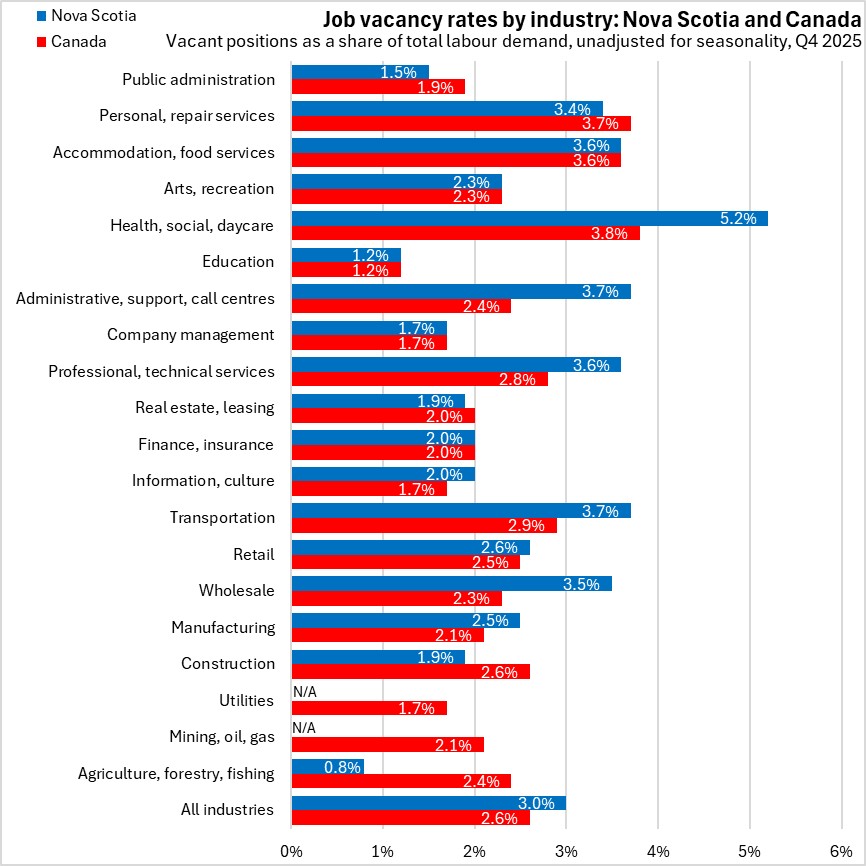
Compared with national averages by industry, Nova Scotia's job vacancy rates were higher for nine of the reporting industries.
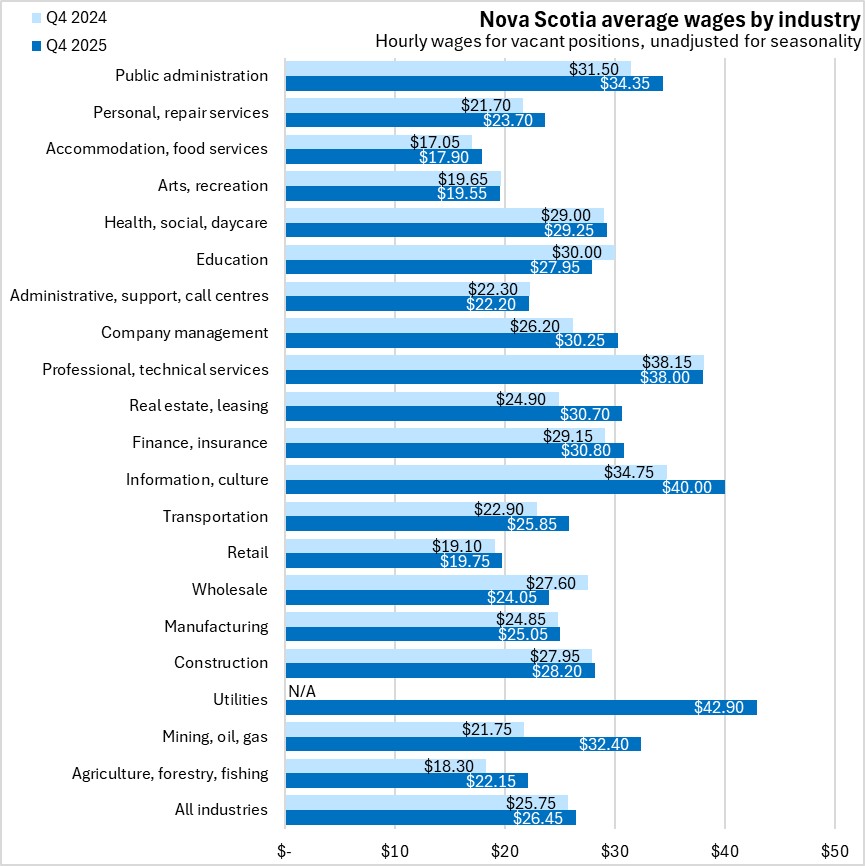
In Q4 2025, average hourly wages offered on vacant positions in Nova Scotia were highest for utilities and information/culture. Hourly wages for vacant positions in Nova Scotia were lowest for accommodation/food services.
From Q4 2024 to Q4 2025, average hourly wages offered on vacant positions in Nova Scotia were up for fourteen industries. Note that quarterly data are unavailable for utilities in Q4 2024.
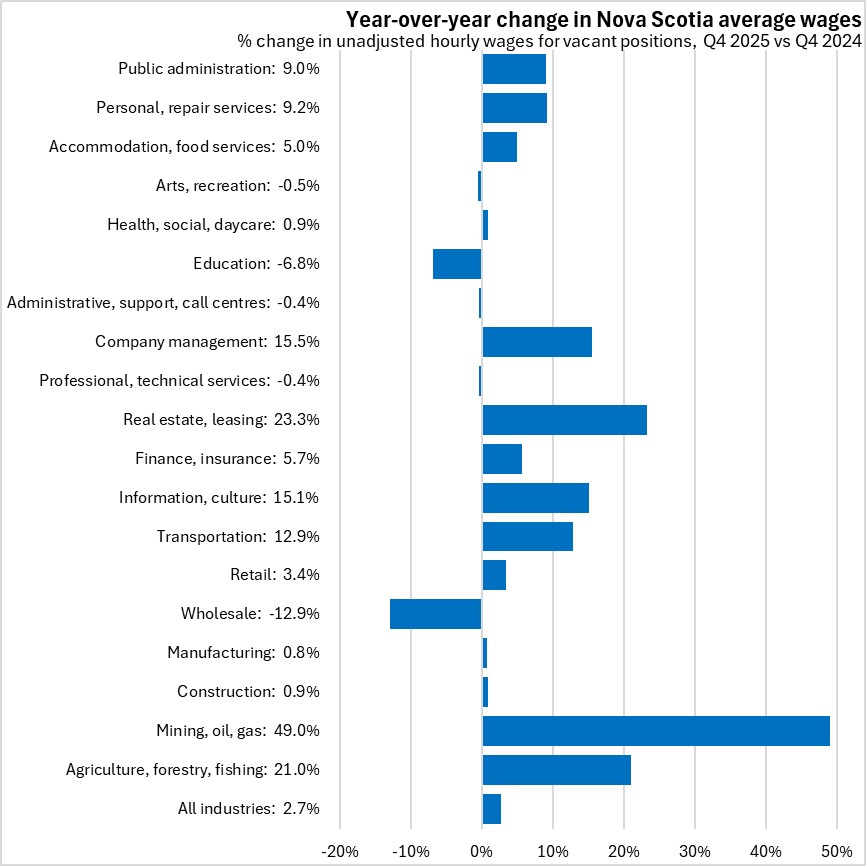
Growth in average hourly wages for vacant positions was strongest for mining/oil/gas comparing Q4 2025 against Q4 2024. Wholesale reported the steepest percentage decline in hourly wages offered on vacant positions over this period.
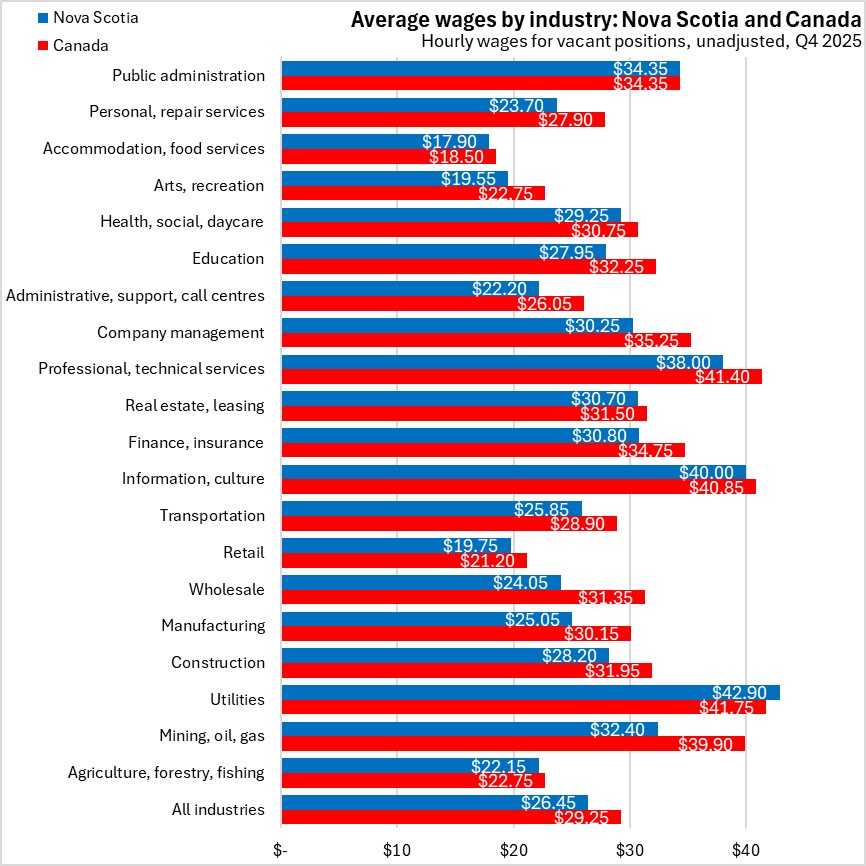
Compared with national averages, average hourly wages on vacant Nova Scotia positions were lower for all reporting industries in Q4 2025, except utilities and public administraion. The gap was largest for mining/oil/gas.
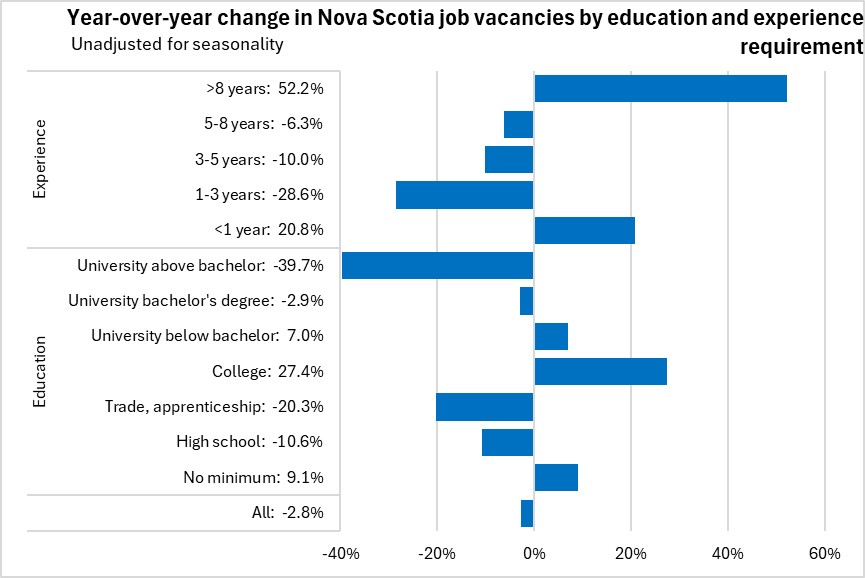
The majority of job vacancies in Q4 2025 required no more than a high school education and less than one year of experience.
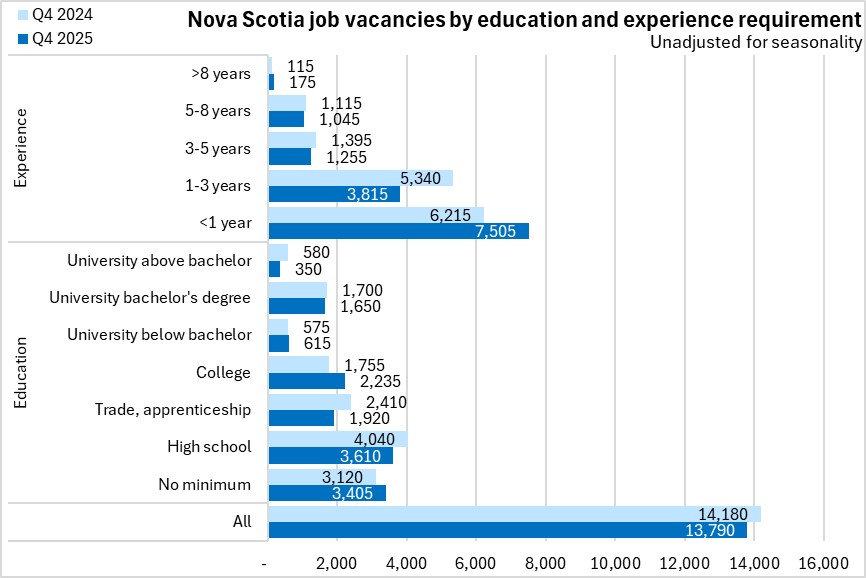
Comparing Q4 2025 against Q4 2024, job vacancies were up the most for those requiring college education and vacancies were down most for university degree above a bachelor. Among experience requirements, vacancies were up the most for more than eight years of experience (though this remains the smallest number of vacancies) followed by less than one year of experience. There was a signifficant decline for jobs requiring 1-3 years of experience.
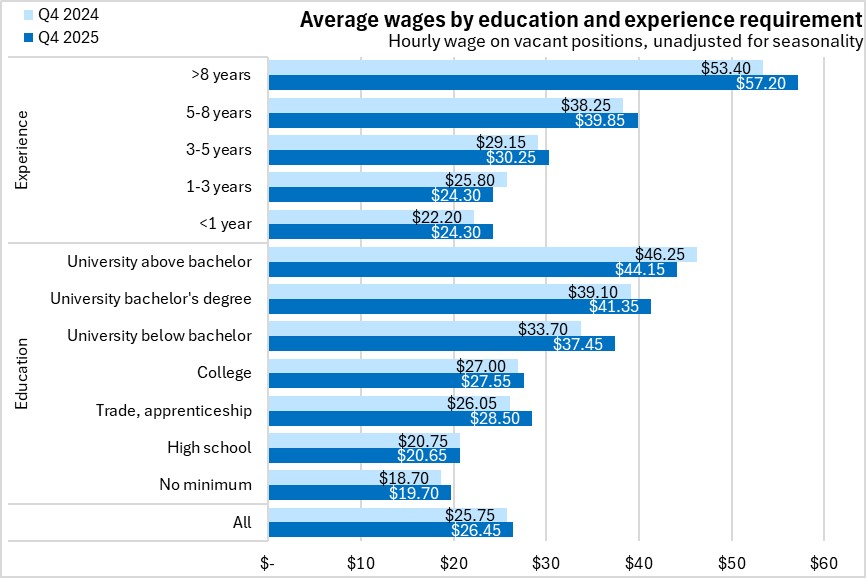
Average hourly earnings for vacant positions were on average higher for increased experience and educational requirements.
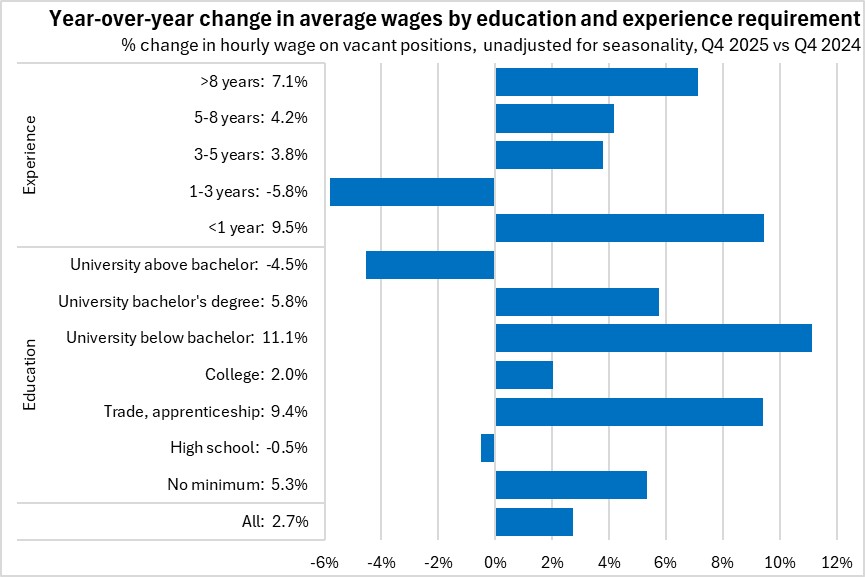
Over the last year (comparing Q4 2025 against Q4 2024), average hourly wages were up the most for positions requiring no more than one year of experience, as well as for those requiring a university below bachelor's degree. Wages were down for vacant positions requiring between 1-3 years of experience. By education requirement, average wages were down for high school requirement.
Trends
Following the pandemic (when job vacancy data were not collected), there was a substantial rise in Nova Scotia's job vacancy rate. The national job vacancy rate also increased over this time. After peaking in early 2022, vacancy rates in both Nova Scotia and across Canada declined steadily. The Canadian rate has continued to decline in 2025 while Nova Scotia's job vacancy rate has remained above national average since the first quarter of 2024.
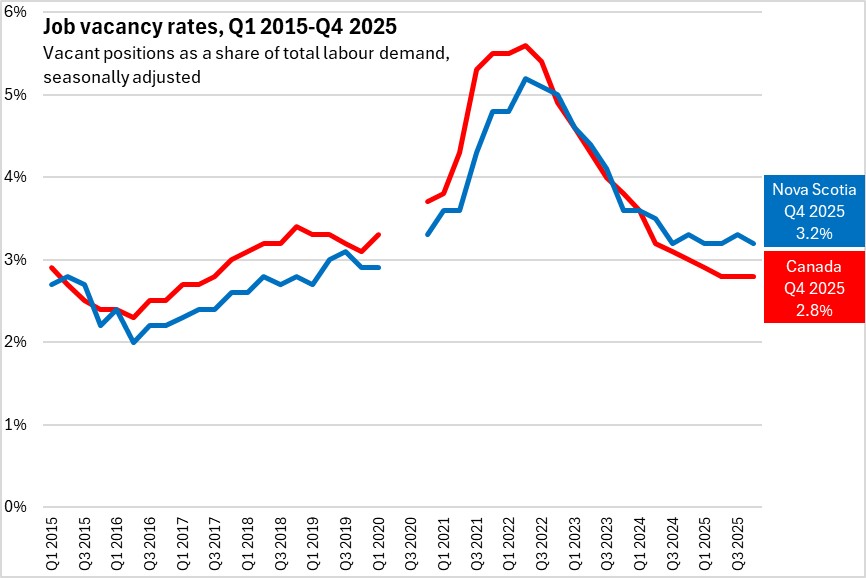
The number of job vacancies in Nova Scotia peaked at 22,305 (seasonally adjusted) in Q3 2022. Since then, the number of vacancies has fallen by 7,855 with declines in all economic regions, except Cape Breton.
Growth in average hourly earnings for vacant positions across Nova Scotia has slowed in the first three quarters of 2025, but grew to a new high in the last quarter.
Notes: Data collection activities were suspended from the start of the pandemic in March to September 2020. There remains a gap in the dataset for this survey.
Source: Statistics Canada. Table 14-10-0398-01 Job vacancies, payroll employees, and job vacancy rate, by economic regions, quarterly, adjusted for seasonality; Table 14-10-0441-01 Job vacancies, payroll employees, job vacancy rate, and average offered hourly wage by economic regions, quarterly, unadjusted for seasonality; Table 14-10-0442-01 Job vacancies, payroll employees, job vacancy rate, and average offered hourly wage by industry sub-sector, quarterly, unadjusted for seasonality; Table 14-10-0443-01 Job vacancies, proportion of job vacancies and average offered hourly wage by occupation and selected characteristics, quarterly, unadjusted for seasonality; Table 14-10-0444-01 Job vacancies and average offered hourly wage by occupation (unit group), quarterly, unadjusted for seasonality
<--- Return to Archive


