The Economics and Statistics Division maintains archives of previous publications for accountability purposes, but makes no updates to keep these documents current with the latest data revisions from Statistics Canada. As a result, information in older documents may not be accurate. Please exercise caution when referring to older documents. For the latest information and historical data, please contact the individual listed to the right.
<--- Return to Archive
For additional information relating to this article, please contact:
March 18, 2026NEW BRUNSWICK BUDGET 2026-27 The Province of New Brunswick released its provincial budget for 2026-27 on March 17, 2026.
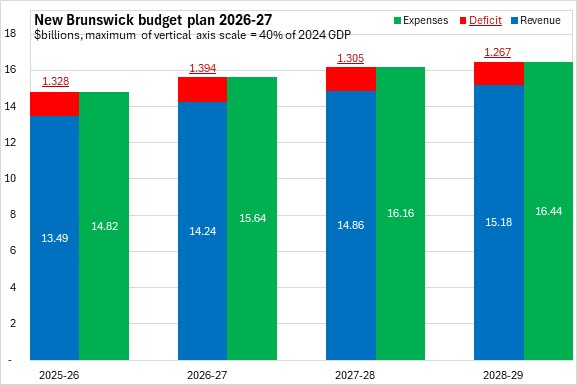
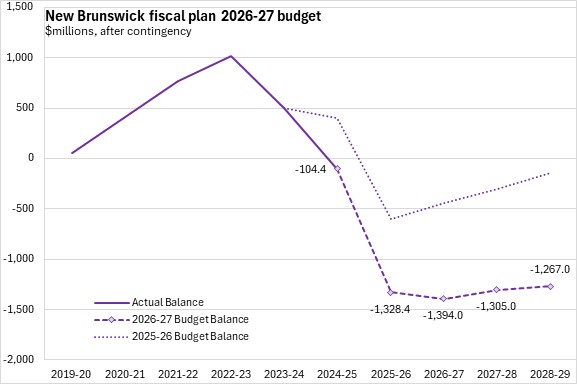
New Brunswick's 2026-27 budget anticipates a deficit of $1.39 billion, widening from the $1.33 billion deficit now forecast for the 2025-26 fiscal year. Over the subsequent two fiscal years, New Brunswick's deficit is projected to contract slightly to $1.27 billion by 2028-29.
New Brunswick's provincial government revenues are projected to grow by 5.6% in 2026-27 while expenditures are projected to rise by 5.5%. For 2027-28, revenues are projected to grow by 4.3% while expenditures rise 3.4%. In 2028-29, revenue growth is projected at 2.1% while expenditures grow 1.7%.
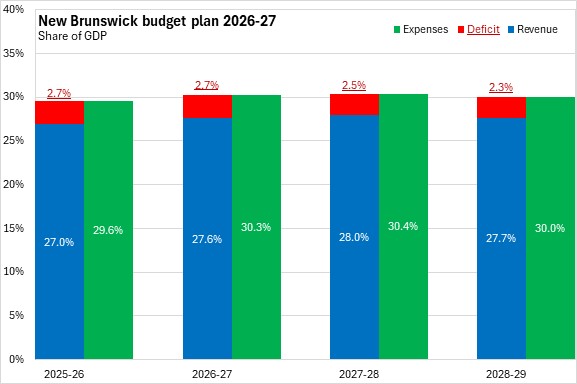
Measured as a share of GDP, the footprint of provincial government in New Brunswick's economy amounts to 30.3% of GDP in 2026-27. This is projected to shrink slightly to 30.0% of GDP by 2028-29. New Brunswick's deficit for 2026-27 amounts to 2.7% of projected 2026 nominal GDP. The deficit is projected to shrink to 2.3% of GDP by 2028-29.
New Brunswick's net debt is expected to amount to 30.8% of GDP in 2026-27. By 2028-29, New Brunswick's net debt is projected to amount to 36.0% of GDP.
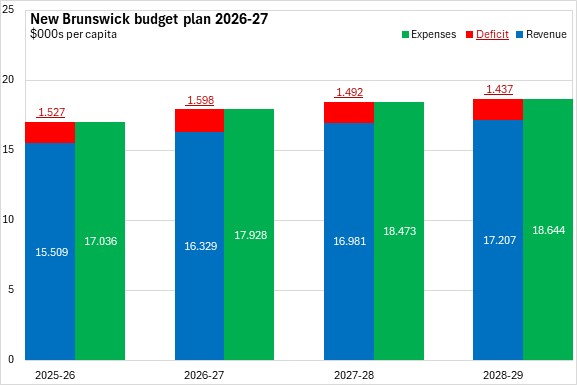
New Brunswick's 2026-27 Budget expenditures amount to $17,928 per capita, funded by revenues of $16,329 per capita and a deficit of $1,598 per capita. Expenditures per capita are projected to rise by $716 by 2028-29 while per capita revenues rise $878 and the per capita deficit declines by $161.
Compared with last year's fiscal plan, New Brunswick's revenues are about the same (-$3 million for 2026-27) while expenditures are projected to be higher (+$944 million).
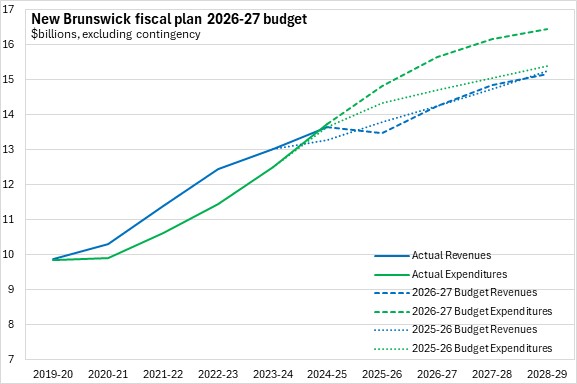
With similar revenues and higher expenditures, New Brunswick's deficit outlook has deteriorated compared to the 2025-26 deficit projection. In 2027-28 and 2028-29, the deterioration in New Brunswick's deficit projection is over $1 billion per year.

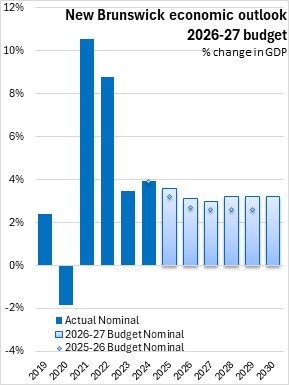
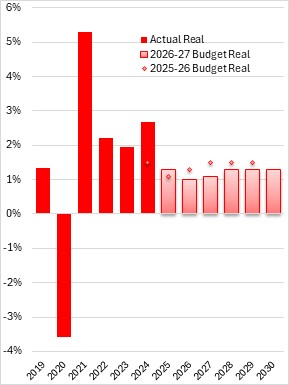
The New Brunswick Budget assumes real GDP growth of 1.0% in 2026 (3.1% in nominal terms) followed by 1.1% in 2027 (3.0% in nominal terms). In the near term, the New Brunswick economic outlook foresees slower population growth, limited labour market gains and moderating residential construction. Wage growth is expected to be consistent with the pace observed in 2025 while the unemployment rate is projected to fall to 6.9%. Public infrastructure along with investment projects at the Saint John pulp mill and Brighton Mountain Wind Farm are expected to contribute to real GDP growth in 2026.
Key Measures and Initiatives
New Brunswick's Budget prioritizes health care, affordability, housing, education and economic development while implementing measures to improve fiscal sustainability.
Health care
- $170.4 million for the physician services agreement, which introduces new compensation models that reward doctors for patient attachment, timely access and participation in team-based collaborative care practices
- $5.4 million to support medical education and to support international recruitment of medical graduates and trained nurses
- $30 million to expand the collaborative care clinic model
- $50 million to modernize and digitize the health-care system
- $2.5 million to equip paramedics with clot-busting medications for people having a heart attack or stroke
- $5 million to expand cancer screening programs and at-home Pap screening
- $10 million to make home care more affordable
- $4 million to expand the Nursing Home Without Walls program
- $2.6 million to increase the hours of care in nursing homes
Housing and affordability
- $17 million for a new community housing retention and expansion project
- $10.2 million in wraparound services for supportive housing
- $4.4 million to index social assistance rates to inflation
- $98.1 million to continue the residential electricity rebate
Education
- An additional $7 million to deliver a school lunch program
- $5.8 million for additional resource teachers, academic support teachers and guidance counsellors
- An additional $1.4 million to support recruitment and retention
Economic development
- $2 million in the Agriculture Growth Action Plan
- $750,000 in the Local Food and Beverage Program
- $21 million in Opportunities NB’s Competitiveness and Growth Program
- $2.8 million to help stabilize the arts and culture sector
- $250,000 to support pay transparency implementation
- $6.7 million to strengthen wildfire preparedness and response
Fiscal sustainability
- Reducing the civil service by 12 per cent over three years, saving up to $100 million
- Reviewing underutilized assets, including government buildings and schools with fewer than 100 students
- Heritage properties with fewer than 5,000 annual visitors will be transferred to community partners or closed
- Handing provincial field veterinary services as well as veterinary lab and foreign animal disease lab services off to the private sector over the next three fiscal years
- Introducing tolls on non-New Brunswick vehicles, starting by 2028, with revenue directed specifically to road and bridge maintenance
New Brunswick Budget 2026-27
<--- Return to Archive


