The Economics and Statistics Division maintains archives of previous publications for accountability purposes, but makes no updates to keep these documents current with the latest data revisions from Statistics Canada. As a result, information in older documents may not be accurate. Please exercise caution when referring to older documents. For the latest information and historical data, please contact the individual listed to the right.
<--- Return to Archive
For additional information relating to this article, please contact:
March 19, 2026QUEBEC BUDGET 2026-27 The Province of Québec released its provincial budget for 2026-27 on March 18, 2026.
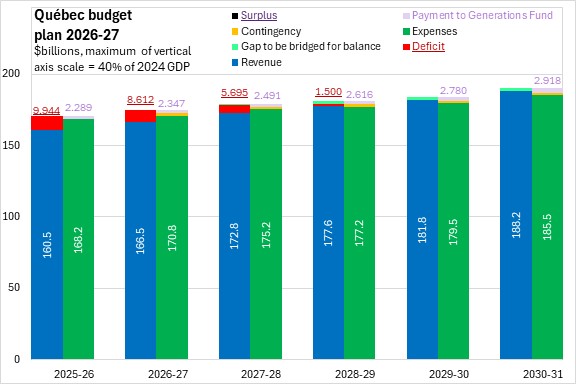
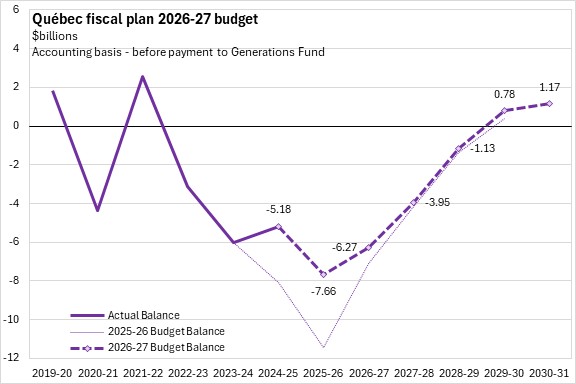
Québec's 2026-27 budget anticipates a deficit of $8.612 billion, though $2.347 billion of this is a contribution to the province's Generations Fund, leaving an "accounting" deficit of $6.265 billion.
In the 2027-28 fiscal year, the province anticipates a further deficit of $5.695 billion. In this year, Québec's fiscal plan includes a $750 million "gap to be bridged" along with a $2.491 billion contribution to the Generations Fund. After adding the gap to be bridged and subtracting the contribution to the Generations Fund, Québec's accounting deficit for 2027-28 falls to $3.954 billion on an accounting basis
By 2028-29, Québec's deficit falls to $1.5 billion, but with a $2.25 billion gap to be bridged and a $2.616 billion contribution to the Generations Fund, the accounting deficit remains at $1.134 billion.
In both 2029-20 and 2030-31, Québec anticipates accounting surpluses. The sum of accounting surpluses and gaps to be bridged amount to the expected contributions to the Generations Fund in these years.
Québec's fiscal plan also includes a $2 billion contingency reserve in 2026-27 as well as $1.5 billion per year thereafter.
In 2026-27, Québec's revenues are projected to rise by 3.7% while expenditures grow 1.5%.
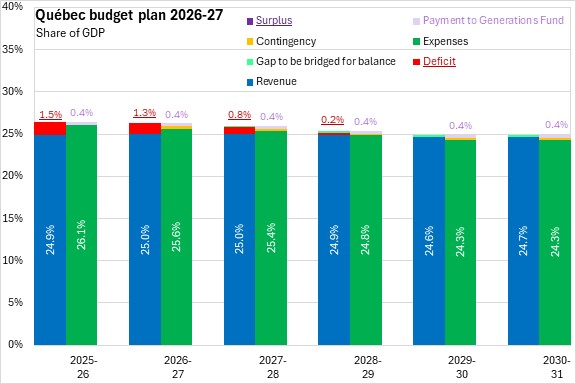
Measured as a share of GDP, the footprint of provincial government in Québec's economy amounts to 26.3% of GDP in 2026-27. This is projected to shrink to 24.9% of GDP by 2029-30 and 2030-31. Québec's deficit for 2026-27 amounts to 1.3% of projected 2026 nominal GDP (though this is only 0.9% on an accounting basis). Contributions to the Generations Fund are expected to remain at a steady 0.4% of GDP throughout the fiscal horizon.
Québec's net debt is expected to amount to 38.9% of GDP in 2026-27, rising to 39.3% in 2027-28. Over the subsequent three fiscal years, Québec's net debt is projected to fall to 36.9% of GDP (2030-31).
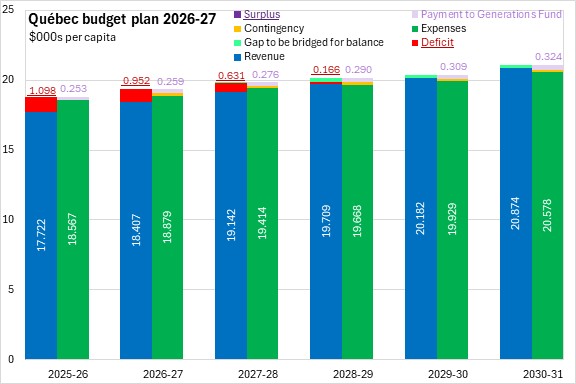
Québec's 2026-27 Budget expenditures amount to $18,879 per capita, along with a $221 per capita contingency and a $259 per capita contribution to the Generations Fund. This is funded by revenues of $18,407 per capita and a deficit of $952 per capita.
By 2030-31, Québec's per capita revenues are projected to grow by $2,467 while expenditures per capita increase by $1,699 and the gap to be bridged rises to $194 per capita. The contingency is projected to contract by $55 per capita while the contribution to the Generations Fund is expected to grow by $64 per capita.
Compared with last year's fiscal plan, Québec's revenues are somewhat stronger in the near term while expenditures are little changed.
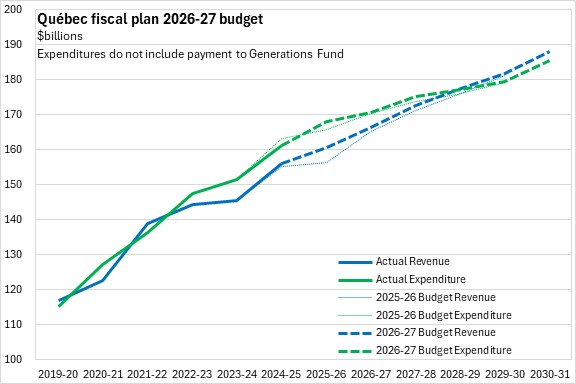
With slightly elevated revenues and similar expenditures, Québec's deficit outlook is somewhat muted from 2025-26 deficit projection. Through the remainder of the fiscal horizon, Québec's deficit projections are little changed.
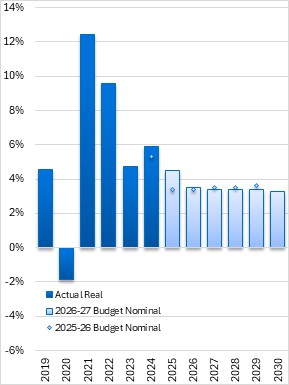
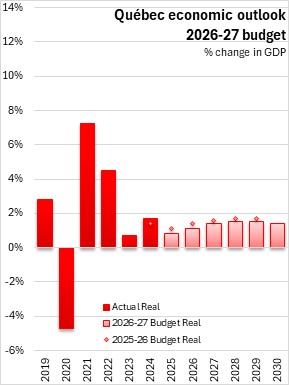
The Québec Budget assumes real GDP growth of 1.1% in 2026 (3.5% in nominal terms) followed by 1.4% in 2027 (3.4% in nominal terms). In the near term, Québec's economy remains more exposed to shifts in US trade policy while the population is expected to decline due to departing non-permanent residents, slowing employment growth. Although financing costs remain low, Québec's economic outlook expects limited non-residential investment in 2026 due to uncertainty and costly imports of machinery due to a weaker currency. With headwinds from investment, trade and employment growth, household consumption spending is expected to be tepid in the near term. Residential construction, however, is expected to remain a robust contributor to Québec's economy. In the medium term, public infrastructure expenditures along with increasing adoption of artificial intelligence are expected to help Québec's economy adapt to these new realities through improvements in productivity.
Key Measures and Initiatives
Québec's Budget prioritizes core services, communities and economic transformation.
Core services
- $2.2 billion for health services and social services, consolidating care and services within the public network
- Additional funding for the government action plan for caregivers 2026-2031
- Extending the assistance program for private seniors’ residences and other related entities to limit the impact of insurance premium increases
- $639 million (5 years) for educational success, school space needs, and attracting educators
- $392 million (5 years ) for higher education training, labour market integration and research, including $132 million to extend employment assistance allowances
- Support training of childcare educators, medical school cohorts, immigrants integrating into the workforce, and the Indigenous workforce
- $45 million for university research
- $1.1 billion (5 years) to consolidate activities in public safety, combat gun violence, ensure cybersecurity operations, and strengthen access to legal services
Communities
- $846 million to convert 5,000 non-subsidized childcare spaces into subsidized spaces and maintaining the capped school tax increase at 3%
- $741 million to build 1,000 affordable housing units
- $264 million to help people experiencing homelessness and better address mental health
- $260 million for shelters serving women who are victims of violence
- $257 million for community organizations and food bank supplies
- Revenu Québec will automatically file tax returns for certain clienteles
- $445 million for maintenance of local and regional infrastructure
- $584 million (5 years) for climate change adaptation and mitigation
- $119 million for culture in schools and cultural field trips
- $58 million to support cultural bodies, Québec’s library network and museums
- $40 million (3 years) for the Québec Cultural Heritage Fund, the Biosphere, Maison St-Pierre and Maison René-Lévesque
Economic transformation
- Increasing infrastructure investment and rehabilitation by more than $5 billion (6 years)
- $410 million for investment projects in promising sectors
- Levers to encourage strategic businesses to keep their head offices in Québec
- Additional capitalization of up to $2.0 billion of Québec's investment funds
- Creation of $500-million loan guarantee fund for Indigenous communities participation in economic projects
- New legislation to accelerate the granting of the authorizations for national-scale projects
- $283 million (5 years) to support innovation and the adoption of technology in the construction sector
- $90 million to fund the innovation ecosystem
- Developing of innovation zones in Québec,
- Encouraging the adoption of artificial intelligence and quantum technologies
- $215 million for tourism and bio-food sectors
- $365 million for the forestry sector
- $429 million for the cultural sector
- Tax credit for Québec news media
Québec Budget 2026-27
<--- Return to Archive


