The Economics and Statistics Division maintains archives of previous publications for accountability purposes, but makes no updates to keep these documents current with the latest data revisions from Statistics Canada. As a result, information in older documents may not be accurate. Please exercise caution when referring to older documents. For the latest information and historical data, please contact the individual listed to the right.
<--- Return to Archive
For additional information relating to this article, please contact:
March 19, 2026SASKATCHEWAN BUDGET 2026-27 The Province of Saskatchewan released its provincial budget for 2026-27 on March 18, 2026.
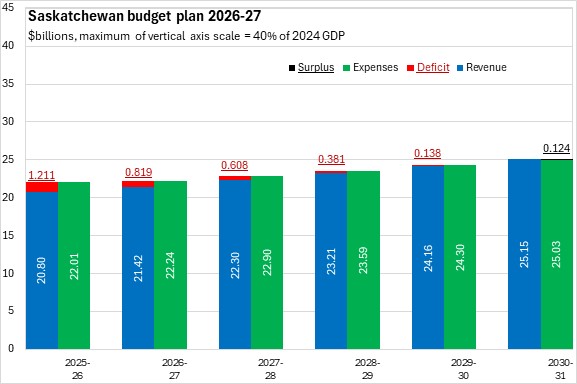
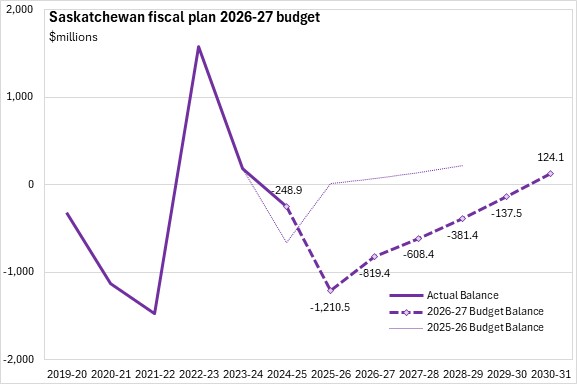
Saskatchewan's 2026-27 budget anticipates a deficit of $819 million, narrowing from the $1.21 billion deficit now forecast for the 2025-26 fiscal year. Over the subsequent four fiscal years, Saskatchewan's deficit is projected to close, generating a $124 million surplus in 2030-31.
Saskatchewan's provincial government revenues are projected to grow by 2.9% in 2026-27 while expenditures are projected to rise by 1.0%. In each of the subsequent four fiscal years, revenues are assumed to grow by 4.1% per year while expenditures rise by 3.0% per year.
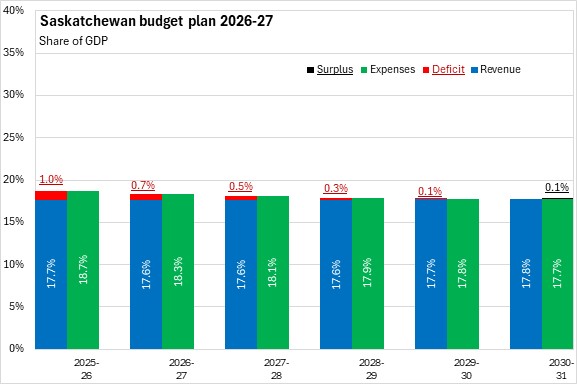
Measured as a share of GDP, the footprint of provincial government in Saskatchewan's economy amounts to 18.3% of GDP in 2026-27. This is projected to shrink somewhat to 17.8% of GDP by 2029-30 and 2030-31. Saskatchewan's deficit for 2026-27 amounts to 0.7% of projected 2026 nominal GDP.
Saskatchewan's net debt is expected to amount to 16.1% of GDP in 2026-27, rising to a peak of 16.7% in 2028-29 before contracting to 15.8% by 2030-31.
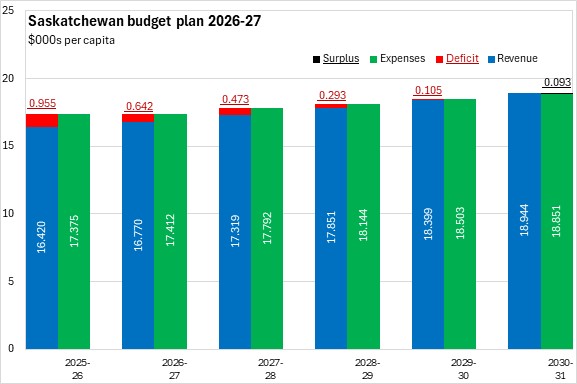
Saskatchewan's 2026-27 Budget expenditures amount to $17,412 per capita, funded by revenues of $16,770 per capita and a deficit of $642 per capita. Expenditures per capita are projected to rise by $1,439 by 2030-31 while per capita revenues rise $2,174 and the per capita deficit of $642 shifts to a surplus of $93 per capita.
Compared with last year's fiscal plan, Saskatchewan's revenues are lower (-$418 million for 2026-27) while expenditures are projected to be higher (+$477 million).
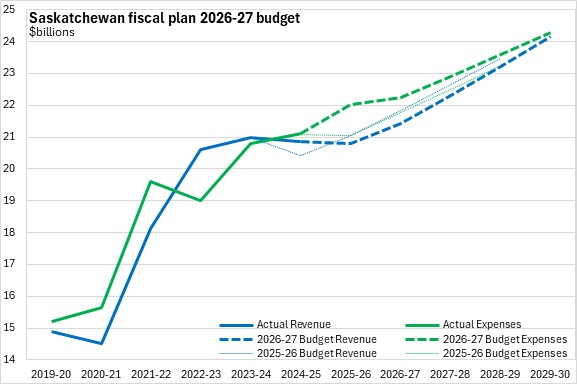
With lower revenues and higher expenditures, Saskatchewan's deficit outlook has deteriorated by $895 million compared to the 2025-26 deficit projection.
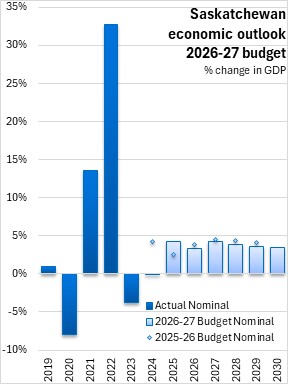
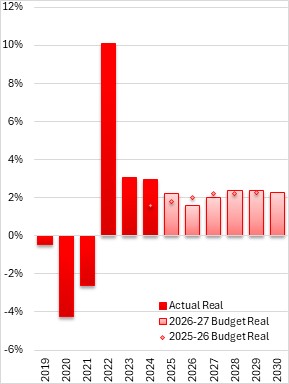
The Saskatchewan Budget assumes real GDP growth of 1.6% in 2026 (3.3% in nominal terms) followed by 2.0% in 2027 (4.3% in nominal terms). Private capital investment continues to be the main driver of Saskatchewan's medium term economic projections, supported by rising crop, oil and uranium production as well as higher potash prices. As with economic growth, the Saskatchewan Budget assumes that population growth is comparable to historical averages - about 1.0% per year - over the medium term.
Key Measures and Initiatives
Saskatchewan's Budget prioritizes economic development, health care, education and community/family supports. Key measures include:
Economic development
- $37 million for agricultural research
- $4.3 billion investment in capital infrastructure
- $125 million for workforce development programs
Health
- $636 million for health care capital
- $98 million increase for system capacity and emergency medical services
- $29 million for health human resources
- $12 million for primary and preventative care
- $9 million for seniors and continuing care
- $673 million for mental health and addictions (+$23 million)
- Funding for 200 more addiction treatment spaces
- $4 million for the Prince Albert Complex Needs Facility
- $3 million for the complex needs facility and programming in North Battleford
Communities and families
- Increased funding of $50 million to support RCMP and First Nations policing (total: $310 million)
- $400 million in Municipal Revenue Sharing (+$30 million)
- $190,000 to introduce the Small Town and Rural Policing Program
- $140 million for the Saskatchewan Public Safety Agency (+$20 million)
- Doubling the Volunteer First Responders’ Tax Credit
- Community-based organizations will receive a 2% increase
- Doubling the Active Families Benefit refundable tax credit
Education
- $3.6 billion for Prekindergarten to Grade 12 education, libraries and early learning and child care
- $124 million in school capital
- $426 million for early learning and child care
- $12 million for provincial libraries
- $1 million for literacy initiatives
- $119 million for post-secondary student affordability, including $68 million for the Graduate Retention Program
- $24 million added for regular infrastructure maintenance, upgrades and renewal
- $15 million in the Western College of Veterinary Medicine
Saskatchewan Budget 2026-27
<--- Return to Archive


