The Economics and Statistics Division maintains archives of previous publications for accountability purposes, but makes no updates to keep these documents current with the latest data revisions from Statistics Canada. As a result, information in older documents may not be accurate. Please exercise caution when referring to older documents. For the latest information and historical data, please contact the individual listed to the right.
<--- Return to Archive
For additional information relating to this article, please contact:
March 27, 2026ONTARIO BUDGET 2026-27 The Province of Ontario released its provincial budget for 2026-27 on March 26, 2026.
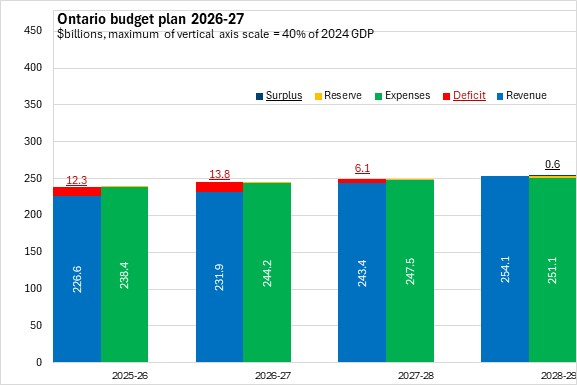
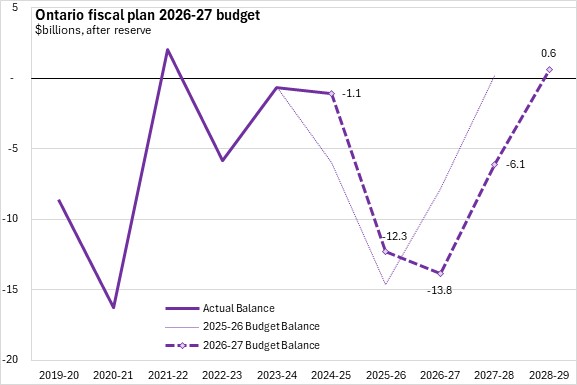
Ontario's 2026-27 budget anticipates a deficit of $13.8 billion (after a $1.5 billion contingency reserve), expanding from the $12.3 billion deficit now forecast for the 2025-26 fiscal year. In 2027-28, Ontario expects to the deficit to fall to $6.1 billion (after a $2 billion reserve). In 2028-29, Ontario anticipates a $600 million surplus (after a $2.5 billion reserve).
Ontario's provincial government revenues are projected to grow by 2.3% in 2026-27 while expenditures are projected to rise by 2.4%. Ontario's revenue growth is projected to accelerate to 5.0% in 2027-28 and to 4.4% in 2028-29 while expenditures grow by 1.4% in 2027-28 and by 1.5% in 2028-29.
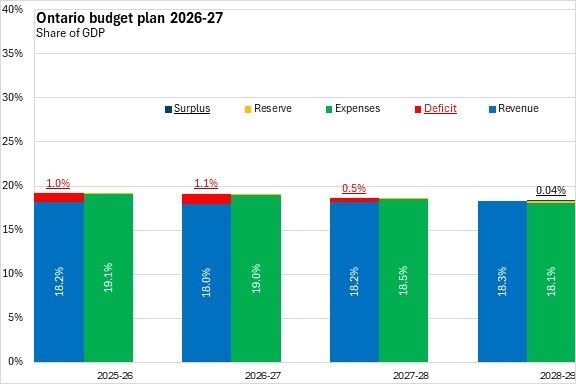
Measured as a share of GDP, the footprint of provincial government in Ontario's economy amounts to 19.1% of GDP in 2026-27. This is projected to shrink somewhat to 18.3% of GDP by 2028-29. Ontario's deficit for 2026-27 amounts to 1.1% of projected 2026 nominal GDP.
Ontario's net debt is expected to be 37.7% in the planning projection for 2026-27, followed by a peak at 38.5% of GDP in 2027-28, and a decline to 38.2% in 2028-29.
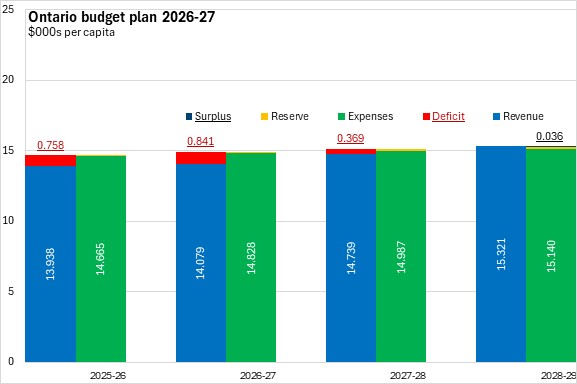
Ontario's 2026-27 Budget expenditures amount to $14,828 per capita (plus a contingency of $91 per capita), funded by revenues of $14,079 per capita and a deficit of $841 per capita. Expenditures per capita are projected to rise by $312 by 2028-29 (along with a $60 per capita rise in the contingency reserve) while per capita revenues rise $1,243 and the per capita deficit of $841 shifts to a surplus of $36 per capita.
Note: this assumes Ontario's August 2025 population projection growth rates are applied to the Province's 2026 Budget population assumption.
Compared with last year's fiscal plan, Ontario now anticipates both higher revenues (+$3.96 billion) and higher expenditures (+$10.5 billion).
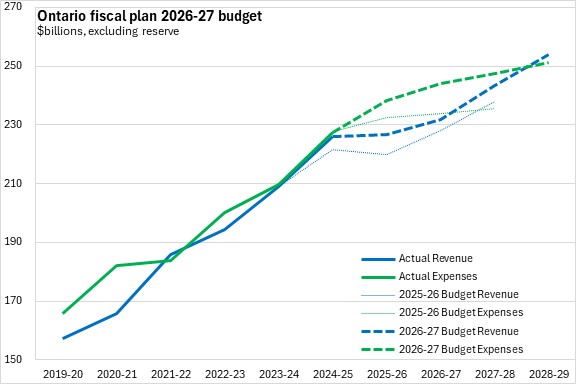
The Ontario Budget continues to expect return to balance, but the path has been shifted out by one year compared with the 2025-26 fiscal plan.
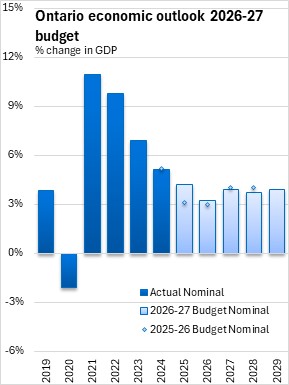
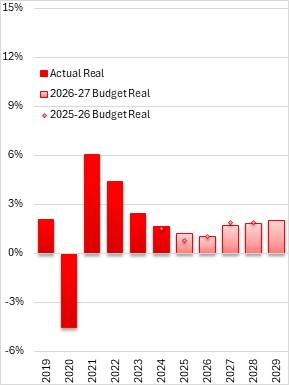
The Ontario Budget assumes real GDP growth of 1.0% in 2026 (3.2% in nominal terms) followed by 1.7% in 2027 (3.9% in nominal terms). Population growth is expected to slow in the near term due to changes in Federal international migration policies, resulting in a softer labour market for 2026. Ontario is more exposed to the impacts of shifting US trade policy and the associated impacts of uncertainty on investment levels. Although construction activity is projected to remain subdued in 2026, Ontario's economic outlook anticipates housing starts to rise again from 2027-2029.
Key Measures and Initiatives
Ontario's Budget prioritizes protection from tariffs and economic uncertainty. Key measures include:
Economy
- Removing the Harmonized Sales Tax for eligible buyers of new homes valued up to $1 million. The maximum rebate of $130,000 would be maintained for new homes valued up to $1.5 million. The federal government has agreed to cost-share with Ontario for the Federal portion of HST on eligible new homes.
- Cutting the small business corporate income tax rate from 3.2 per cent to 2.2 per cent effective July 1, 2026
- Establishing the Protect Ontario Account Investment Fund, $4 billion to attract investment from pension funds and other private capital
- Investing an additional $107 million (3 years) for Critical Technologies Initiatives in key sectors
- Investing $9.4 million (3 years) for the Summer Company and Starter Company Plus
- Providing $3 million (3 years) for the Churchill Plus Catalyst Fund
Capital investment
- Planned capital investments of $210 billion over 10 years, including $37 billion in 2026–27.
- Adding $300 million (6 years) for the Community Sport and Recreation Infrastructure Fund
- Funding (with Federal support) to eligible municipalities to reduce development charges
- Modernization and expansion of Billy Bishop Airport
Services
- Increasing funding for the Ontario Autism Program to nearly $1 billion annually
- Expanding Ontario’s four-year investment in the Primary Care Action Plan to $3.4 billion (5 years)
- Investing $66 million per school year for elementary school homeroom teachers, covering $750 annually in out-of-pocket expenses
- Establishing a new long-term funding model for postsecondary students
- $30 billion (10 years) for new and redeveloped schools and child care projects
- $64 billion (10 years) for health infrastructure
- Providing $139.4 million in additional annual funding for long-term care
- $44.1 million to ensure every long-term care resident receives an average of four hours of direct care each day from nurses and support workers, along with 36 minutes of care from allied health professionals.
Affordability
- Extending the Ontario One Fare (transit) Program for an additional two years
- New consumer protection measures that will make it illegal for tickets to concerts, cultural events, sports games, theatre performances and other live events held in Ontario to be resold for more than their original cost.
Borders and communities
- $32.5 million to establish to enable municipal and First Nations police services to acquire specialized assets along with targeted operational funding for police services to address border‑related enforcement gaps
- Expanding the capacity of the adult correctional system and hiring 700 more correctional officers, nurses and support staff
- $41 million (3 years) for School Resource Officers to reduce the risk of violence in schools
- Adding $8.3 million for the Bail Compliance and Warrant Apprehension Grant program
Ontario Budget 2026-27
<--- Return to Archive


