The Economics and Statistics Division maintains archives of previous publications for accountability purposes, but makes no updates to keep these documents current with the latest data revisions from Statistics Canada. As a result, information in older documents may not be accurate. Please exercise caution when referring to older documents. For the latest information and historical data, please contact the individual listed to the right.
<--- Return to Archive
For additional information relating to this article, please contact:
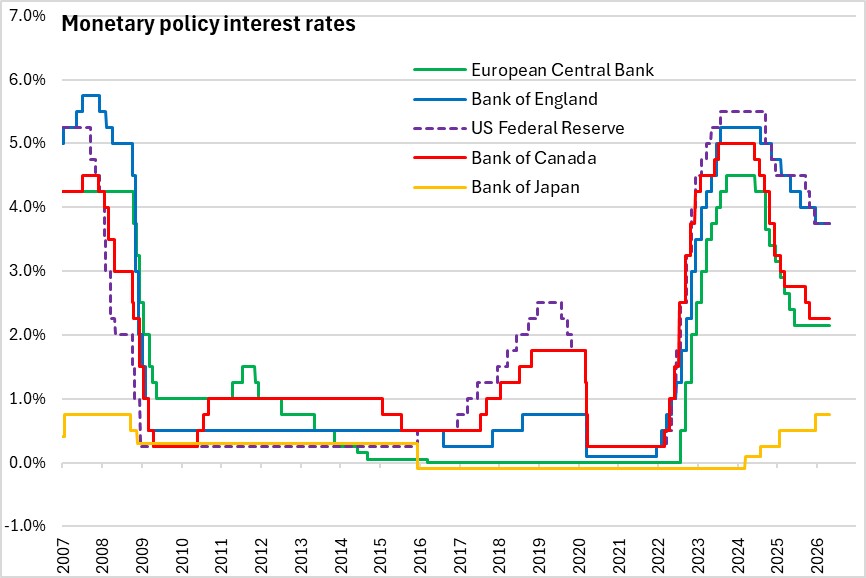
April 30, 2026BANK OF ENGLAND MONETARY POLICY The Monetary Policy Committee (MPC) of the Bank of England voted to maintain the Bank Rate at 3.75% in their April meeting.
The conflict in the Middle East has created significant global energy price uncertainty, which cannot be addressed via monetary policy. However, policy will be set to ensure that economic adjustments to higher energy prices do not occur in a way that jeopardizes the 2% inflation target. The measures required to achieve this will depend on the scale and duration of the shock, and how it is distributed throughout the economy.
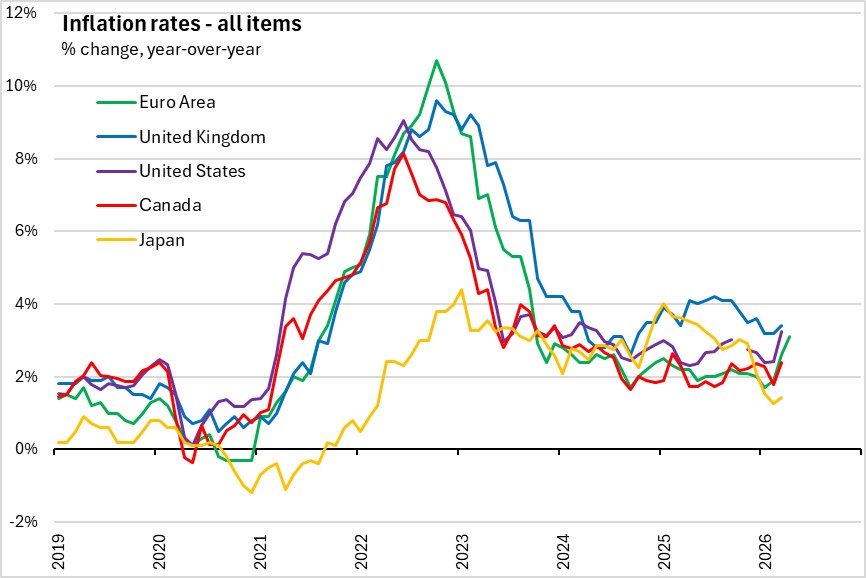
CPI inflation rose to 3.3% in March, and is likely to trend higher as the effects of higher energy prices pass through. Labour markets continue to loosen, and a weakening economy could work to contain inflationary pressures. Tighter financial conditions since the beginning of the conflict will also help to reduce inflation over time.
UK GDP is estimated to have grown 0.5% in Q1 2026. Growth was unusually strong in February 2026, and the Bank staff project underlying quarterly GDP growth for Q1 2026 to be 0.2%. The energy shock may weigh on GDP growth as real income growth slows, resulting in lower demand amidst higher uncertainty. The impact of the conflict on near-term growth is expected to be moderate.
Labour demand continues to ease, with the unemployment rate at 4.9% in the three months to February. The decline in the unemployment rate was entirely driven by a drop in the participation rate, resulting from an increase in the number of people not seeking work due to studying.
The Committee is vigilant in monitoring the conflict development in the Middle East and its impact on global energy supply. Monetary policy cannot influence global energy prices, but it aims to ensure that the economic adjustment to them occurs in a way that achieves the 2% target inflation.
The next scheduled monetary policy meeting will be on June 18, 2026.
Source: Bank of England, Monetary Policy Summary, April 2026, Monetary Policy Report, April 2026
<--- Return to Archive


