The Economics and Statistics Division maintains archives of previous publications for accountability purposes, but makes no updates to keep these documents current with the latest data revisions from Statistics Canada. As a result, information in older documents may not be accurate. Please exercise caution when referring to older documents. For the latest information and historical data, please contact the individual listed to the right.
<--- Return to Archive
For additional information relating to this article, please contact:
April 30, 2026JOB VACANCIES, FEBRUARY 2026 Monthly (February 2026 vs January 2026, seasonally adjusted)
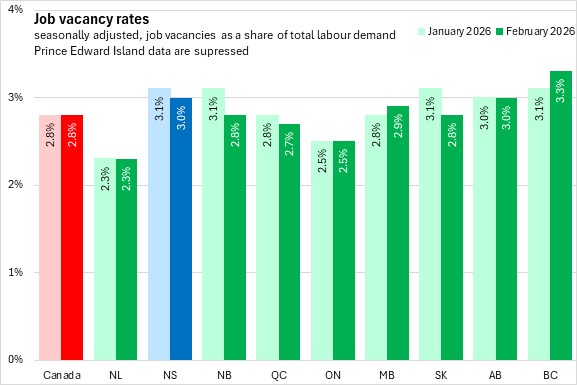
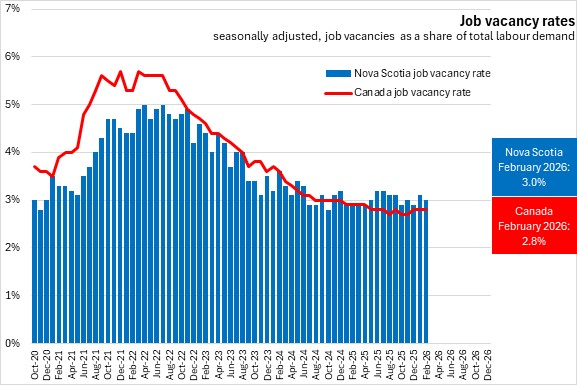
Nova Scotia had 14,555 job vacancies in February 2026 with a vacancy rate of 3.0%, down 0.1 percentage point from the previous month.
Canadian employers were actively recruiting for 497,160 positions in February with the national job vacancy rate of 2.8%, unchanged from the previous month. Among provinces, four reported lower vacancy rates, three were unchanged, and two increased compared to January. The highest vacancy rate was reported in British Columbia, while the lowest was in Newfoundland in Labrador. Data from Prince Edward Island were supressed.
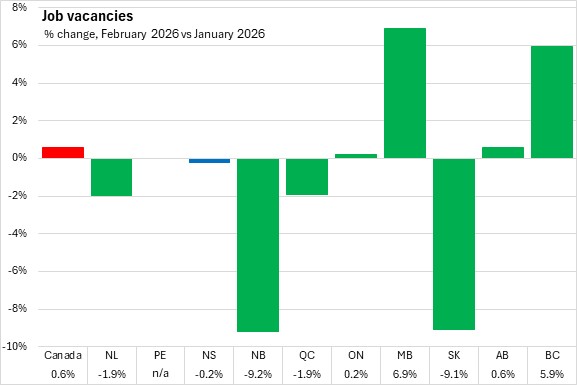
When compared to January 2026, the number of job vacancies in Nova Scotia declined 0.2% (-35 vacant positions). National job vacancies rose 0.6% (+2,730 vacant positions). Job vacancies rose in four provinces, led by Manitoba and British Columbia, while New Brunswick and Saskatchewan reported the fastest declines in vacant positions.
Year-over-year (February 2026 vs February 2025)
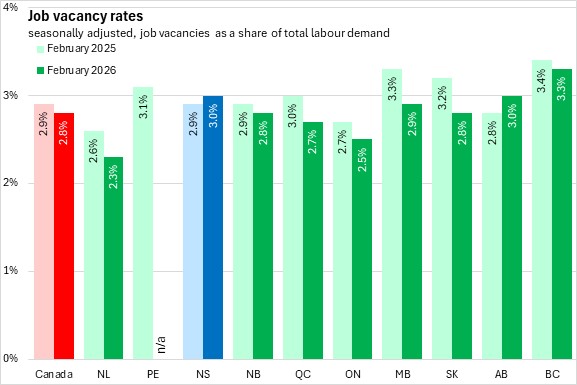
Nova Scotia's job vacancy rate was up 0.1 percentage point compared to February 2025. Nationally, the job vacancy rate declined 0.1 percentage point compared to February 2025. All provinces except Nova Scotia and Alberta reported lower job vacancy rates compared to one year ago. The largest percentage point declines were reported in Manitoba and Saskatchewan (-0.4 percentage points).
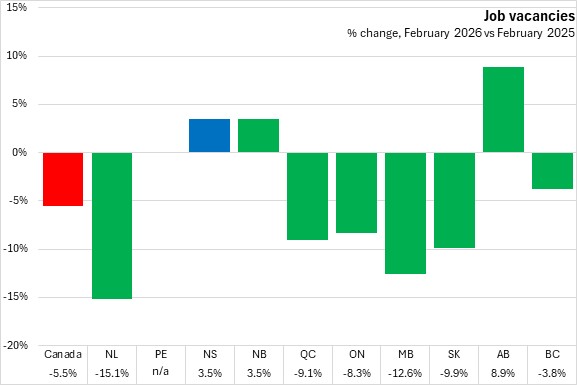
When compared to February 2025, the number of job vacancies in Nova Scotia rose 3.5% or by 495 vacancies. National job vacancies declined 5.5% or by 29,040 vacant positions. Six provinces reported declines in the number of vacancies over the twelve-month period ending in February, led by Newfoundland and Labrador. Alberta reported the fastest rise in job vacancies.
Trend
Nationally, job vacancy rates have trended downward after peaking in April-May 2022.
Nova Scotia's job vacancy rate peaked in the spring of 2022 and has also been on a downward trend. Nova Scotia's job vacancy rate has fluctuated in a narrow band around 3.0% since mid-2024. Nova Scotia's job vacancy rate has been above or equal to the national rate for the last sixteen months.
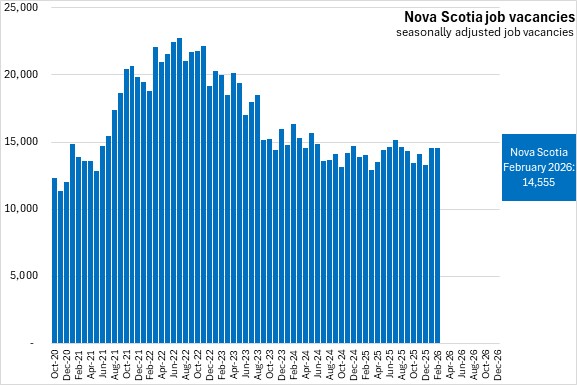
Nova Scotia's job vacancies peaked at 22,775 in July 2022 and have been trending down. There was an increase in Nova Scotia job vacancies through the summer of 2025, followed by a decrease in the autumn months.
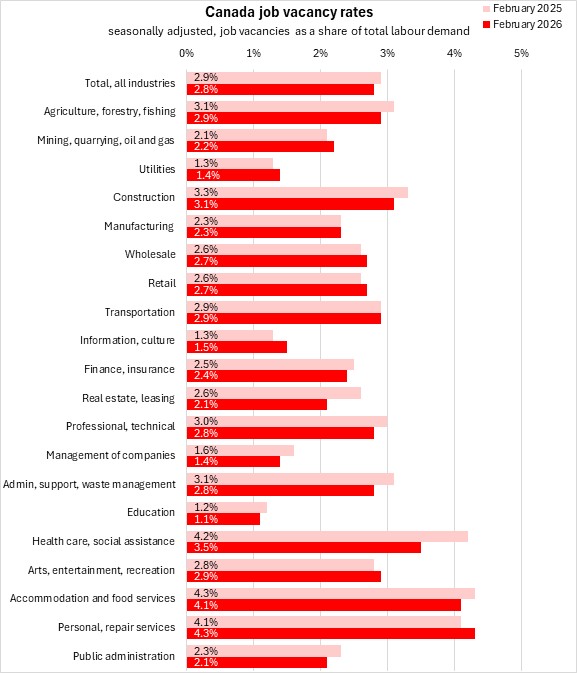
Canada job vacancy rate and job vacancies by industry, February 2026
Nationally, personal/repair services, accommodation/food services, and health care/social assistance had the highest job vacancy rates. The lowest vacancy rates were in education, company management and utilities. Mining/oil/gas, utilities, wholesale and retail trade, information/culture, arts/entertainment/recreation, and personal/repair services reported higher vacancy rates compared to a year ago.
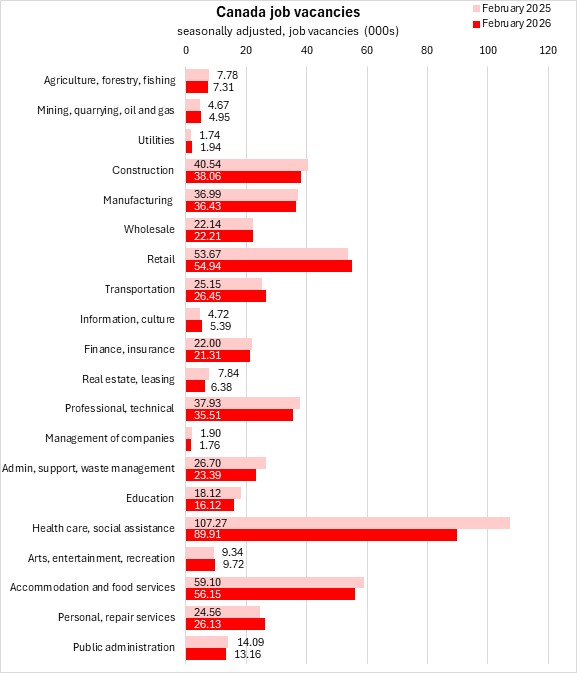
Health care and social assistance had the highest number of vacancies in Canada at 89,910 in February 2026 and experienced the most significant decline in the number of vacancies (-17,355).
Notes: The job vacancy rate is the percentage of job positions (both filled and vacant) that are vacant. A higher job vacancy rate indicates a tighter labour market where it is more difficult for employers to find suitable candidates for the positions offered. A lower job vacancy rate signals labour market slack and potentially more job seekers competing for each vacant position.
During the COVID-19 pandemic, data collection was suspended from April to October 2020. There remains a break in this data series.
Sources: Statistics Canada, Table 14-10-0432-01 Job vacancies, payroll employees, and job vacancy rate by provinces and territories, monthly, adjusted for seasonality, Table 14-10-0406-01 Job vacancies, payroll employees, and job vacancy rate by industry sector, monthly, adjusted for seasonality
<--- Return to Archive


