The Economics and Statistics Division maintains archives of previous publications for accountability purposes, but makes no updates to keep these documents current with the latest data revisions from Statistics Canada. As a result, information in older documents may not be accurate. Please exercise caution when referring to older documents. For the latest information and historical data, please contact the individual listed to the right.
<--- Return to Archive
For additional information relating to this article, please contact:
May 04, 2026VALUE ADDED IN EXPORTS, 2022 Statistics Canada has updated its estimates of value added and employment embodied in Canadian exports.
Value-added represents the contribution of labour and capital to the production process. Its components are labour income, gross operating surplus (or profits and depreciation) and taxes net of subsidies on production. The sum of value-added by all industries plus taxes net of subsidies on products is equal to GDP.
Exports only generate income (GDP) within Nova Scotia when value is added to either the domestically-produced or imported outputs. However, exports are typically reported on a gross basis, including the cost of imported inputs. Statistics Canada’s supply and use tables allow for the calculation of the proportion of exports that represent value added, and therefore, income generated within the provincial economy.
Statistics Canada's estimates calculate a value added amount within each sector that generates the exports. Statistics Canada further estimates the amount of value added created by upstream sectors within a province that supply an exporting sector. Statistics Canada also estimates the number of jobs associated with exports - both within exporting sectors and upstream sectors that supply them.
These estimates allow examination of the relative significance of trade for each province and sector. As the data are constructed using supply and use tables, there is a considerable lag in their production and they have only been updated to 2022 (along with revisions to prior years).
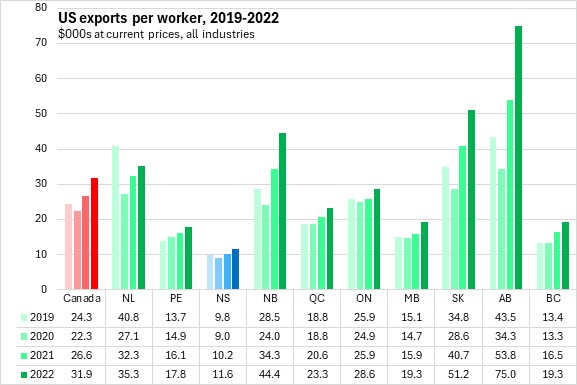
Overall, Nova Scotia's economy generated the least amount of exports (scaled to total employment in all industries) at $19,133 per worker. National exports per worker were $44,592 with the highest values (by considerable margins over the next highest exporters) in Newfoundland and Labrador, Saskatchewan and Alberta. Nova Scotia's exports per worker amounted to 42.9% of the national per worker average in 2022.
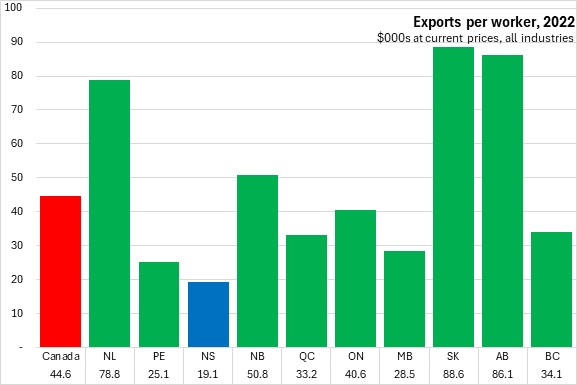
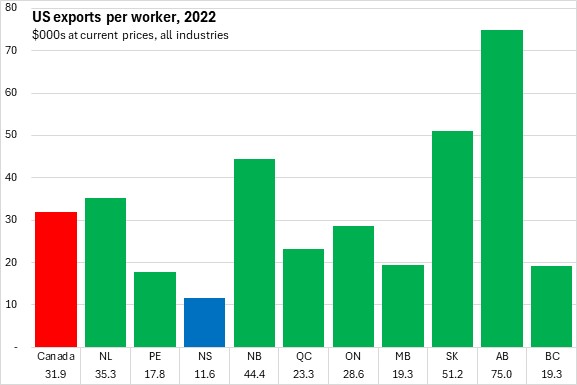
Nova Scotia's exports to the US in 2022 amounted to $11,583 per worker - also the lowest among provinces (36.3% of the national average exports per worker to the US). Exports to the US per worker were $31,883 nationally with the highest values in Alberta and Saskatchewan.
Nova Scotia's exports to the US amounted to 60.5% of 2022 exports - the fourth lowest share after Newfoundland and Labrador, Saskatchewan and British Columbia. Alberta and New Brunswick reported the highest shares of US exports in total exports.
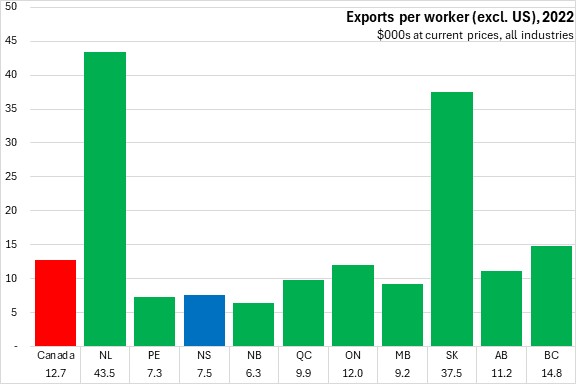
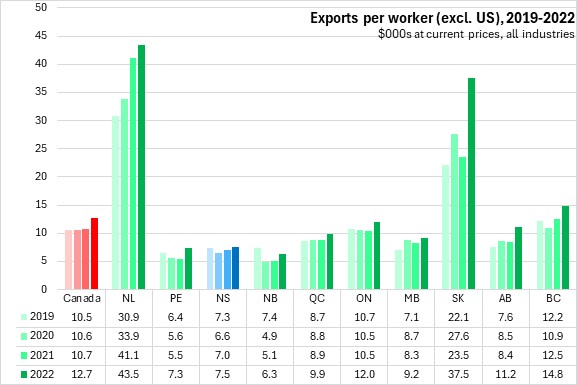
Nova Scotia's exports to the rest of the world outside the US amounted to $7,550 per worker in 2022 - 3rd lowest among provinces after New Brunswick and Prince Edward Island. Canada's exports per worker to the rest of the world amounted to $12,708 with the highest values in Newfoundland and Labrador as well as Saskatchewan.
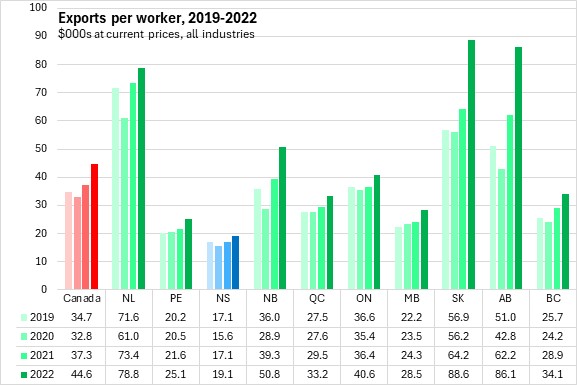
Nova Scotia's exports per worker continued a post-pandemic rebound in 2022, rising by 11.6%. There were notably faster gains in Saskatchewan, Alberta and New Brunswick.
Nova Scotia's US exports per worker were up 13.8% while per worker exports per worker to the rest of the world rose 8.3%. Alberta's per worker exports to the US grew the fastest among provinces while Saskatchewan's per worker exports to non-US destinations reported the fastest growth. Newfoundland and Labrador reported the slowest percentage growth in per worker exports to both US and non-US destinations.
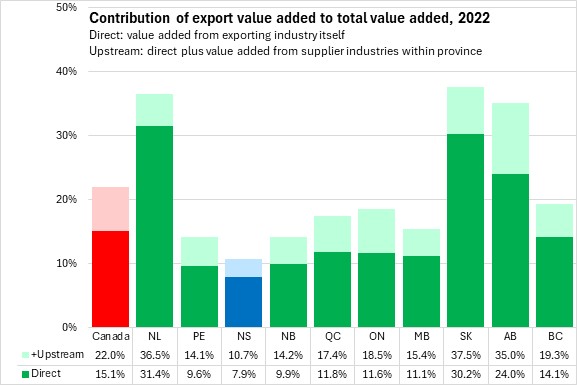
Of the total value added in the economy, Nova Scotia relied the least on exports to generate value added in 2022, with 10.7% of provincial value added (ie: GDP) accounted for by value added in exports (either directly or in upstream in supplier industries within the province). Saskatchewan generated the largest portion of its provincial value added from exports at 37.5% (followed closely by Newfoundland and Labrador and Alberta). The Maritime provinces and Manitoba reported the lowest portions of GDP accounted for by value added in exports.
Exports to the US made up 6.2% of Nova Scotia's value added in 2022 - the lowest among provinces. Alberta's GDP had the highest reliance on US exports.
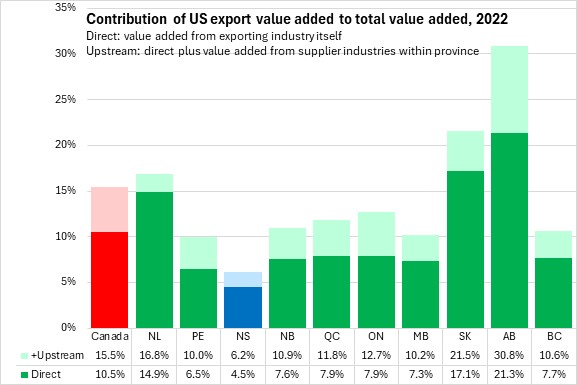
The share of Nova Scotia's 2022 value added attributable to exports outside the US was 4.5%. This was lower than the national average, but above Alberta, New Brunswick and Prince Edward Island. Newfoundland and Labrador and Saskatchewan had (by far) the highest portions of provincial value added attributable to non-US exports.
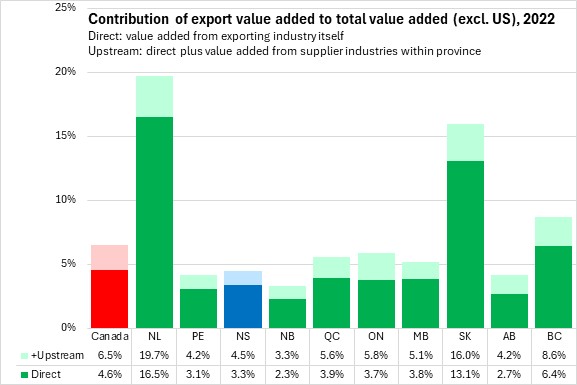
Despite its relatively low export intensity, the amount of direct value added measured as a share of total exports in Nova Scotia (42.2%) was just below the national average (45.0%) in 2022. Counting the value added in exports created in upstream supplier industries of the exporting sector, 57.3% of Nova Scotia's exports represented value added that generated income within the province. Newfoundland and Labrador and Saskatchewan reported higher value added portions of exports. New Brunswick's value added share of exports was lower because of the large value of imported content in its sizable petroleum refining industry.
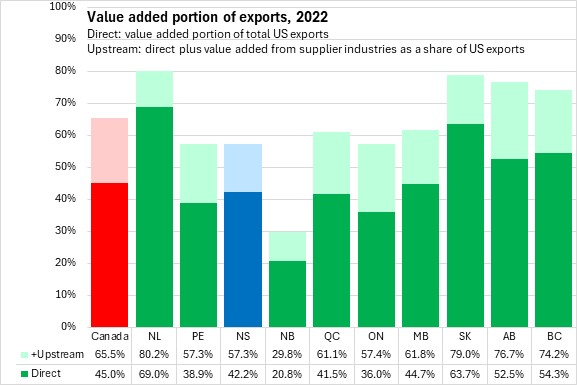
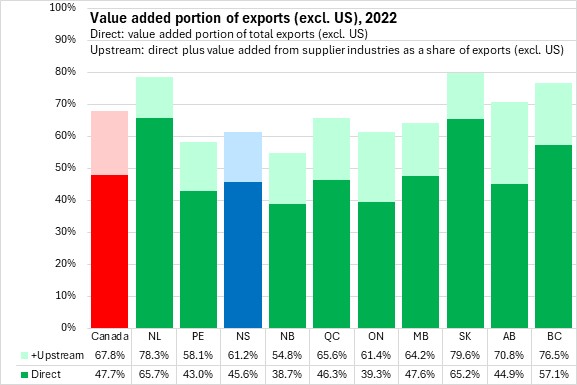
Nova Scotia's exports to the US had a slightly lower value added portion (40.0% direct, 54.8% including upstream) in 2022 while exports to the rest of the world had a slightly higher value added portion (45.6% direct, 61.2% including upstream).
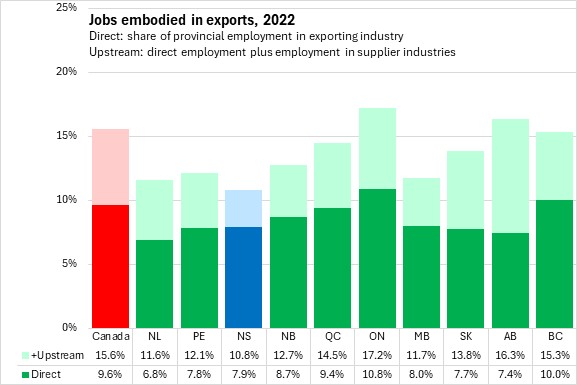
Nova Scotia's employment was comparatively less dependent on international exports in 2022 as only 7.9% of jobs were attributable directly to exports. Including upstream jobs embodied in exports, Nova Scotia's share of employment connected to exports was 10.8% (lowest among provinces). The national average share of employment from exports was 15.6%. The highest share was in Ontario at 17.2%.
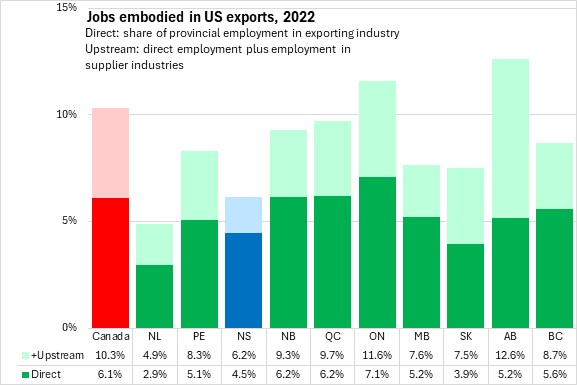
Only Newfoundland and Labrador reported a lower share of employment embodied in US exports than Nova Scotia's 6.2% in 2022. Nationally, 10.3% of jobs were dependent on US exports with the highest shares in Alberta and Ontario.
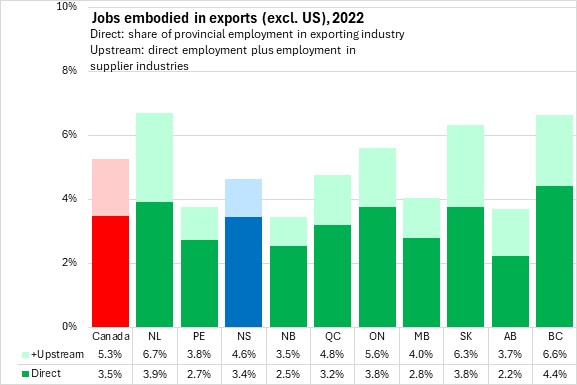
Nova Scotia's exports to the rest of the world embodied 4.6% of provincial employment in 2022. Nationally, 5.3% of employment was connected to global exports outside the US with the highest share in Saskatchewan and the lowest shares in New Brunswick, Alberta and Prince Edward Island.
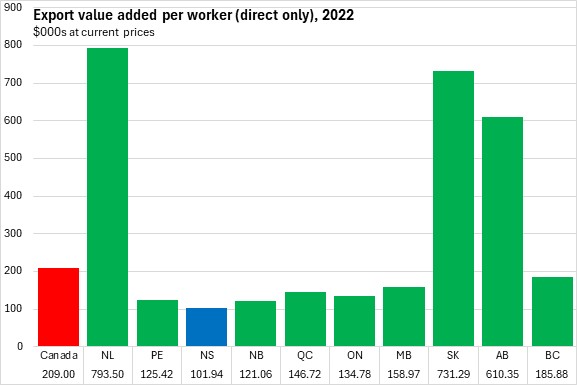
The amount of export value added per worker (directly within exporting industries) in 2022 was $101,936 for Nova Scotia, the lowest among provinces in 2022. The national average of direct value added per worker was $208,997, with much higher value for resource-producing provinces where export values are high because of low labour intensity for mining, oil and gas industries.
The direct value added per worker in Nova Scotia's US and non-US exports was little different from the overall average in 2022.
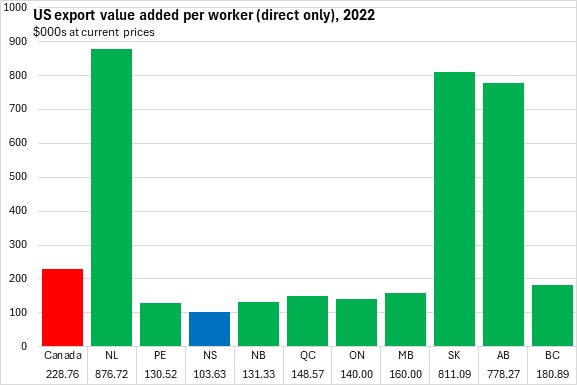
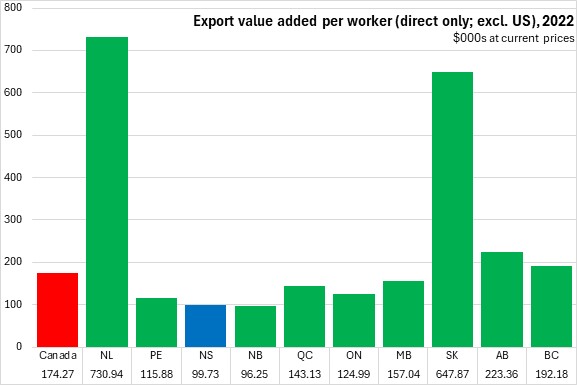
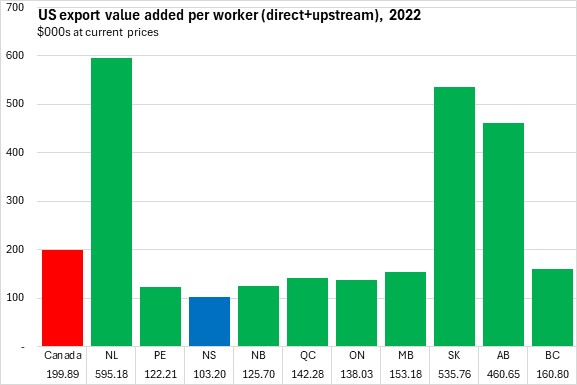
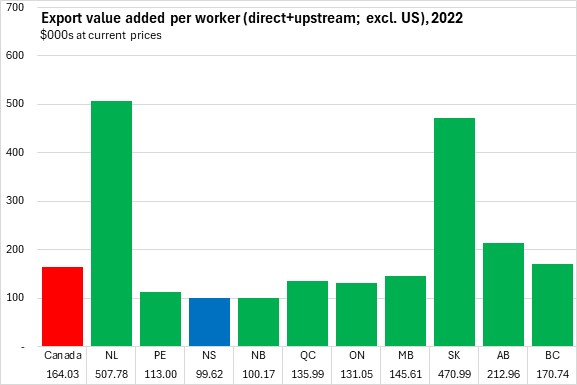
Including upstream value added to exports and upstream employment, Nova Scotia's export value added per worker was slightly lower at $101,663 per worker in 2022. However, export value added per worker in provinces with resource-intensive economies was considerably lower after including upstream workers as upstream industries are more labour-intensive than oil and gas extraction.
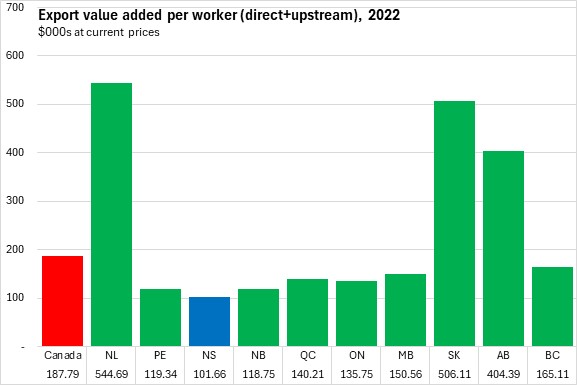
As with direct value added per worker, total (direct+upstream) value added per worker in Nova Scotia's US and non-US exports was little different from the overall average in 2022.
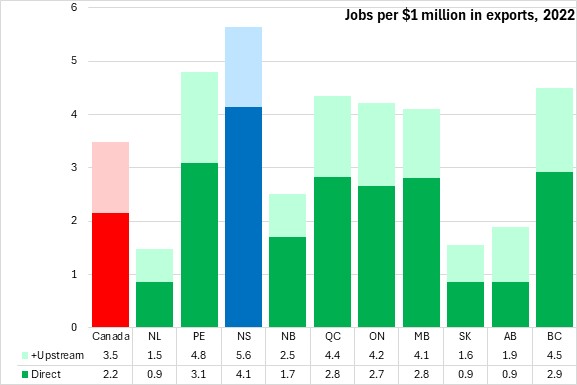
Calculating the number of workers required to generate $1 million in exports offers another perspective on the relationship between exports and employment. Nova Scotia's exports were the most labour intensive in the country requiring 5.6 jobs to generate $1 million in exports in 2022. Nationally, it took 3.5 workers to generate $1 million in exports with the lowest labour intensities in Saskatchewan and Newfoundland and Labrador.
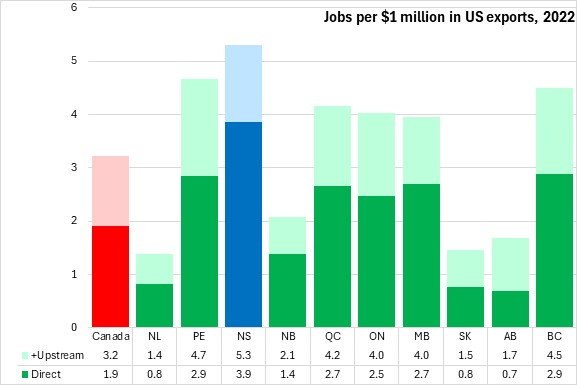
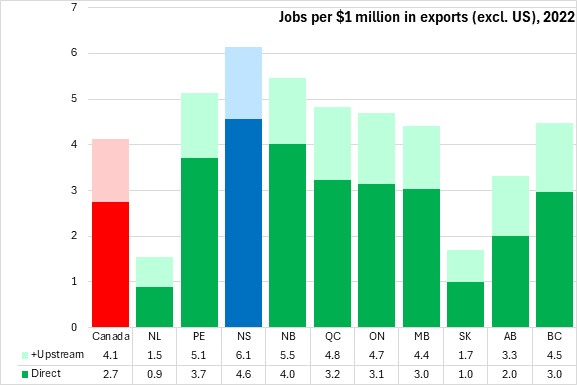
The labour-intensity of Nova Scotia's exports to the US was slightly lower than its exports to the rest of the world.
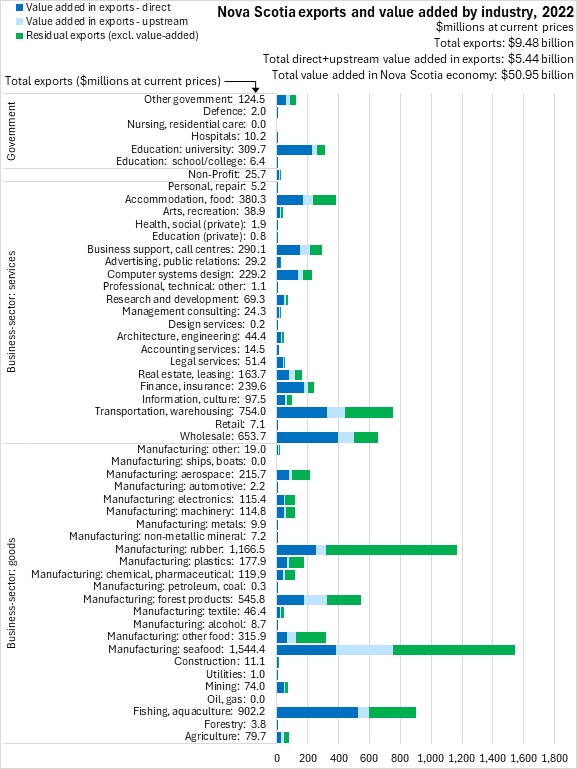
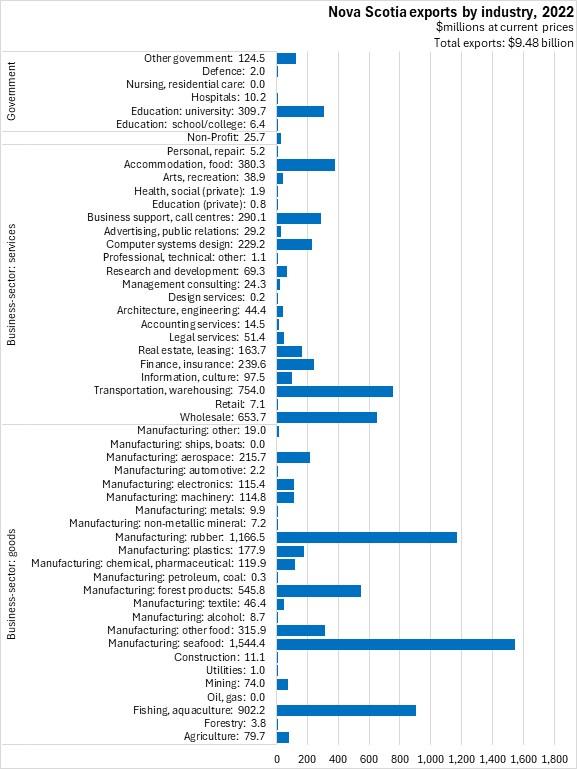
The value added in exports data also provides the most detailed information on the value of exports from all industries, including services. Of the total value of $9.48 billion in exports from Nova Scotia in 2022, the largest values were from resources and manufacturing, notably seafood products ($1,544.4 million, not including unprocessed), rubber products ($1,166.5 million), fishing/aquaculture products ($902.2 million) and forest products ($545.8 million). Transportation services ($754.0 million) and wholesale trade ($653.7 million) also generated substantial international exports for Nova Scotia.
From its exports, Nova Scotia generated $5.44 billion in added value, including the exporting industry as well as upstream industries within the province.
The chart below illustrates the amount of value added generated within each exporting industry as well as the value added generated in upstream industries.
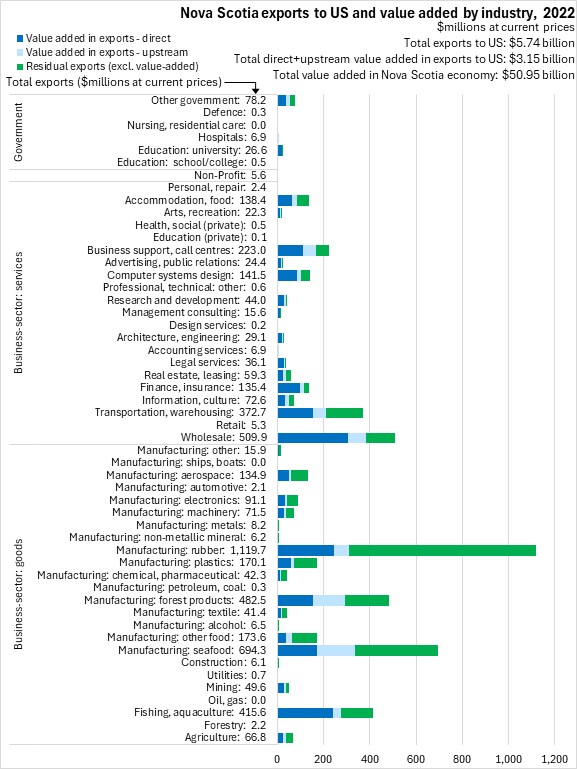
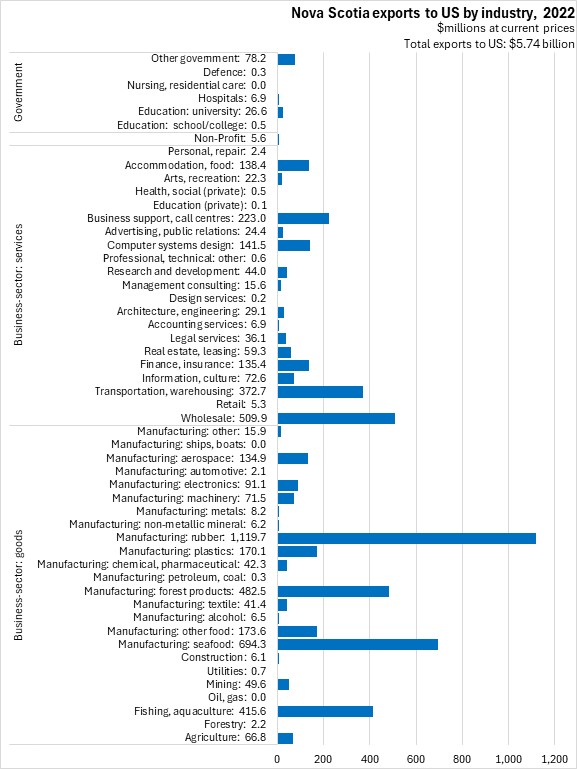
Nova Scotia's exports to the US were $5.74 billion in 2022 including $3.15 billion in value added.
Nova Scotia's largest exports to the US were rubber products, processed seafood, wholesale trade, fishing/aquaculture, forest products and transportation/warehousing.
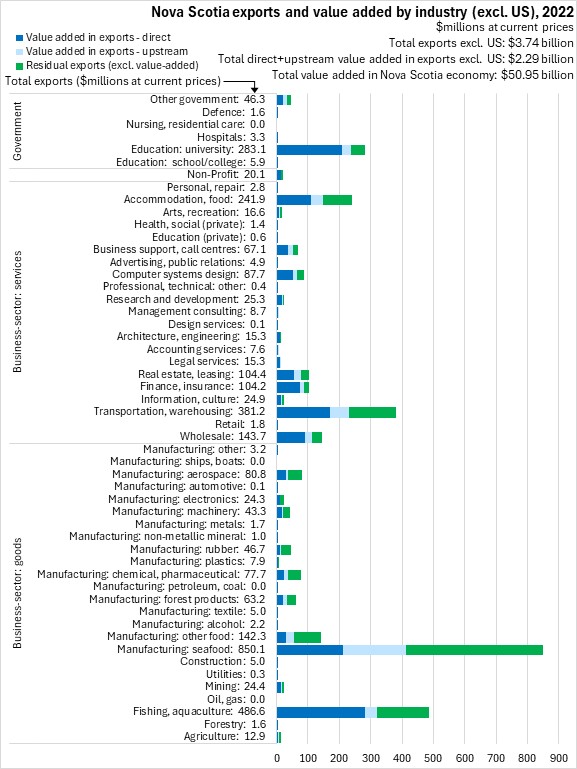
Nova Scotia's exports to the rest of the world outside the US amounted to $3.74 billion in 2022, of which $2.29 billion was value added. Nova Scotia's exports to the rest of the world were more concentrated in processed seafood, fishing/aquaculture, transportation/warehousing and university education.
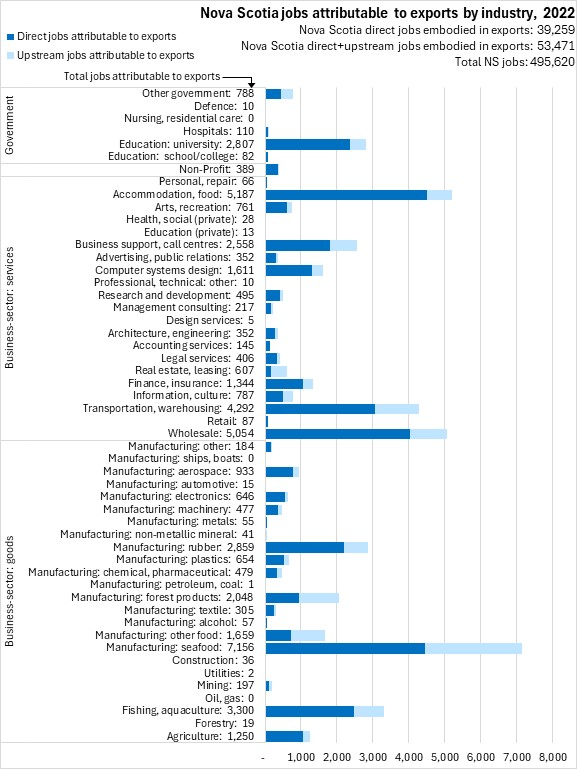
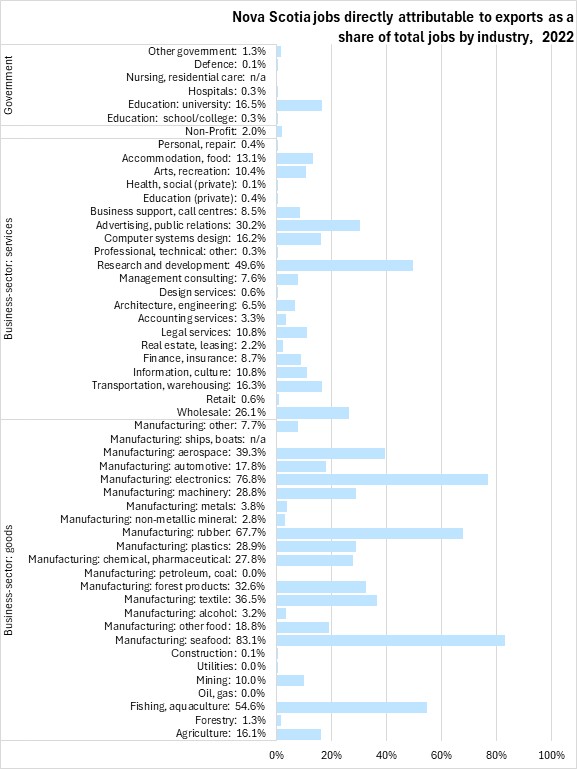
Statistics Canada estimates that in 2022, 39,259 jobs were directly attributable to exports from all industries. Including upstream industries, 53,471 jobs in Nova Scotia depended on exports. Export-dependent employment was highest for Nova Scotia's seafood processing, wholesale trade, accommodation/food services, transportation/warehousing, fishing/aquaculture, rubber products, universities, business support/call centre and forest product industries.
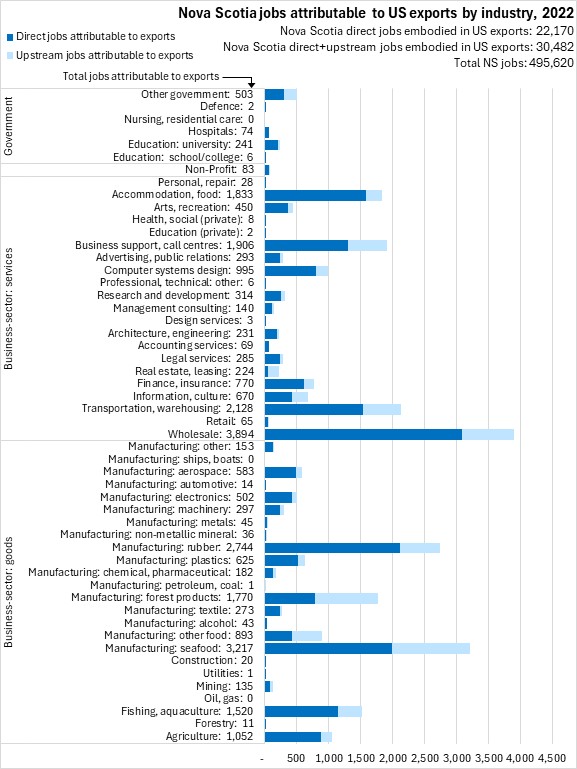
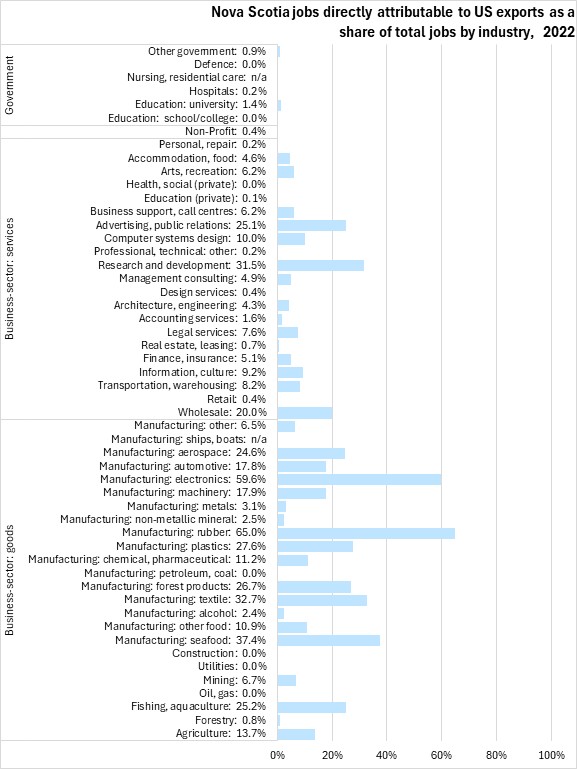
Nova Scotia's employment attributable to US exports was 22,170 in 2022 (30,482 including upstream jobs), with greater concentration in wholesale trade, seafood processing, rubber products, transportation/warehousing, business support/call centres, accommodation/food services and forest products.
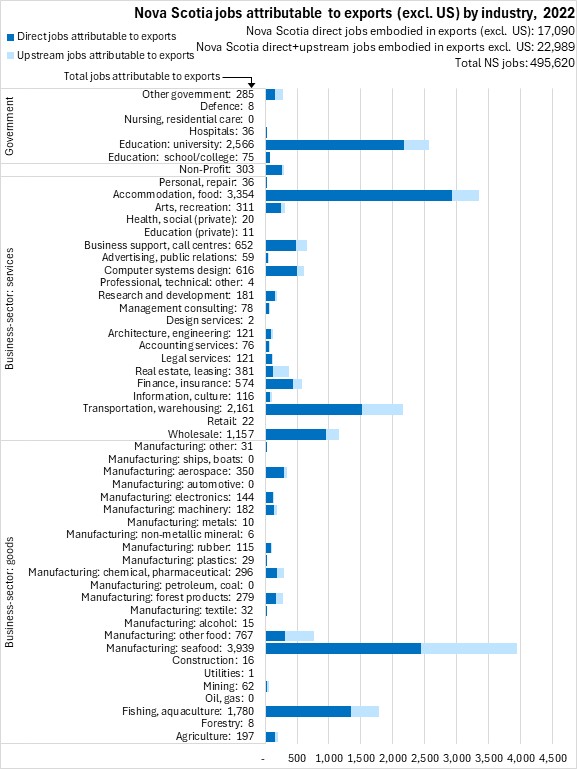
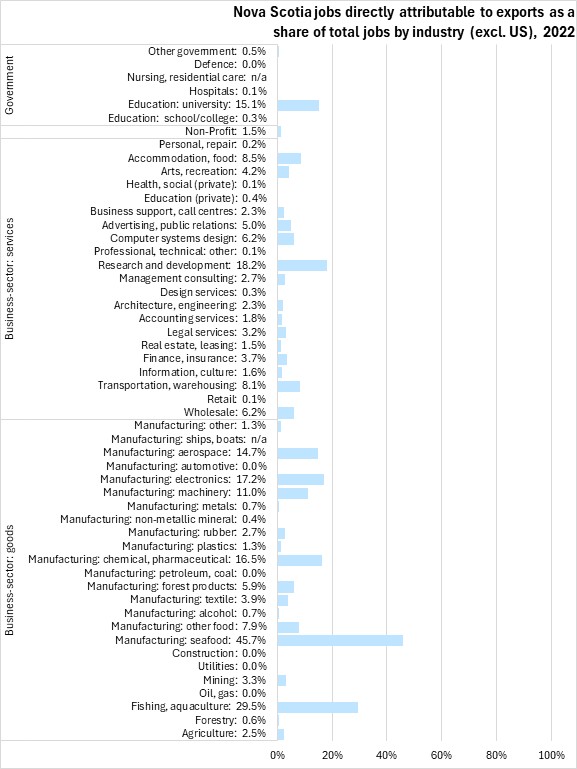
Employment generated by Nova Scotia's exports to the rest of the world 17,090 in 2022 (22,989 including upstream employment). This export-related employment was concentrated in seafood processing, accommodation/food services, universities, fishing/aquaculture and transportation/warehousing.
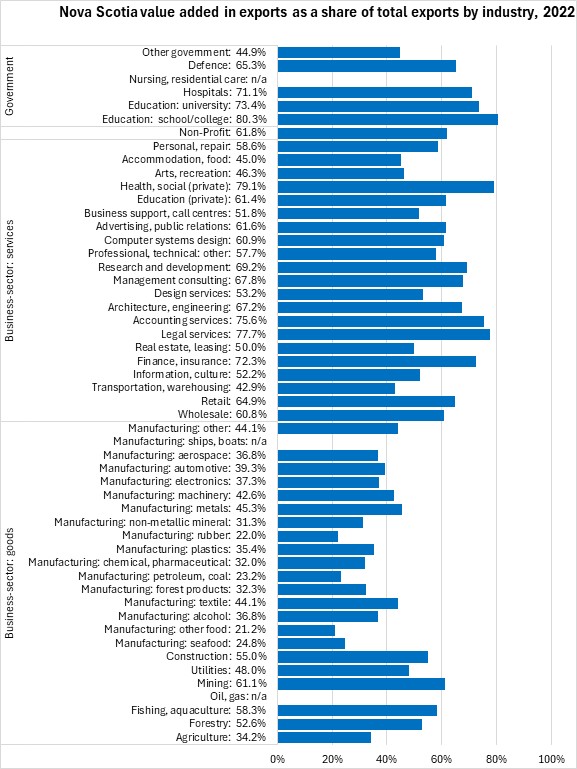
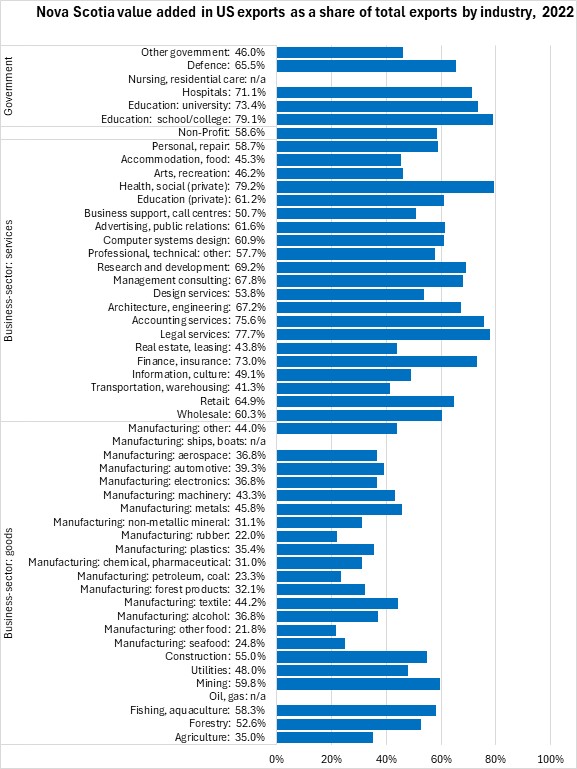
With fewer imported inputs, exports of services generally had higher value added portions of total exports than exports of goods. This was the same for both US and non-US exports from Nova Scotia's industries.
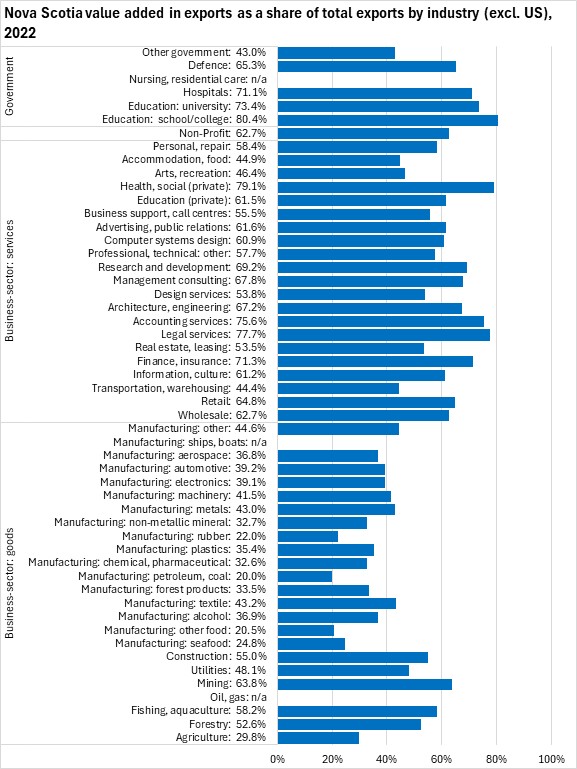
Measured by the share of total employment directly attributable to exports, Nova Scotia's most export-dependent employers in 2022 were seafood product manufacturing, rubber product manufacturing, electronics manufacturing, fishing/aquaculture, and scientific research and development.
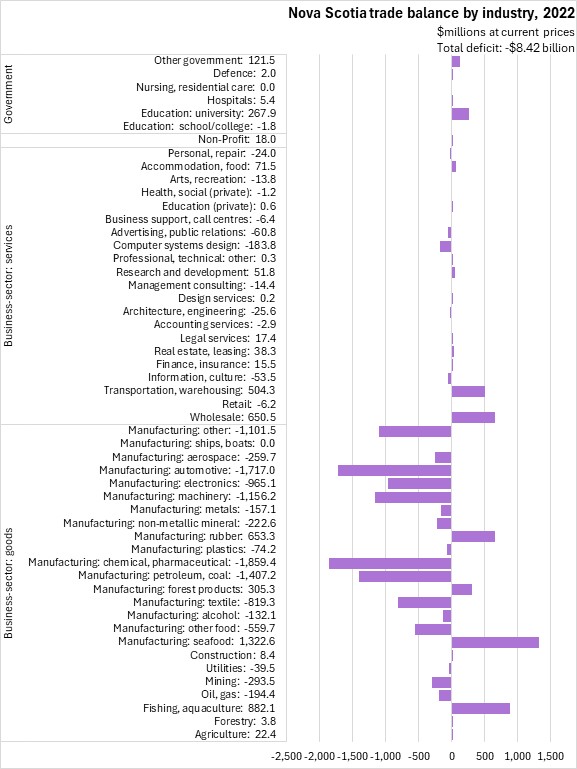
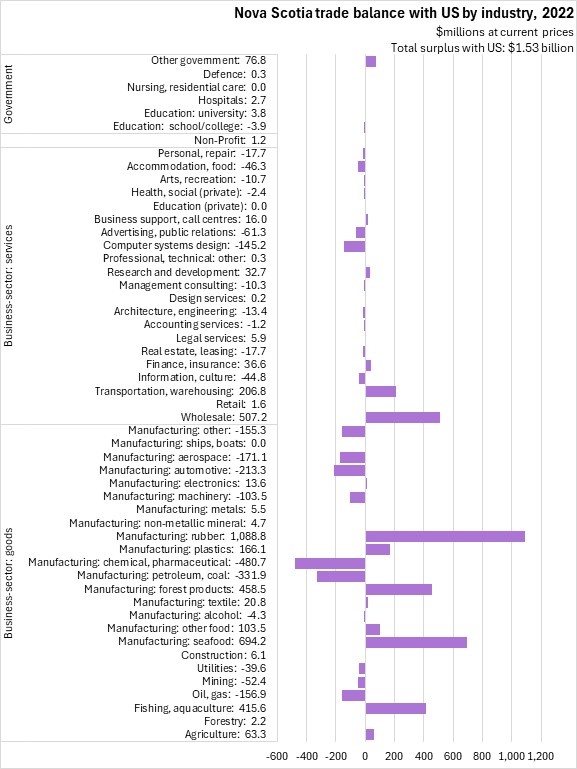
Statistics Canada's value added in exports also provides data on imports by sector as well, allowing the assessment of a trade balance by industry. The province's overall trade balance was a deficit of $8.42 billion as imports of $17.90 billion were substantially larger than international exports of $9.48 billion.
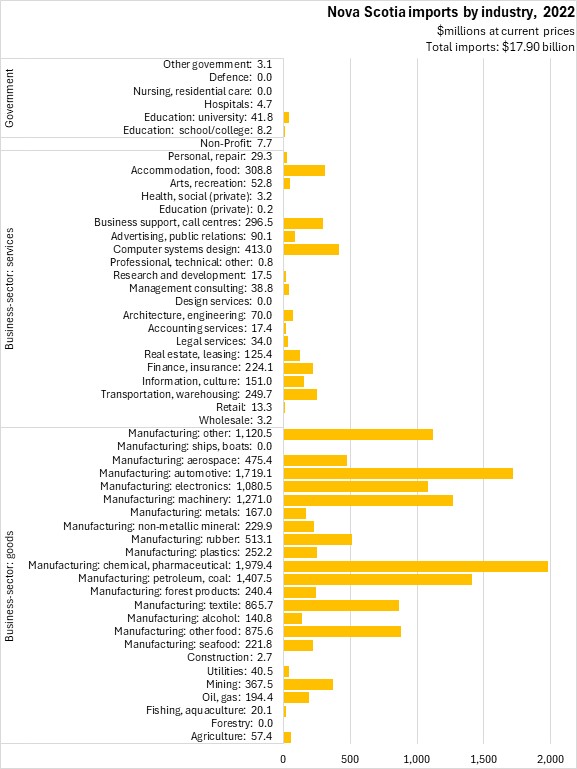
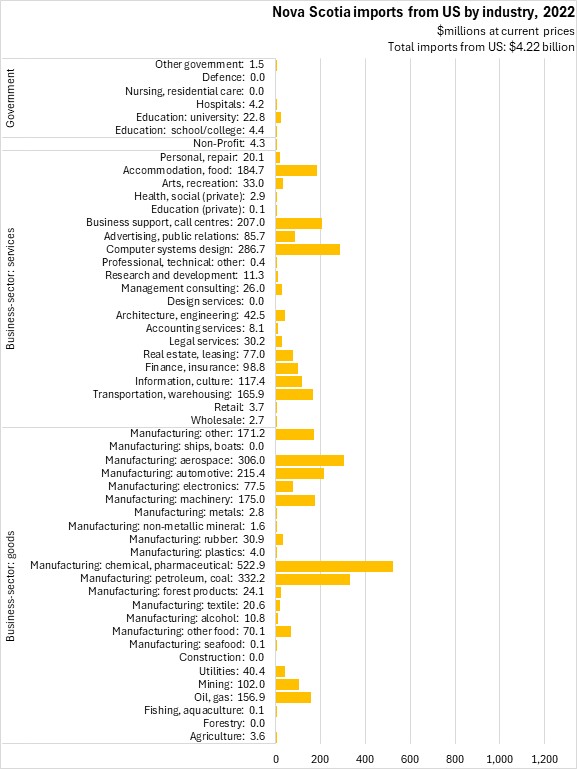
In 2022, Nova Scotia's imports are heavily concentrated in manufactured products, notably: automotive, electronics, chemical/pharmaceutical, machinery, metals, food and refined petroleum. With relatively little production in these industries (except food), Nova Scotia has a substantial trade deficit in these products, with imports in excess of exports. Nova Scotia's products and services with trade surplus include: agriculture, fishing/aquaculture, seafood processing, forest products, rubber products, wholesale trade, transportation/warehousing, accommodation/food services and university education.
Nova Scotia had a trade surplus of $1.53 billion with the US in 2022. Nova Scotia had sizable surpluses in rubber products, fishing/aquaculture, processed seafood, wholesale trade, forest products, transportation, plastics and other food products (such as baked goods). It was in these industries that Nova Scotia reported its largest exports to the US. Nova Scotia's largest imports from the US were in aerospace/parts, petroleum/coal manufacturing (including refineries), electronics, computer systems design, business support/call centres and information/cultural industries (including broadcasting). Nova Scotia's largest trade deficits with the US were in pharmaceuticals, aerospace, refined petroleum/coal products, electronics, automotive, oil/gas, other manufacturing and computer system design.
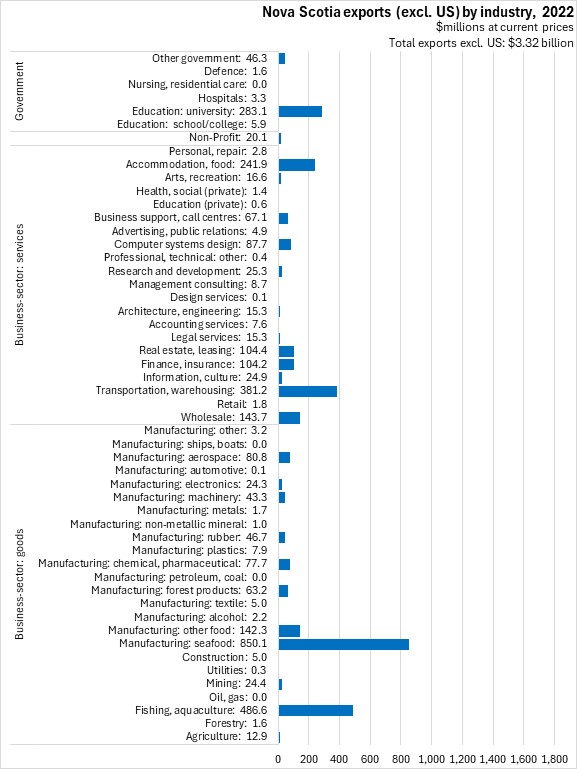
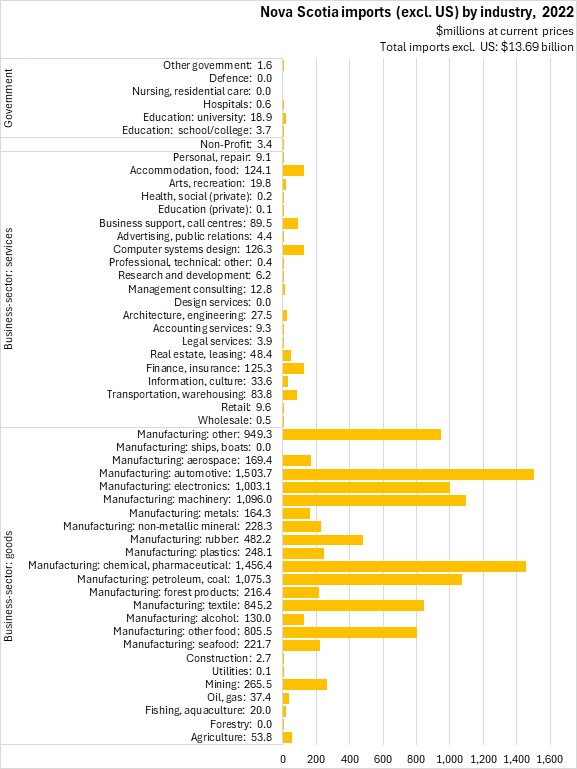
Nova Scotia' exported $3.32 billion to the rest of the world outside the US in 2022, while it imported $13.69 billion for a trade deficit of $9.95 billion.
Nova Scotia's largest exports to the rest of the world (outside the US) were in processed seafood, fishing/aquaculture, transportation, university education and accommodation/food services. These industries also accounted for Nova Scotia's largest trade surpluses with the rest of the world.
Nova Scotia's largest imports (and trade deficits) from the rest of the world were in auto manufacturing, chemical/pharmaceutical manufacturing, electronics, machinery and other manufacturing (including furniture).
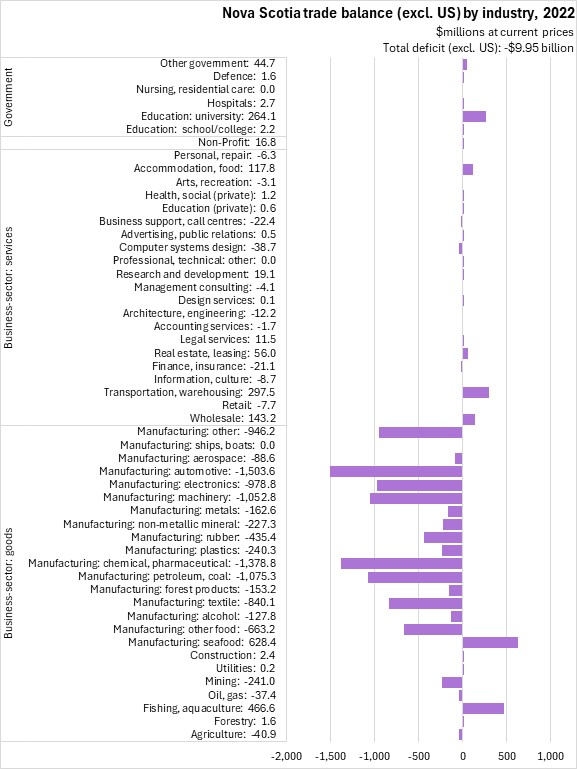
Statistics Canada: Table 12-10-0100-01 Value added in exports, by industry, provincial and territorial
<--- Return to Archive


