The Economics and Statistics Division maintains archives of previous publications for accountability purposes, but makes no updates to keep these documents current with the latest data revisions from Statistics Canada. As a result, information in older documents may not be accurate. Please exercise caution when referring to older documents. For the latest information and historical data, please contact the individual listed to the right.
<--- Return to Archive
For additional information relating to this article, please contact:
June 02, 2026CULTURE AND SPORT INDICATORS, 2024 Statistics Canada has updated indicators of Canada's culture and sport activities for 2024.
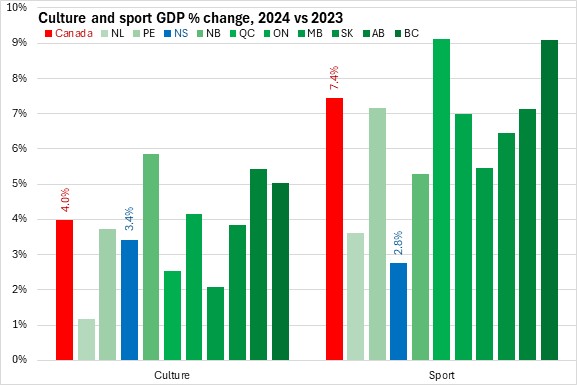
Nova Scotia's GDP from cultural production increased by 3.4% from 2023 to 2024, slowing after posting the fastest gain among provinces in 2023. Nova Scotia's GDP from sport increased by 2.8%, the slowest increase among provinces.
Nationally, GDP from culture increased by 4.0% while GDP from sport was up 7.4%. All provinces reported rising GDP for both culture and sport production. New Brunswick reported the fastest gain in culture GDP (Newfoundland and Labrador the slowest) while British Columbia and Québec reported the fastest gains in sport GDP.
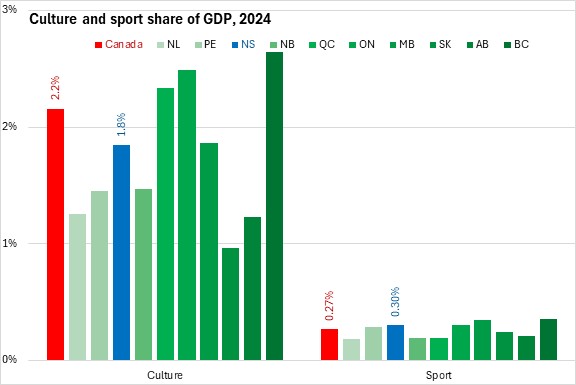
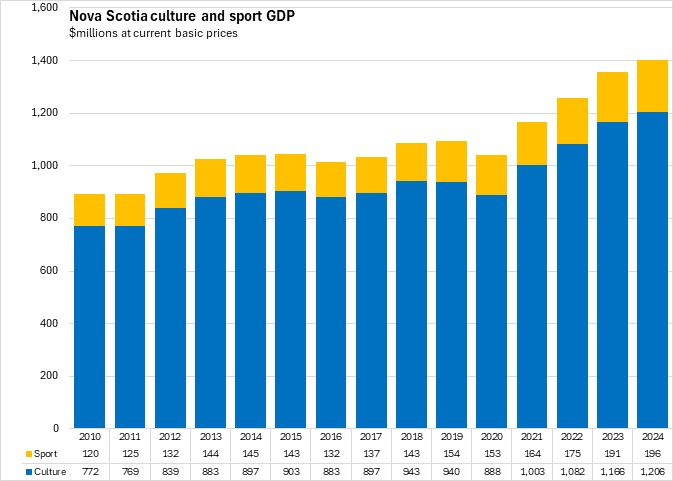
Nova Scotia's production of culture products generated $1,206 million in nominal GDP in 2024. This was 1.8% of Nova Scotia's nominal GDP. Across Canada, GDP from culture was 2.2% of national GDP in 2024, with the highest shares in Québec, Ontario and British Columbia. Culture accounted for the lowest share of GDP for Saskatchewan.
GDP from sport in Nova Scotia was $196 million; 0.30% of provincial GDP. National sport production accounted for 0.27% of Canada's GDP (highest shares in British Columbia and Manitoba, lowest shares in Québec and Newfoundland and Labrador).
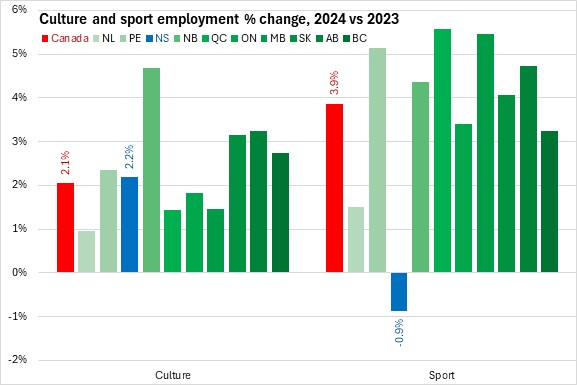
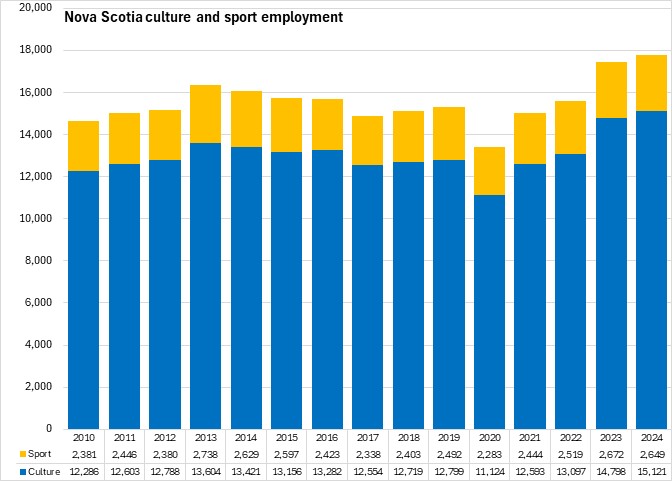
Production of culture and sport products is labour intensive. Nova Scotia's employment in culture products increased by 2.2% in 2024 (+2.1% nationally). Sport employment was down 0.9% in Nova Scotia, the only decline among provinces (+3.9% nationally, led by Québec).
All provinces reported rising employment levels for culture and sport, with the exception of sport employment in Nova Scotia. New Brunswick reported the fastest growth rates in culture employment while Québec had the fastest growth in sport employment. Culture employment growth was slowest in Newfoundland and Labrador.
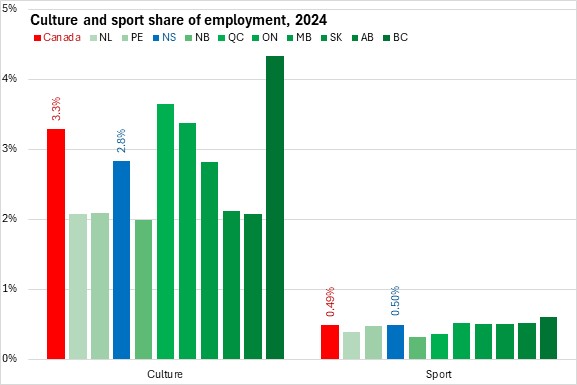
In Nova Scotia, there were 15,121 jobs in cultural production, amounting to 2.8% of provincial employment. Sport production added a further 2,649 jobs; 0.50% of Nova Scotia's employment. Nationally, culture accounted for 3.3% of employment (highest share: British Columbia, lowest share: New Brunswick). Sport accounted for 0.49% of national employment in 2024 (highest shares: British Columbia, lowest share: New Brunswick).
Culture and sport GDP each grew for the fourth consecutive year in Nova Scotia (in nominal terms) in 2024. Culture and sport combined GDP has increased in 7 of the last 8 years (exception: 2020).
Nova Scotia's culture employment growth (+323) more than offset the slight decline in sport employment (-23) in 2024.
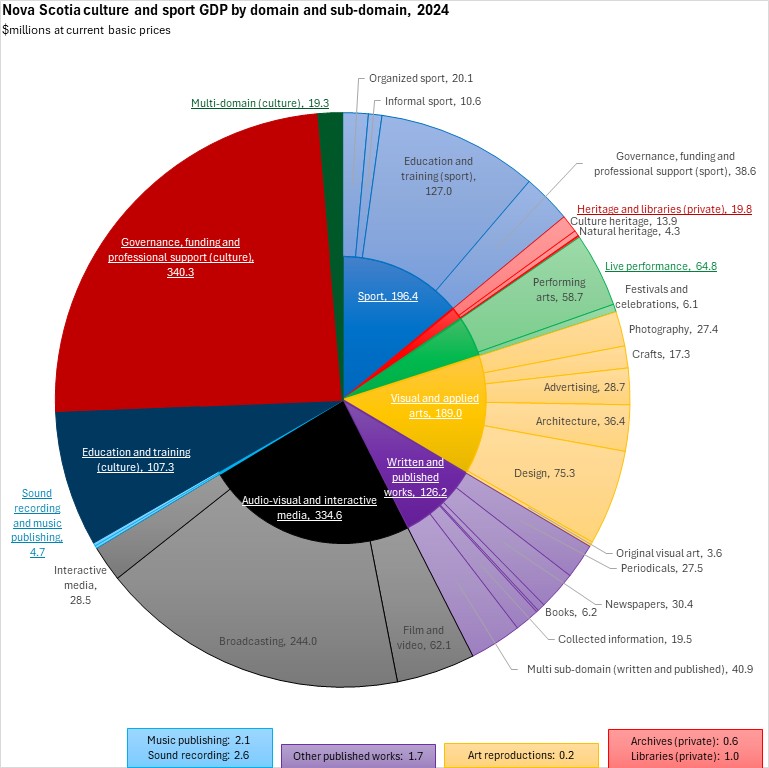
Production of culture and sport products is divided into several domains and sub-domains. In this categorization, all Federal, Provincial and municipal government-owned institutions (except schools, colleges and universities) are classified under "governance, funding and professional support" even when their activity falls within the scope of another sub-domain. "Multi-domain" categories include industries that may be associated with more than one domain (examples: convention/trade show organizers, lessors of non-financial intangible assets).
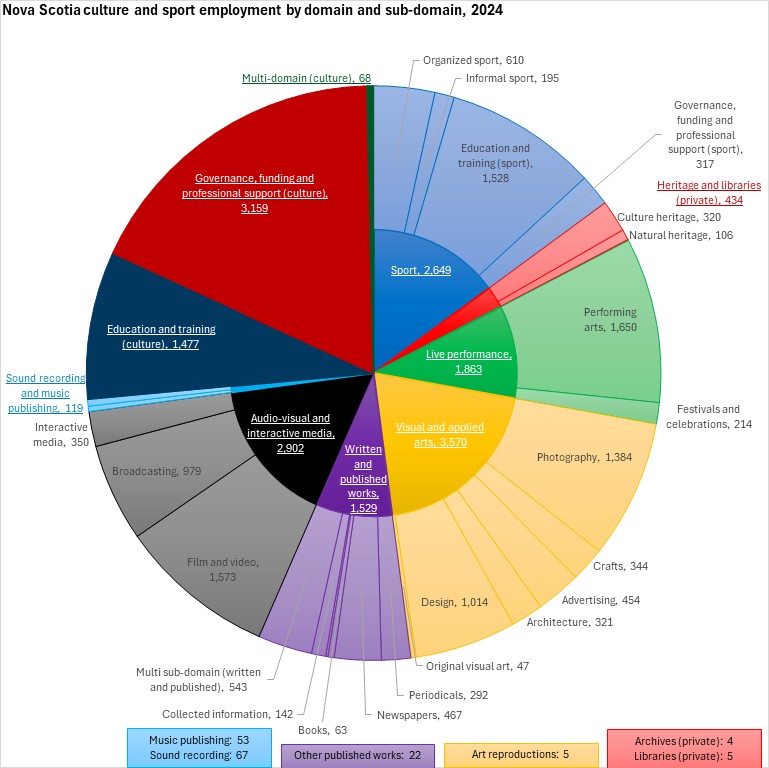
Governance, funding and professional support (ie: government institutions) account for the largest shares of GDP and employment in culture and sport production.
Audio-visual and interactive media account for the second largest portion of Nova Scotia's culture and sport GDP; the majority of this GDP is generated from broadcasting.
Sport production accounts for the third largest part of culture and sport GDP in Nova Scotia. Education and training accounting for the majority of sport GDP, with an even larger contribution to GDP than education and training in culture.
Visual and applied arts were the fourth largest contributor to culture and sport GDP with the bulk of activity concentrated in design, architecture and advertising sub-domains.
Written and published works were the fifth largest contributor to Nova Scotia's culture and sport GDP, followed by live performance and (private) heritage and library institutions. Sound recording and music publishing was the smallest major domain of culture and sport GDP.
Each domain's contributions to Nova Scotia's culture and sport employment differed somewhat from the contributions to GDP. Governance, funding and professional support in culture remained the largest contributor to employment. Visual and applied arts and audio-visual/interactive media were the second and third largest employers among all culture and sport domains, followed by sport, live performance, written/published works and cultural education/training.
Notes: culture and sport share of GDP are calculated using GDP by income, adjusted for taxes less subsidies on products and imports; employment shares calculated using job totals from labour productivity tables
Source: Statistics Canada. Table 36-10-0452-01 Culture and sport indicators by domain and sub-domain, by province and territory, product perspective (x 1,000); Table 36-10-0221-01 Gross domestic product, income-based, provincial and territorial, annual (x 1,000,000); Table 36-10-0480-01 Labour productivity and related measures by business sector industry and by non-commercial activity consistent with the industry accounts
<--- Return to Archive


