The Economics and Statistics Division maintains archives of previous publications for accountability purposes, but makes no updates to keep these documents current with the latest data revisions from Statistics Canada. As a result, information in older documents may not be accurate. Please exercise caution when referring to older documents. For the latest information and historical data, please contact the individual listed to the right.
<--- Return to Archive
For additional information relating to this article, please contact:
June 04, 2026NATURAL RESOURCES EMPLOYMENT AND COMPENSATION , 2024 Statistics Canada publishes a human resources module to the Natural Resources Satellite Account. The human resources module of the Natural Resources Satellite Account reports provincial employment and compensation for certain industries in natural resource extraction (energy, forestry, mining/minerals and hunting/fishing/water) as well as downstream processing (only for forestry and mining/minerals).
In 2024, there were 18,343 Nova Scotians employed in the industries reported by the Natural Resources Satellite Account, including both employees and the self-employed. This amounted to 3.4% of Nova Scotia's total employment across all industries: 2.6% or 13,709 in extraction and 0.9% or 4,634 in downstream processing.
Across Canada, natural resources employment was 4.7% of national employment. Alberta, Newfoundland and Labrador, New Brunswick and Saskatchewan reported notably higher natural resource employment shares in 2024. Prince Edward Island reported the lowest share of employment in natural resources (followed by Nova Scotia).
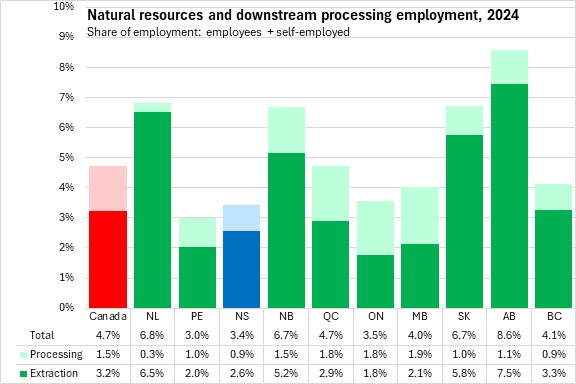
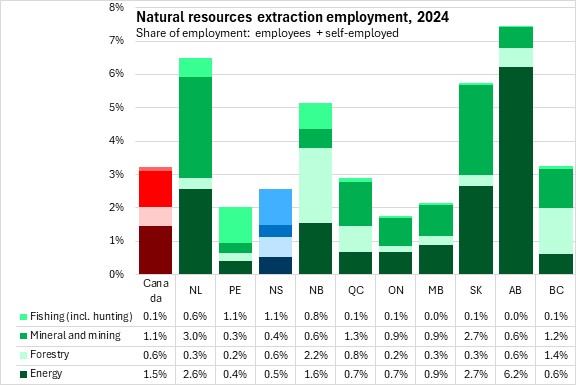
Higher natural resource employment in Alberta was associated almost entirely with energy. In Saskatchewan and Newfoundland and Labrador higher natural resource employment was split between energy and mining/minerals. In New Brunswick, forestry contributed to the larger share of natural resource employment.
Fishing (which also includes hunting and water extraction in this categorization) was a substantially larger share of employment in all four Atlantic Provinces.
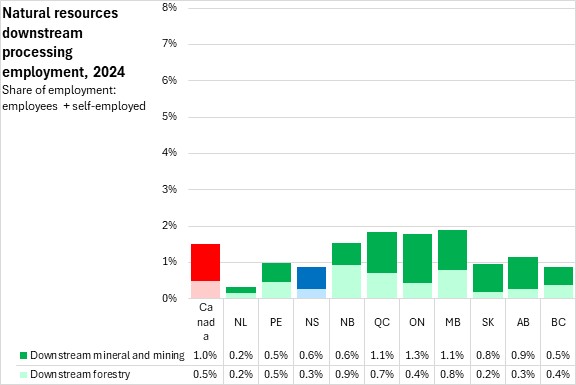
Downstream resource processing industries made up a larger share of employment in Québec, Ontario and Manitoba. Newfoundland and Labrador had the lowest employment share in downstream natural resource processing.
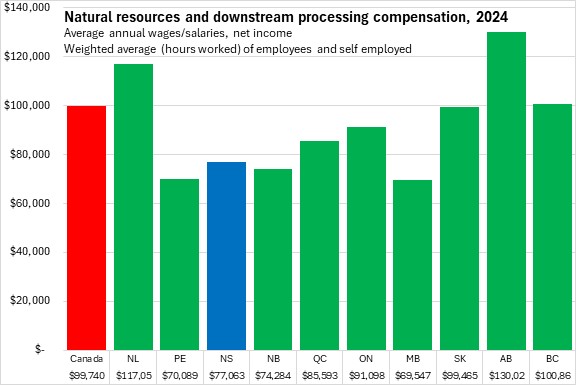
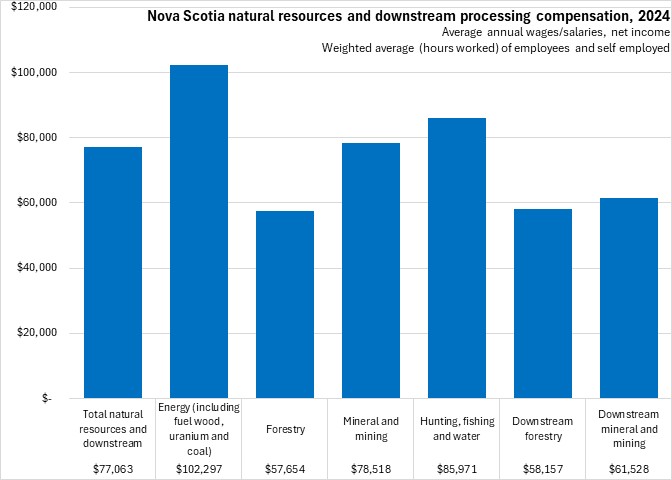
In Nova Scotia, the weighted average wages/salaries/net income per natural resources worker was $77,063 (representing a weighted average of employees and the self-employed).
Across Canada, natural resource industries averaged $99,740 per worker in wages/salaries/net income. There were notably higher wages/salaries/net income for natural resource workers in Alberta and Newfoundland and Labrador. Prince Edward Island and Manitoba had the lowest natural resources wages/salaries/net income.
Natural resource industries pay on average higher wages/salaries/net income than all-industry averages. In Nova Scotia, wages/salaries/net income in natural resources amounted to about 112.7% of total employee compensation per worker across all industries.
Across Canada, natural resource wages/salaries/net income per worker amounted to 127.7% of average employee compensation per worker. There were notably higher differentials in Alberta, Newfoundland and Labrador and Saskatchewan (and to a lesser extent British Columbia).
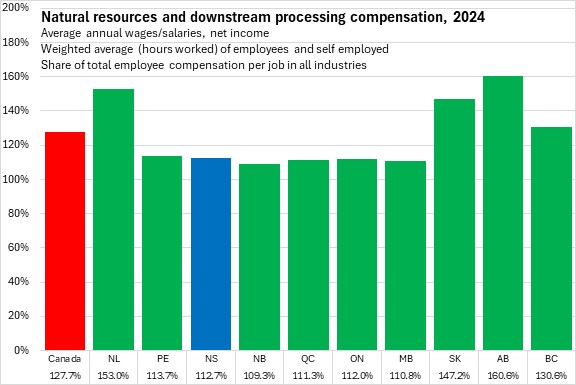
Nova Scotia's natural resource wages/salaries/net incomes per worker were higher for energy, fishing and mining. Values for forestry and downstream processing were lower.
Nova Scotia's employment in these natural resource industries declined from 2009-2019, particularly after the closure of large forest products producers (2011-2012, 2020). Energy employment has also contracted. In recent years, there has been growth in employment for mining/mineral extraction as well as associated downstream processing industries.
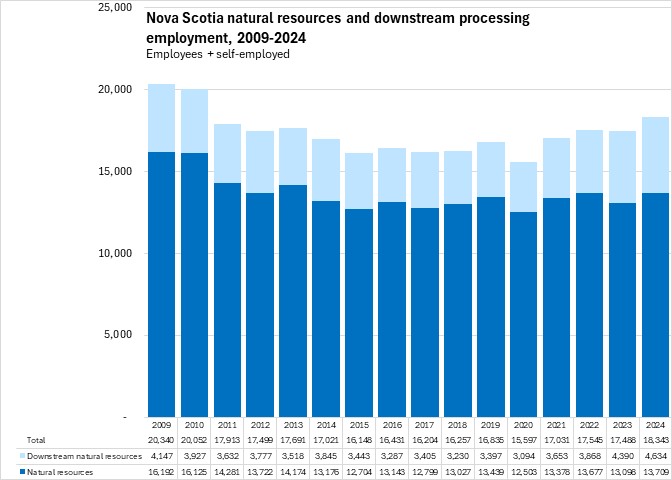
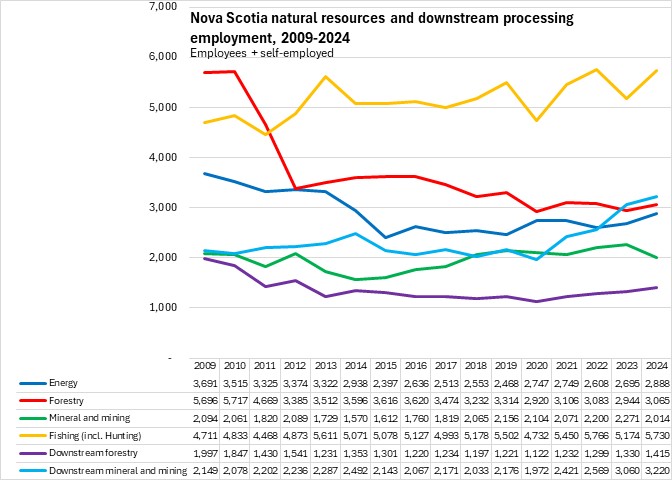
Although Nova Scotia's natural resource employment has grown in recent years, employment in other industries has grown more quickly, reducing natural resources' share of employment to 3.4% of the total. Natural resources employment was 4.4% of total employment in 2009.
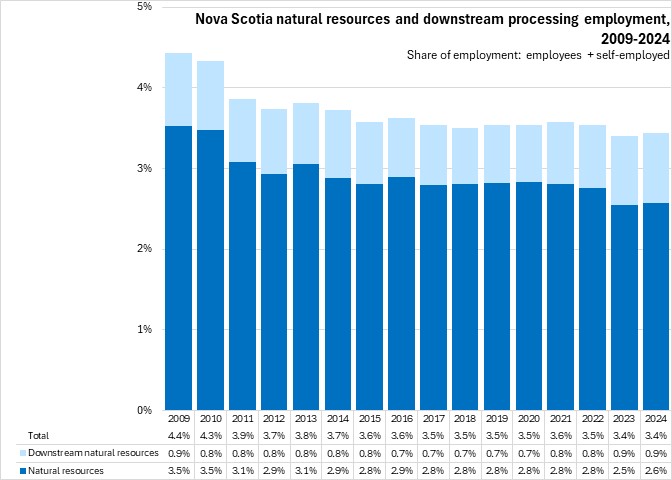
Sources: Statistics Canada. Table 36-10-0654-01 Employment in the natural resources sector by type of worker; Table 36-10-0480-01 Labour productivity and related measures by business sector industry and by non-commercial activity consistent with the industry accounts
<--- Return to Archive


