The Economics and Statistics Division maintains archives of previous publications for accountability purposes, but makes no updates to keep these documents current with the latest data revisions from Statistics Canada. As a result, information in older documents may not be accurate. Please exercise caution when referring to older documents. For the latest information and historical data, please contact the individual listed to the right.
<--- Return to Archive
For additional information relating to this article, please contact:
June 17, 2026NOVA SCOTIA QUARTERLY POPULATION ESTIMATES AS OF APRIL 1, 2026 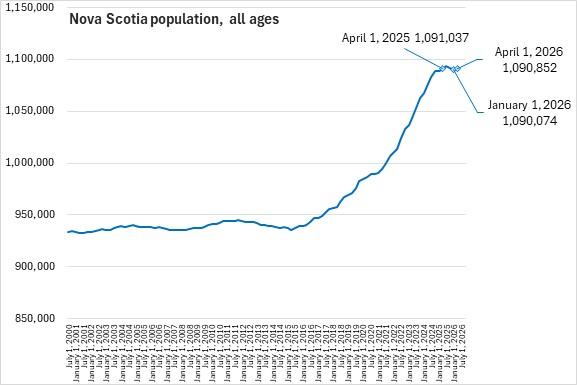
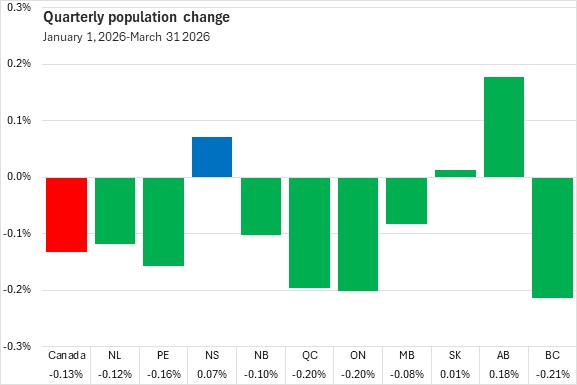
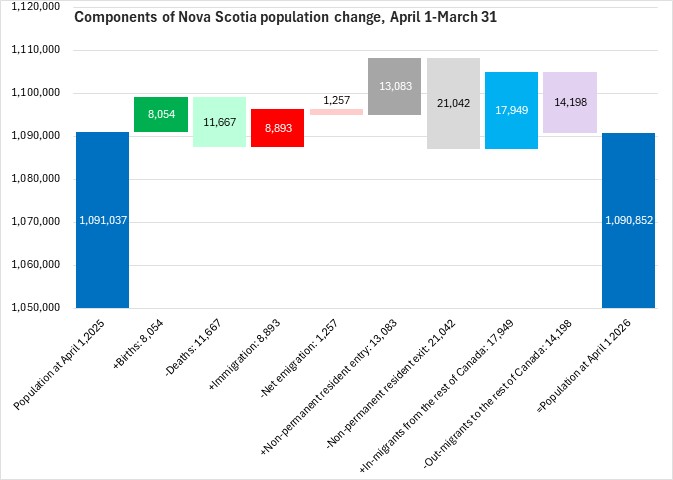
Nova Scotia's population was 1,090,852 as of April 1, 2026, a gain of 778 (+0.07%) from January 1, 2026.
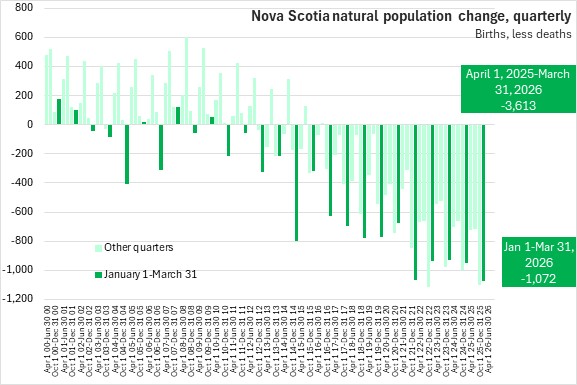
From January 1 to March 31, 2026 natural population change continues to be negative as deaths (3,067) outnumber births (1,995). Natural population change has been negative for every quarter since 2016.
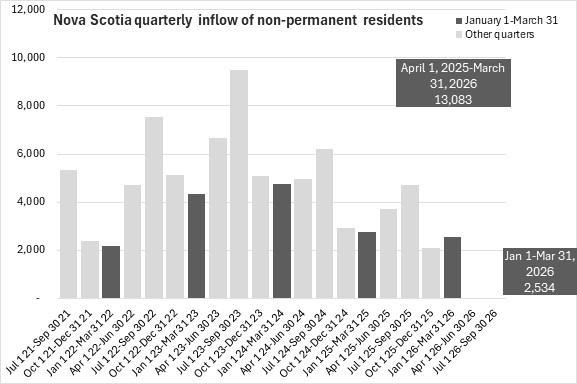
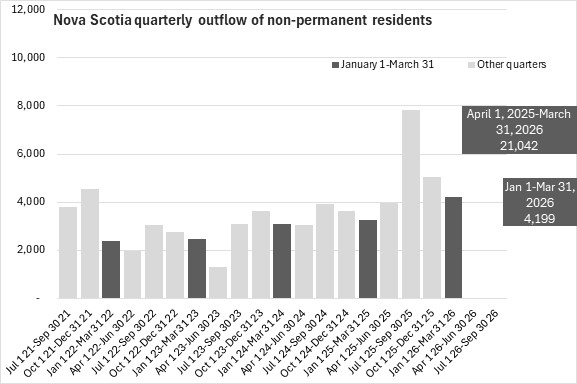
The number of immigrants (2,568) substantially outnumbered net emigrants (256) while the number of non-permanent residents leaving Nova Scotia (4,199) substantially exceeded the number entering the province (2,534), leading to a net reduction of 1,665 in Nova Scotia's non-permanent residents.
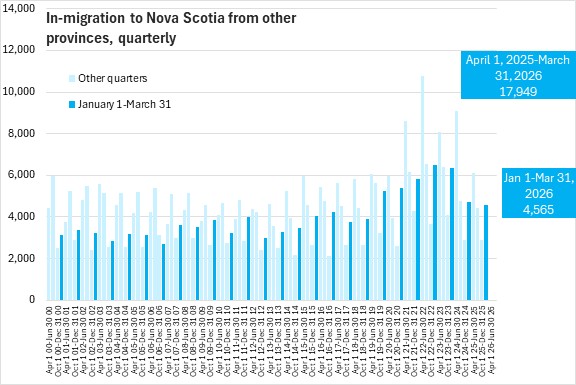
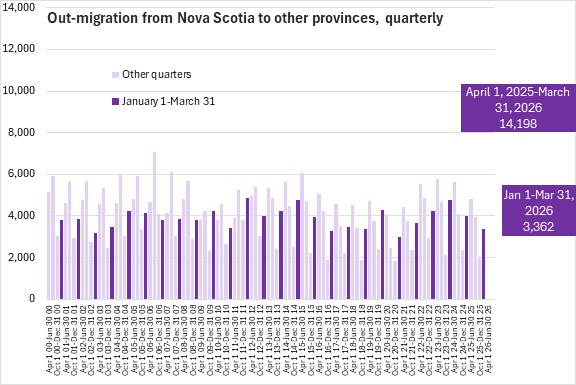
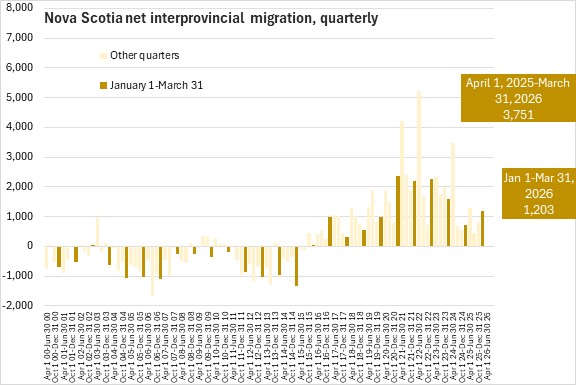
The number people moving into Nova Scotia from another province or territory (4,565) exceeded the number of Nova Scotians moving away to another province (3,362), resulting in a net interprovincial inflow of 1,203 persons.
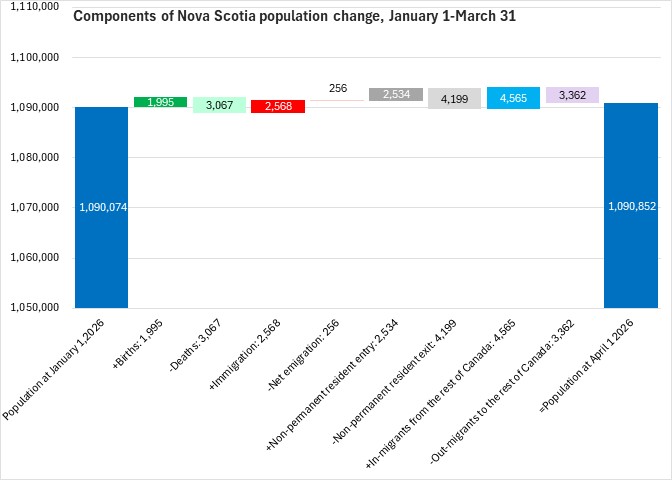

Nova Scotia's population gain of 778 (+0.07%) from January 1 to March 31, 2026 was the first gain following two consecutive quarterly declines.
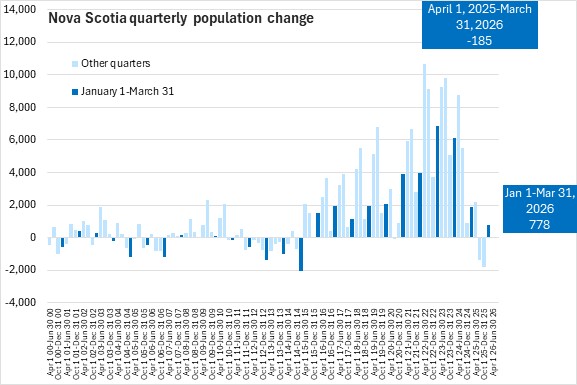
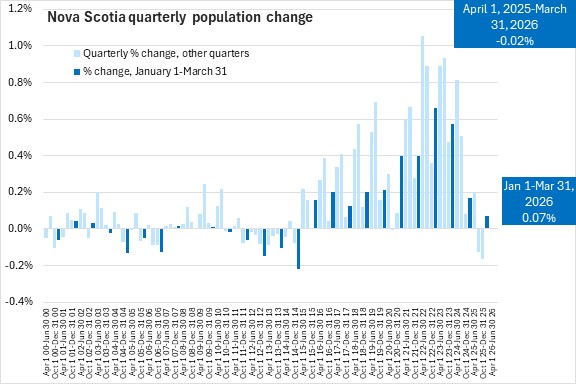
From January 1 to March 31, 2026 Nova Scotia’s population increased 0.07%. Seven provinces reported declining populations with the fastest decline in British Columbia. The largest population gain was reported in Alberta.
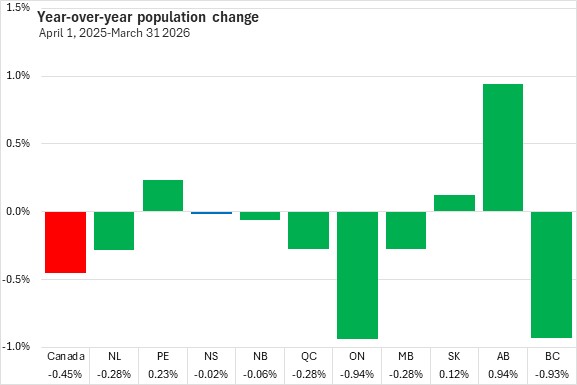
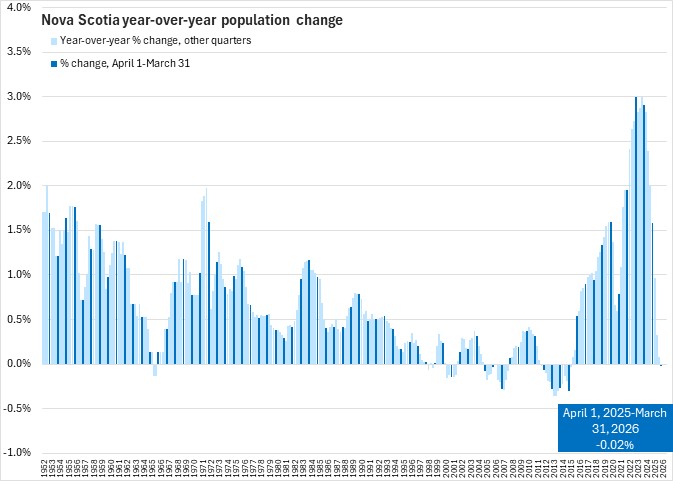
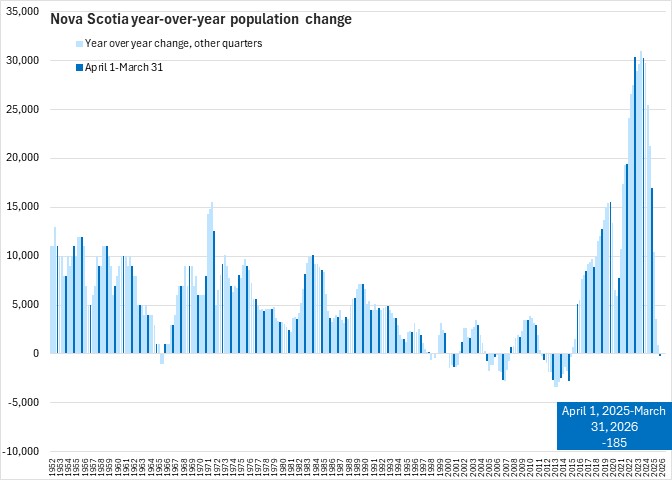
Nova Scotia's population edged down 0.02% (-185) from April 1, 2025 to March 31, 2026. Nationally, the population shrank by 0.45% over the last year, with declines in seven provinces. Alberta reported the fastest growth rate, while Ontario and British Columbia saw the fastest declines.
This was the first decline in Nova Scotia's year-over-year population since 2015.
From April 1, 2025 to March 31, 2026, international sources added to the population as immigration (8,893) combined with non-permanent resident entries (13,083) partially offset net emigration (1,257) plus exit of non-permanent residents (21,042).
Natural change reduced Nova Scotia's population by 3,613 as deaths (11,667) exceeded births (8,054).
The number people moving into Nova Scotia from another province or territory (17,949) exceeded the number of Nova Scotians moving away to another province (14,198) by 3,751.
Nova Scotia’s natural population change (the number of births less the number of deaths) has been negative in every quarter since 2016. Between January 1 and March 31, 2026 there were 1,995 births and 3,067 deaths, amounting to a natural population decline of 1,072. The decline in the January-March period 2026 was somewhat larger than in the same periods of 2023, 2024, and 2025.
From April 1, 2025 to March 31, 2026, there were 8,054 births, which were outnumbered by 11,667 deaths, resulting in a natural population decline of 3,613.
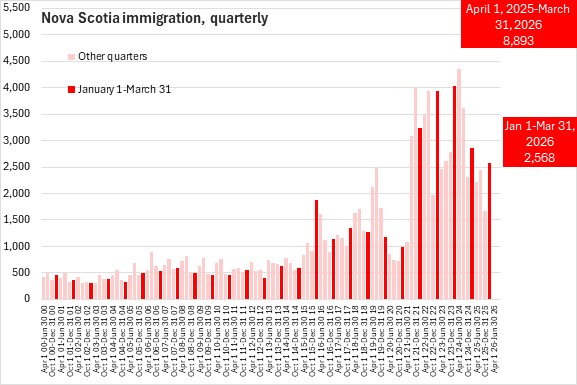
Immigration from other countries continued to be contribute to Nova Scotia's population growth. For the period January 1 to March 31, 2026 an additional 2,568 immigrants came to the province, the lowest rate for the same period since 2020. Over the past year (April 1, 2025 to March 31, 2026) 8,893 immigrants have arrived in Nova Scotia.
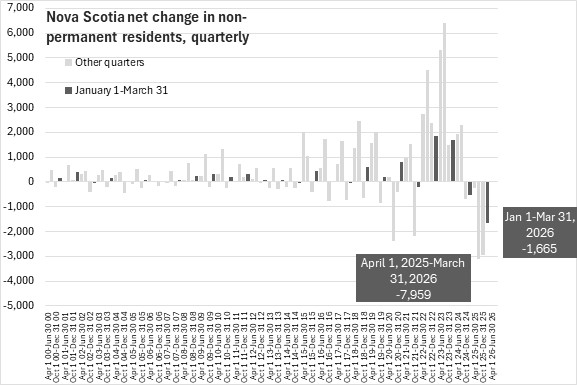
From January 1 to March 31, 1,665 more non-permanent residents left Nova Scotia than the number that arrived. The number of non-permanent residents arriving in Nova Scotia was 2,534 while 4,199 non-permanent residents left the province.
In the period April 1, 2025 to March 31, 2026 there was a net decrease of 7,959 non-permanent residents in Nova Scotia with 13,083 non-permanent resident entries and 21,042 non-permanent resident exits.
There has been a net decline in Nova Scotia's non-permanent residents for six consecutive quarters. This is the first occurrence of six consecutive quarters of non-permanent resident decline since the data series started in 1971.
A total of 4,565 new Nova Scotians arrived in the province from other parts of Canada between January 1 to March 31, 2026. This was the slowest pace of in-migration for the same period since 2020. From April 1, 2025 to March 31, 2026, 17,949 interprovincial migrants arrived in Nova Scotia.
A total of 3,362 Nova Scotians left the province bound for other parts of Canada between January 1 and March 31, 2026 - a pace that has slowed since the same periods over 2022-2025. Over the past year (April 1 2025 to March 31, 2026), Nova Scotia has seen 14,198 interprovincial outmigrants.
From January 1 to March 31, 2026 Nova Scotia's net interprovincial migration generated a net inflow of +1,203. From April 1 2025 to March 31, 2026, Nova Scotia's net interprovincial migration was positive (+3,751). With slowing in-migration, Nova Scotia's net interprovincial migration flows have decelerated in the last two years.
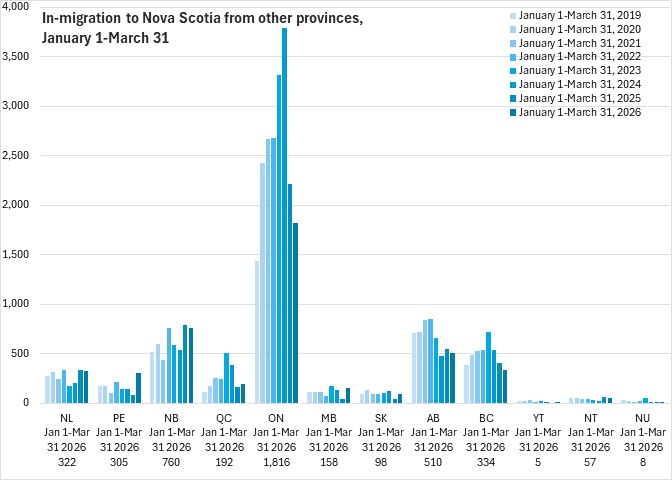
For January 1 to March 31, 2026 Ontario continued to account for the largest number of in-migrants to Nova Scotia, however this pace slowed substantially from the pace observed in the same periods from the previous 6 years. There have been notable slow-downs for in-migration to Nova Scotia from Newfoundland and Labrador as well as Alberta and Saskatchewan, however these trends were reversed in the most recent data.
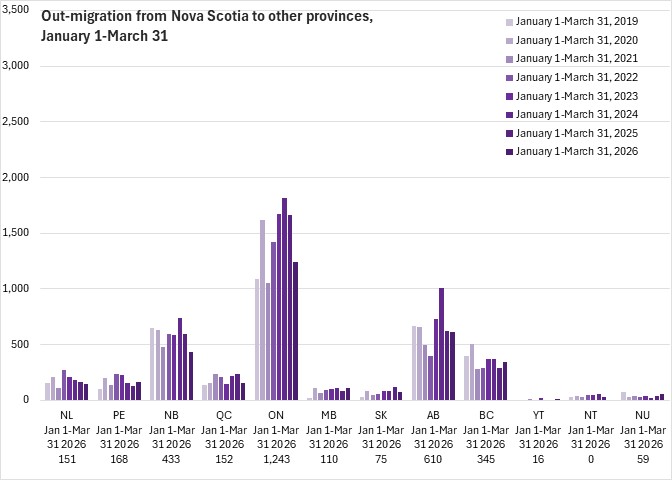
Ontario, Alberta, British Columbia and New Brunswick were the largest destinations for those leaving Nova Scotia between January 1 and March 31 of 2026. Out-migration was down compared to the same quarter in the previous year for most provinces and territories except Prince Edward Island, Manitoba, British Columbia, Yukon and Nunavut.
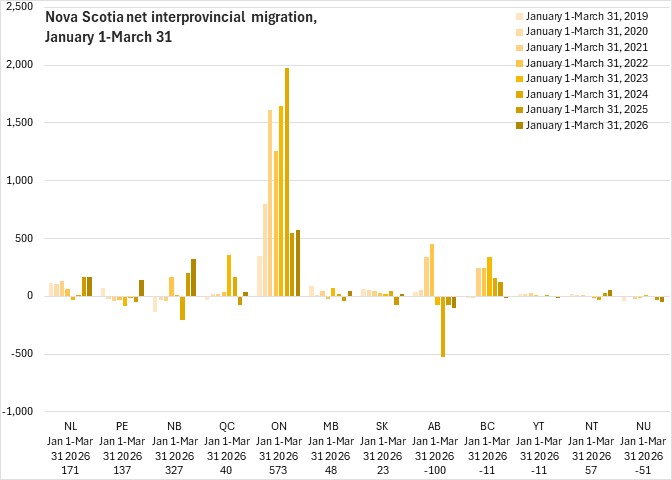
From January 1 to March 31, Nova Scotia's net interprovincial population gain reflected net inflows from most provinces and territories except Alberta, British Columbia, Yukon, and Nunavut, with Ontario (+573) contributing the most to net interprovincial migration.
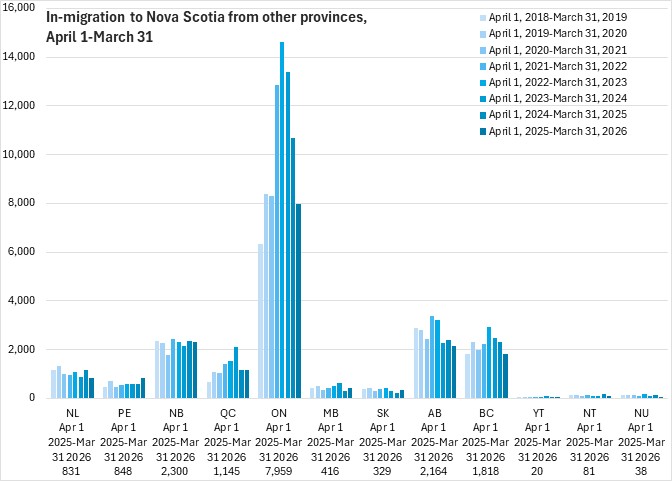
From April 1, 2025 to March 31, 2026, the largest source of interprovincial in-migration was from Ontario (7,959), which was lower than in any of the previous six years. In-migration was slower from all provinces and territories except Prince Edward Island, Manitoba, and Saskatchewan compared to the previous year.
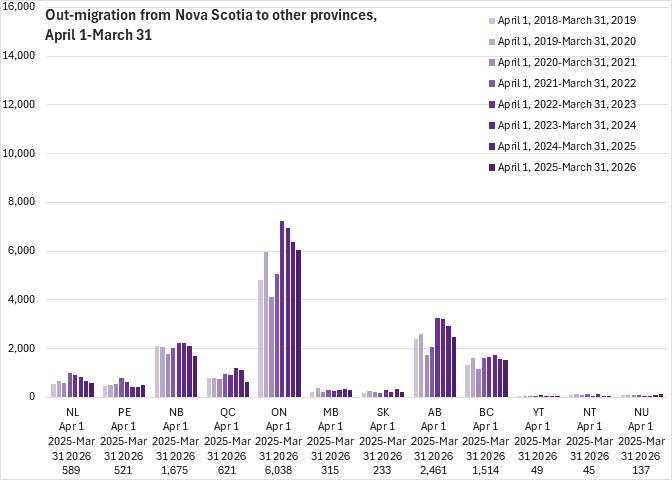
From April 1, 2025 to March 31, 2026, the primary destinations for outmigration from Nova Scotia were Ontario, Alberta and New Brunswick. Compared to the previous year, Nova Scotia out-migration decreased for all of the provinces and territories except Prince Edward Island, Yukon and Nunavut.
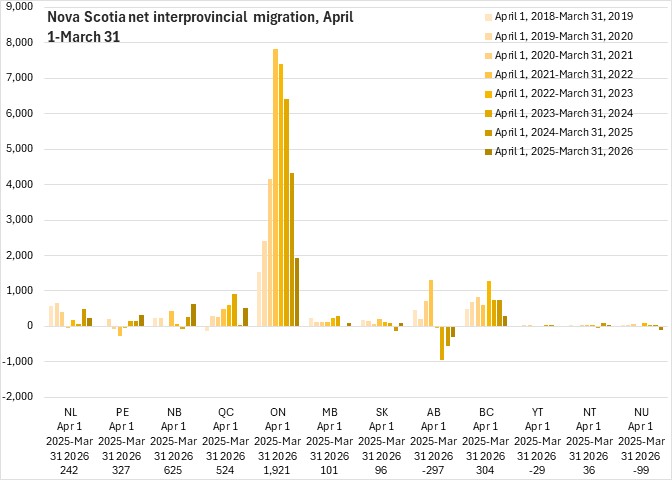
Ontario contributed the most substantial positive net interprovincial migration from April 1, 2025 to March 31, 2026 (+1,921). There was also positive net interprovincial migration with: New Brunswick (+625), Québec (+524), Prince Edward Island (+327), British Columbia (+304), Newfoundland and Labrador (+242), Manitoba (+101), Saskatchewan (+96), and Northwest Territory (+36). Alberta reported the largest net outmigration with Nova Scotia (-297) along with smaller net out-migrations to Nunavut (-99) and Yukon (-29).
Non-permanent residents
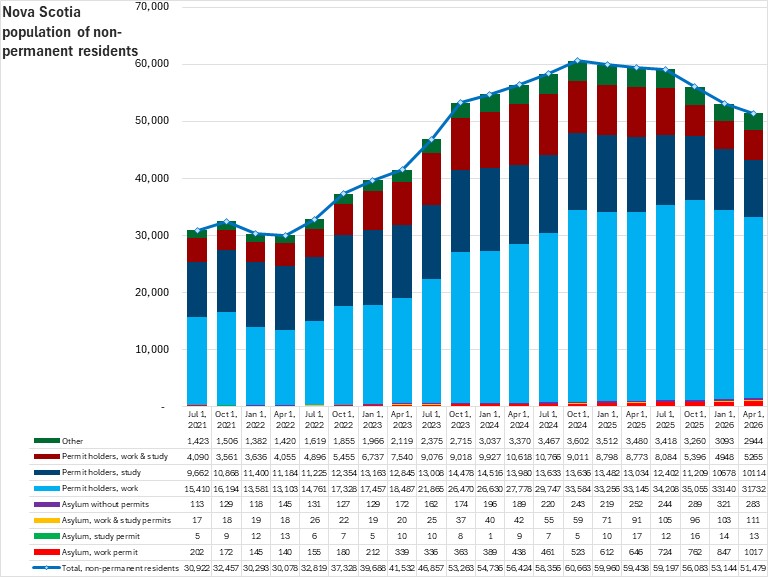
The number of non-permanent residents in Nova Scotia was 51,479 as of April 1, 2026. This was down 1,665 from January 1, 2026 and down 9,184 from the peak population of non-permanent residents on October 1, 2024 (60,663). Non-permanent residents most often hold work permits (31,732), study permits (10,114), or both work and study permits (5,265). The largest declines in the last quarter were among those holding study permits and work permits.
Asylum claimants, both with and without study/work permits, were 1,424 as of April 1, 2026.
There were 2,944 other non-permanent residents who are typically family members living with permit holders or persons with temporary resident permits.
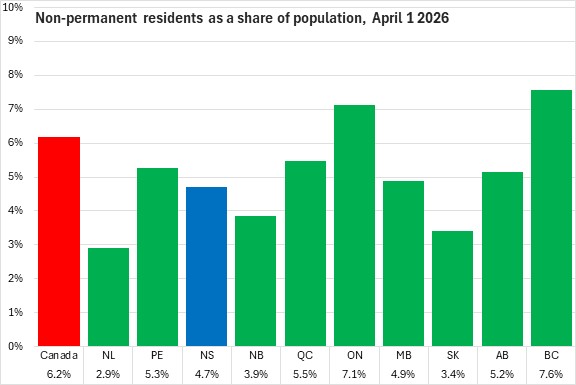
Non-permanent residents accounted for 4.7% of Nova Scotia's population as of April 1, 2026. Nationally, non-permanent residents make up 6.2% of the population with the highest shares in British Columbia (7.6%) and Ontario (7.1%) and lowest shares in Newfoundland and Labrador (2.9%) and Saskatchewan (3.4%).
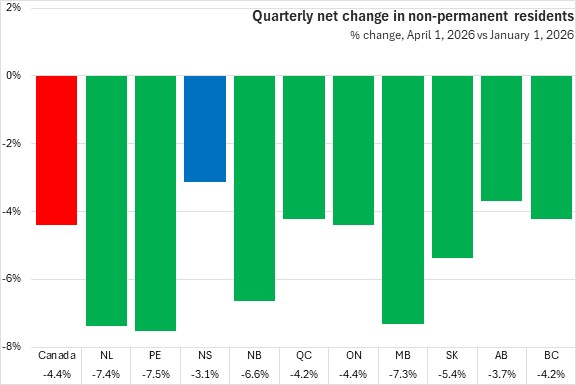
For the period January 1 to March 31, 2026 the non-permanent resident population in Nova Scotia fell 3.1%, the slowest decline among provinces. Nationally, the non-permanent resident population was down 4.4% with declines in all provinces. Prince Edward Island, Newfoundland and Labrador, and Manitoba reported the steepest declines in non-permanent residents.
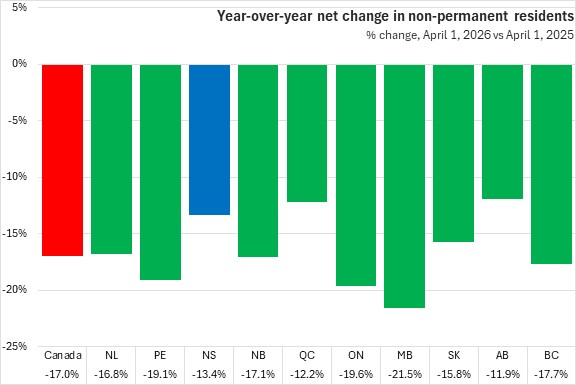
The non-permanent resident population in Nova Scotia fell 13.4% from April 1, 2025 to March 31, 2026. Nationally, the non-permanent resident population decreased 17.0% with declines in all provinces. Manitoba (-21.5%) reported the steepest year-over-year decline in non-permanent residents. Alberta (-11.9%) reported the least decline.
Source: Statistics Canada. Table 17-10-0009-01 Population estimates, quarterly; Table 17-10-0059-01 Estimates of the components of natural increase, quarterly; Table 17-10-0020-01 Estimates of the components of interprovincial migration, quarterly; Table 17-10-0040-01 Estimates of the components of international migration, quarterly; Table 17-10-0045-01 Estimates of interprovincial migrants by province or territory of origin and destination, quarterly; Table 17-10-0121-01 Estimates of the number of non-permanent residents by type, quarterly
<--- Return to Archive


