The Economics and Statistics Division maintains archives of previous publications for accountability purposes, but makes no updates to keep these documents current with the latest data revisions from Statistics Canada. As a result, information in older documents may not be accurate. Please exercise caution when referring to older documents. For the latest information and historical data, please contact the individual listed to the right.
<--- Return to Archive
For additional information relating to this article, please contact:
September 17, 2026EMPLOYMENT INSURANCE, JULY 2026 Monthly (July vs June 2026, seasonally adjusted regular beneficiaries)
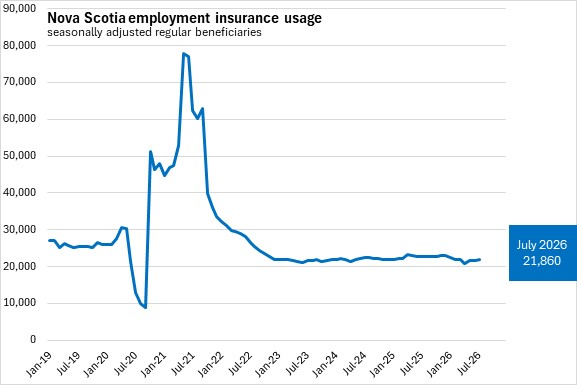
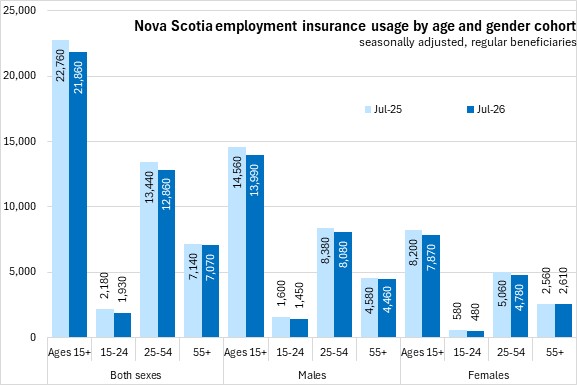
In July 2026 there were 21,860 Nova Scotians in receipt of regular employment insurance benefits (seasonally adjusted). Nova Scotia's seasonally adjusted regular employment insurance usage in July increased by 90 (+0.4%) from June.
There were 547,050 Canadians in July in receipt of regular employment insurance benefits (seasonally adjusted). That represents an increase of 2,860 (+0.5%) from June.
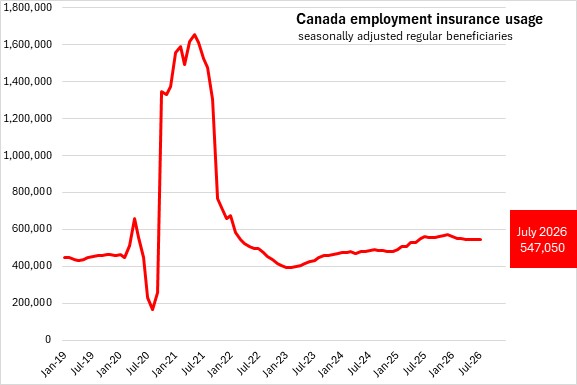
Employment insurance usage was up in six provinces in July, with the fastest growth reported in Manitoba. Newfoundland and Labrador reported the fastest decrease in employment insurance usage compared to June.
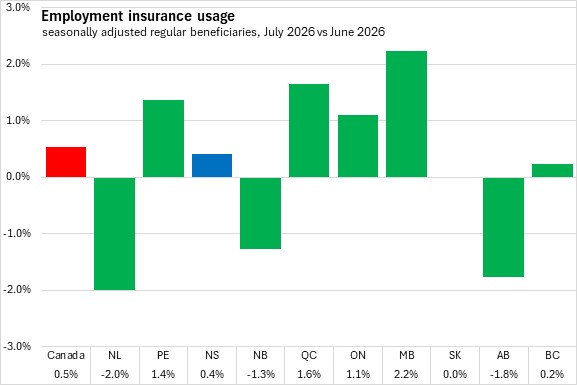
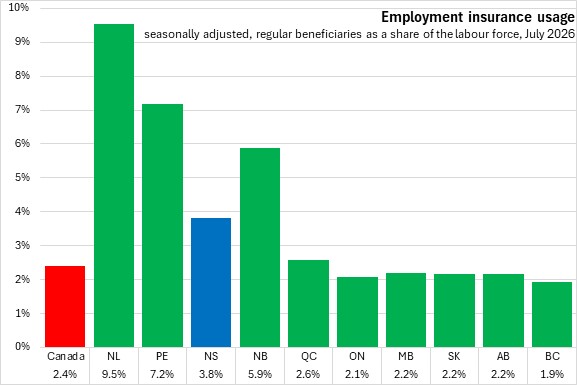
The number of employment insurance beneficiaries amounted to 3.8% of the labour force in Nova Scotia in July 2026, unchanged from the June 2026 share. Nationally, the share of beneficiaries was 2.4% of the labour force. EI beneficiaries as a share of labour force was highest in Newfoundland and Labrador and lowest in British Columbia.
Year-over-year (July 2026 vs July 2025)
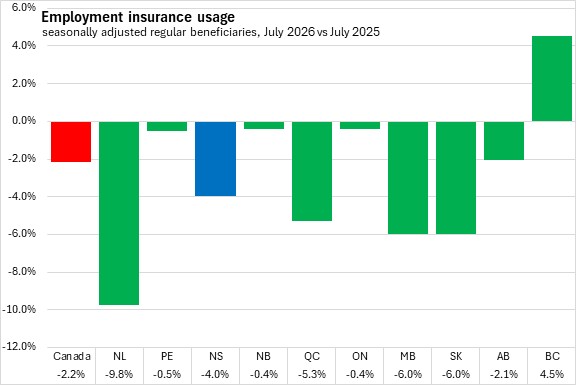
Compared to July 2025, Nova Scotia's employment insurance usage fell 4.0% (-900). National employment insurance usage decreased 2.2% (-12,190). Nine provinces reported declines, led by Newfoundland and Labrador. British Columbia recorded the only increase.
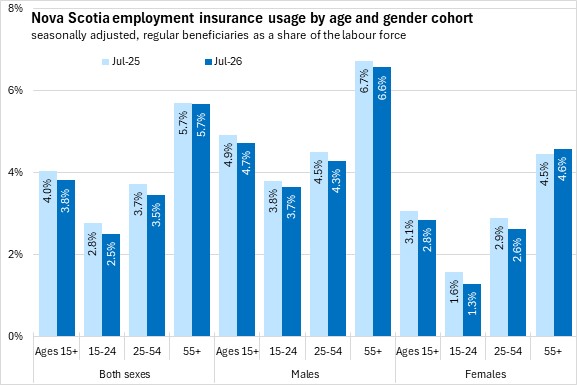
In July 2026, employment insurance usage as a share of the labour force was lowest among youth aged 15-24 and highest among workers aged 55 and over. Across all age groups, male employment insurance usage exceeded female usage as a share of the labour force. Compared with July 2025, employment insurance usage as a share of the labour force declined for all age-gender cohorts, except females aged 55 and over, whose usage increased slightly.
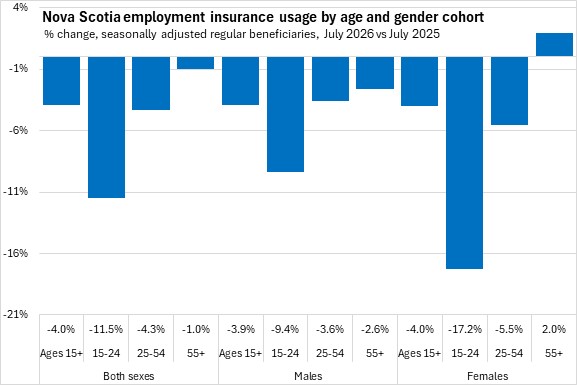
Employment insurance usage declined across nearly all age and gender cohorts in July 2026 compared with one year earlier. The only increase was among females aged 55 and over, while the fastest decline was among females aged 15-24.
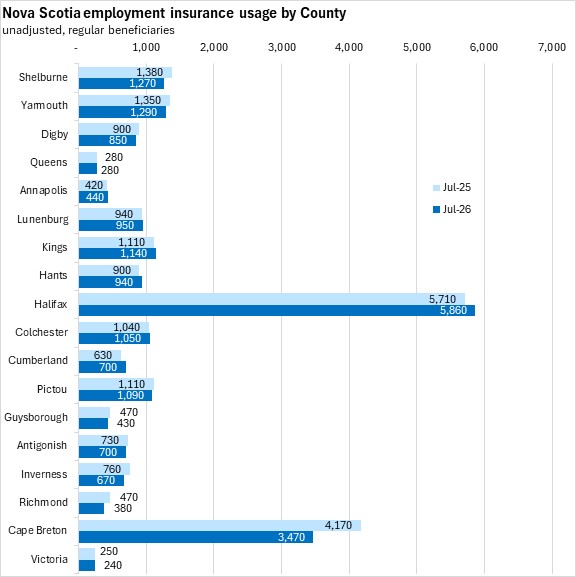
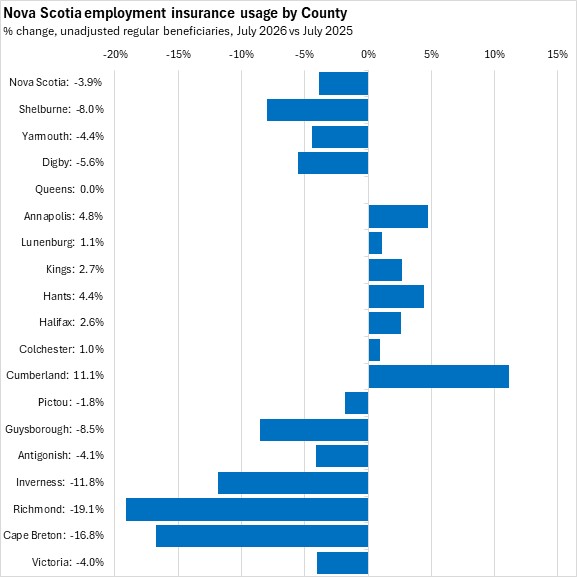
Comparing unadjusted regular beneficiaries in July 2026 with July 2025, ten of Nova Scotia's 18 counties recorded lower employment insurance usage. The fastest decline occurred in Richmond and Inverness while the fastest increase was in Cumberland.
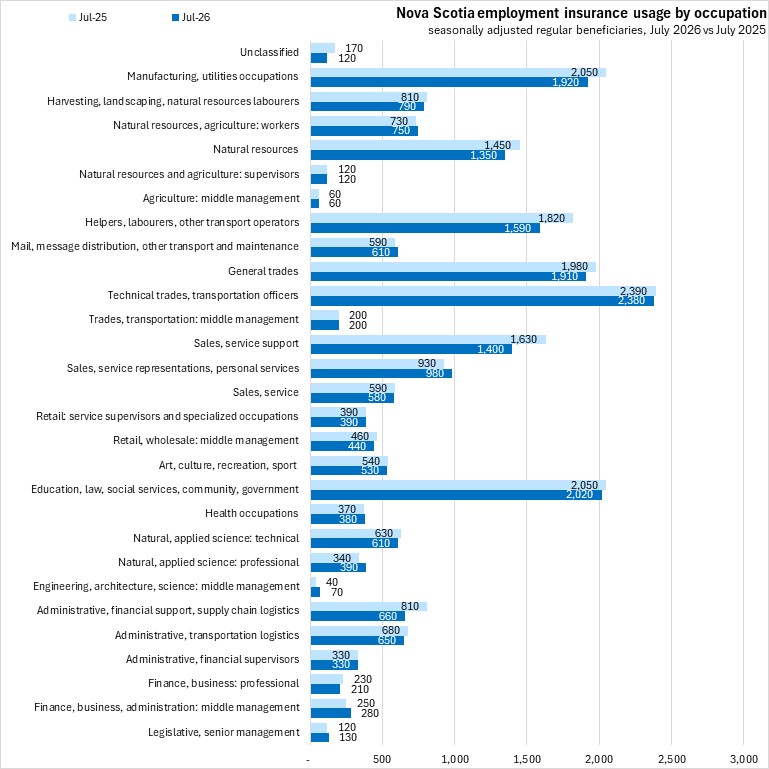
By occupation, employment insurance beneficiaries were concentrated in technical trades and transportation, education/law/social services/community/government, manufacturing and utilities, and general trades occupations in July 2026. There was a notable decline in helpers/labourers.
Year-to-date (January-July 2026 vs January-July 2025)
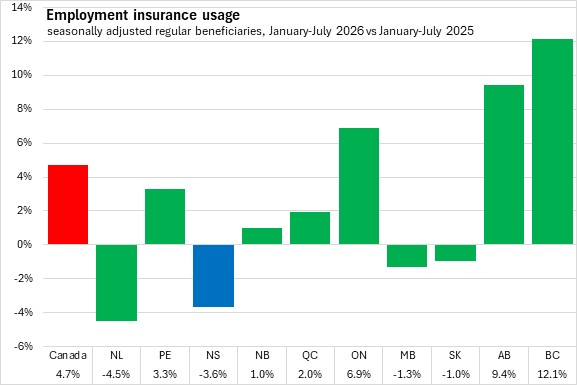
In the first seven months of 2026, Nova Scotia's regular employment insurance beneficiaries declined 3.6% compared with the same period in 2025, the second-fastest decrease among provinces after Newfoundland and Labrador (-4.5%). Nationally, employment insurance usage increased, with gains in six provinces led by British Columbia.
Year-to-date employment insurance usage as a share of the labour force declined across most age-gender cohorts. The largest decrease was among males aged 55 and over, while females aged 55 and over recorded a slight increase.
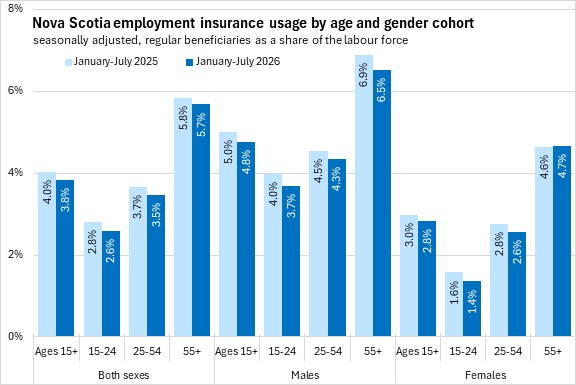
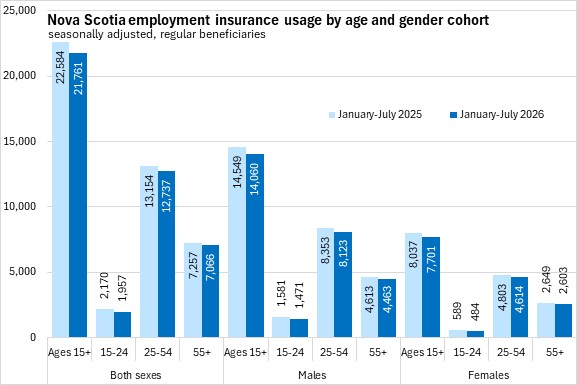
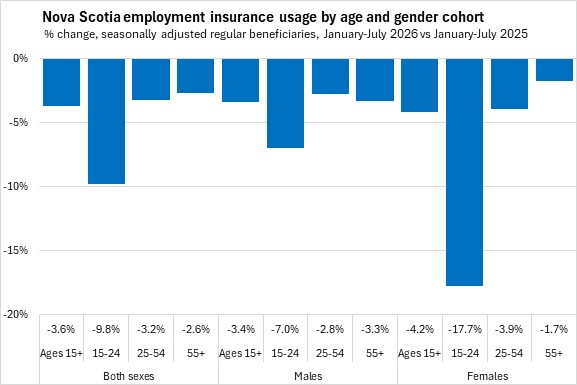
Employment insurance usage was lower across all age-gender cohorts compared with the first seven months of 2025. The fastest decline was among females aged 15-24, followed by males aged 15-24.
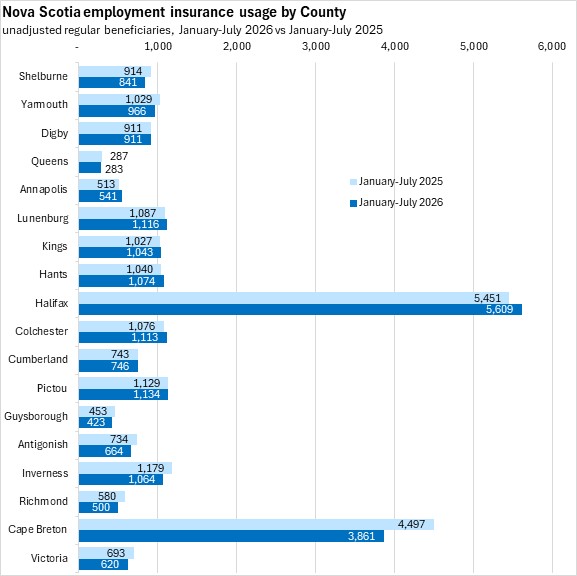
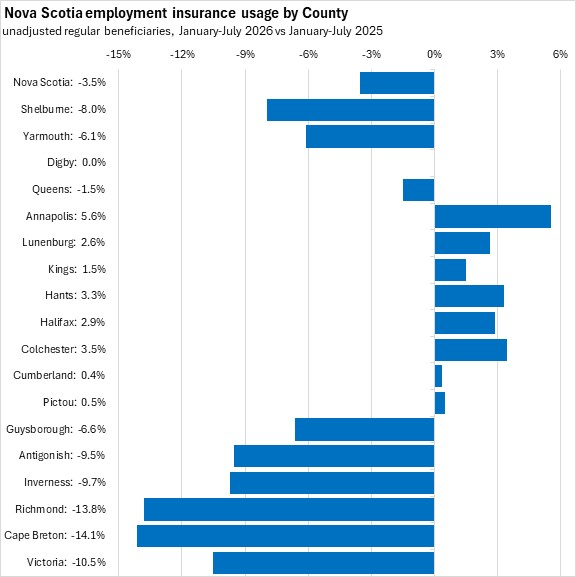
Compared with January-July 2025, employment insurance usage increased in eight Nova Scotia counties, led by Annapolis. The fastest declines were reported in the four counties on Cape Breton Island.
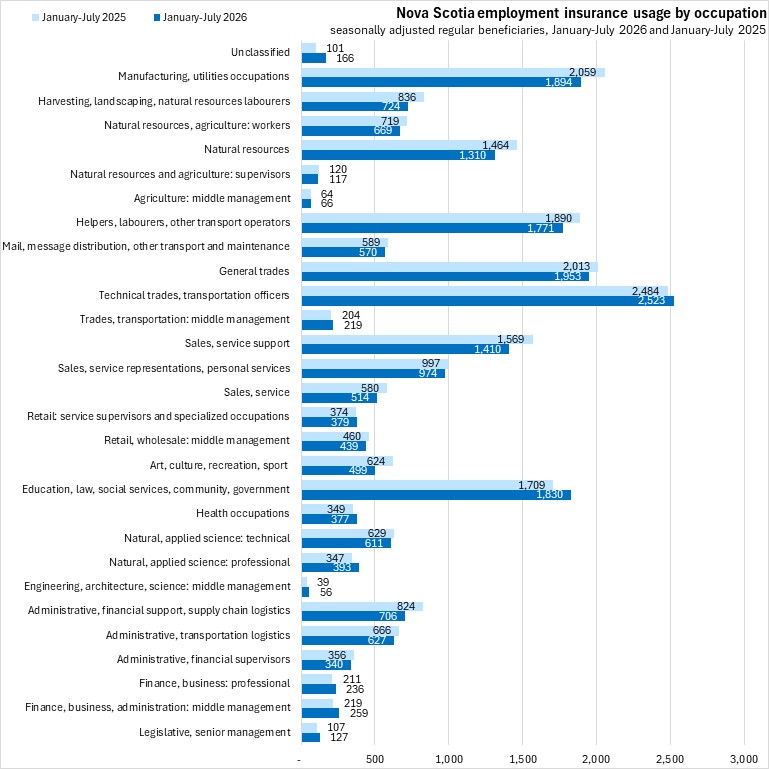
Compared with January-July 2025, employment insurance beneficiaries increased the most among education, law, social services, community and government occupations, while manufacturing and utilities occupations recorded the largest decline.
Source: Statistics Canada. Table 14-10-0011-01 Employment insurance beneficiaries (regular benefits) by province and territory, monthly, seasonally adjusted; Table 14-10-0323-01 Employment insurance beneficiaries by census division, monthly, unadjusted for seasonality; Table 14-10-0456-01 Employment insurance beneficiaries (regular benefits) by province, territory and occupation, monthly, seasonally adjusted; Table 14-10-0287-01 Labour force characteristics, monthly, seasonally adjusted and trend-cycle, last 5 months
<--- Return to Archive


