The Economics and Statistics Division maintains archives of previous publications for accountability purposes, but makes no updates to keep these documents current with the latest data revisions from Statistics Canada. As a result, information in older documents may not be accurate. Please exercise caution when referring to older documents. For the latest information and historical data, please contact the individual listed to the right.
<--- Return to Archive
For additional information relating to this article, please contact:
September 21, 2026BUILDING CONSTRUCTION, JULY 2026 Monthly (July vs June 2026, seasonally adjusted)
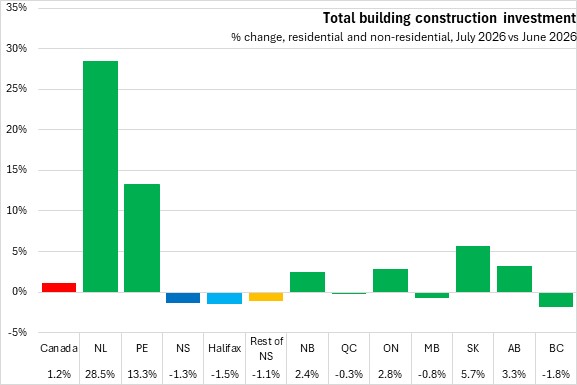
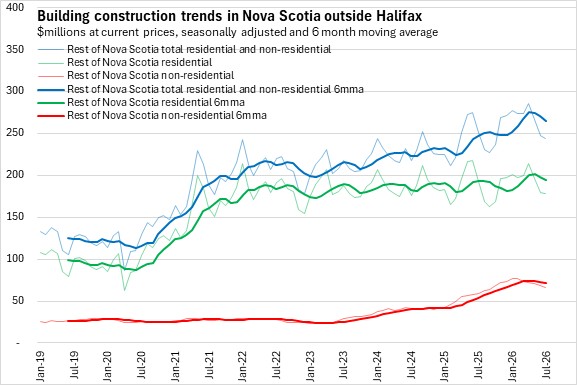
Investment in Nova Scotia building construction decreased 1.3% in July 2026 to $517.5 million. Halifax monthly building construction was down 1.5% to $273.3 million while outside of Halifax building construction was down 1.1% to $244.2 million. Nationally, investment in building construction grew 1.2% with gains in six provinces. Newfoundland and Labrador reported the fastest gain in building construction investment, while British Columbia reported the fastest decline.
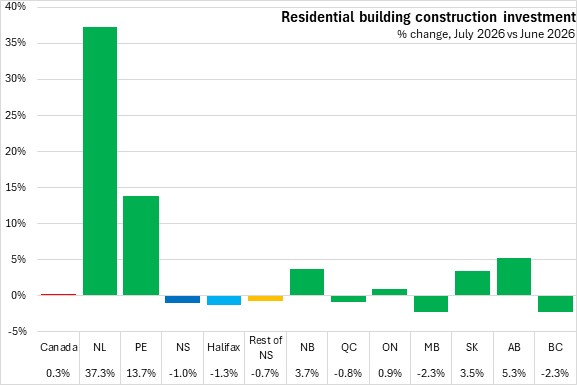
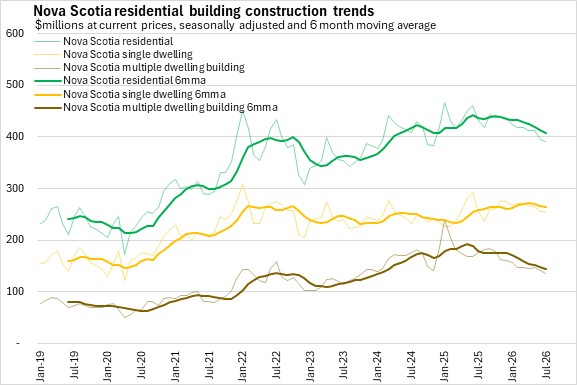
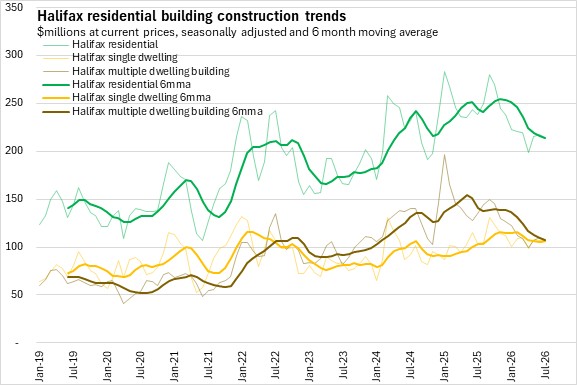
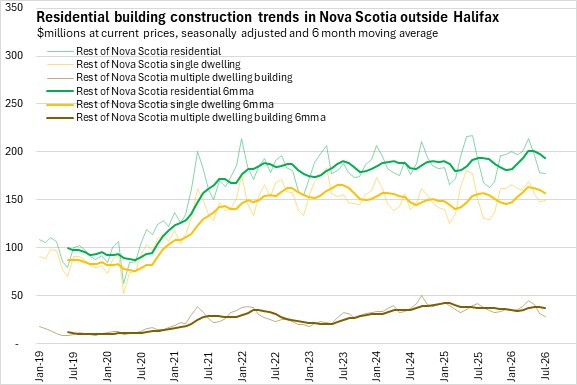
Nova Scotia's July 2026 residential construction investment fell 1.0% to $391.9 million. Halifax residential construction fell 1.3% to $214.2 million. Outside of Halifax residential construction was down 0.7% to $177.8 million. National residential construction grew 0.3%, with five provinces reporting gains. Newfoundland and Labrador reported the fastest gain while British Columbia reported the fastest decline.
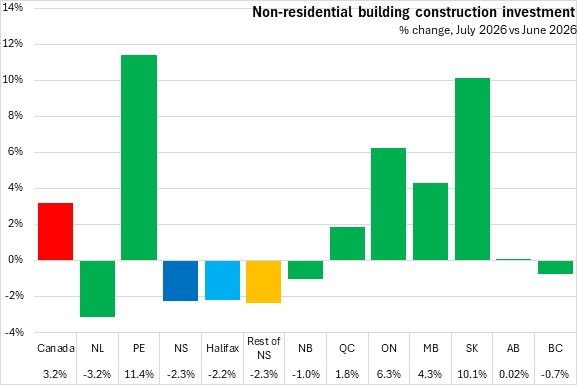
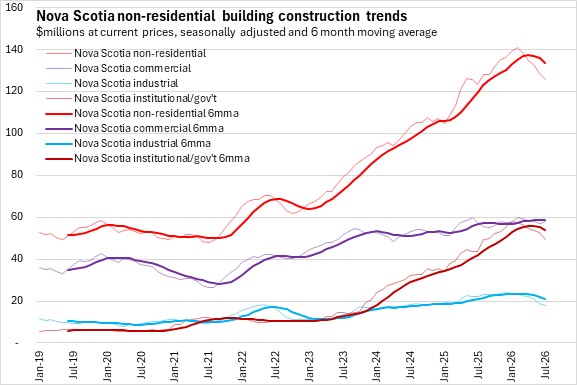
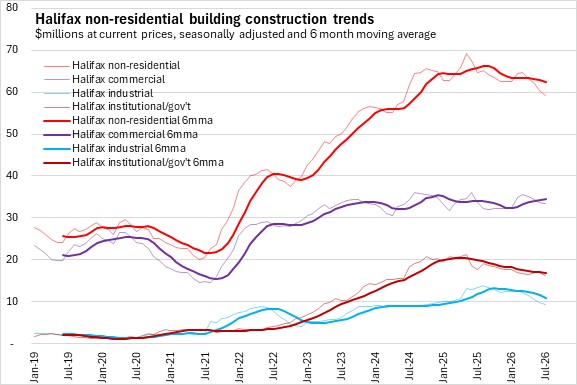
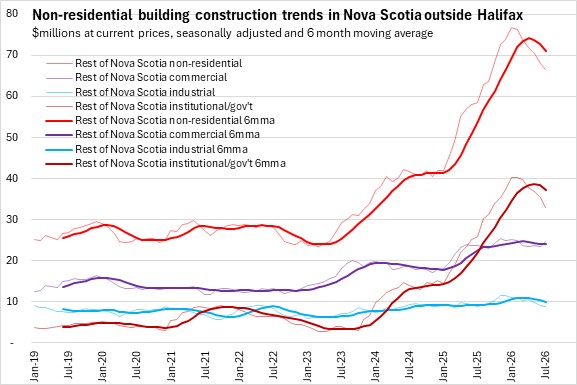
Nova Scotia's non-residential building construction fell 2.3% to $125.6 million. In Halifax, non-residential construction dropped 2.2% to $59.1 million. Outside of Halifax, non-residential construction was down 2.3% to $66.5 million. National non-residential building construction increased 3.2% in July 2026 with increases in six provinces. Prince Edward Island reported the largest gain.
Year-to-date (January-July 2026 vs January-July 2025)
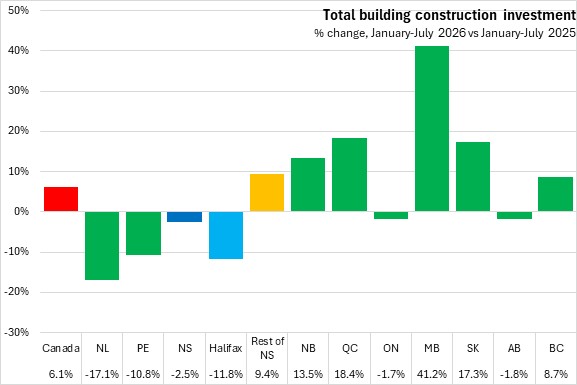
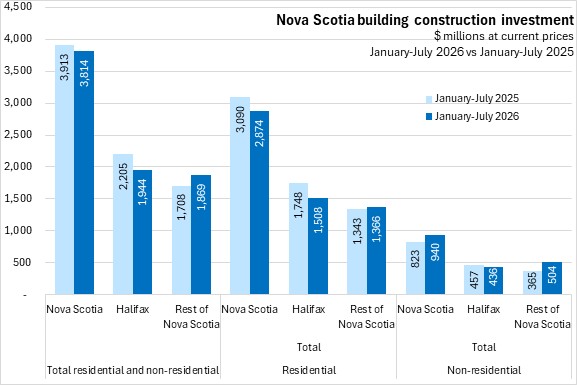
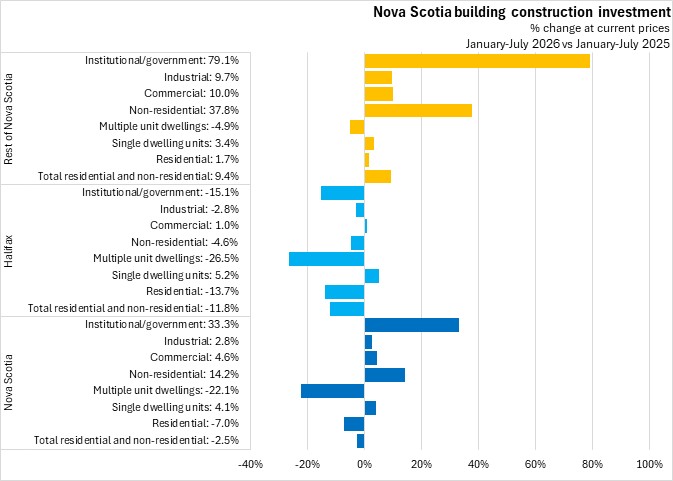
Compared to January-July 2025, building construction investment was down 2.5% in Nova Scotia. Halifax construction activity was down 11.8% and outside of Halifax construction activity was up 9.4%. National building construction investment was up 6.1%, with gains in five provinces. The fastest growth was reported in Manitoba while Newfoundland and Labrador reported the fastest decline.
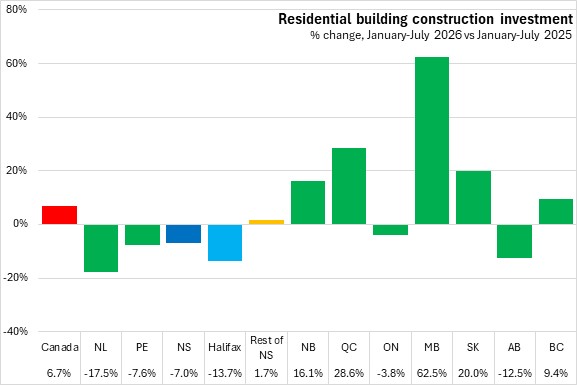
Residential construction investment was down 7.0% in Nova Scotia compared to January-July 2025. Halifax's residential construction was down 13.7% while outside of Halifax residential construction was up 1.7%. National residential construction was up 6.7% with gains in five provinces. Manitoba reported the fastest gain, while Newfoundland and Labrador experienced the steepest decline.
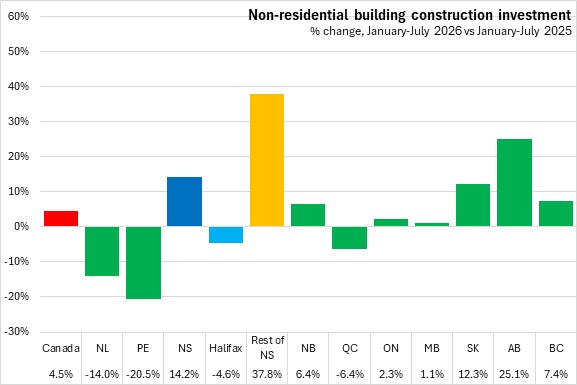
Nova Scotia's non-residential construction was up 14.2% compared to first seven months of 2025, the second fastest gain among provinces, behind Alberta. Halifax's non-residential construction fell 4.6% while outside of Halifax, non-residential construction was up 37.8%. National non-residential construction investment increased 4.5% compared to first seven months of 2025, with gains in seven provinces. Prince Edward Island reported the steepest decline.
Nova Scotia's total building construction investment decreased from $3.913 million in January-July 2025 to $3.814 million in January-July 2026. Lower residential investment in Halifax was not offset by higher residential investment outside of Halifax. Nova Scotia's non-residential investment increased, resulting from gains outside of Halifax.
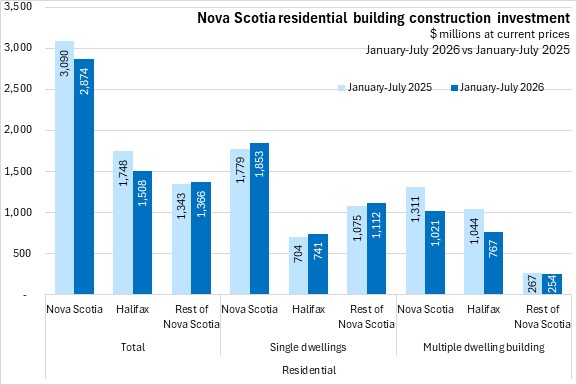
Residential investment declines were concentrated in multiple unit dwellings across the province. Investment in singles was up across the province.
Non-residential building construction investment was up most for institutional and government projects outside of Halifax. There were smaller gains for commercial investment across the province, as well as industrial. Nova Scotia's total non-residential growth is driven by gains in non-residential outside of Halifax.
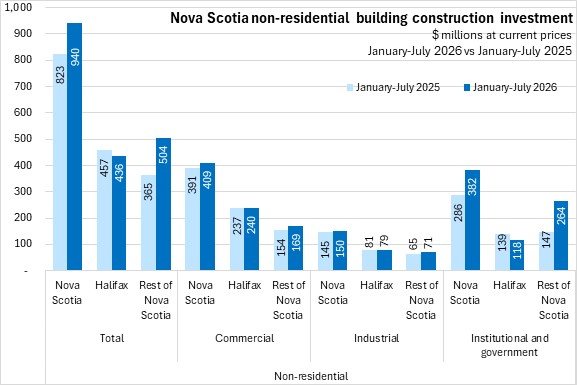
In Halifax, the year-to-date decline in building construction was led by a decline in multi-unit residential investment, followed by lower institutional and government investment. Outside of Halifax, gains were led by institutional and government investment.
Trends
Building construction has trended up over recent years, particularly from rising residential investment. Residential investment (and therefore total investment) exhibits peaks and troughs around a rising trend although this has declined over the last year driven by declines in Halifax residential investment. Non-residential investment has been on a more gradual increasing trend.
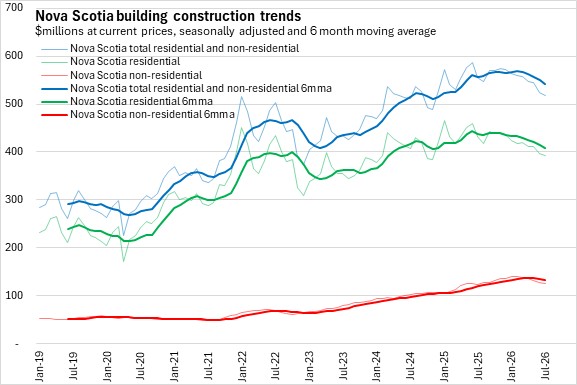
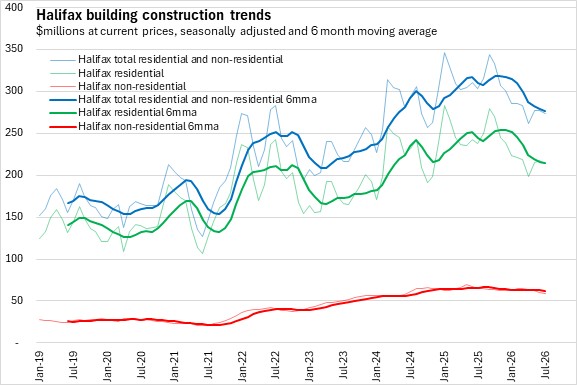
In Halifax since July 2022, multiple dwelling unit buildings have represented a larger share of investment than single dwelling units, with a closing of the gap in recent months. The opposite is true outside of the city. In Halifax, residential construction investment had trended up for multi-unit dwellings from late 2024 to the summer of 2025, when it peaked, with recent dips. Single unit dwelling investments in Halifax grew through 2025 but have since peaked. Outside of Halifax, single unit dwelling investment declined through the second half of 2025 and started rising again in recent months.
Non-residential building construction has lower values than residential construction. Non-residential investment has been steadily increasing since 2023 due to growth in institutional and government building construction.
Halifax institutional and government building construction plateaued in 2025 and have declined in recent months. Halifax's non-residential commercial construction showed a similar pattern but with recent increases. Its industrial projects continue to grow. Outside the city, non-residential investment levels rose since 2023 on rising institutional and government and commercial building investments while in recent months non-residential investment plateaued on declining institutional and government building projects.
Statistics Canada. Table 34-10-0293-01 Investment in Building Construction
<--- Return to Archive


