The Economics and Statistics Division maintains archives of previous publications for accountability purposes, but makes no updates to keep these documents current with the latest data revisions from Statistics Canada. As a result, information in older documents may not be accurate. Please exercise caution when referring to older documents. For the latest information and historical data, please contact the individual listed to the right.
<--- Return to Archive
For additional information relating to this article, please contact:
October 29, 2026CANADIAN COMMUNITY HEALTH SURVEY, 2025 Statistics Canada released annual results from the 2025 Canadian Community Health Survey (CCHS) in January. This survey is an annual population health survey that provides insight into life satisfaction, stress, perceived health, health conditions and behaviours of the Canadian population. The survey is representative of the population aged 18 and older living outside the territories. These are not exact counts. The CCHS survey excludes persons living on reserves and other Indigenous settlements in the provinces; full-time members of the Canadian Forces; the institutionalized population, and persons living in the Quebec health regions of Région du Nunavik and Région des Terres-Cries-de-la-Baie-James.
Life satisfaction
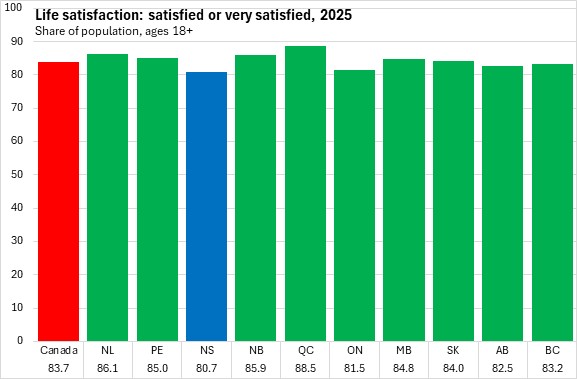
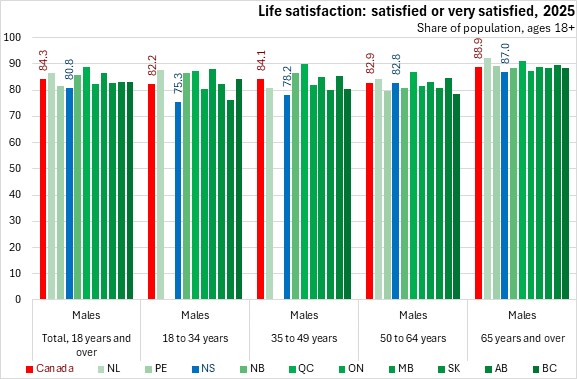
In Nova Scotia, 80.7% of adults reported being satisfied or very satisfied with their lives, lowest among the provinces. National life satisfaction average 83.7%. Québec reported the highest level of life satisfaction.
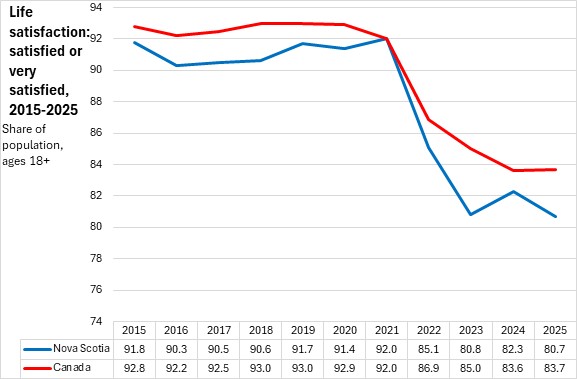
Life satisfaction has weakened considerably from levels reported before 2022. The existing series shows a pronounced decline in both Nova Scotia and Canada beginning in 2022, although Nova Scotia subsequently recorded some improvement. In 2025 life satisfaction has resumed its decline.
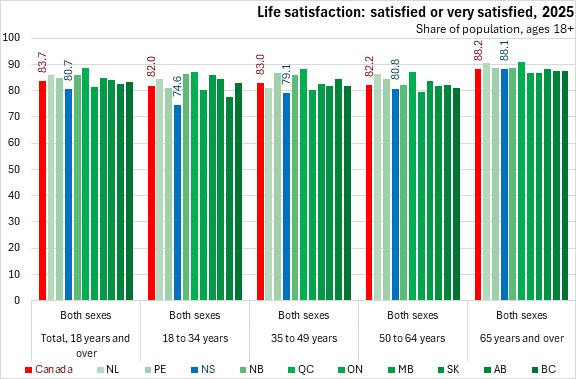
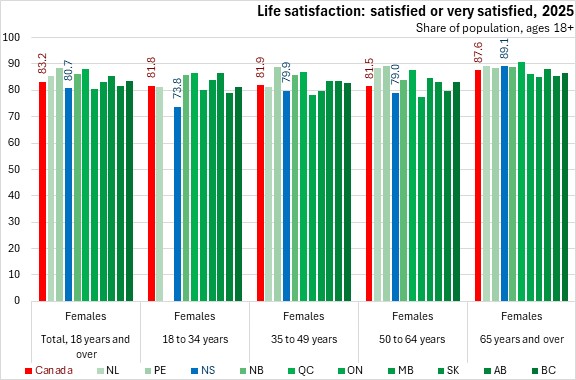
Life satisfaction was highest among Nova Scotians aged 65 and older, while younger adults reported lower levels of life satisfaction.
Sense of belonging to community
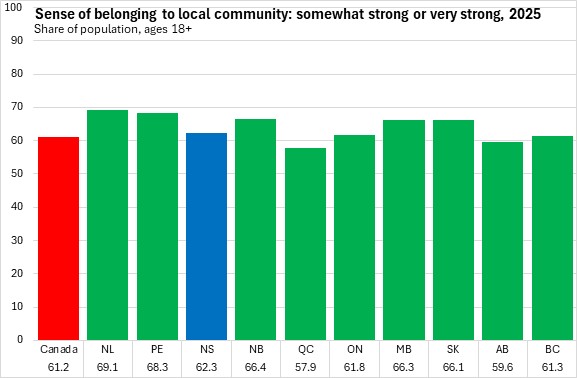
In Nova Scotia, 62.3% reported a somewhat or very strong sense of belonging to their local community, compared with 61.2% nationally. Newfoundland and Labrador reported the highest result and Québec the lowest.
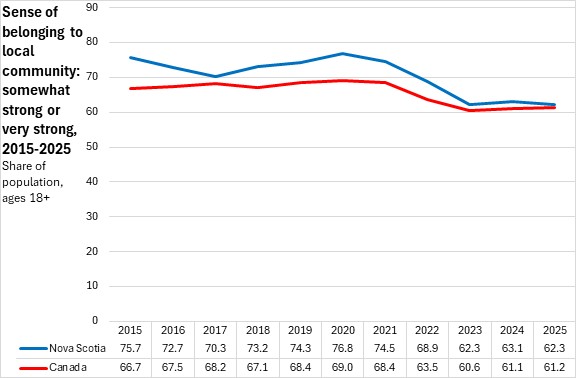
The longer-term series of sense of belonging indicates some recovery after declines through 2023.
Life stress
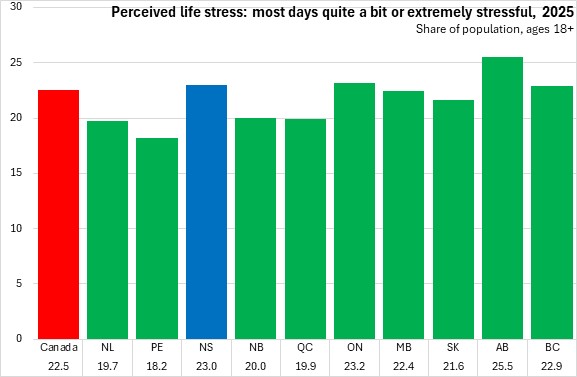
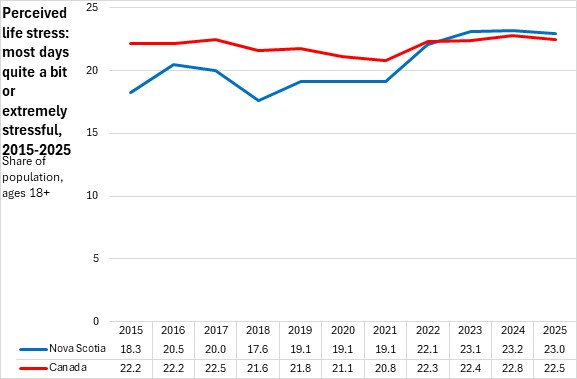
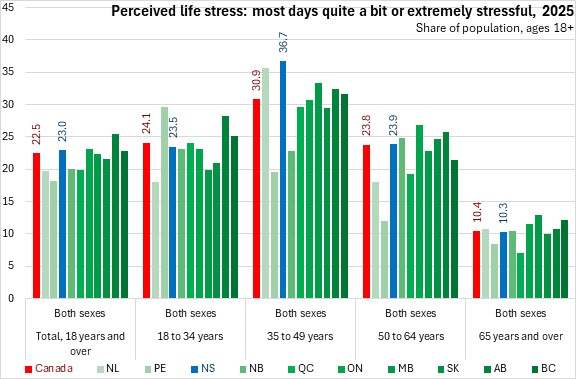
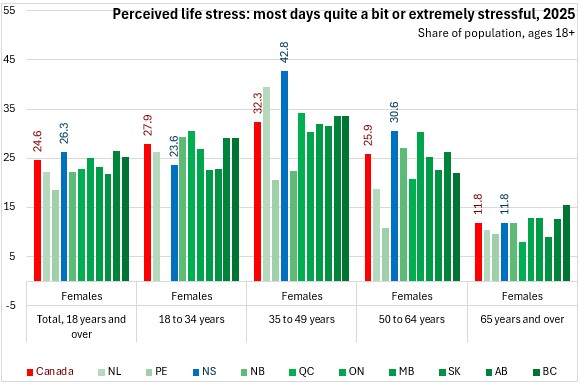
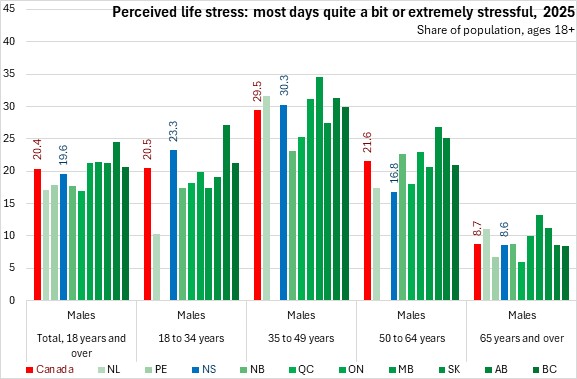
Life stress remains more prevalent in Nova Scotia at 23.0%, compared with 22.5% nationally. Stress was highest among younger and middle-aged Nova Scotians, with particularly high results among females in these age groups; seniors reported substantially lower levels
Life stress rose in Nova Scotia in 2022 and 2023 before that growth moderated.
Life stress was felt most acutely by Nova Scotians aged 35 to 49 and 50 to 64 and quite particularly among females in these age cohorts. Seniors reported lower levels of life stress in Nova Scotia than other age cohorts, though Nova Scotia seniors reported the fourth lowest levels of life stress compared with seniors in other provinces.
![]()
Perceptions of physical and mental health
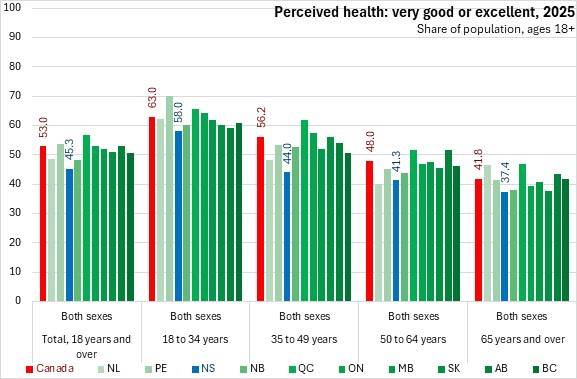
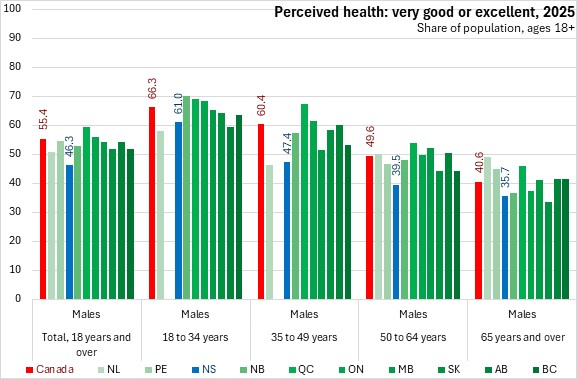
Nova Scotians report less favourable perceptions of their physical health than Canadians overall. The survey's provincial results indicate that Nova Scotia had among the lowest proportions reporting very good or excellent physical health, while Québec reported the highest. The survey finds that perceptions of very good or excellent health decline with age.
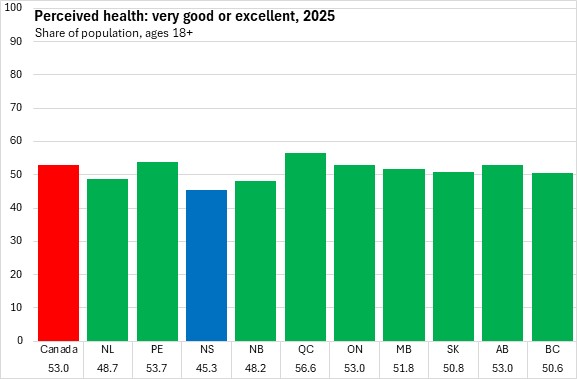
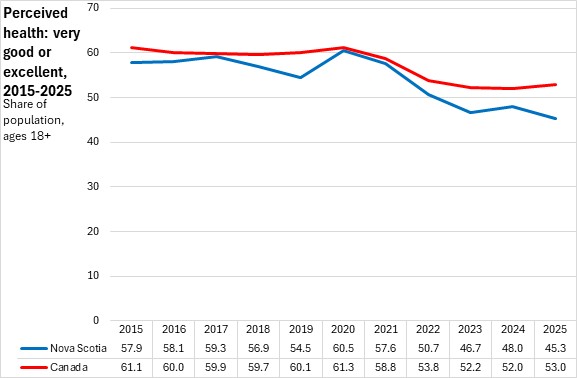
Self-reported physical health has also weakened over time. Nova Scotia experienced a considerable decline from 2020 through 2023 followed by some recovery, while the national measure also declined.
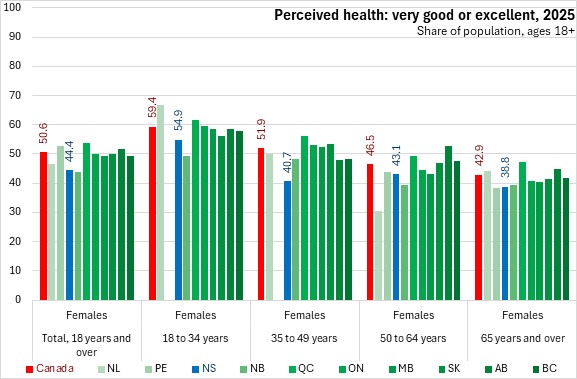
In Nova Scotia, perceptions of very good or excellent physical health declined with age for both females and males.
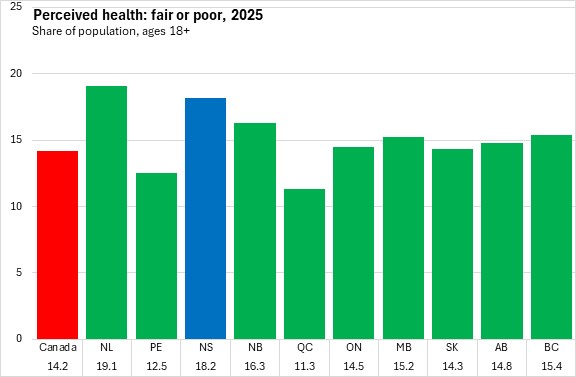
Conversely, 18.2% of Nova Scotians reported fair or poor physical health, compared with 14.2% nationally.
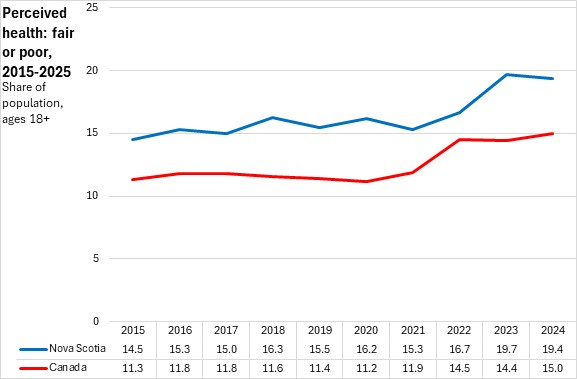
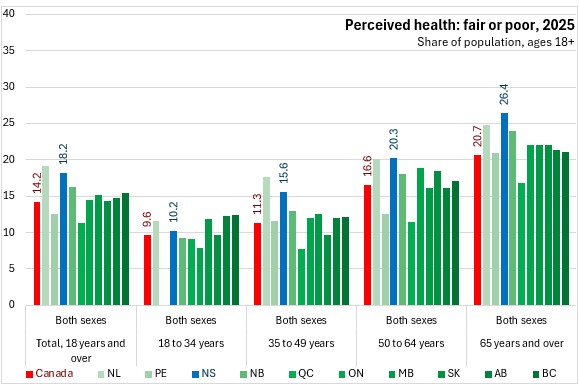
Fair or poor physical health increased substantially with age, with Nova Scotia above the national rate in the older age groups.
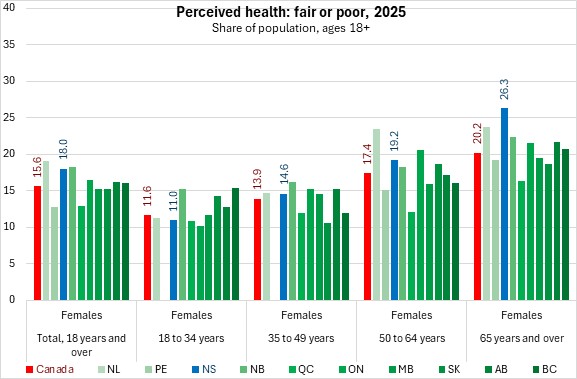
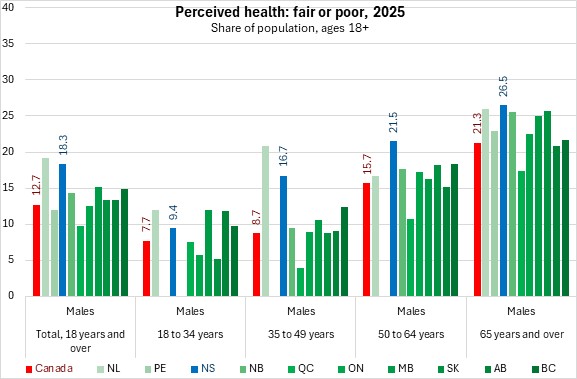
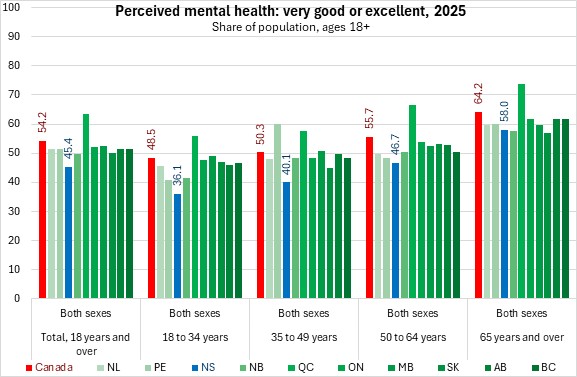
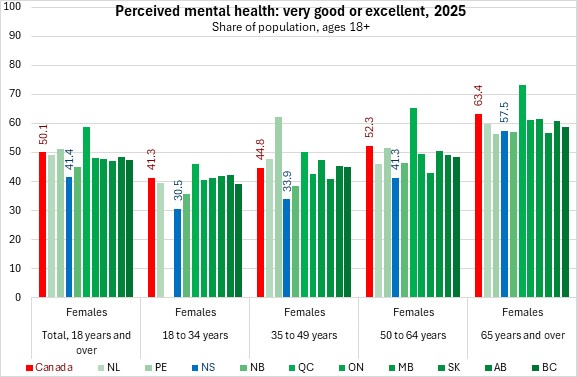
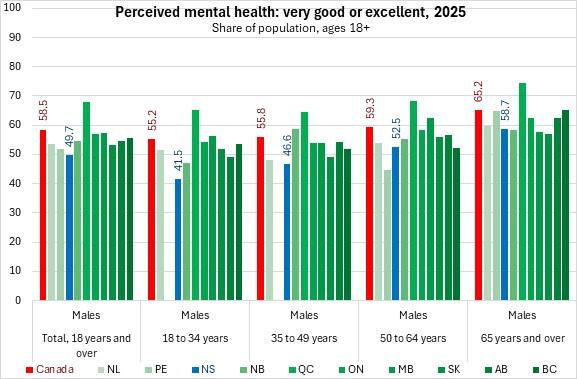
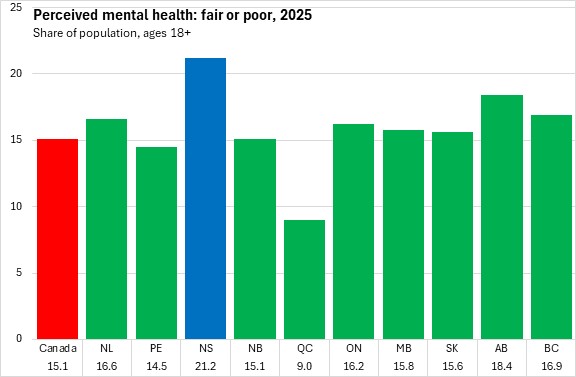
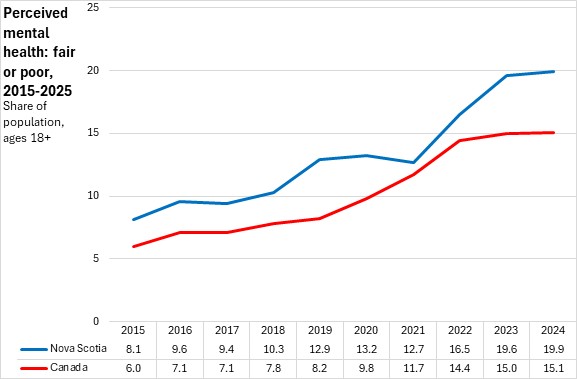
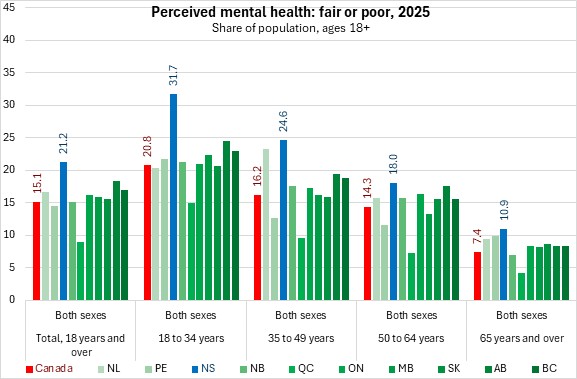
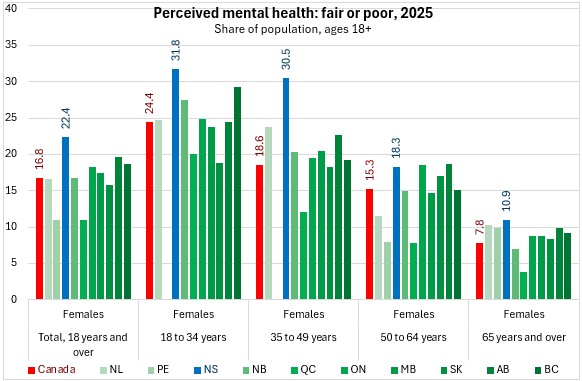
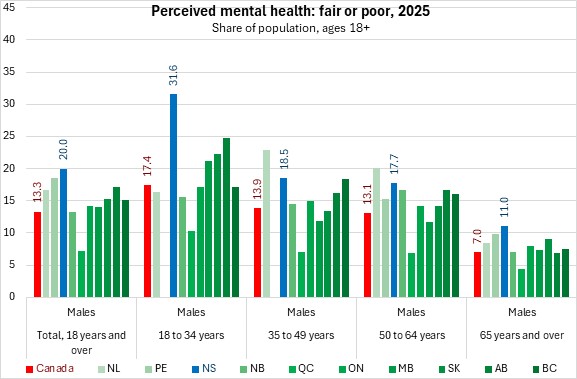
Nova Scotia also reports relatively weak self-perceived mental health. The survey identifies Nova Scotia as having the lowest provincial proportion reporting very good or excellent mental health and the highest proportion reporting only fair or poor mental health.
Perceptions of very good or excellent mental health have generally weakened since 2015. Within Nova Scotia, weaker results are evident among younger adults, particularly females aged 18–34, while seniors report stronger perceptions of mental health.
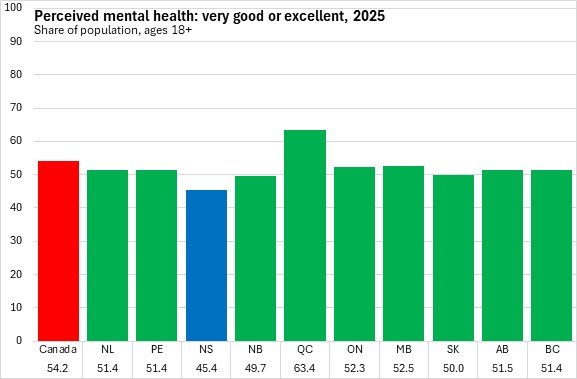
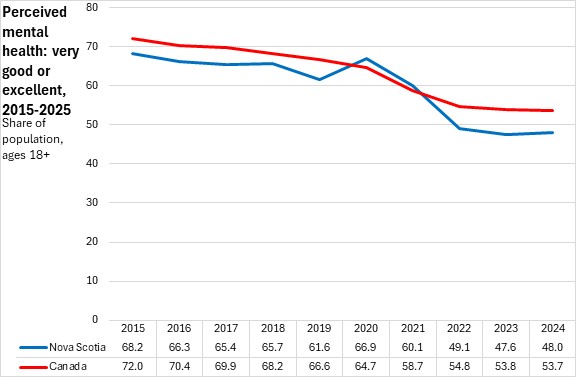
Within Nova Scotia, very good or excellent mental health was lowest among adults aged 18 to 34 and highest among those aged 65 and older.
Health conditions
In 2025, an estimated 1.7% of Nova Scotia's population aged 18 and older reported autism spectrum disorder, compared with 1.2% nationally.
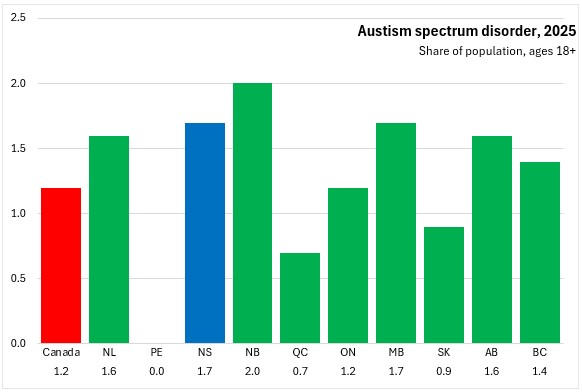
Nationally, the estimate was 3.1% among adults aged 18–34, compared with 0.9% among those aged 35–49, 0.2% among those aged 50–64 and 0.1% among those aged 65 and older.
CCHS results are survey estimates -- a reported estimate of 0.0%, should not be interpreted as evidence that there are no people with autism in that population. Results for smaller populations and detailed demographic groups should be interpreted cautiously.
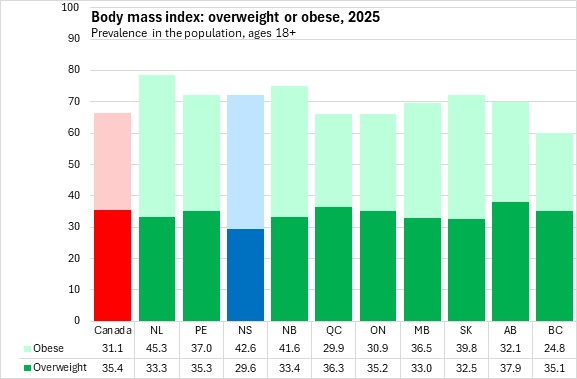
Body mass index increased with age among Nova Scotians, with older age groups more likely to be classified as overweight or obese. While Nova Scotia's prevlance of being overweight (29.6%) is lower than the Canada average (35.4%), its prevlance of obesity (42.6%) is substantially higher.
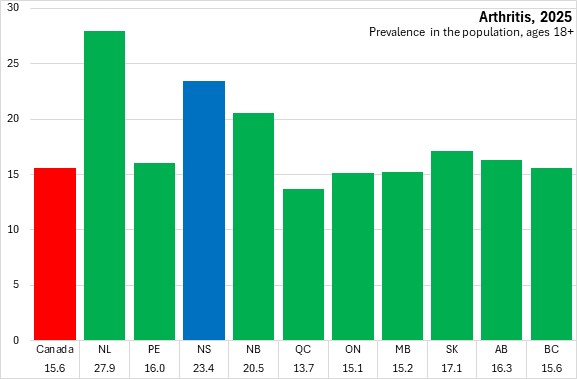
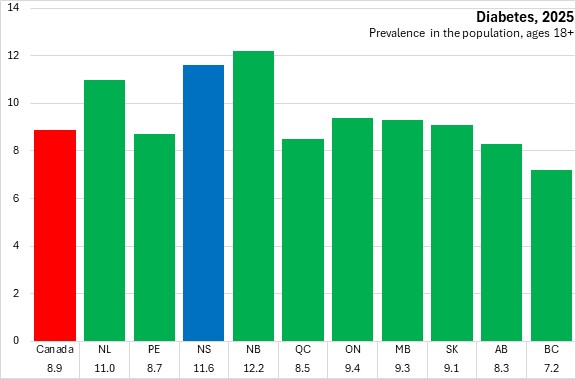
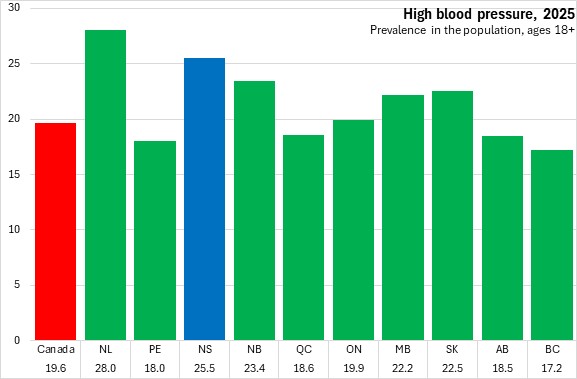
Nova Scotia reports a comparatively high prevalence of several chronic conditions. The survey finds that Nova Scotia has the second-highest provincial prevalence of arthritis among adults, at 23.4%, compared to 15.6% nationally. Diabetes was reported by 11.6% of Nova Scotians compared with 8.9% nationally. Nova Scotia also had the second-highest prevalence of high blood pressure, at 25.5%, above the national average of 19.6%.
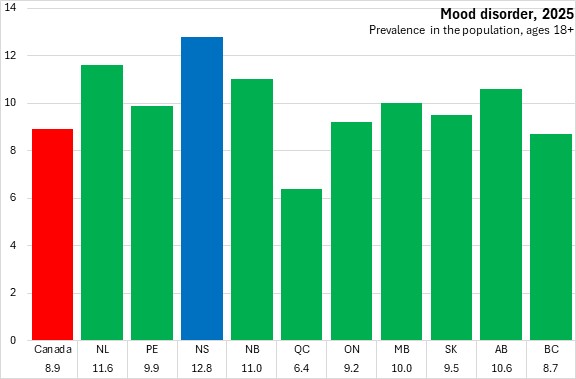
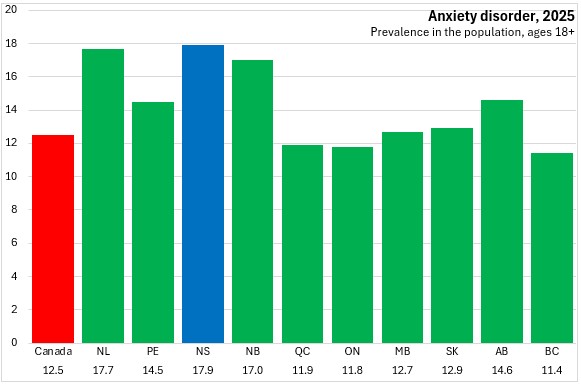
The survey identifies Nova Scotia as having the highest provincial prevalence of reported mood disorders, at 12.8%, compared with 8.9% nationally. Nova Scotia also reported the highest prevalence of anxiety disorder (17.9%), above the national prevalence of 12.5%.
Healthy behaviours
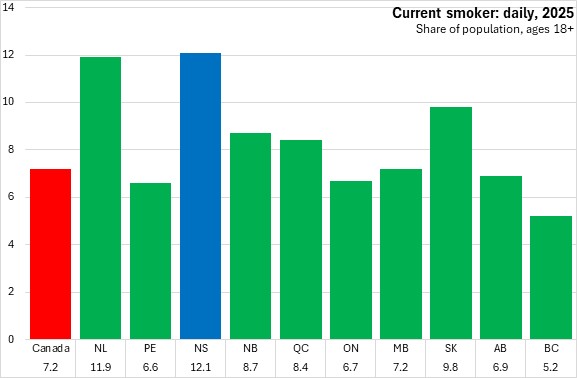
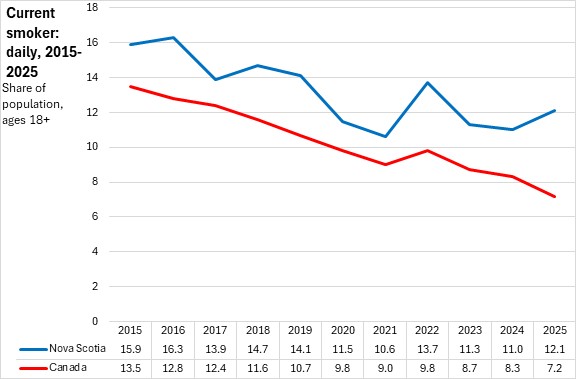
Nova Scotia had the highest proportion of daily smokers among provinces, at 12.1%, compared with 7.2% nationally. Smoking rates have nevertheless generally trended downward.
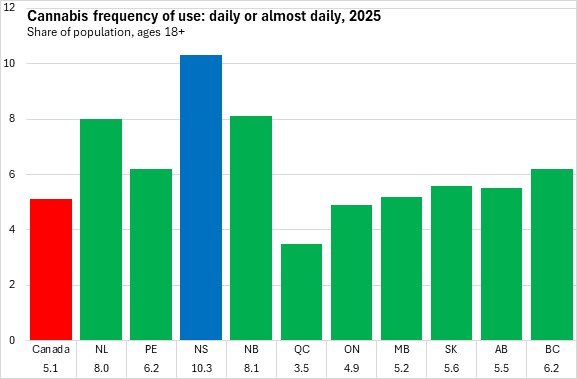
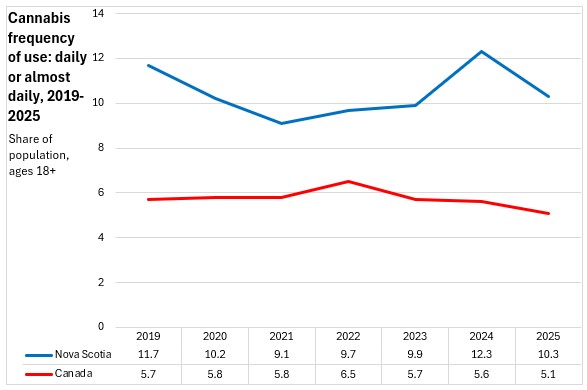
Nova Scotia also reported the highest prevalence of daily cannabis use, at 10.3%, compared with 5.1% nationally. Daily cannabis use in Nova Scotia has increased in each year since 2021, however, 2025 saw a slight decline.
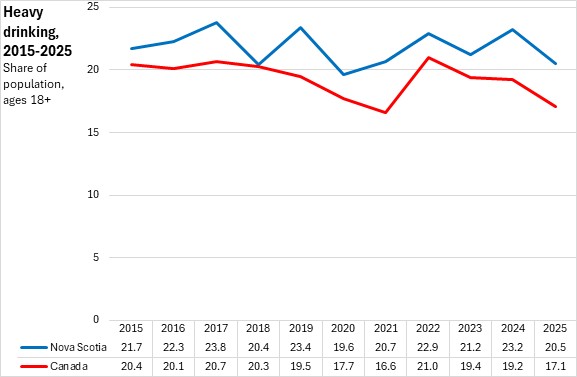
Nova Scotia reported a higher incidence of heavy drinking, at 20.5%, compared to Canada overall. Newfoundland and Labrador recorded still higher results.
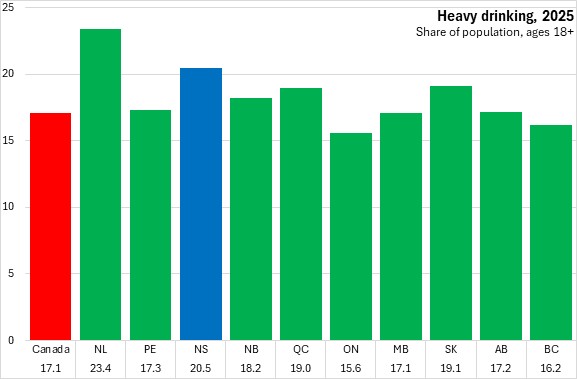
Heavy drinking was down in Nova Scotia and Canada last year.
Source: Statistics Canada. Table 13-10-0905-01 Health indicator statistics, annual estimates; Table 13-10-0906-01 Health indicator statistics, annual estimates, by household income quintile and highest level of education
<--- Return to Archive


