The Economics and Statistics Division maintains archives of previous publications for accountability purposes, but makes no updates to keep these documents current with the latest data revisions from Statistics Canada. As a result, information in older documents may not be accurate. Please exercise caution when referring to older documents. For the latest information and historical data, please contact the individual listed to the right.
<--- Return to Archive
For additional information relating to this article, please contact:
November 09, 2026FEDERAL BUDGET 2027-28 Canada's Federal government has tabled its 2027-28 Budget on November 5, 2026.
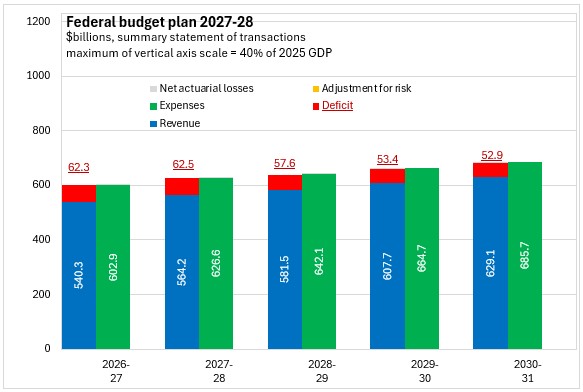
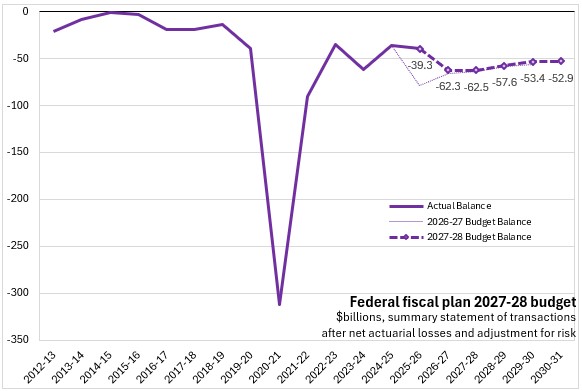
The Federal Budget deficit for 2027-28 (summary statement of transactions) is projected to be $62.5 billion, slightly up from $62.3 billion now forecast for 2026-27. Revenues are projected to rise by 4.4% while expenditures grow by 3.9%. Although revenue growth is projected to outpace rising expenditures over the entire fiscal planning horizon, the Federal government anticipates Budgetary deficits in each year through to 2030-31.
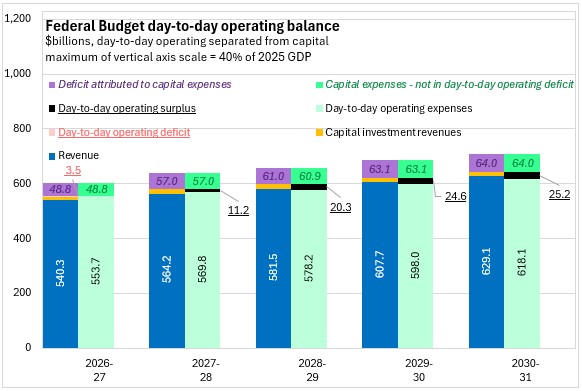
The 2027-28 Federal Budget distinguishes capital investments from day-to-day operating expenses. These capital investments include capital grants and transfers, capital-focused tax incentives, amortization of Federal capital assets, support for private sector research and development, support to unlock large-scale private sector capital investments and measures to grow the housing stock. Outside of these expenditures (and adjusting for any revenues associated with capital investment), the Federal Budget's day-to-day operations are projected to have a surplus of $11.2 billion in 2027-28, rising to $20.3 billion in 2028-29 and expected to rise over the entire fiscal planning horizon. The Federal deficit over the fiscal planning horizon is associated with capital expenditures.
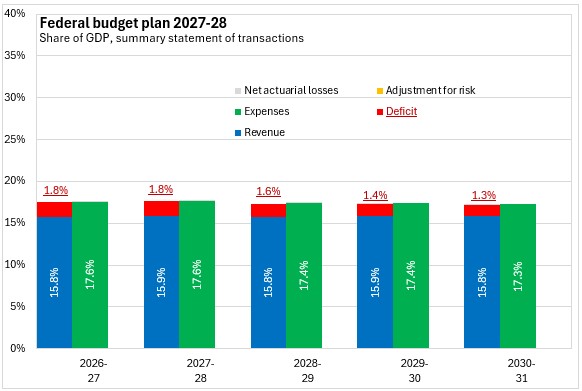
Measured as a share of GDP, the footprint of the Federal government in the Canadian economy amounts to 17.6% of GDP in 2027-28. This is projected to shrink slightly to 17.2% of GDP by 2030-31.
Canada's federal deficit (summary statement of transactions) for 2027-28 amounts to 1.8% of 2027 nominal GDP.
Canada's Federal debt as a percentage of GDP is expected to rise to 40.2% in 2027-28 (up from 39.9% in 2026-27) and then to peak at 40.4% in 2028-29 before contracting to 40.1% by 2030-31.
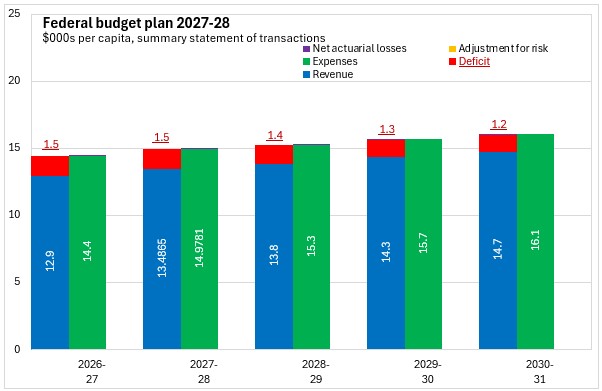
Federal Budget expenditures from the summary statement of transactions amount to $14,978 per capita in 2027-28 (assuming Canada's population grows at the same pace as reported in Statistics Canada's M1 medium population growth scenario), funded by $13,487 per capita in revenues and a deficit of $1,494 per capita.
Comparing the fiscal plan from the 2026-27 Federal Budget with that from the 2027-28 Federal Budget, revenues are projected to be $22.5 billion higher for 2027-28 than planned at this time last year. Federal expenditures (summary statement of transactions, before net actuarial losses) are projected to be $22.9 billion higher for 2027-28 than planned at this time last year.
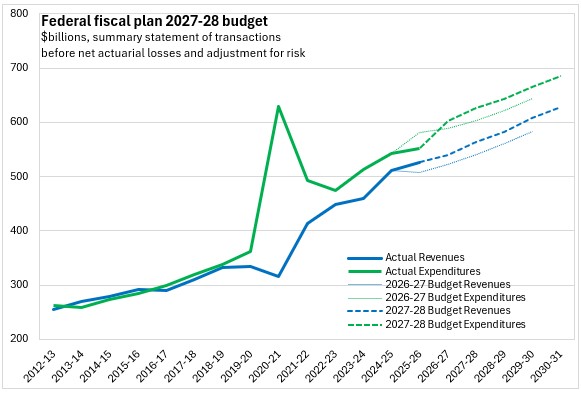
The 2027-28 Budget plan included slightly faster narrowing of the deficit than was anticipated in the 2026-27 Federal Budget.

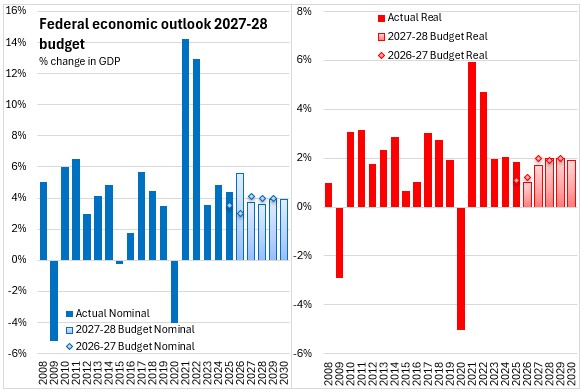
US tariffs and related trade actions have modestly lowered Canada's near-term growth outlook. The Federal Budget assumes weak real growth but strong nominal growth, driven by higher inflation in 2026 (1.0% real, 5.6% nominal) and 2027 (1.7% real, 3.7% nominal).
Tariffs and trade policy uncertainty are expected to persist, with some easing but no return to the low-tariff environment of previous decades. Resilient domestic demand and strong energy exports should continue to support activity. Business investment is expected to be supported by investment incentives such as the Productivity Mega Deduction. AI adoption is expected to support productivity. Higher oil price assumptions for 2026 to 2028, reflecting a prolonged Middle East conflict, are expected to affect mainly inflation and nominal income. CPI inflation is projected to stay at or above the top of the target range until the second quarter of 2027, averaging 2.8% in 2026 and 2.2% in 2027, with the Bank of Canada expected to raise its policy rate by two 25-basis-point increases over the next year and then hold it steady.
Key Measures and Initiatives
Canada's 2027-28 Federal Budget prioritizes capital investments, productivity/economic growth, security/defence spending, bringing down costs while reducing the size and cost of Federal public administration. Key measures include:
- The 10% public-service reduction is retained, but the earlier savings figures ($13 billion annually by 2028-29 and $60 billion over five years) are replaced by a limit on program-spending growth and an earlier operating-balance target
- Fast-tracking nation-building project is retained and now specifies the number of initiatives, investment value, expected construction jobs and the streamlined review approach
- Trade Diversification and Infrastructure Strategies are retained, with a $6.6-billion allocation, a 2035 export target and a broader market-access goal
- The $115-billion five-year framing is replaced by a 10-year fund-specific allocation with ongoing annual funding and specified infrastructure categories
- Buy Canadian Policy to support domestic supply chains, leveraging approximately $37 billion in annual federal procurement.
- Implementing a $7.7 billion Defence Industrial Strategy to grow the defence sector, increasing the defence-sector workforce from approximately 38,000 to 89,000 and raising the share of defence acquisitions awarded to Canadian firms to 70%.
- The Productivity Super-Deduction becomes the permanent Productivity Mega Deduction, with full and immediate expensing and estimated GDP and employment effects.
- Maintaining GST relief for first-time homebuyers purchasing newly built homes through the First-Time Home Buyers’ GST Rebate, which can provide savings of up to $50,000 on a qualifying new home.
- Expanding Build Canada Homes, launched in September 2025 and now a Crown corporation, to accelerate housing delivery.
- Continuing the National School Food Program as an ongoing part of the federal affordability framework, reducing grocery costs for families of more than 400,000 children.
- Expanding automated federal benefits through Automatic Federal Benefits, which is intended to help up to 5.5 million low-income Canadians receive benefits for which they qualify..
- Encouraging made-in-Canada artificial intelligence tools through Digital Transformation Canada, launched in September 2026, including deployment of Cohere technology across the public service
- Enhancing Canada Groceries and Essentials Benefit with a 50% top-up in the new year
- Delivering a $2-billion investment to retrofit 1 million homes to save Canadians more than $1 billion per year in heating and cooling costs
- Making the Canada Caregiver Credit fully refundable to provide up to $1,260 to all eligible Canadians who are caring for a loved one
- Strengthening support for workers so they can keep more money in their pockets through the Build Canada Workers Benefit which would now provide up to $1,859 to individuals and $3,143 to families
- Building a housing market that works for all Canadians through an investment of $45 billion to build homes faster and more efficiently
- Recruiting skilled workers and talent through Team Canada Strong, which aims to recruit, train and hire up to 100,000 Red Seal workers, supported by six Workforce Alliances and skills-development opportunities
Canada Federal Budget 2027-28
<--- Return to Archive


