The Economics and Statistics Division maintains archives of previous publications for accountability purposes, but makes no updates to keep these documents current with the latest data revisions from Statistics Canada. As a result, information in older documents may not be accurate. Please exercise caution when referring to older documents. For the latest information and historical data, please contact the individual listed to the right.
<--- Return to Archive
For additional information relating to this article, please contact:
April 16, 2026NEW MOTOR VEHICLE SALES, FEBRUARY 2026 Year-to-date (January-February 2026 vs January-February 2025)
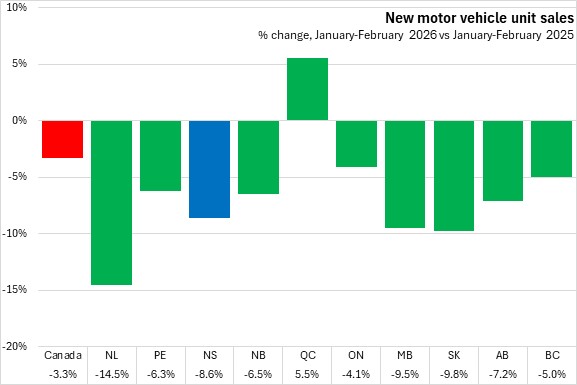
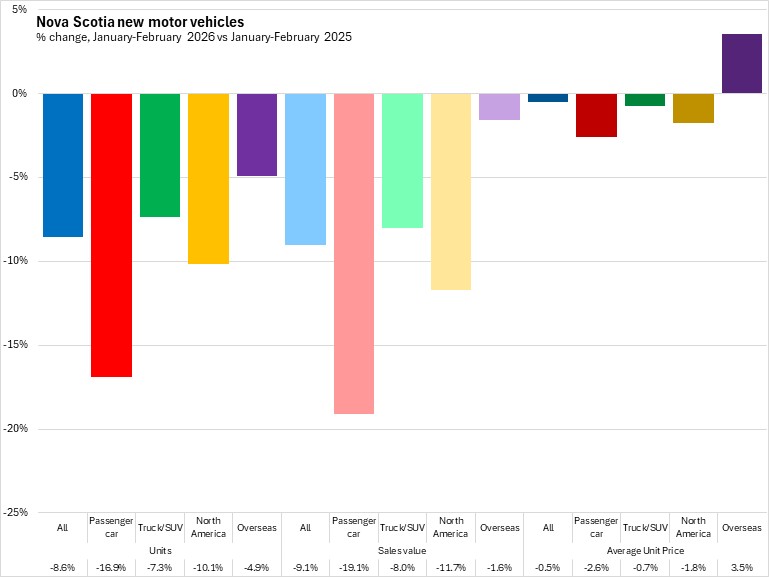
Compared with January-February 2025, Nova Scotia unit sales of new vehicles declined 8.6%. National unit sales were down 3.3% with unit sales down in all provinces except Québec. The fastest decline was reported in Newfoundland and Labrador.
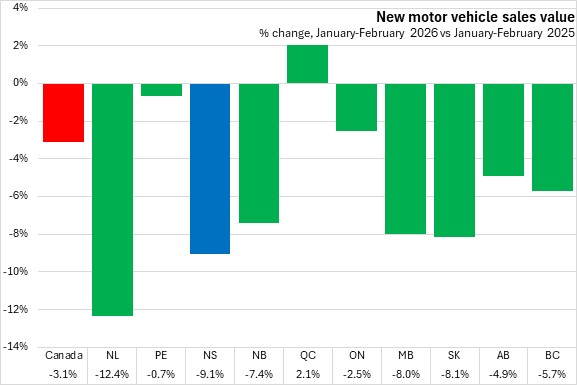
The sales values of new vehicles decreased 9.1% in Nova Scotia in January-February 2026, the second fastest decline among provinces behind Newfoundland and Labrador. National sales values were down 3.1% with declines in all provinces except Québec.
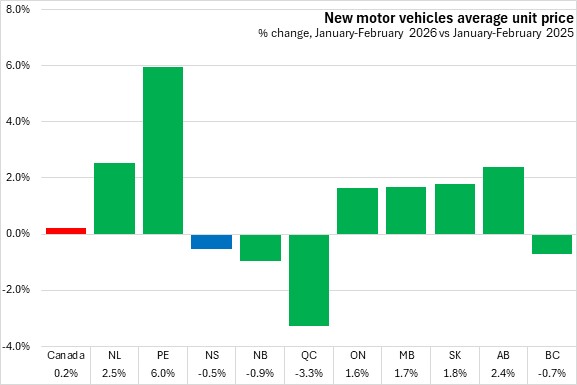
Compared to January-February 2025, average unit prices were down 0.5% in Nova Scotia in the first two months of 2026. National average unit prices were up 0.2% with gains in six provinces led by Prince Edward Island. Québec reported the largest decline in average unit prices.
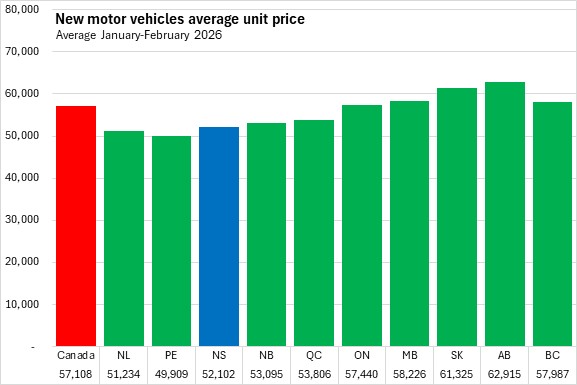
The average price of a new vehicle in the first two months of 2026 was $51,102 in Nova Scotia - second lowest among provinces ahead of Prince Edward Island. Nationally, the average price of a new vehicle was $57,108, with the highest value in Alberta.
Compared with January-February 2025, unit sales and sales values were down notably faster for passenger cars compared to other vehicle types. Average sales prices were down for all manufacturing types, except for overseas manufacturers.
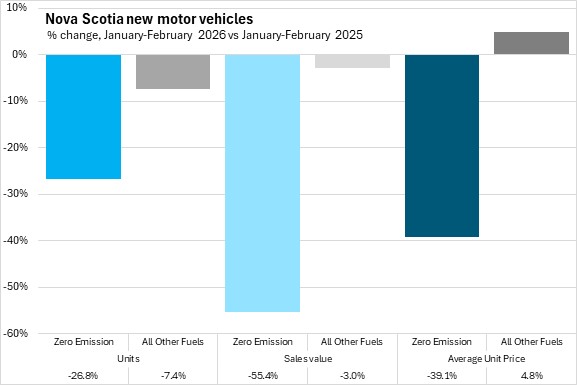
Zero emission vehicle unit sales were down 26.8% in the first two months of 2026 compared with the same period of 2025, while sales values fell 55.4% and average prices fell 39.1%. Other fuel type vehicles, which account for the majority of vehicles sold, saw unit sales decline 7.4% while sales values declined 3.0%, with average unit prices for other fuel type vehicles up 4.8%.
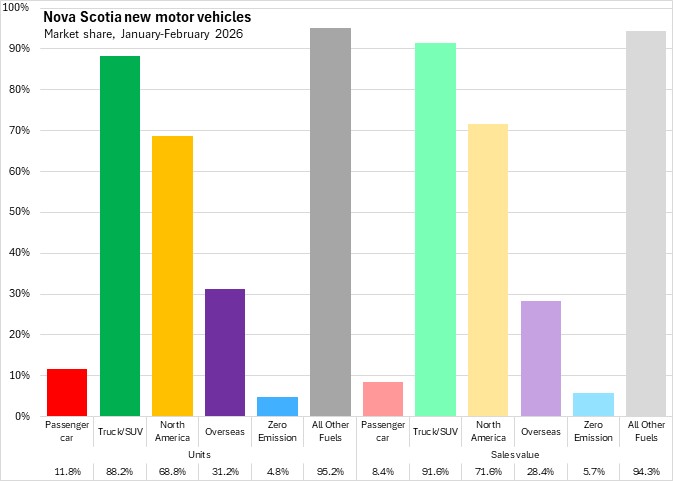
In January-February 2026, trucks/SUVs accounted for 88.2% of unit sales and 91.6% of sales values. North American manufacturers accounted for 68.8% of Nova Scotia's unit sales and 71.6% of sales values in January-February 2026. Zero emission vehicles made up 4.8% of unit sales, and 5.7% of sales values, while all other fuel types accounted for 95.2% of unit sales and 94.3% of sales values.
Year-over-year (February 2026 vs February 2025)
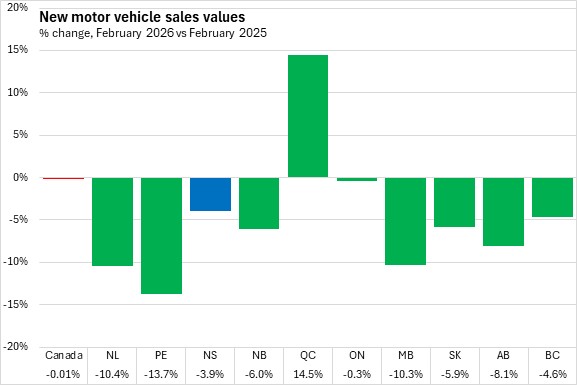
Compared with February 2025, Nova Scotia unit sales of new vehicles declined 4.6%. National unit sales were down 0.9% with declines in all provinces except Québec. The fastest decline was in Prince Edward Island.
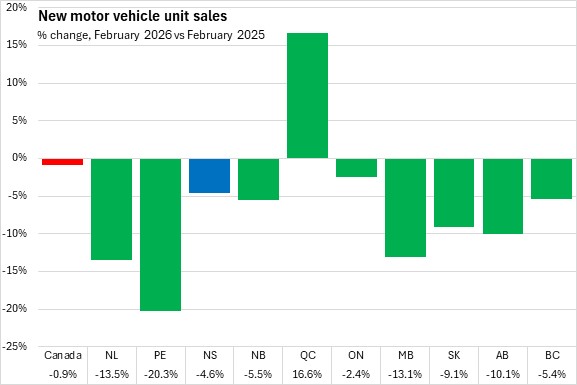
The sales values of new vehicles decreased 3.9% in Nova Scotia in February 2026. National sales values edged down 0.01% with declines in all provinces except Québec. The fastest decline was in Prince Edward Island.
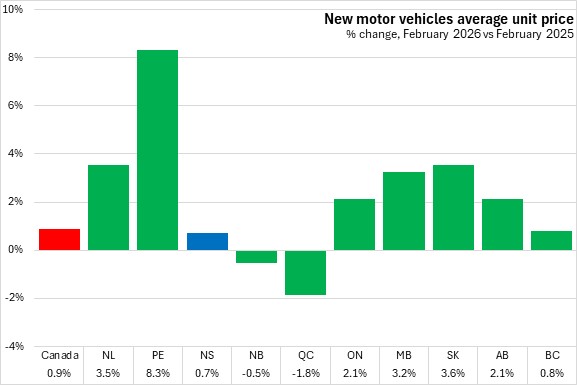
Compared to February 2025, average unit prices were up 0.7% in Nova Scotia in February 2025. National average unit prices were up 0.9% with gains in eight provinces led by Prince Edward Island. Québec reported the largest decline in average unit prices.
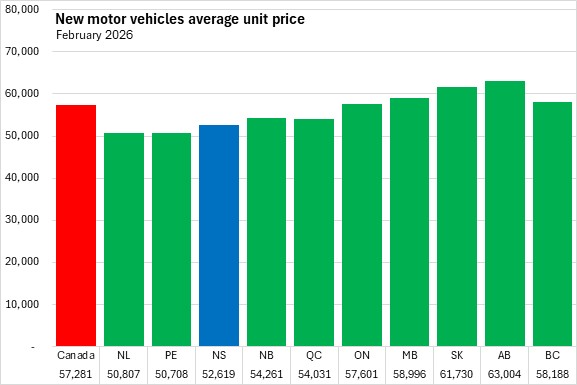
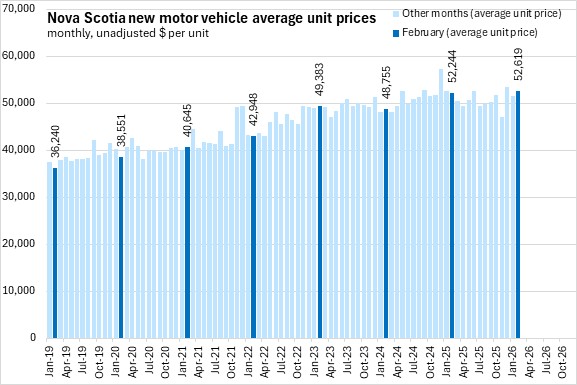
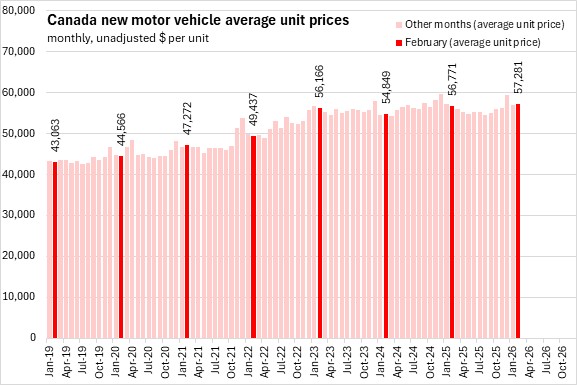
The average price of a new vehicle in February 2026 was $52,619 in Nova Scotia - third lowest among provinces ahead of Prince Edward Island and Newfoundland and Labrador. Nationally, the average price of a new vehicle was $57,281, with the highest value in Alberta.
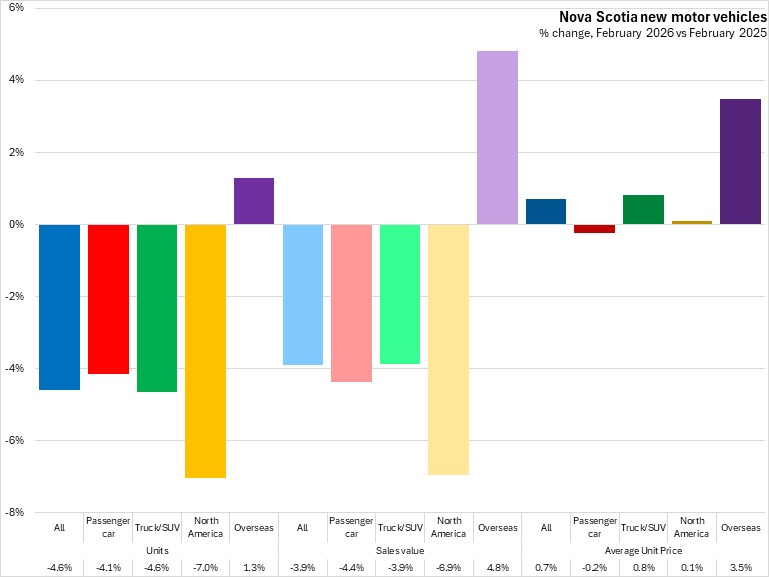
Compared with February 2025, unit sales and sales values were down notably faster for North American manufactured cars compared to other vehicle types. Overseas unit sales and sales values were up, with sales value outpacing unit sales. Average sales prices were up for all manufacturing types, except for passenger cars, with the fastest growth for overseas vehicles.
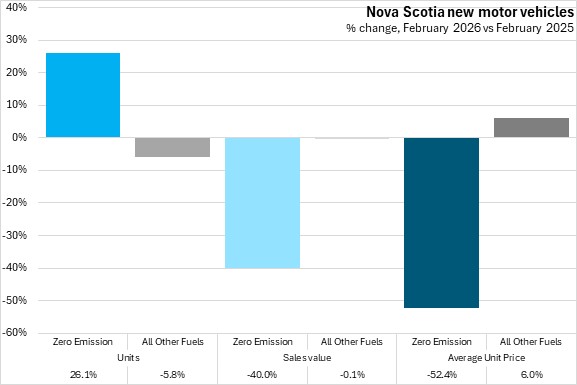
Zero emission vehicle unit sales were up in the February 2026 compared with February 2025, while sales values fell. There was a notable decline of 52.4% in average unit prices for zero emission vehicles. Other fuel type vehicles, which account for the majority of vehicles sold, saw unit sales decline fastest than sales values, with average unit prices for other fuel type vehicles up 6.0%.
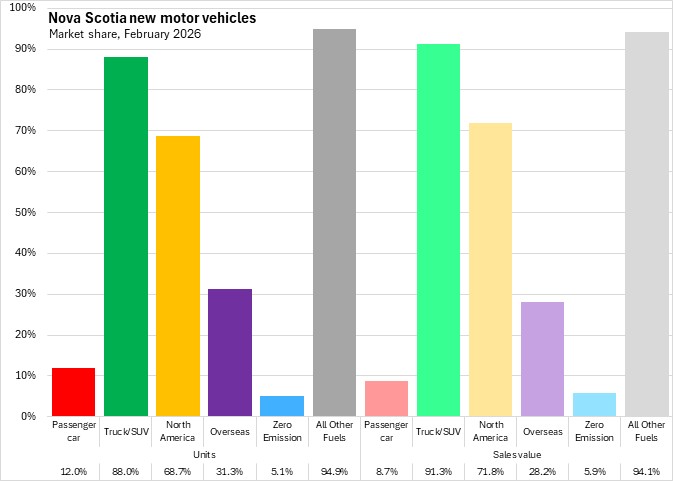
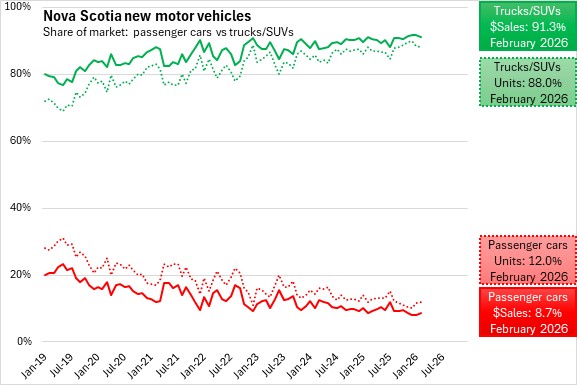
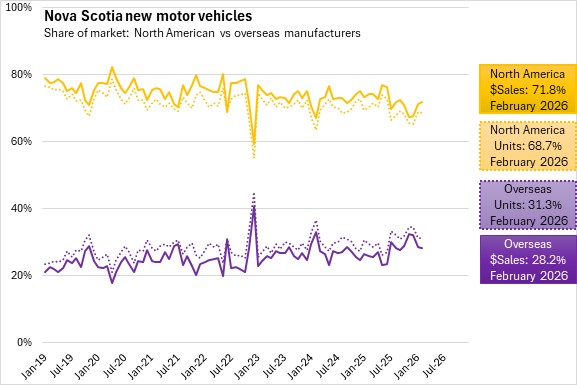
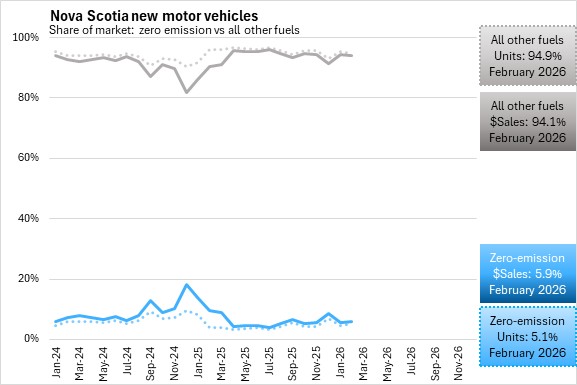
In February 2026, trucks/SUVs accounted for 88.0% of unit sales and 91.3% of sales values. North American manufacturers accounted for 68.7% of Nova Scotia's unit sales and 71.8.% of sales values in February 2026. Zero emission vehicles made up 5.1% of unit sales, and 5.9% of sales values, while all other fuel types accounted for 94.9% of unit sales and 94.1% of sales values.
Trends
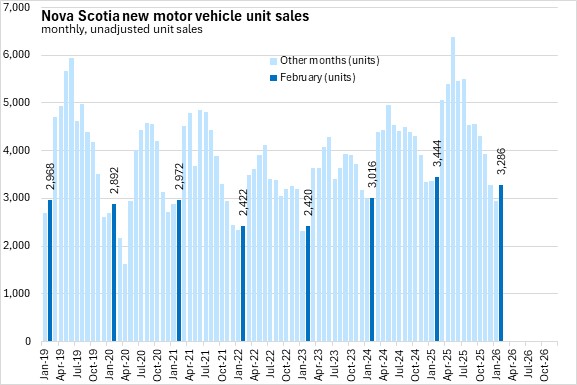
Nova Scotia's unit sales of 3,286 in February 2026 was slightly lower than the same month in 2025, but above the same month in previous years.
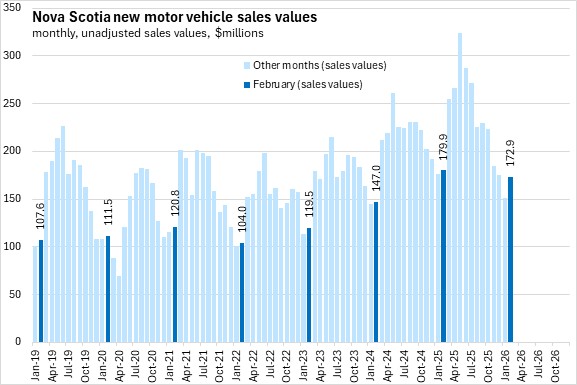
Sales value of $172.9 million was below the same month in 2025, but above the same month in previous years.
Average unit price in February 2026 was higher than in same month in previous years.
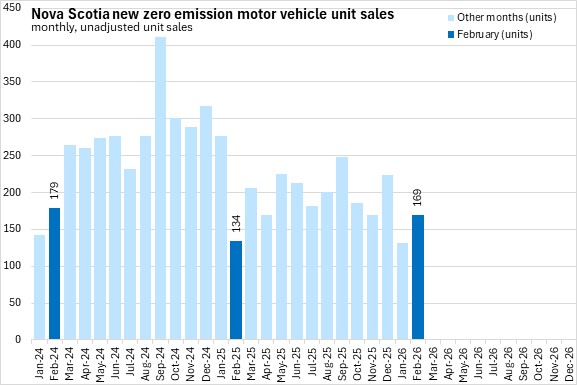
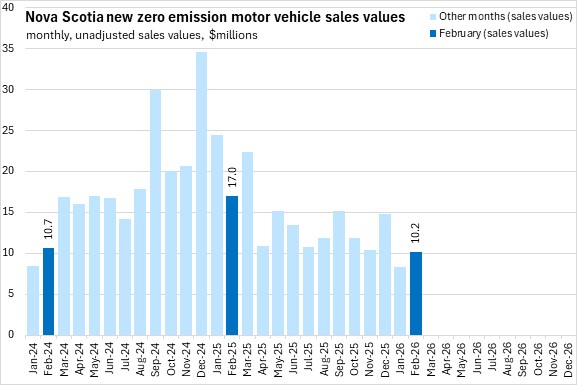
Zero-emission vehicles are currently a small share of the new motor vehicle market in Nova Scotia. Due to the small number of vehicles sold, there can be volatility in the year-over-year or year-to-date comparisons for unit sales, sales value and average prices. Nova Scotia zero-emission vehicle sales values were down compared to February 2025 and 2024, while unit sales were down compared to February 2024 but up compared to February 2025.
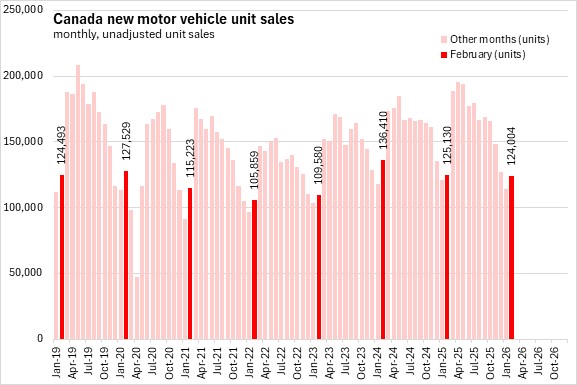
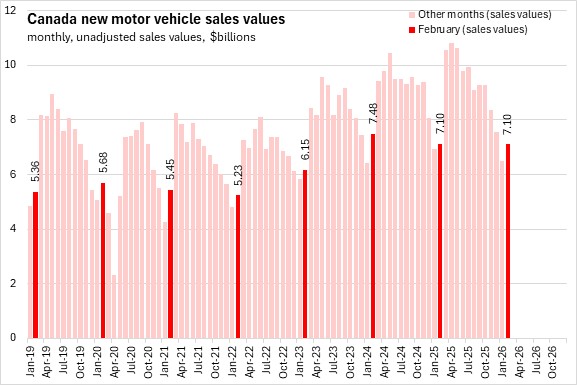
Across Canada, national unit sales were below the same month in 2025 and 2024, but above comparable months between 2021 and 2023.
National sales values for February 2026 were virtually the same as the values in February 2025, but above other comparable months in recent history (with the exception of 2024).
February 2026 average unit prices were above any comparable month in recent history.
There has been a steady trend of increasing market share for trucks/SUVs while the market share of passenger cars declines. This trend has become less volatile in recent months.
Over the last twenty years, there has been a slow decline in market share for North American manufacturers while overseas manufacturers' market share has risen.
The market share for new zero-emission vehicles peaked at the end of 2024 and has since declined
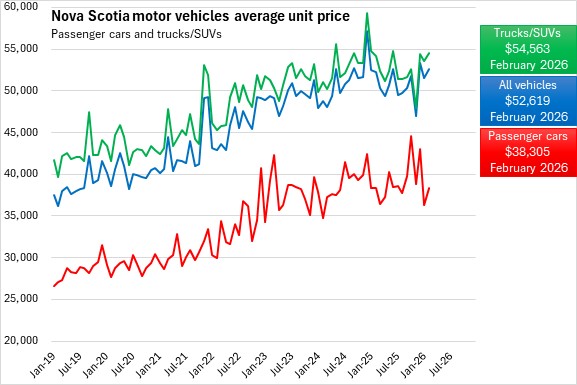
Prices for trucks/SUVs (the bulk of the market) have fallen from their recent peaks at the end of 2024. Prices for passenger cars posted a small recovery in February following a sharp decline in January 2026.
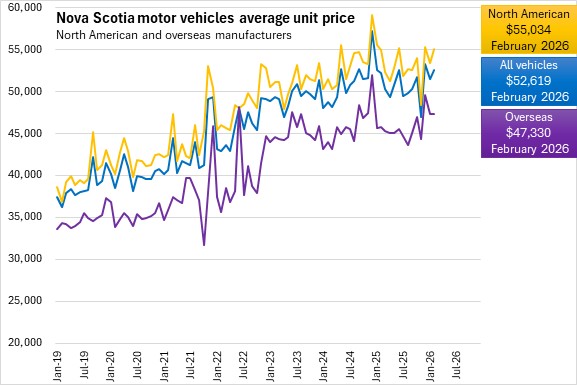
Prices for vehicles from North American manufactures remain above average prices for overseas manufacturers.
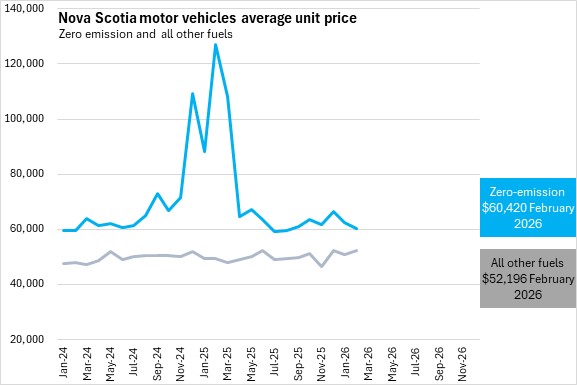
Average prices for zero-emission vehicles rose sharply in late 2024 and subsequently fell below previous levels by July 2025. Average price for zero-emission vehicles remain below late 2024 and early 2025 levels. The low overall number of zero emission vehicles sold in Nova Scotia (169 in February 2026) can lead to volatility in prices.
Source: Statistics Canada. Table 20-10-0001-01 New motor vehicle sales
<--- Return to Archive


