The Economics and Statistics Division maintains archives of previous publications for accountability purposes, but makes no updates to keep these documents current with the latest data revisions from Statistics Canada. As a result, information in older documents may not be accurate. Please exercise caution when referring to older documents. For the latest information and historical data, please contact the individual listed to the right.
<--- Return to Archive
For additional information relating to this article, please contact:
January 05, 2026HEALTH CARE ACCESS AND INDICATORS, 2024 Statistics Canada carried out a new Survey on Health Care Access and Experiences in 2024. Recently released results show the wait time for an initial consultation with a medical specialist after patient/physician decisions to seek specialist care. Respondents were also asked about chronic health conditions, use of regular/primary/specialist health care providers, discrimination, unmet health care needs and pharmaceuticals. Data for Canada excludes the territories.
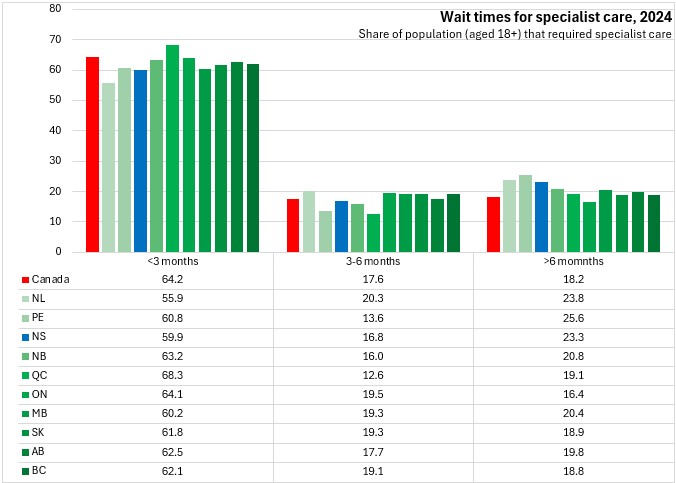
In 2024, 59.9% of Nova Scotians that required specialist care received an initial consultation within 3 months. A further 16.8% of Nova Scotians requiring specialist care had an initial consultation within 3 to 6 months while 23.3% waited longer than 6 months.
Nationally, 64.2% of those that required specialist care had an initial consultation within 3 months, with the highest share in Québec and the lowest share in Newfoundland and Labrador. Across Canada, 18.2% of those requiring specialist care waited longer than 6 months for an initial consultation (highest: Prince Edward Island, lowest: Ontario).
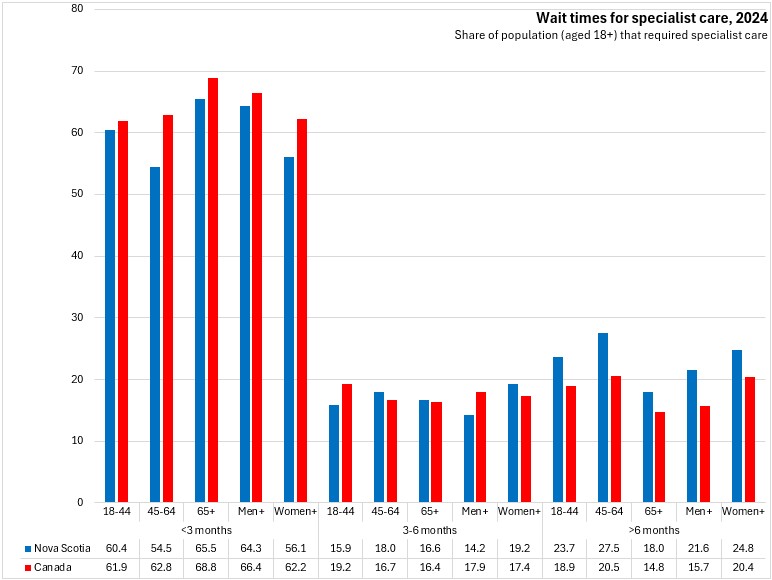
For all age and gender cohorts in Nova Scotia, the portions receiving initial specialist consultation within 3 months were below national averages for the same cohorts. Likewise, the portions of Nova Scotians waiting longer than 6 months for initial specialist consultations were above national averages for all age and gender cohorts.
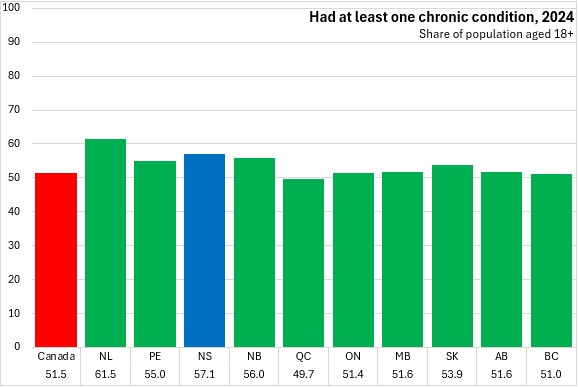
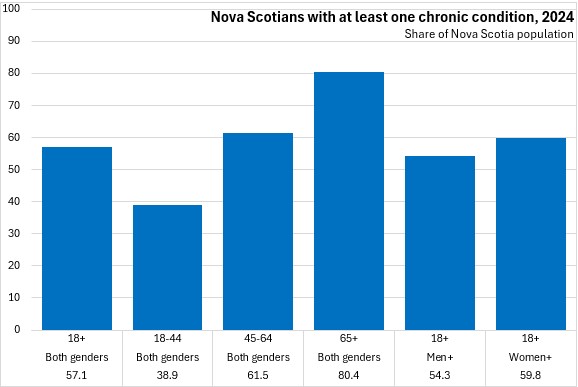
In Nova Scotia, 57.1% of the population indicated having at least one chronic medical condition in 2024. This was the second highest prevalence of chronic conditions after Newfoundland and Labrador. Nationally, 51.5% of the population reported having at least one chronic condition with the lowest share in Québec.
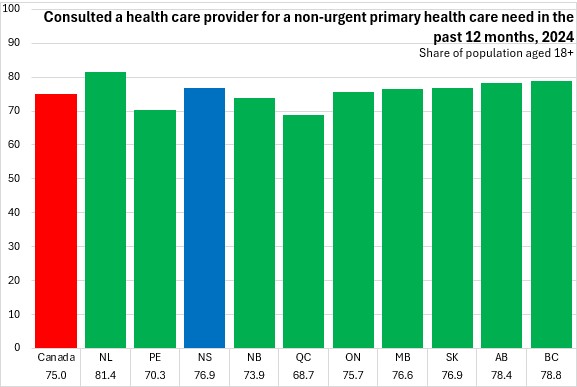
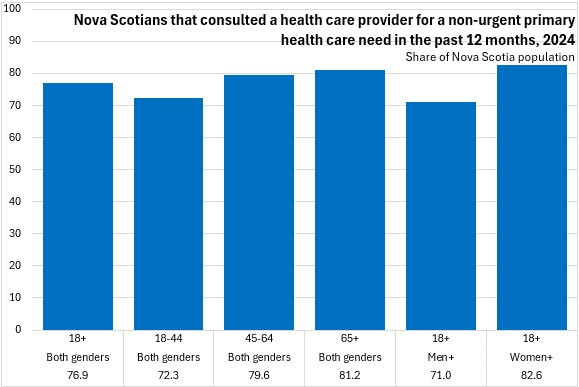
In 2024, 76.9% of Nova Scotians aged 18+ sought non-urgent health care from a primary provider - just above the national average (75.0%). Newfoundland and Labrador reported the highest share of the population that sought non-urgent primary care while Québec reported the lowest share.
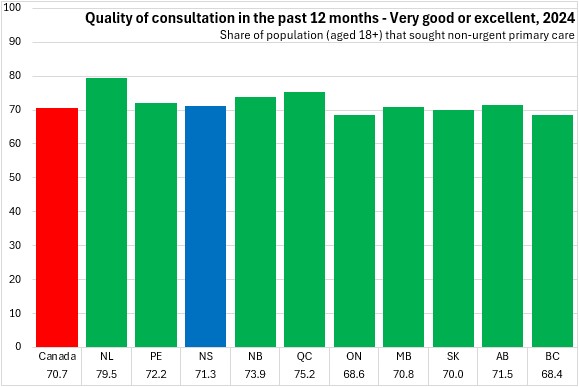
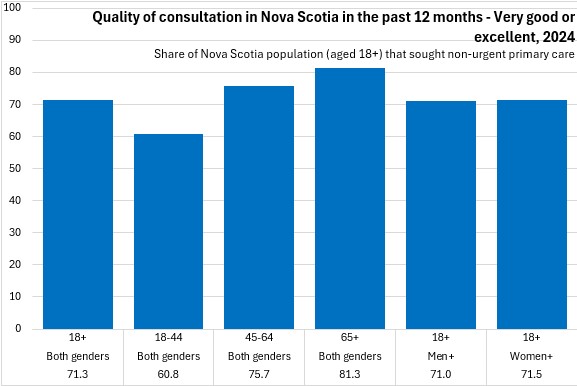
Of those Nova Scotians that sought non-urgent primary care, the majority (71.3%) reported the quality of consultation was very good or excellent, which was above the national average (70.7%). Those in Newfoundland and Labrador reported the highest share that felt quality of consultation was very good or excellent. Patients in Ontario and British Columbia reported the lowest shares that felt consultations were very good or excellent.
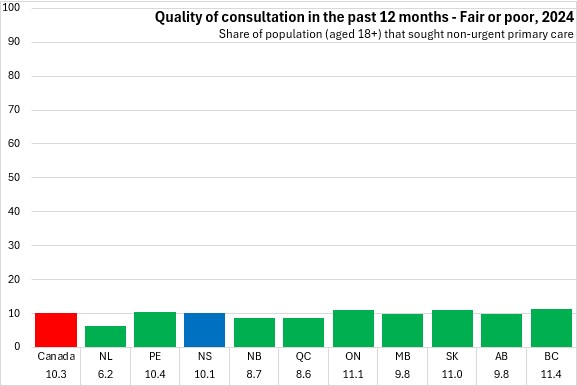
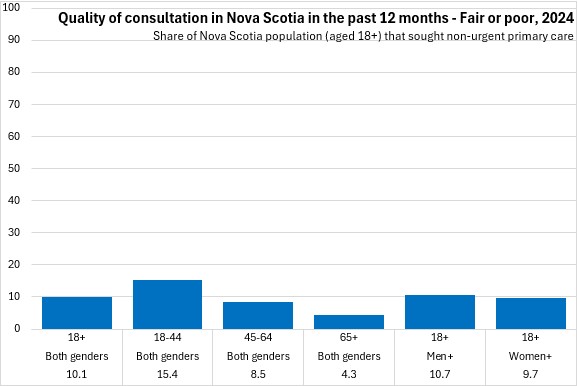
Just 10.1% of Nova Scotians seeking non-urgent primary care reported fair or poor quality consultation, which was similar to the national average (10.3%). Fair/poor quality consultations were reported least frequently in Newfoundland and Labrador and most frequently in Ontario, Saskatchewan and British Columbia.
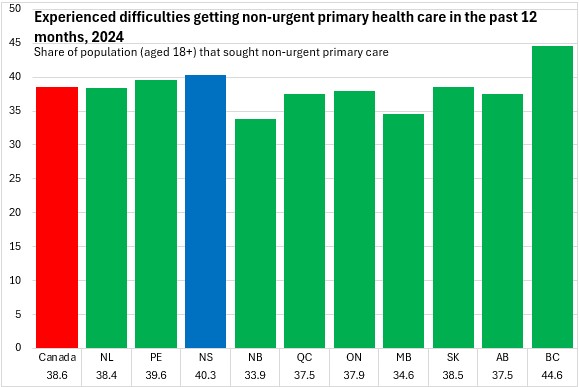
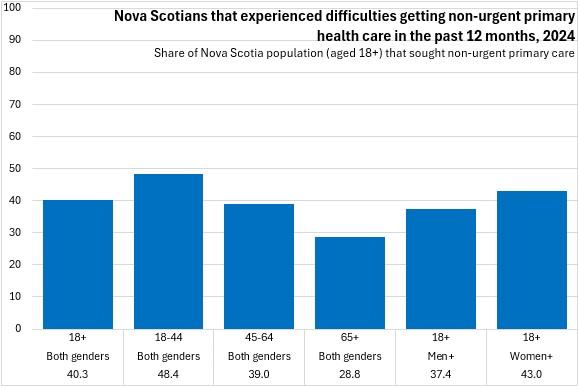
In Nova Scotia, 40.3% of the population reported difficulties getting non-urgent primary care in 2024 - the second highest share after British Columbia. Nationally, 38.6% of patients reported difficulty getting non-urgent primary care with the lowest shares in New Brunswick and Manitoba.
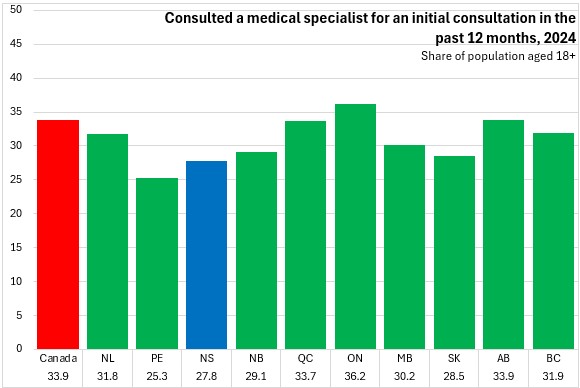
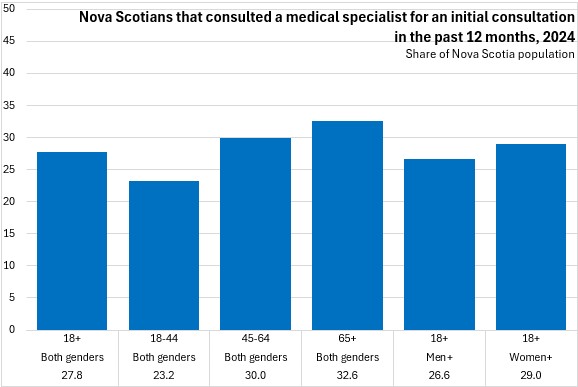
Initial specialist consultations were sought by 27.8% of Nova Scotians in 2024, the second lowest portion among provinces after Prince Edward Island. Nationally, 33.9% of the population aged 18+ sought an initial consultation with a medical specialist in 2024 with the highest share in Ontario.
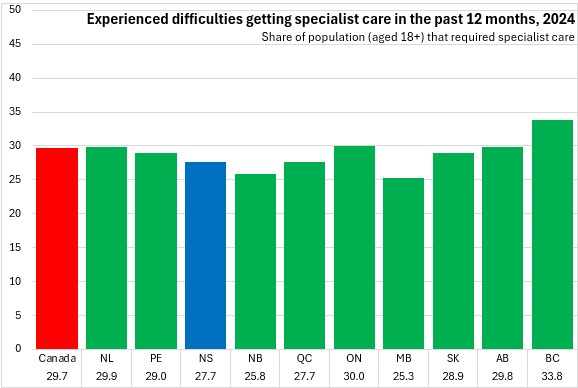
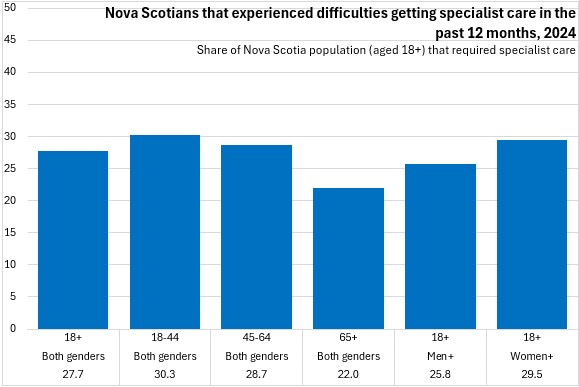
Of those that sought specialist care in 2024, 27.7% of Nova Scotians reported difficulties getting specialist care, which was below the national average (29.7%). Difficulties getting specialist care were most common in British Columbia and least common in Manitoba.
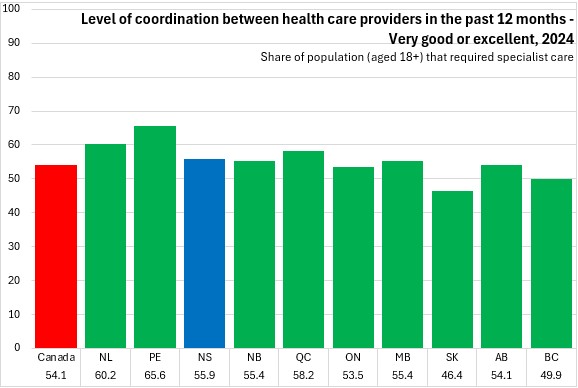
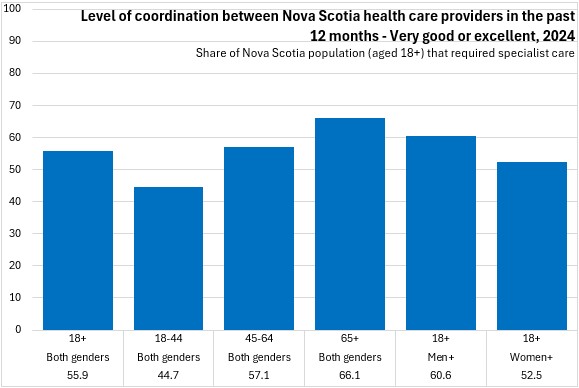
Of those requiring health care from multiple providers, 55.9% of Nova Scotians reported very good to excellent coordination among providers, which was just above the national average (54.1%). Very good or excellent coordination was most widely reported in Prince Edward Island and least prevalent in Saskatchewan.
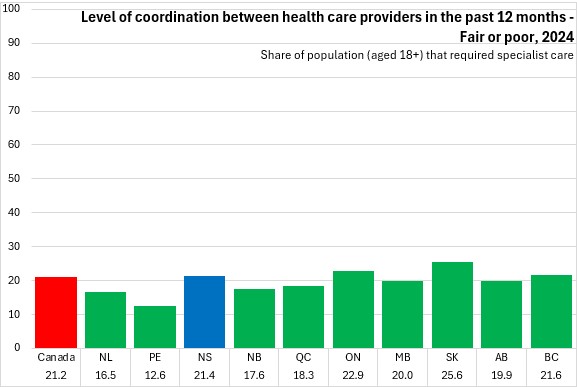
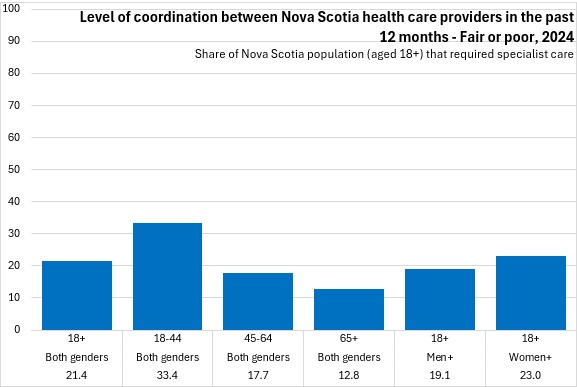
Among those with multiple providers, 21.4% of Nova Scotians found coordination to be just fair or poor (slightly above the national share: 21.2%). Coordination was most often reported as fair or poor in Saskatchewan and least often in Prince Edward Island.
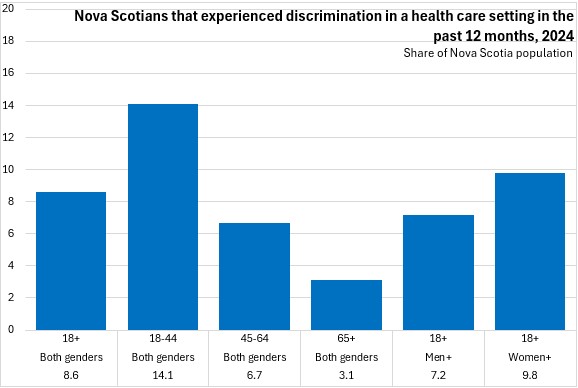
In 2024, 8.6% of Nova Scotians reported experiences of discrimination in a health care setting, which was third highest among provinces after Saskatchewan and Alberta. Discrimination was less frequently reported in Québec health care settings in 2024.

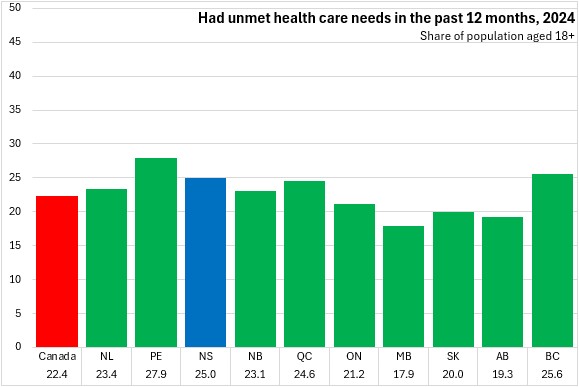
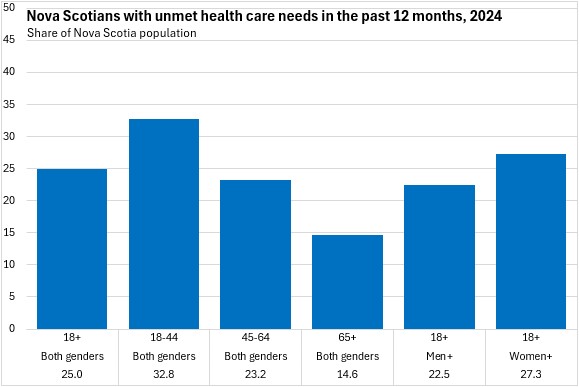
One quarter (25.0%) of Nova Scotians aged 18+ reported having unmet health care needs in 2024, the third highest share among provinces after Prince Edward Island and British Columbia. Unmet health care needs were less common in the three prairie provinces.
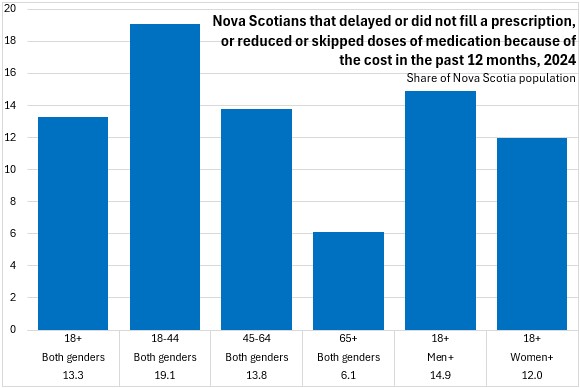
The share of Nova Scotians aged 18+ that reported difficulties with costs of filling prescriptions or taking all required doses was the same as the national average in 2024: 13.3%. Patients in Québec reported the least difficulties with prescription costs while those in Alberta reported the most difficulties.

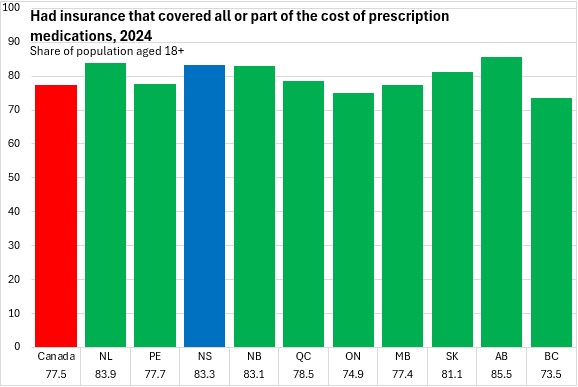
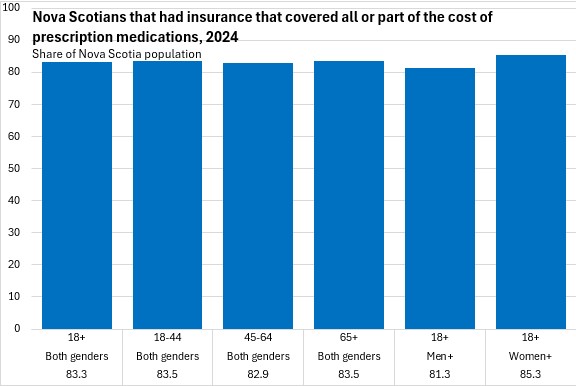
A higher than average share of Nova Scotians (83.3%) reported having health insurance that covered all or part of prescriptions. The national average share of the population aged 18+ with health insurance coverage for prescriptions was 77.5% (highest: Alberta, lowest: British Columbia).
In Nova Scotia, chronic conditions were more prevalent among seniors than younger age cohorts. A higher portion of women reported chronic health conditions than men.
Consultation with a provider for non-urgent primary care was slightly less common among younger cohorts in Nova Scotia as well as among men.
A higher portion of seniors reported very good or excellent consultation with primary care providers in 2024.
A higher portion of younger cohorts reported fair or poor quality primary health care consultations in 2024.
Difficulties getting non-urgent primary health care were more common for younger cohorts as well as for women. Seniors reported less difficulties getting access to non-urgent primary care.
Consultation with a medical specialist was more common among older cohorts as well as among women.
Although they had lower use of specialists, younger cohorts reported more difficulties getting specialist care. Women also reported more difficulties getting specialist care than men. Seniors reported less difficulty getting specialist care.
Among those with multiple health care providers, seniors and men were more likely to report very good to excellent coordination.
Younger cohorts and women that had multiple health care providers were more likely to report fair to poor levels of coordination among them.
Experiences of discrimination in health care settings were most commonly reported among younger cohorts and least commonly reported among seniors. Women reported more experiences of discrimination in a health care setting than did men.
Younger cohorts and women were most likely to report having unmet health care needs while seniors were least likely to report unmet needs.
Delaying or skipping prescriptions due to costs were more common among younger cohorts and men. Seniors reported much less incidence of cost-related problems with prescriptions.
For each age and gender cohort, over 80% of Nova Scotians had health insurance with prescription coverage. Women had slightly higher shares with prescription insurance coverage than men.
Note: Survey responses were collected from January 3-November 3, 2024 from Canadians aged 18 and older. Medical specialists are defined as: "...a medical doctor certified to practice in a specified field...", providing: "...expert care for complex conditions that require in-depth knowledge and advanced treatments."
Source: Statistics Canada. Table 13-10-0961-01 Wait time for an initial consultation with a medical specialist in the past 12 months; Table 13-10-0962-01 Health indicators, Survey on Health Care Access and Experiences - Primary and Specialist Care
<--- Return to Archive


