The Economics and Statistics Division maintains archives of previous publications for accountability purposes, but makes no updates to keep these documents current with the latest data revisions from Statistics Canada. As a result, information in older documents may not be accurate. Please exercise caution when referring to older documents. For the latest information and historical data, please contact the individual listed to the right.
<--- Return to Archive
For additional information relating to this article, please contact:
July 22, 2026LABOUR MARKET OUTCOMES, COLLEGE AND UNIVERSITY CLASS OF 2019 Statistics Canada has released new results from the Post Secondary Student Information System. This tracks median earnings of graduates of post secondary programs.
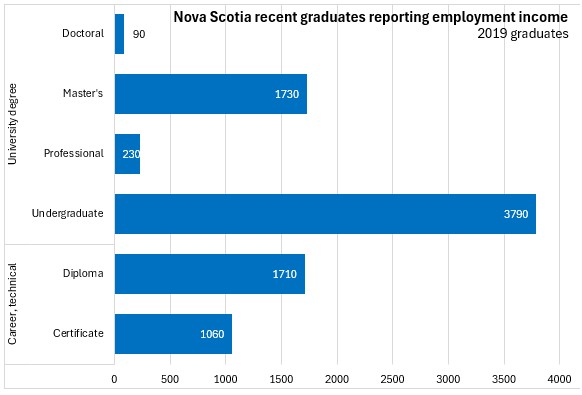
Among Nova Scotia 2019 post-secondary graduates, undergraduate degree holders represented the largest group reporting employment income five years after graduation, accounting for 3,790 individuals. Undergraduates were followed by Master's degree holders, and graduates of career, technical or professional training programs with diplomas or certificates. Professional and doctoral degrees represented the smallest number of graduates in 2019.
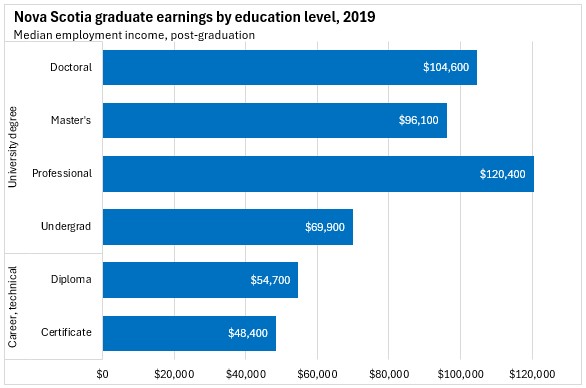
Median employment income generally increased with educational attainment. Five years after graduation, professional degree graduates reported the highest median employment income at $120,400, followed by doctoral graduates ($104,600) and Master's graduates ($96,100). Graduates with career/technical/professional diplomas or certificates reported the lowest median employment incomes five years after graduation.
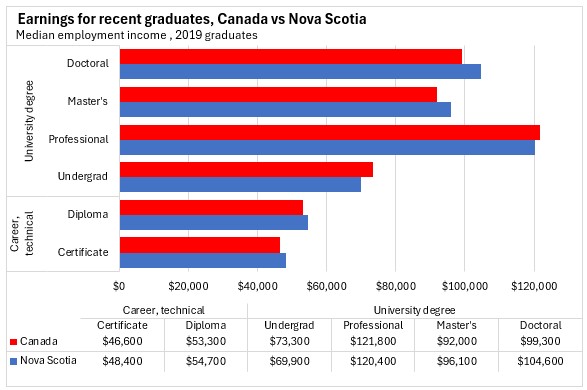
Labour market outcomes for Nova Scotia graduates were generally comparable to, and in several cases exceeded, national averages. Five years after graduation, Nova Scotians with career/technical/professional training diplomas or certificates, Master's degrees or doctoral degrees earned more than the national average for comparable credentials. The only credential levels where Nova Scotia's graduates earned less than the Canadian median were undergraduates and professional degrees.
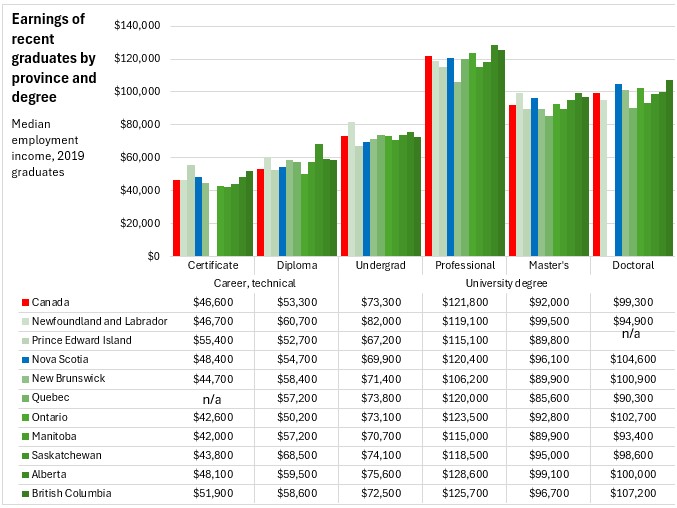
Across Canada notable differences exist in graduate earnings by province and credential. Nova Scotia ranked near the middle of the provinces for most credential categories. Median employment income for undergraduates in Nova Scotia were higher than Prince Edward Island but lower than Newfoundland and Labrador, Alberta Saskatchewan, Ontario, and British Columbia. For Nova Scotia's recent Master's degree graduates, post-graduation median employment income was higher than those in most provinces and closely aligned with those in British Columbia and Saskatchewan. Nova Scotia's recent doctoral graduates reported one of the stronger outcomes nationally -- only British Columbia reported a higher median employment income. Recent professional degree graduates in Nova Scotia reported median employment income only behind those in Alberta and British Columbia.
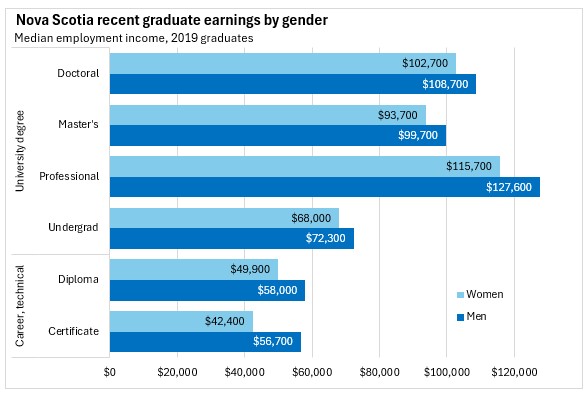
Male graduates reported higher median employment income than female graduates across all credential categories five years after graduation. The largest gender gap was observed among career/technical/professional certificate and diploma graduates. Females earned approximately 75% as much as males in this category.
Gender differences were smaller at higher levels of educational attainment. Among Undergraduate and Master's degree and doctoral graduates, females earned approximately 94% of males' post-graduation employment income at median.
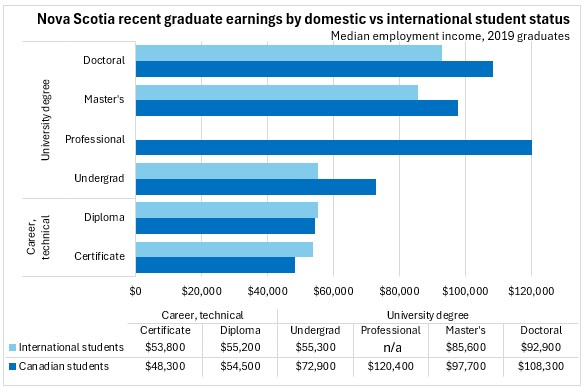
Labour market outcomes differed between Canadian and international students across credential categories. Among certificate and diploma graduates, international students reported median earnings that were higher than those of Canadian graduates. In contrast, Canadian students generally reported stronger outcomes at higher levels of education, particularly among Master's degree and doctoral graduates. Data were suppressed for international students' professional degree.
Post-graduation median employment income varied considerably across Nova Scotia's recent graduates' field of study. Five years after graduation, health and related fields reported the highest earnings, followed closely by mathematics, computer and information sciences and architecture, engineering and related trades. Graduates in visual and performing arts, and communications technologies reported the lowest, followed by Humanities.
Several fields experienced substantial earnings growth between two and five years after graduation. Architecture, engineering and related trades graduates recorded the largest increase. In contrast, earnings growth in health-related fields was modest, reflecting the fact that these fields already reported relatively high earnings two years after graduation.
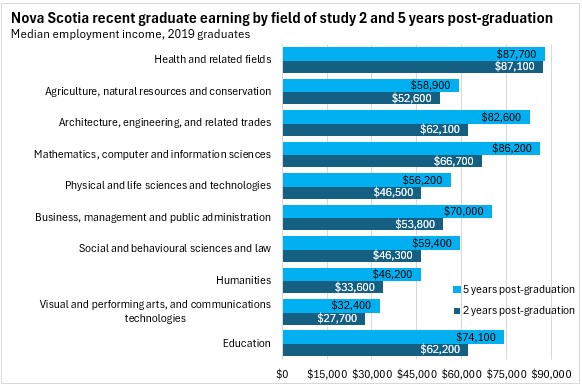
Source: Statistics Canada. Table 37-10-0280-01 Characteristics and median employment income of longitudinal cohorts of postsecondary graduates two and five years after graduation, by educational qualification and field of study (alternative primary groupings)
<--- Return to Archive


